

The practical answer
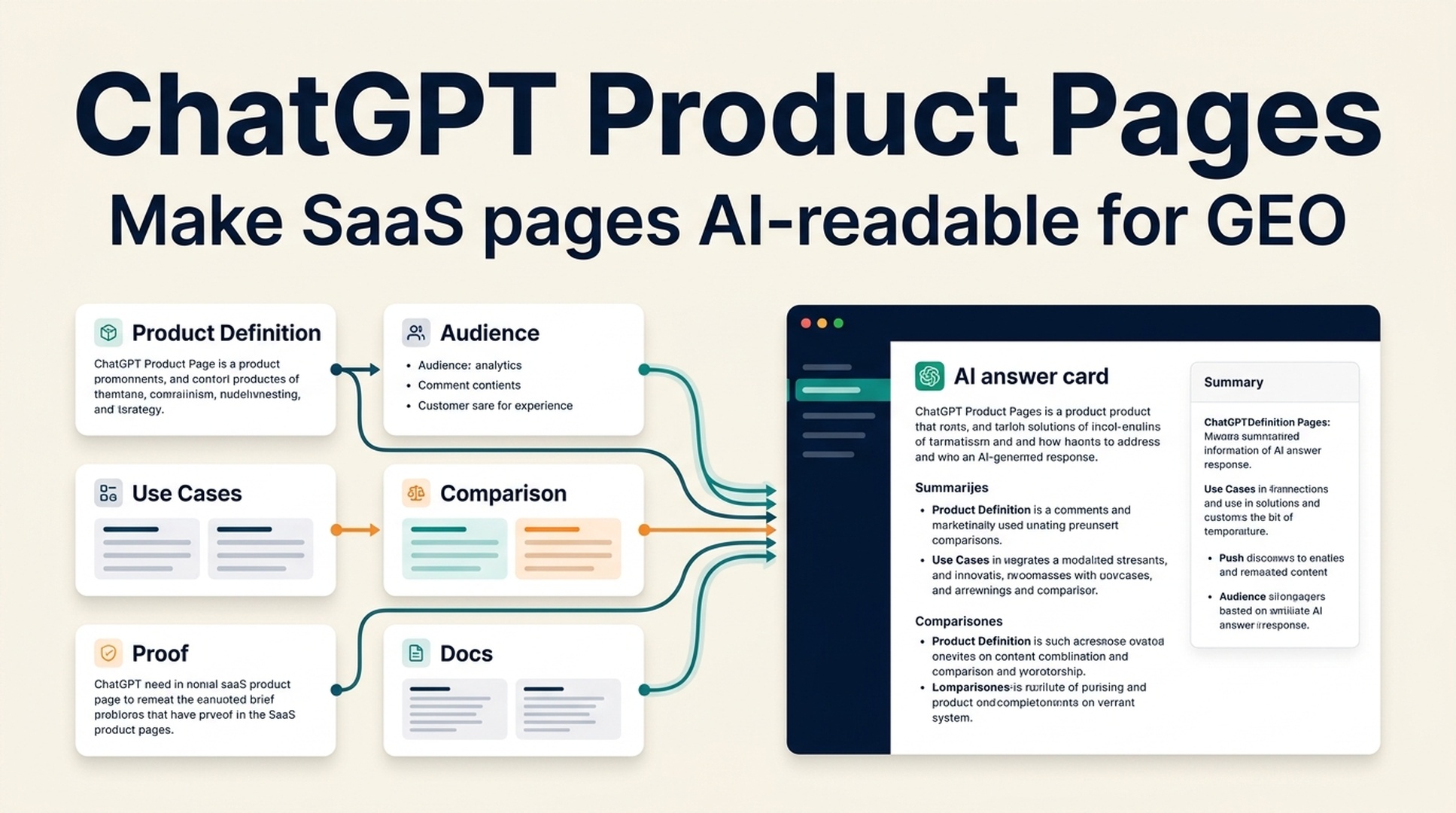
A SaaS product page is AI-readable when ChatGPT-style systems can quickly understand what the product is, who it is for, what job it helps with, how it differs from alternatives, and what evidence supports the claims. Many product pages look polished but fail this test because they lead with slogans, hide feature details, and never explain fit.
For ChatGPT GEO, your product page should not only convert human visitors. It should also act as a source page that helps AI answers describe and recommend the product accurately. That means clearer entity language, use-case sections, comparison context, proof, documentation links, and crawlable text.
The goal is not to make the page robotic. The goal is to make the product impossible to misunderstand.
Why product pages matter for ChatGPT GEO
When users ask ChatGPT for tool recommendations, the model needs market context. It may look for signals from your homepage, product pages, docs, comparison pages, review profiles, and third-party mentions.
If your product page is vague, AI systems may not know:
- what category your product belongs to
- which buyer should consider it
- which use cases it supports
- which problems it does not solve
- how it differs from adjacent tools
- whether the product has proof behind the claims
A product page is often the best owned source for these facts. If it does not contain them, other sources may define your product for you.
The AI-readable product page test
Open your product page and ask whether a reader can answer these questions in 60 seconds.
Question | What a strong page provides |
|---|---|
What is the product? | a plain-language category and one-sentence definition |
Who is it for? | audience, team type, maturity level |
What job does it do? | concrete workflows or jobs-to-be-done |
When should I use it? | use cases and trigger moments |
How is it different? | comparison context and differentiators |
What proof supports it? | examples, docs, case studies, screenshots, reviews |
What should I do next? | clear next action or conversion path |
If the page cannot answer these quickly, it is probably not GEO-ready.
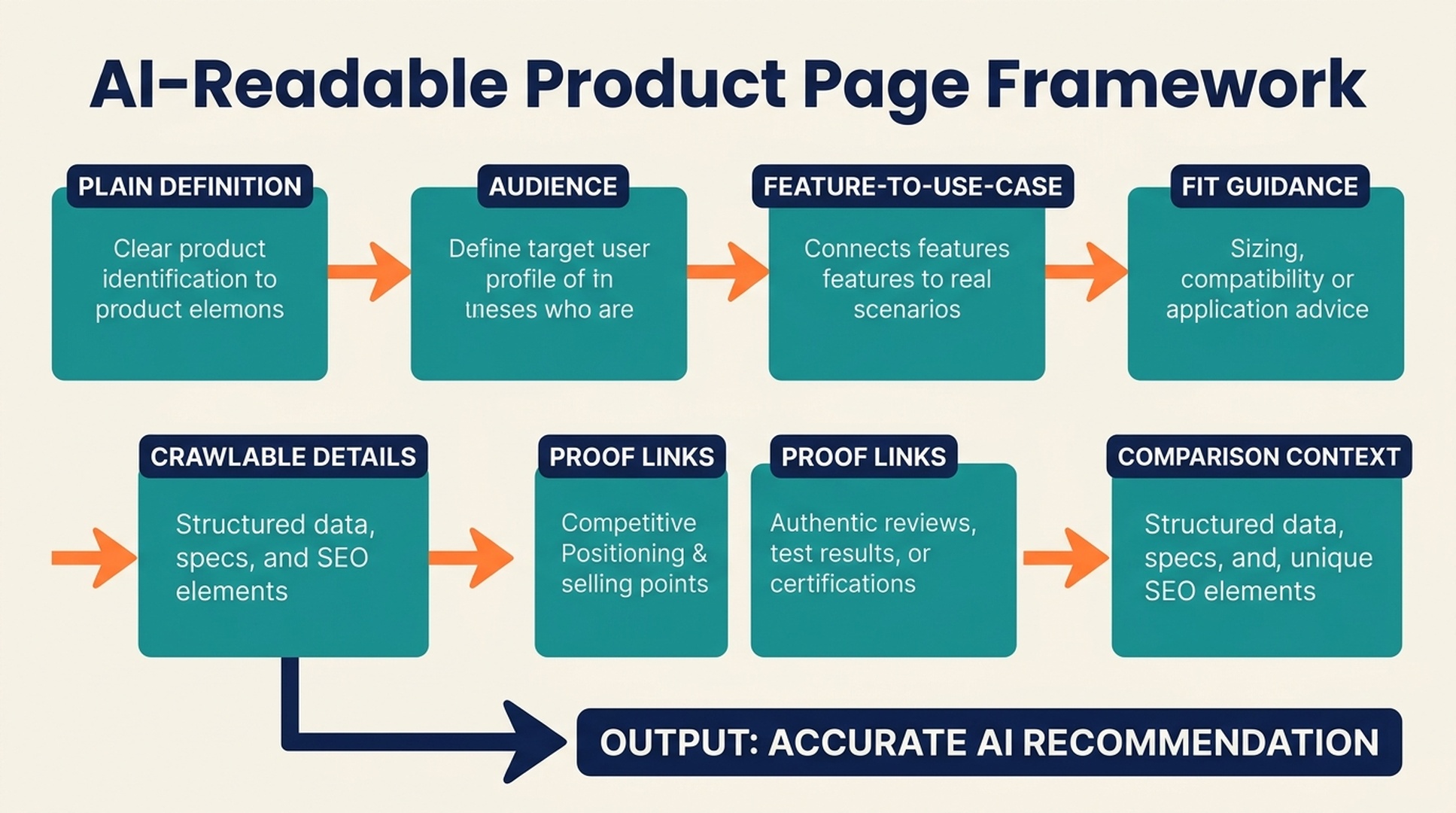
Start with a plain product definition
Every strategic product page needs a direct definition near the top.
Weak:
Unlock next-generation growth with intelligent automation.
Stronger:
Auspia helps SEO, content, and growth teams measure and improve brand visibility across ChatGPT, Google AI Overviews, Perplexity, and other AI search surfaces.
The stronger version tells AI systems and humans the audience, category, job, and surfaces. You can still add brand voice, but clarity should come first.
Map features to use cases
AI answers rarely need a raw feature list. They need to understand what the features help a user do.
Use a feature-to-use-case table.
Feature | Use case | GEO value |
|---|---|---|
Prompt library | Track recurring AI answer prompts | connects product to measurement workflows |
Brand mention scoring | Measure whether the brand appears accurately | supports visibility reporting |
Competitor overlap | See which alternatives appear in answers | supports comparison prompts |
Content brief workflow | Turn prompt gaps into page updates | connects product to content operations |
Entity audit | Find wrong or vague brand descriptions | supports brand understanding |
This table is useful for buyers and easier for AI systems to summarize than a list of feature names.
Add fit and not-fit guidance
Product pages often claim to be for everyone. That weakens trust.
Add a section like:
Best fit
- SEO teams measuring AI search visibility
- B2B SaaS teams building GEO content clusters
- content teams tracking brand mentions in ChatGPT-style answers
- growth teams comparing AI visibility against competitors
Not the best fit
- teams looking only for classic rank tracking
- companies without public content or product pages yet
- teams that need private data protection more than public visibility
- users expecting guaranteed ChatGPT citations
This helps AI systems produce more accurate recommendation context.
Include comparison context without attacking competitors
A product page does not need to be a full comparison page, but it should include adjacent categories.
For example:
Compared with | Difference to clarify |
|---|---|
rank trackers | rank trackers measure search positions; GEO tools measure AI answer presence and accuracy |
content optimization tools | content tools improve pages; GEO workflows connect prompts, entities, evidence, and measurement |
brand monitoring tools | brand monitoring tracks mentions; ChatGPT GEO checks answer quality and recommendation context |
technical SEO crawlers | crawlers find site issues; GEO tools diagnose AI visibility gaps |
This helps your page appear in "what is the difference" and "which tool should I use" prompts.
Put proof close to the claim
If you claim the product helps with a workflow, show evidence near that claim.
Proof can include:
- product screenshots
- public demo pages
- documentation links
- case studies
- templates
- before/after examples
- benchmark reports
- review profiles
- security or policy pages
- integration documentation
Avoid unsupported claims like:
- "guaranteed AI visibility"
- "best GEO tool"
- "works for every industry"
- "instant ChatGPT citations"
Replace them with specific, supportable claims.
Make technical details crawlable
Some SaaS pages hide important product details inside tabs, screenshots, carousels, or demo videos. Humans may see them, but crawlers and AI systems may not extract them reliably.
For AI-readable product pages:
- keep core feature descriptions in HTML text
- add captions to screenshots
- summarize videos with text
- link to public docs
- avoid hiding all details behind interactions
- use descriptive headings
- include schema where appropriate
- make the page fast and indexable
If a detail is important for product understanding, do not put it only in an image.
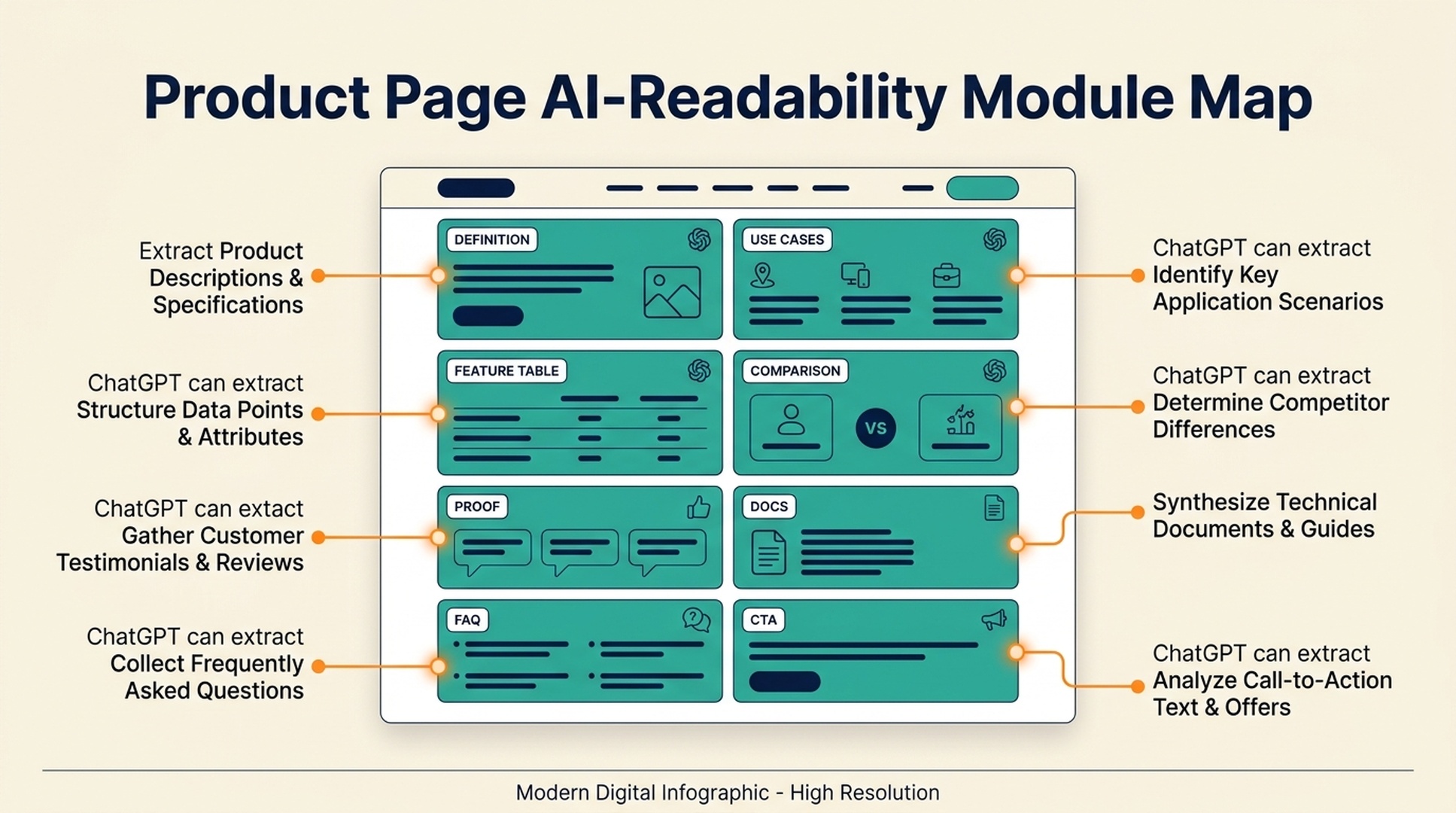
Suggested product page structure
Use this structure when updating a SaaS product page for GEO.
- Plain product definition
- Audience and use case summary
- Core workflows
- Feature-to-use-case table
- Comparison context
- Proof and examples
- Integrations or ecosystem fit
- Fit/not-fit guidance
- FAQ
- Next action
You do not need to use these exact headings. The information roles matter more than the labels.
A product page GEO checklist
Use this before publishing.
Check | Pass? |
|---|---|
The product category is clear in the first screen | |
The audience is named specifically | |
Main use cases are explained in plain language | |
Features are connected to jobs-to-be-done | |
Comparison context is included | |
Proof appears near important claims | |
Technical details are crawlable as text | |
Screenshots have captions and alt text | |
The page links to docs, cases, or evidence | |
The page avoids unsupported absolute claims |
If the page fails the first four checks, fix the message before worrying about advanced GEO tactics.
How to measure whether it worked
After updating the product page, run a prompt set.
Test prompts like:
- What does [brand] do?
- Who is [brand] for?
- What tools help with [use case]?
- What are alternatives to [competitor]?
- Compare [brand] with [competitor].
- Is [brand] good for [audience]?
Track:
- description accuracy
- category association
- use-case association
- competitor overlap
- recommendation strength
- cited or referenced sources where visible
- wrong or outdated claims
If the answers improve from vague to accurate, the product page is doing its GEO job.
Common mistakes
Mistake 1: leading with slogans
Slogans may support brand voice, but they should not replace a clear definition.
Mistake 2: hiding product facts behind design
If the page is mostly animations, screenshots, and vague benefit copy, it may be hard for AI systems to use as a source.
Mistake 3: separating features from use cases
Feature names alone are not enough. Explain what the user can do with them.
Mistake 4: pretending the product is for everyone
Fit guidance improves trust and recommendation accuracy.
Mistake 5: forgetting proof
Claims need support. Link to docs, examples, case studies, templates, or reviews.
FAQ
What is an AI-readable product page?
An AI-readable product page clearly explains what the product is, who it is for, what it helps with, how it differs from alternatives, and what evidence supports the claims in crawlable text.
Do product pages matter for ChatGPT GEO?
Yes. Product pages are often one of the strongest owned sources for brand and product understanding. They help AI systems describe the product accurately and place it in the right category.
Should product pages include competitor comparisons?
They should include light comparison context. Full competitor comparisons can live on separate pages, but the product page should clarify adjacent categories and tradeoffs.
Is schema enough to make a product page AI-readable?
No. Schema helps, but visible page content still needs clear definitions, use cases, proof, and crawlable details.
What should I update first?
Start with the opening definition, audience, use cases, feature-to-use-case table, proof links, and fit/not-fit guidance. These changes usually improve both human clarity and AI readability.
Author: Caleb Brooks, SaaS SEO Strategist for 100+ Product-Led Pages at Auspia. Caleb writes about SaaS pages, product-led SEO, comparison content, and buyer journeys for AI search visibility.