The likely problem: Perplexity has no clear reason to cite you
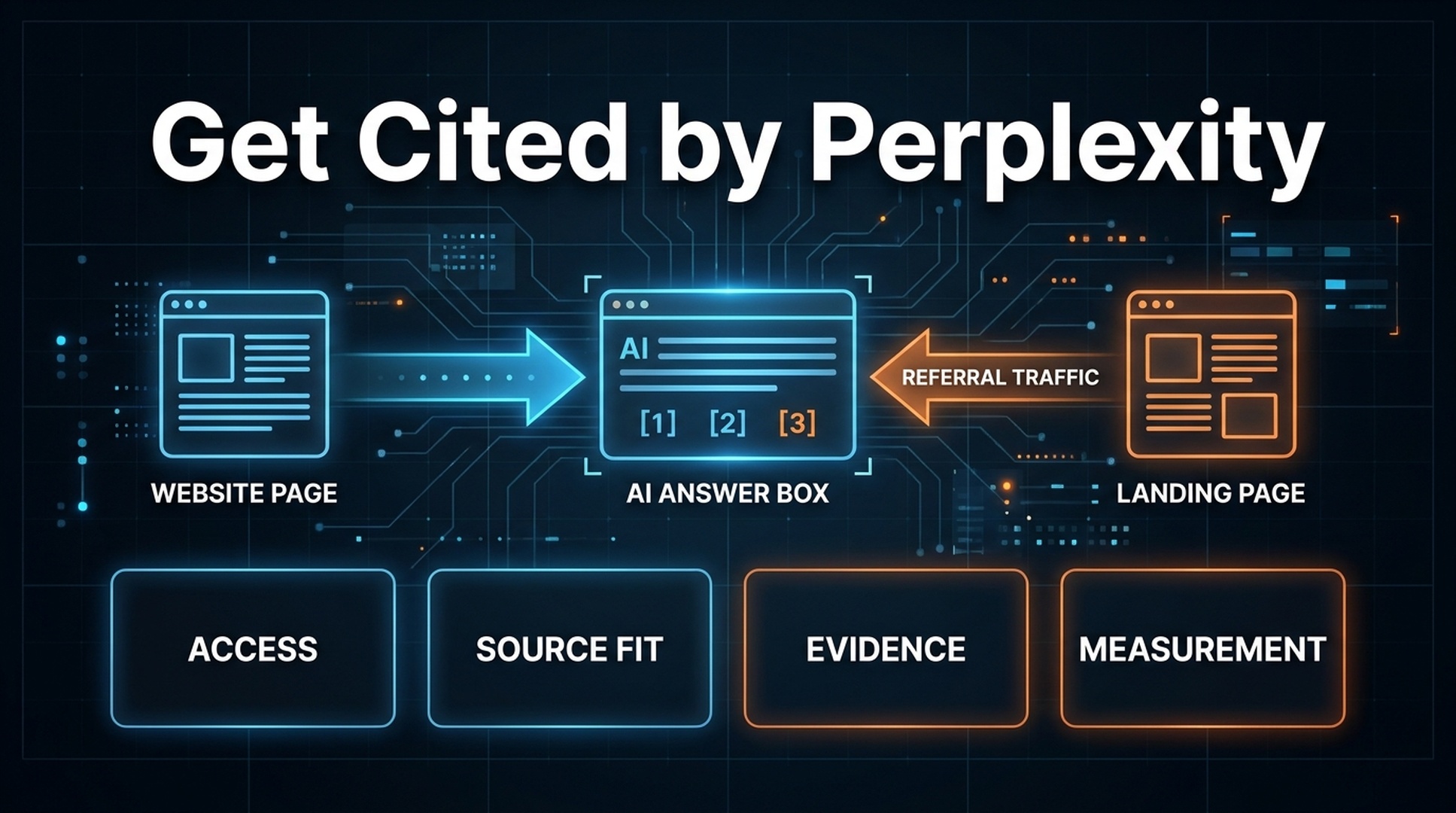
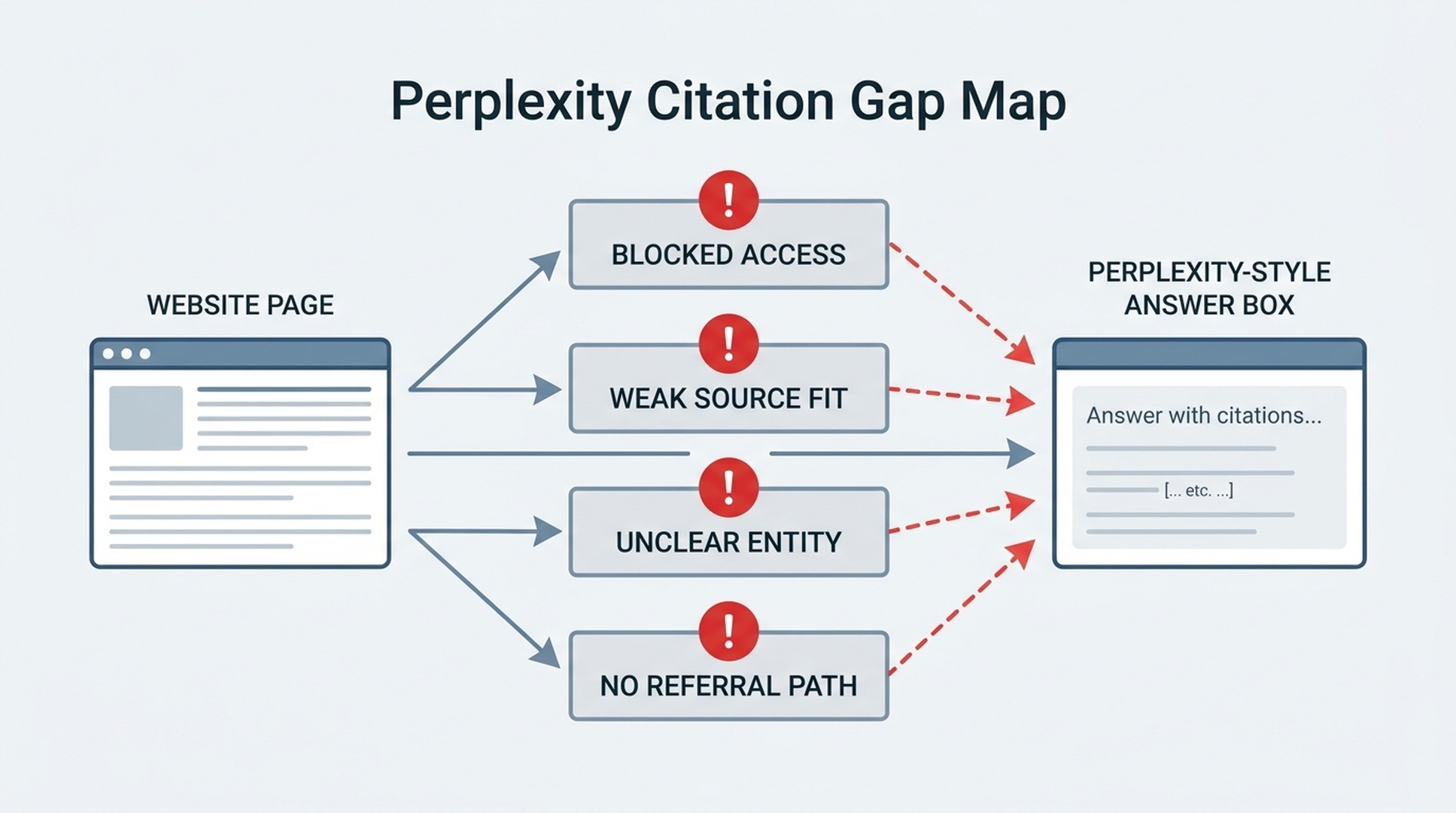
If Perplexity is not citing your brand, the problem is usually not one missing tag. More often, your pages fail one of four tests.
Can Perplexity access the page? Can the page answer a real question clearly? Does the page contain facts worth citing? Can the system verify your brand through other sources?
That is the practical work behind Perplexity GEO. You are not trying to trick an AI answer engine into mentioning you. You are making your website and brand evidence useful enough to become a source.
For most teams, the repair path looks like this:
Citation gap | What to fix first |
|---|---|
Perplexity cannot access your pages | Robots.txt, WAF, CDN, user-agent blocks, server errors |
The page is accessible but not cited | Add direct answers, definitions, tables, examples, dates, and original value |
The brand is mentioned inaccurately | Clean up entity facts across site, profiles, schema, and third-party pages |
Citations happen but do not drive traffic | Improve cited-page CTAs, internal paths, analytics, and prompt tracking |
This playbook focuses on the operating workflow: what to inspect, what to change, and how to measure whether Perplexity citations are improving.
What a Perplexity citation actually does
A Perplexity citation is a source link attached to an AI-generated answer. Perplexity's own help material explains that answers include citations linking to original sources so users can verify information or read further.
That changes the marketing job.
In Google SEO, the page competes for ranking position. In Perplexity GEO, the page competes to become useful source material inside a synthesized answer. The user may not click every source. Still, the cited page can shape the answer, put the brand near the user's decision, and create a high-intent visit when the user wants more detail.
A citation can create three kinds of value:
Value | What it looks like |
|---|---|
Brand exposure | Your brand or page title appears inside a research answer |
Trust transfer | The answer uses your page as evidence for a claim |
Referral traffic | The user clicks the citation to verify, compare, or continue |
Do not measure only the last one. Referral traffic matters, but citations and mentions can influence the buyer journey before analytics records a session.
How Perplexity chooses sources: what we can safely infer
Perplexity does not publish a full source-ranking formula. Any article claiming a guaranteed citation recipe is overselling.
What we can say safely:
- Perplexity uses web retrieval and cited sources as part of the answer experience.
- It has documented crawler identities such as
PerplexityBotandPerplexity-User. - It needs accessible pages to retrieve current information.
- It is more likely to use pages that answer the query directly and provide verifiable details.
- It may cite owned sites, third-party articles, documentation, reviews, news, research, and other public pages depending on the query.
The operating principle is simple: improve the odds that your page is retrievable, understandable, useful, and trusted for a specific class of prompts.
That means citation work starts before writing. You need to know which prompts you want to appear for.
Step 1: build a prompt map before editing pages
Most Perplexity citation projects start too late. The team picks a blog post, adds FAQs, and waits.
Start with prompts instead.
Group prompts by how real users research your category:
Prompt group | Example | Best source asset |
|---|---|---|
Problem diagnosis | "Why is my website not appearing in AI search results?" | Troubleshooting guide, audit checklist |
Category discovery | "Best tools for measuring AI search visibility" | Category page, comparison guide, tool page |
Comparison | "Auspia vs other AI visibility tools" | Honest comparison page, alternative page |
Technical implementation | "How do I allow AI crawlers in robots.txt?" | Technical guide, docs page, crawler checker |
Buyer validation | "Which AI SEO tools are credible for SaaS teams?" | Case study, review profile, third-party mention |
Then choose 10-20 prompts that matter commercially. For each prompt, decide:
- which page should be cited
- which claim the page should support
- which competitor pages currently appear
- what evidence is missing
- what next action the visitor should take after clicking
This keeps the work grounded. You are optimizing for source eligibility against real questions, not polishing pages in isolation.
For a broader foundation, start with the Auspia guide to Perplexity SEO.
If the issue is technical access rather than content quality, use the PerplexityBot SEO guide before rewriting pages. If you need a broader checklist, use the Perplexity SEO audit checklist.
Step 2: remove access blockers
Before rewriting anything, check whether Perplexity can access the pages you want cited.
Review:
Area | What to inspect |
|---|---|
Robots.txt | Are priority pages blocked by broad AI crawler rules? |
WAF/CDN | Are unknown bots or AI user agents challenged or blocked? |
Status codes | Do source pages return |
Rendering | Is the main answer content visible without heavy JavaScript? |
Login gates | Is the source text public and readable without authentication? |
Server logs | Do you see successful requests from relevant crawlers or user agents? |
Perplexity's crawler documentation separates PerplexityBot, used for discovery and indexing, from Perplexity-User, which can be triggered by a user request. For public marketing and educational pages, many teams choose to allow relevant crawlers while keeping private, paid, or sensitive content blocked.
A good access policy is specific. Do not blindly allow everything. Do not blindly block everything either.
Use Auspia's Robots.txt AI Crawler Checker when you need a quick crawler-access review.
Step 3: turn target pages into usable sources
A page gets cited when it is useful as source material. That sounds obvious until you look at most marketing pages.
Many pages say:
"We help teams improve visibility with AI-powered insights."
A source-ready page says:
"Auspia helps growth teams monitor AI search visibility across prompts, citations, brand mentions, and referral traffic. Teams use it to check whether their pages appear in AI answers and whether AI crawlers can access important URLs."
The second version gives Perplexity concrete facts to use.
For each target page, add:
Source-ready element | Why it helps |
|---|---|
Direct answer near the top | Makes the page easier to summarize |
Clear definition | Helps answer "what is..." and category prompts |
Specific audience | Prevents vague or wrong brand descriptions |
Product or method details | Gives the answer something concrete to cite |
Comparison table | Helps with evaluation prompts |
Dated updates | Helps freshness-sensitive answers |
Original framework or data | Gives the page a reason to be cited over generic content |
FAQ based on real questions | Helps answer extraction without stuffing keywords |
Keep the writing plain. Citation systems do not need slogans. They need usable statements.
Step 4: add evidence Perplexity can verify
Owned pages are the base. External evidence is the multiplier.
If your website is the only place saying you are a leading solution for a category, the claim is weak. If your site, docs, review profiles, partner pages, directory listings, and a few independent mentions all describe the brand consistently, the entity becomes easier to verify.
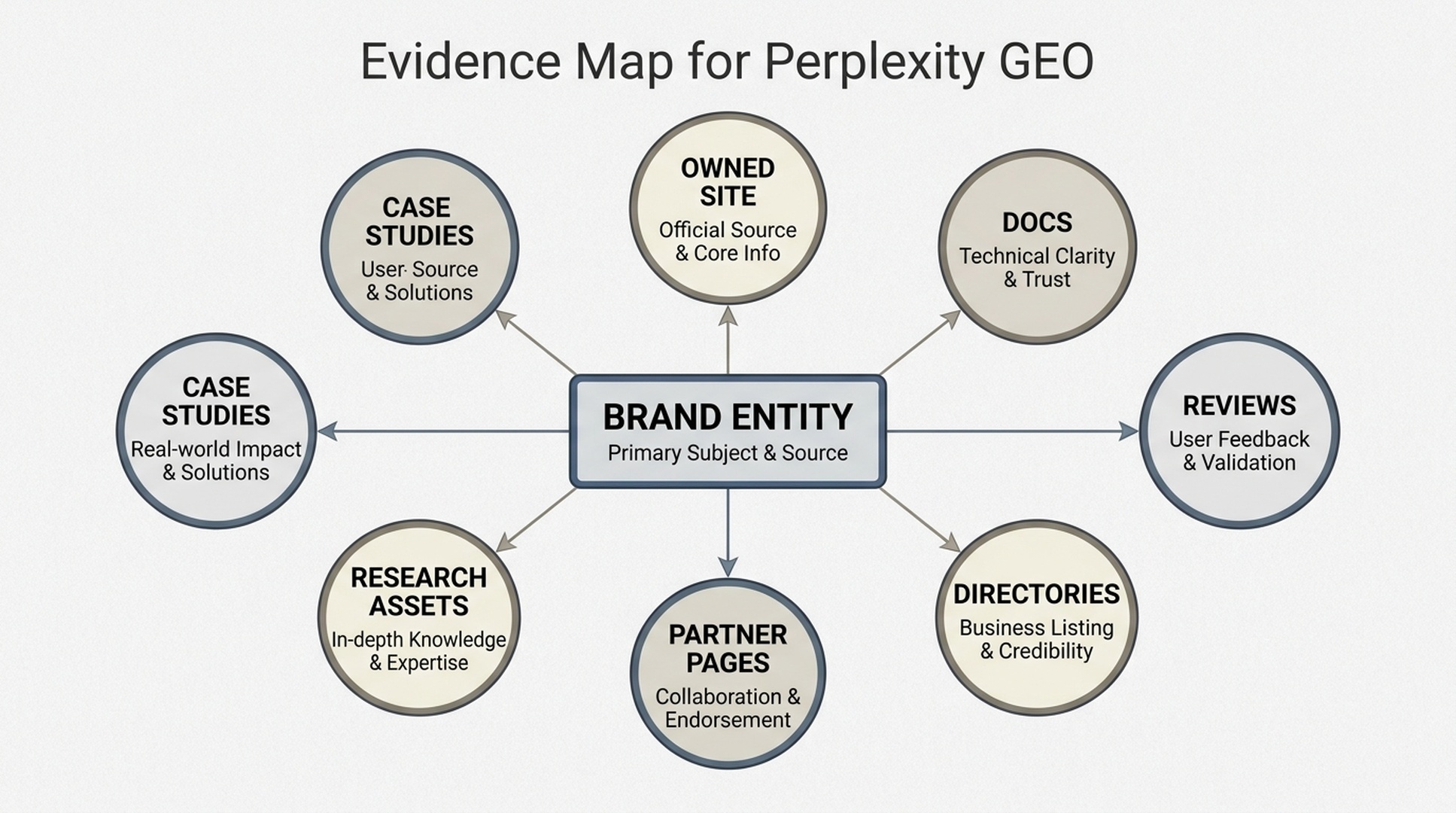
Build an evidence map:
Evidence source | What to strengthen |
|---|---|
About page | Official name, category, market, product facts |
Product pages | Use cases, features, supported platforms, pricing boundaries |
Docs/help center | Technical claims, integrations, setup details |
Review profiles | Category, customer language, recurring use cases |
Directories | Consistent company description and categories |
Partner pages | Integration or ecosystem proof |
Research/report pages | Original numbers, benchmarks, methodology |
Case studies | Specific use case and outcome, clearly attributed |
Avoid low-quality link schemes. They add noise and risk. Perplexity GEO benefits more from clear, retrievable, credible pages than from random backlinks.
Step 5: make brand facts consistent
Brand inconsistency creates bad answers.
If your homepage says you are an "AI SEO platform," your directory profile says "marketing automation software," and your About page says "content intelligence suite," Perplexity may choose the wrong label or blend them into something vague.
Create a brand fact sheet and use it across public pages:
Fact | Example format |
|---|---|
Brand name | Auspia |
Category | AI search visibility and GEO tools |
Primary audience | Growth, SEO, and content teams |
Core use case | Measuring and improving visibility in AI search answers |
Main products | AI Search Visibility Checker, Robots.txt AI Crawler Checker, GEO tools |
Differentiator | Connects prompt visibility, citation readiness, and crawler access checks |
Preferred description | "Auspia helps growth teams improve visibility across AI search, GEO, AEO, and SEO." |
This is not only for humans. It helps retrieval systems resolve who you are and when to mention you.
Step 6: design the cited page for referral traffic
A Perplexity citation is not the finish line. A cited page should give the visitor a next step that matches the question they asked.
If the prompt was technical, send them to a checker, template, or implementation guide. If the prompt was category discovery, send them to a comparison page or product workflow. If the prompt was educational, offer a checklist or diagnostic tool.
Map it like this:
Prompt intent | Cited page CTA |
|---|---|
"How do I check AI crawler access?" | Run the Robots.txt AI Crawler Checker |
"How do I measure AI search visibility?" | Try the AI Search Visibility Checker |
"How do I improve Perplexity citations?" | Follow a citation-readiness checklist |
"What is Perplexity SEO?" | Continue to the Perplexity SEO hub |
"Which GEO tools should I compare?" | View a tool comparison or request an audit |
Do not bury the next step under a generic "Contact us" button. Perplexity visitors are often in research mode. Give them a useful action before asking for a sales conversation.
Step 7: measure citations without fooling yourself
Perplexity visibility is messy. Treat measurement as directional, not perfectly deterministic.
Track the same prompt set every week or every two weeks. Keep the test environment consistent where possible.
Measure:
Metric | What it tells you |
|---|---|
Brand mentioned | Whether the brand enters the answer |
URL cited | Whether Perplexity uses your page as a source |
Citation position | Whether the source is prominent or buried |
Claim attached | What Perplexity says your brand/page proves |
Competitor presence | Who appears in the same answer set |
Answer accuracy | Whether the brand description is correct |
Referral sessions | Whether users click from Perplexity |
Downstream behavior | Whether those users explore, return, or convert |
Do not panic over one prompt. Look for patterns across a prompt group. If five prompts in the same buyer journey keep citing competitors, that is a content or evidence gap worth fixing.
A 21-day citation sprint
Use this when you need a focused repair cycle.
Day range | Work | Output |
|---|---|---|
Days 1-3 | Prompt and citation baseline | 10-20 target prompts, current cited sources, competitor notes |
Days 4-6 | Access audit | Robots.txt review, WAF/CDN check, status code check, log sample |
Days 7-11 | Source-page rewrite | Direct answers, tables, definitions, dated facts, stronger brand descriptions |
Days 12-15 | Evidence cleanup | About page update, schema review, directory/profile consistency, partner proof list |
Days 16-18 | Referral path update | Better CTAs, internal links, tool/demo paths, analytics annotations |
Days 19-21 | Re-test and report | Citation changes, brand mention movement, cited URL changes, next backlog |
The sprint should produce a backlog, not just a report. Separate fixes into three buckets:
Bucket | Examples |
|---|---|
Can fix this week | Rewrite answer section, fix title/H1, add table, update About page |
Needs engineering | WAF changes, rendering issue, log pipeline, schema implementation |
Needs external proof | Partner mention, review profile cleanup, original research asset, industry listing |
That keeps the project moving after the initial audit.
What not to do
There are a few habits that waste time.
Do not publish 20 shallow posts around the same keyword. Perplexity needs useful sources, not a pile of near-duplicates.
Do not make unsupported claims like "best," "most trusted," or "leading" without evidence. These claims are easy to ignore and hard to verify.
Do not treat llms.txt as a shortcut. It may help AI systems understand preferred paths, but it does not replace crawlable pages, credible evidence, and clear source content.
Do not optimize only your homepage. Perplexity often needs specific answers. Product pages, comparison pages, docs, guides, reports, and tools can be better citation assets.
Do not measure once and declare success. AI answer results can shift with query wording, freshness, location, model updates, and source availability.
FAQ
How do I get my website cited by Perplexity?
Start with a prompt map. Identify the questions where your brand should appear, then make sure the matching pages are accessible, specific, and useful as sources. Add direct answers, tables, facts, examples, and external evidence. Track whether those pages are cited across the same prompt set over time.
How long does it take to get cited by Perplexity?
There is no fixed timeline. Technical access fixes can be immediate, but citation changes depend on retrieval, source competition, freshness, and query intent. Use a 21- or 30-day sprint to establish a baseline, fix blockers, and re-test the same prompts.
Does Perplexity use Google rankings to choose citations?
Perplexity uses web retrieval, but it does not work like a normal Google SERP. Strong traditional SEO can help because well-structured, crawlable, authoritative pages are easier to find. Still, ranking is not the same as being selected as a cited source.
Should every page be optimized for Perplexity citations?
No. Focus on pages that answer high-value questions: category guides, comparison pages, technical explainers, product pages, research assets, tool pages, and evidence-backed case studies. Thin promotional pages are usually poor citation candidates.
Can schema help me get cited?
Schema can clarify your organization, products, breadcrumbs, articles, and FAQs. It supports entity understanding and extraction. It does not guarantee citations. Use schema as infrastructure alongside better content and evidence.
What is the difference between Perplexity SEO and Perplexity GEO?
Perplexity SEO is often the term users search for when they want to optimize for Perplexity. Perplexity GEO is the broader growth discipline: improving brand mentions, citations, recommendations, answer accuracy, and referral value inside generative search experiences.
How should I report Perplexity GEO results?
Report prompt visibility, brand mentions, cited URLs, citation position, answer accuracy, competitor presence, Perplexity referral sessions, and downstream conversions. Include examples of changed answers, not only charts.
Sources
- Perplexity Help Center: How does Perplexity work?
- Perplexity Docs: Perplexity crawlers
- Perplexity Docs: API overview
Auspia takeaway
Getting cited by Perplexity is not a single optimization trick. It is a source-readiness loop.
Pick the prompts that matter. Make sure Perplexity can access the right pages. Rewrite those pages so they answer clearly. Support the brand with external evidence. Then measure citations, mentions, and referral quality over time.
That loop is slower than chasing a keyword. It is also more durable.
Author: Isabel Grant, Researcher of 2,000+ AI Citation Patterns at Auspia. Isabel writes about citation earning, source quality, and how AI answer systems select evidence.