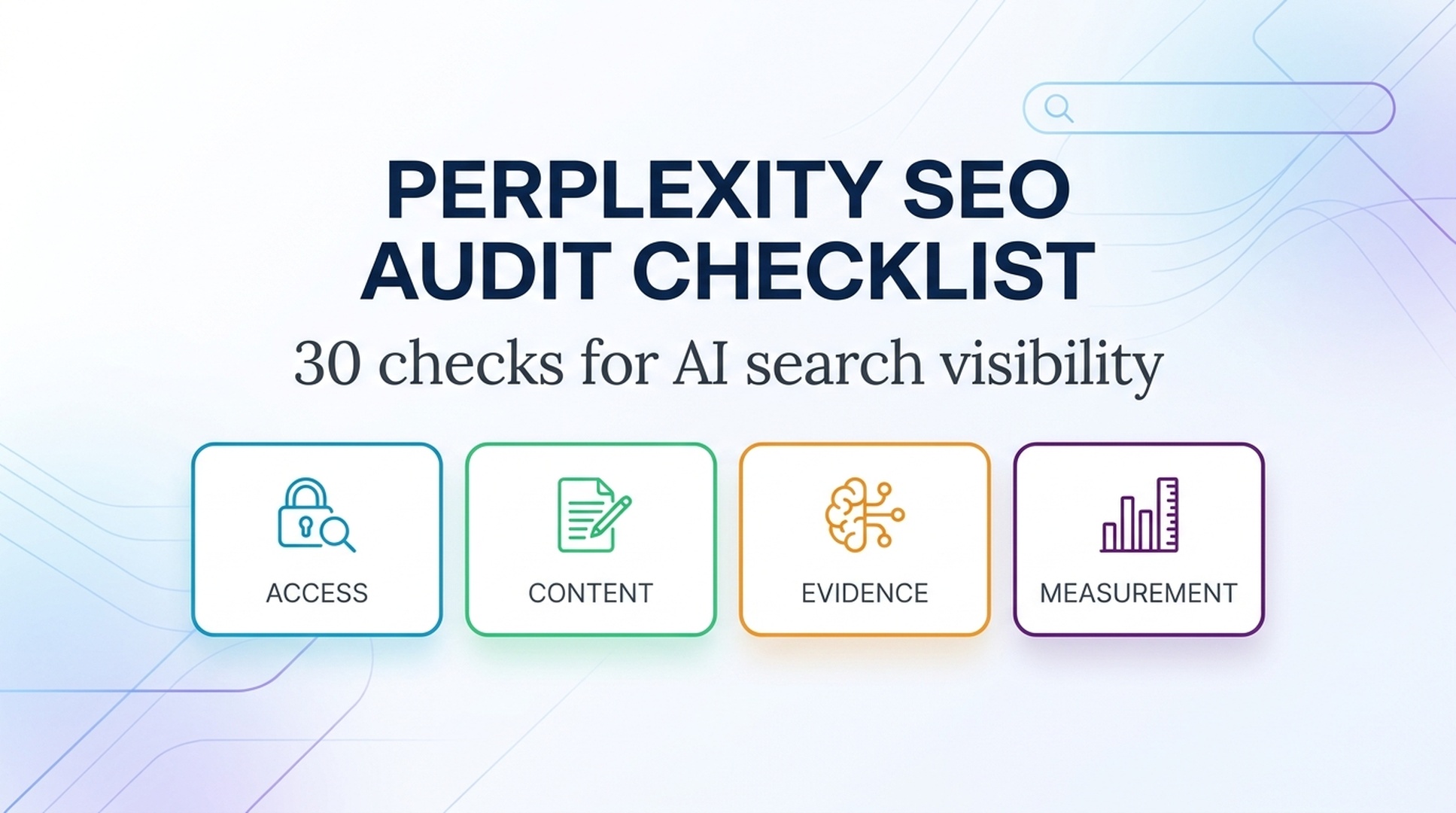
The 30-check audit in one view
A Perplexity SEO audit should tell you whether your brand is ready to be discovered, cited, and trusted inside AI answers. It is not just a content review. It includes crawl access, answer structure, brand entity clarity, external evidence, measurement, and referral paths.
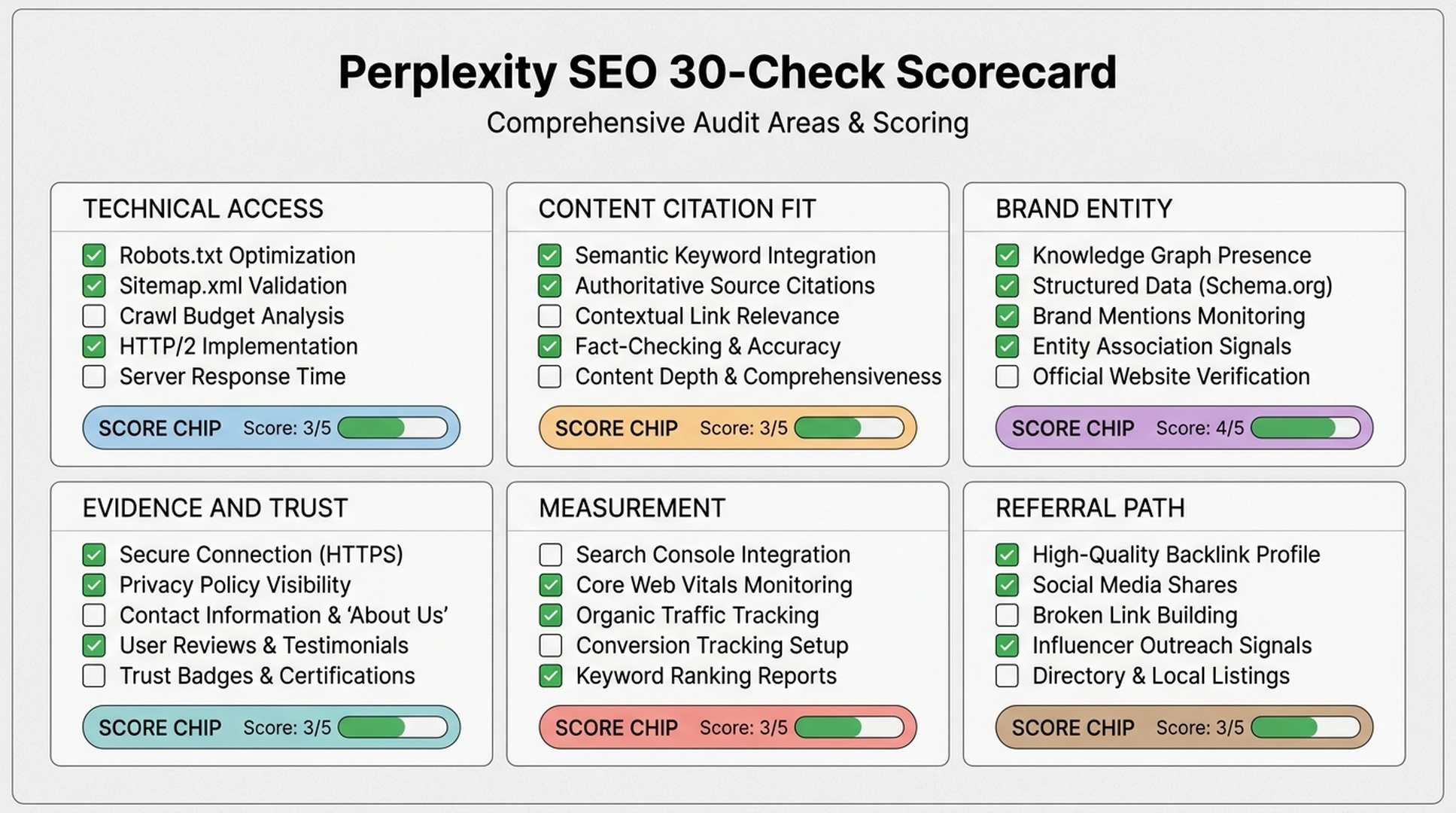
Use this scorecard first:
Audit area | Checks | Goal |
|---|---|---|
Technical access | 1-6 | Perplexity can reach and read the right public pages. |
Content citation fit | 7-14 | Pages can support AI answers with clear, specific, verifiable information. |
Brand entity clarity | 15-19 | Perplexity can describe the brand accurately. |
Evidence and trust | 20-24 | Claims are supported by owned and third-party sources. |
Measurement | 25-28 | The team can track prompts, mentions, citations, and traffic. |
Referral path | 29-30 | Cited pages can turn attention into useful visits. |
If you want a fast rule: fix technical access first, then source quality, then measurement. Do not rewrite 50 pages before you know whether Perplexity can access your site.
For the access layer, start with Auspia's Robots.txt AI Crawler Checker, then confirm harder WAF and log issues with your engineering team.
How to use this checklist
Run the audit on a small set of high-value URLs:
- homepage
- About page
- top product or service page
- one comparison page
- one technical guide or docs page
- one tool page
- one research, benchmark, or glossary page
- one article that should be cited for a commercial prompt
Score each check:
Score | Meaning |
|---|---|
0 | Fails or unknown |
1 | Partially passes |
2 | Passes clearly |
A 30-check audit has a maximum score of 60. The score is not the goal. The backlog is the goal.
For deeper crawler diagnostics, use the PerplexityBot SEO guide. For content fixes after the audit, use the Perplexity-ready content structure guide.
Technical access checks
1. Priority pages are not blocked in robots.txt
Check whether public pages you want cited are blocked by broad crawler rules. Pay special attention to AI crawler rules and folder-level disallows.
2. PerplexityBot policy is intentional
Perplexity documents PerplexityBot as a crawler used for discovering and indexing web content. If it is blocked, make sure that is a deliberate policy choice, not an old blanket rule.
3. User-triggered fetches are not challenged by default
Perplexity also documents Perplexity-User, a user-triggered agent. Review whether WAF, bot protection, or CDN rules challenge relevant requests on public pages.
4. Priority URLs return clean 200 status codes
Avoid long redirect chains, soft 404s, intermittent 5xx errors, and accidental 403s. A source page should be boringly reliable.
5. Main content is visible and extractable
If the key answer appears only after heavy JavaScript, login, user interaction, or delayed API calls, the page may be weak source material.
6. Server logs can confirm access
Logs should show requested URL, user agent, status code, timestamp, WAF action, and response behavior. If no one can check logs, the audit is guessing.
Content citation fit checks
7. The page answers the main question early
A Perplexity-ready page should not make the reader wait through a long brand intro. Use a direct answer, diagnosis, decision memo, or short summary near the top.
8. The page has a clear definition or scope
Define the topic, product, category, or method. Explain who it applies to and who it does not apply to.
9. Claims include specific facts
Replace vague claims with facts, dates, numbers, categories, examples, integrations, markets, or constraints.
10. Tables clarify key information
Use tables for comparisons, checklists, prompt maps, measurement fields, or criteria. Do not add tables just for decoration.
11. The page includes concrete examples
Examples should name a scenario, audience, query, page type, or workflow. Generic examples do not help much.
12. External claims have source links
If you mention platform behavior, market data, technical rules, or third-party claims, link to credible sources. Use official documentation when available.
13. The page has a freshness signal
For changing topics, include update dates or current context. AI search and platform behavior change quickly.
14. The page avoids unsupported superiority claims
Words like "best," "leading," and "most trusted" need evidence. If you cannot support the claim, rewrite it as fit guidance or criteria.
Brand entity clarity checks
15. Brand name is consistent
Use the same official brand name across homepage, About page, product pages, schema, directories, and social profiles.
16. Category language is consistent
If one page says "AI SEO platform," another says "GEO tool," and another says "content intelligence suite," Perplexity may describe you vaguely. Pick a primary category and use variants intentionally.
17. Audience is clear
State who the product or content is for: SEO teams, content teams, growth teams, ecommerce sellers, developers, local businesses, or another clear audience.
18. Product facts are public and specific
List what the product does, what inputs it needs, what outputs it gives, and what limitations matter.
19. Structured data supports entity understanding
Use Organization, Article, Product, Breadcrumb, FAQ, or other relevant schema where appropriate. Schema is support, not a citation guarantee.
Evidence and trust checks
20. About page supports the brand story
A useful About page gives official name, category, audience, product scope, and contact or company context.
21. Docs or help pages support technical claims
If you claim a feature, integration, crawler workflow, or measurement method, public documentation makes the claim easier to verify.
22. Third-party profiles are consistent
Review directories, review profiles, partner pages, marketplace listings, and public profiles for mismatched descriptions.
23. Original assets exist
Benchmarks, reports, tools, templates, glossaries, and datasets give Perplexity stronger source material than generic opinion posts.
24. Competitor citations reveal evidence gaps
If Perplexity cites competitors often, inspect what sources it uses. Are they cited because of docs, reviews, comparisons, data, or stronger definitions?
Measurement checks
25. Prompt library exists
Create 20-40 prompts across problem, category, comparison, technical, use-case, and branded groups.
26. Brand mentions are tracked
Record whether the brand appears, where it appears, and what wording is used.
27. Cited URLs are tracked
Record owned URLs, third-party URLs, competitor URLs, citation position, and source type.
28. Answer accuracy is reviewed
A mention is not always a win. Check whether Perplexity describes the brand, product, and claim correctly.
Referral path checks
29. Cited pages have a useful next step
A visitor from Perplexity may still be researching. Offer a tool, checklist, comparison, demo, template, or deeper guide that matches the query.
30. Analytics can identify Perplexity sessions
Track referral sessions, landing pages, engagement, tool usage, demo events, assisted conversions, and later branded-search movement where possible.
60-minute audit workflow
Use this when you need a quick first pass.
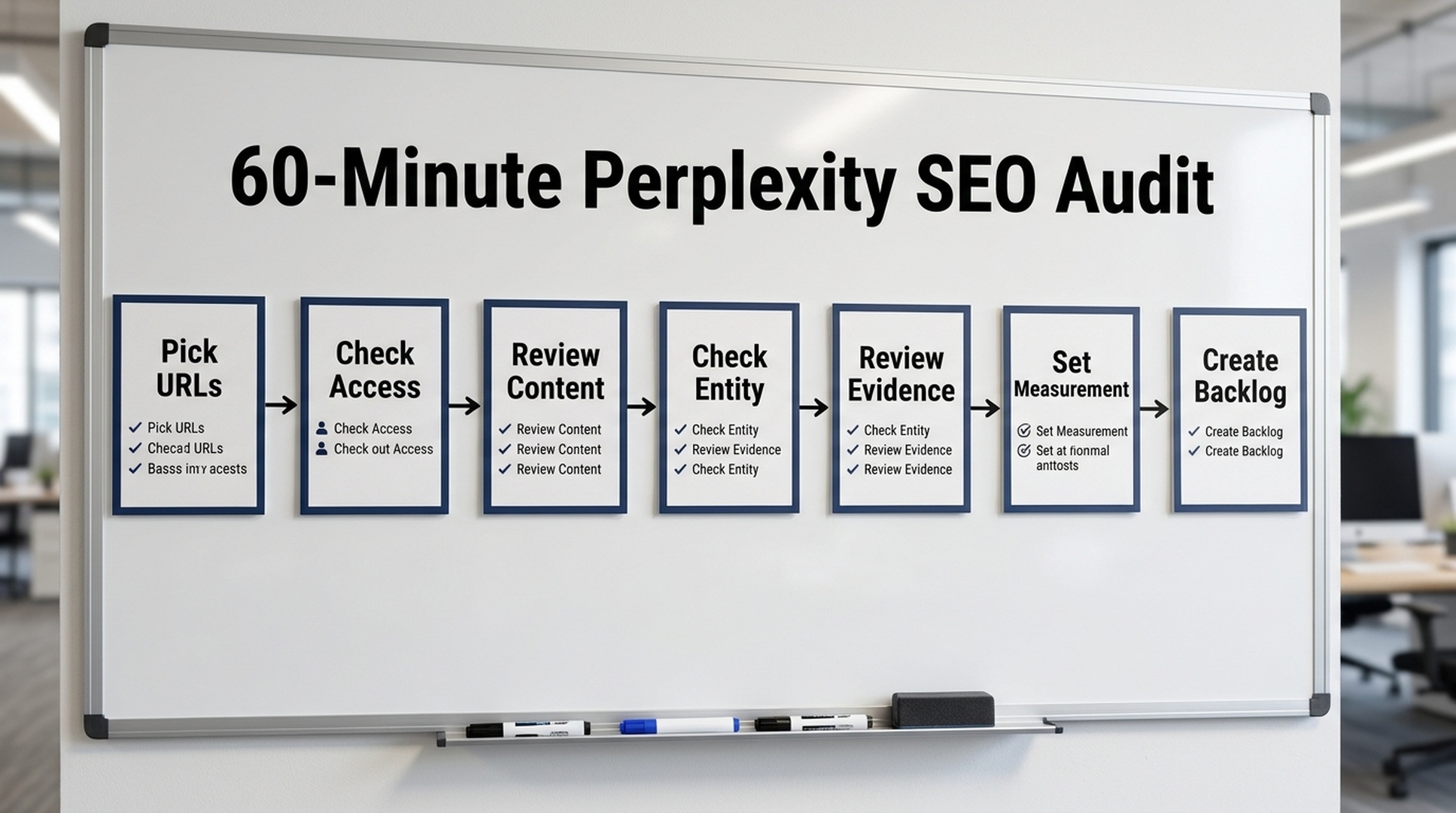
Time | Task | Output |
|---|---|---|
0-10 min | Pick 5-8 priority URLs | Audit URL list |
10-20 min | Check robots.txt, status codes, WAF assumptions | Access issue list |
20-30 min | Review answer blocks, facts, tables, sources | Content rewrite notes |
30-40 min | Check brand entity consistency | Entity cleanup notes |
40-50 min | Review third-party evidence and competitor citations | Evidence gap list |
50-60 min | Create prompt baseline and fix backlog | Next actions by owner |
Assign owners before the meeting ends:
Owner | Typical fixes |
|---|---|
SEO | URL list, prompt map, internal links, title/H1 updates |
Content | Answer blocks, examples, tables, source links, FAQ |
Engineering | WAF, rendering, status codes, schema, logs |
PR/Brand | Third-party profiles, partner pages, directory consistency |
Analytics | Referral tracking, dashboard, assisted-conversion notes |
A Perplexity SEO audit fails if it ends as a PDF no one uses. Turn it into a fix backlog.
Priority fixes by score
Score range | Interpretation | What to do next |
|---|---|---|
0-20 | Not ready | Fix access, page structure, and brand facts before measuring citations. |
21-40 | Partially ready | Prioritize pages with commercial prompt value and repair the biggest blockers. |
41-50 | Good foundation | Improve evidence, measurement cadence, and referral paths. |
51-60 | Strong baseline | Run controlled refreshes and competitor citation monitoring. |
The exact score matters less than the failure pattern. A site with great content but blocked crawler access needs a technical sprint. A site with good access but vague content needs editorial repair. A site with citations but no traffic needs conversion-path work.
FAQ
What is a Perplexity SEO audit?
A Perplexity SEO audit checks whether your public pages are accessible, source-ready, entity-clear, evidence-backed, measurable, and able to turn Perplexity citations into useful visits.
How is this different from a normal SEO audit?
A normal SEO audit focuses on crawlability, indexability, rankings, content quality, and traffic. A Perplexity SEO audit adds AI-answer visibility: prompts, brand mentions, cited URLs, citation position, answer accuracy, external evidence, and referral quality.
How many pages should I audit first?
Start with 5-8 high-value pages. Include homepage, About page, product or service page, comparison page, technical guide, tool page, and one article that should be cited for a commercial prompt.
Should I audit PerplexityBot access first?
Yes. Technical access comes first. If Perplexity cannot reach or read the page, content improvements may not matter.
What is a good audit score?
Use the score as a diagnostic, not a benchmark. A score above 40 usually suggests a usable foundation. A score below 20 means you likely have major access, content, entity, or measurement gaps.
How often should I repeat the audit?
Run a full audit quarterly. Recheck technical access after site migrations, WAF changes, robots.txt updates, CMS changes, or major content refreshes. Monitor prompt visibility weekly or biweekly during active optimization.
Sources
- Perplexity Docs: Perplexity crawlers
- Perplexity Help Center: How does Perplexity work?
- Perplexity Docs: API overview
Auspia takeaway
A Perplexity SEO audit should not end with a vague score. It should tell the team what to fix next.
Start with access. Check whether the page can be reached and read. Then inspect content structure, brand facts, evidence, measurement, and referral paths. The brands that improve fastest are not the ones with the longest checklist. They are the ones that turn the checklist into a repair sprint.
Author: Victor Lane, GEO Audit Specialist with 300+ Readiness Reviews at Auspia. Victor writes about readiness audits, checklists, scorecards, diagnostics, and practical repair workflows for AI search visibility.