A brand mention is not evidence
An AI assistant naming your company can be encouraging. It is not, by itself, proof that a GEO program is working.
Answers change with the prompt, location, product version, browsing state, and sources available at that moment. A screenshot of one favorable response cannot tell a growth team whether the brand was recommended, why it appeared, whether the answer can be reproduced, or what page deserves credit.
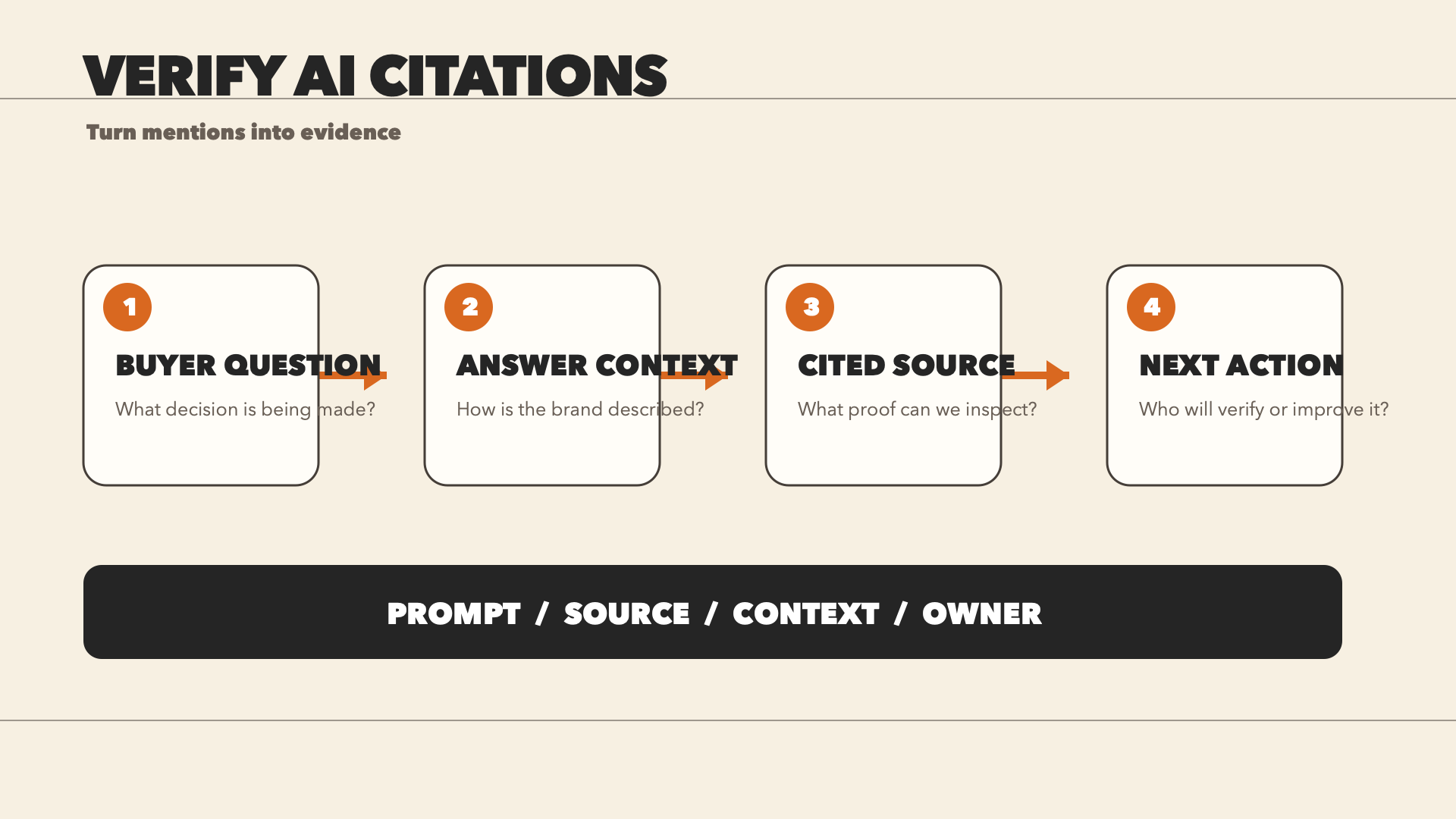
The useful standard is simpler and stricter: a captured AI citation should let another person understand the buyer question, recreate the check where possible, inspect the supporting evidence, and decide on a next action. That turns a volatile answer into a reviewable signal.
This framework is for teams that already monitor AI-search visibility and want to avoid two common mistakes: treating every mention as a win, or dismissing answer-engine visibility because it is harder to measure than a rank.
The diagnosis: your report has observations, not a chain of evidence
Open a typical AI visibility report and you may see a mention count, a few answer excerpts, and a chart moving up or down. Useful clues, perhaps. But several questions are still unanswered:
- Which customer question produced the answer?
- Was the brand a recommendation, a cited source, a comparison option, or a passing mention?
- What source did the answer use, if it showed one?
- Does the answer contain an outdated, incomplete, or incorrect claim?
- Did the answer lead to a content, product, or brand-information decision?
If the report cannot answer those questions, it has a collection problem. It may be collecting outputs without retaining the context that makes them useful.
The fix is not a larger prompt list. It is a small evidence record for every observation worth discussing.
Build an AI citation record that a second reviewer can use
Treat each meaningful answer as a case file. A short structured record is enough. The goal is not to archive every word an assistant produces; it is to preserve the facts needed for review.
Field | What to capture | Why it matters |
|---|---|---|
Buyer question | The exact prompt, including audience, market, and constraints | Broad prompts and buyer prompts lead to very different answers |
Check conditions | Platform, date, country, language, signed-in state, and browsing or search setting when relevant | Makes a later comparison fairer |
Answer role | Recommended option, comparison entry, source citation, neutral mention, or negative mention | A name in a list is not automatically a positive result |
Brand wording | The exact description, limitation, or qualification attached to the brand | Reveals how the market is being understood |
Evidence URL | The cited URL, or the closest owned/public source supporting the claim | Connects the answer to information a team can inspect |
Confidence | Directly observed, inferred from the answer, or unverified | Stops inference from becoming a reported fact |
Owner and next action | The person who will verify, correct, publish, or monitor | Keeps the signal from becoming a spreadsheet graveyard |
For example, "best customer support platform" is a weak record on its own. "Best customer support platform for a 50-person SaaS team that needs multilingual help-center content" is a decision scenario. It gives a reviewer something concrete to test and gives the content team a clear question to answer.
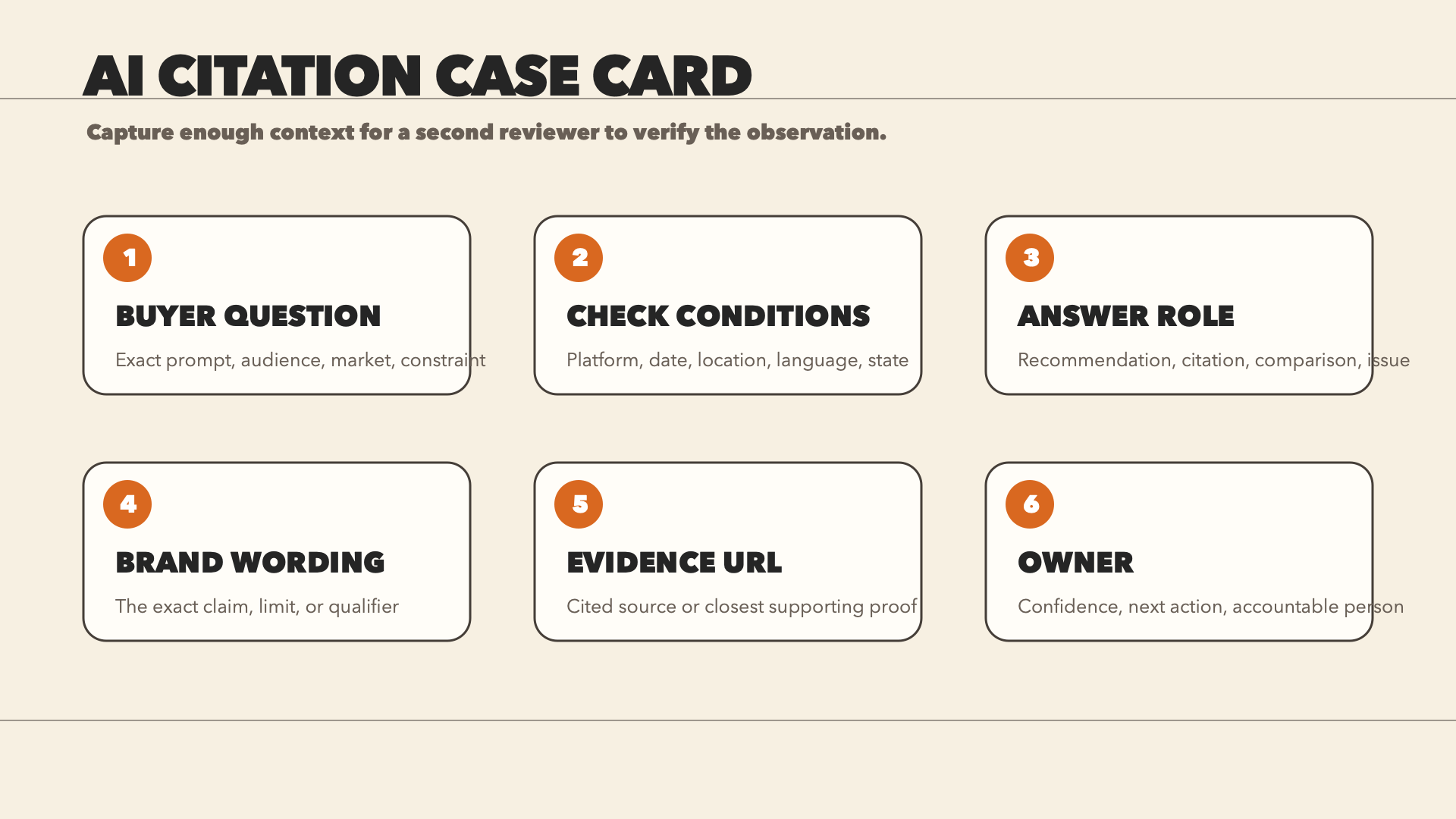
A complete citation case record makes it possible for a second reviewer to verify the observation.
Separate four answer outcomes before you celebrate or react
The same brand can appear in an answer in several ways. Mixing them creates poor reporting and even worse priorities.
Outcome | What it means | First response |
|---|---|---|
Direct recommendation | The answer presents the brand as a suitable choice for the stated need | Check whether the stated reason is accurate and supported by a useful page |
Comparison presence | The brand appears beside alternatives, often with a condition or trade-off | Improve the decision criteria, comparison evidence, and fit explanation |
Source citation | An owned page supports a claim, even if the product is not recommended | Protect and strengthen the source; check whether the page connects naturally to relevant use cases |
Problematic mention | The answer repeats a stale limitation, confuses the brand, or makes an unsupported claim | Verify the fact, find the source of confusion, and route a correction or clarification |
This classification gives the team a more honest dashboard. A direct recommendation and a problematic mention should not both add to the same "visibility" total. Nor should a citation to a useful guide be written off because it did not produce a product recommendation in the same answer.
Verify the source before assigning credit
Some answer surfaces display sources clearly. Others summarize information without a transparent citation path. In both cases, resist the temptation to say an answer came from your page unless the evidence supports that claim.
When a visible citation points to an owned URL, inspect the page first. Does it contain the claim the answer made? Is the page current, accessible, and clear about its scope? Is there another public source with the same language that may be the more likely origin? A citation link is evidence of selection, but it does not prove that one sentence in the answer was generated from one sentence on the page.
When no source is shown, record the answer as an observation. Then search your own site and trusted public sources for the relevant brand fact. If the answer is right but your proof is hard to find, that is a documentation opportunity. If it is wrong, start with the canonical sources you control: product pages, help documentation, pricing and policy pages, structured organization details, and clear comparison guidance.
There is an important distinction here. GEO work can improve the quality and availability of evidence. It cannot guarantee that a particular system will cite a particular page on demand.
Use a review score, not a vanity score
One favorable answer can be real and still be a bad basis for a priority decision. A compact quality score helps teams focus on observations with commercial relevance and a clear action path.
Score each item from 0 to 2 on these five checks:
Check | 0 | 1 | 2 |
|---|---|---|---|
Question quality | Generic or irrelevant | Related to the category | Mirrors a real buyer decision |
Reproducibility | No conditions recorded | Partial conditions recorded | Prompt and check conditions recorded clearly |
Evidence quality | No source or unclear claim | Plausible supporting source | Relevant, current, inspectable evidence |
Brand context | Passing or ambiguous mention | Neutral comparison or citation | Clear recommendation, useful source role, or material error to fix |
Actionability | No owner or practical next step | General idea only | Specific page, fact, or test has an owner |
An item scoring 8 to 10 deserves a review queue. A score of 3 may still be interesting, but it should not trigger a content sprint. This is deliberately less glamorous than a single "AI visibility score." It is also more defensible in a leadership meeting.
Turn repeated gaps into pages and proof, not keyword stuffing
The most valuable patterns appear across a cluster of related questions. Suppose a company is repeatedly cited for implementation advice but absent whenever users ask which solution fits regulated teams. The problem may not be lack of mentions. The site may lack an honest, specific explanation of compliance boundaries, implementation model, security documentation, or fit criteria.
Use the table below to turn a pattern into a practical response.
Repeated pattern | What it may reveal | Better next move |
|---|---|---|
Competitors are recommended for high-intent comparisons | The decision criteria are better explained elsewhere | Create a factual comparison or selection guide that states where your offer fits and where it does not |
Your guides are cited but the product is absent | Helpful education is disconnected from the commercial use case | Add clear, relevant use-case paths and product evidence without turning the guide into a sales page |
The same outdated limitation appears repeatedly | Core brand facts are inconsistent or buried | Audit the canonical facts, update high-visibility pages, and watch the prompt cluster after the correction |
The brand is confused with another company or category | Entity signals and naming context are weak | Clarify the organization, product category, key differentiators, and authoritative profile information |
Answer quality varies wildly across prompts | The prompt set is too broad or the evidence is uneven | Split the cluster by decision stage and improve the pages behind the high-value questions first |
Do not solve a weak answer by publishing thin pages for every wording variation. Buyers and answer systems both benefit more from a small number of clear, evidence-rich pages that address real decisions.
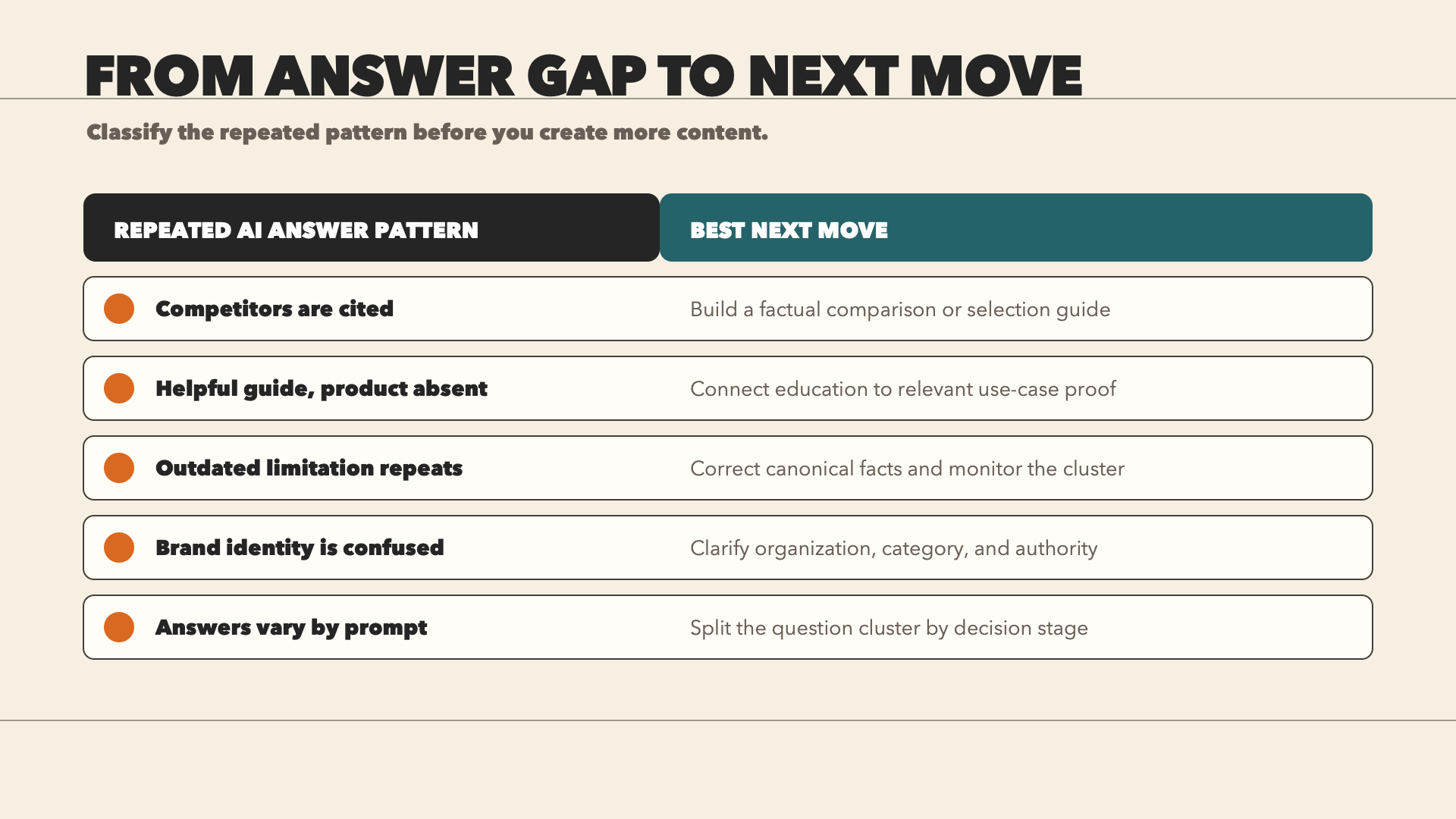
Repeated answer patterns should lead to specific evidence and content decisions, not generic keyword production.
A weekly review that stays useful
Start with 20 to 40 questions drawn from sales calls, support conversations, comparison research, and high-intent search behavior. Group them by decision stage: discovery, evaluation, implementation, and risk. Capture the same conditions each review where the platform allows it.
During the weekly session, do three things:
- Flag material changes in recommendation context, citations, or incorrect brand statements.
- Cluster observations that point to the same evidence gap instead of opening a ticket for every answer.
- Assign only actions that can be verified: update a fact page, add a comparison section, publish documentation, inspect a crawl issue, or rerun the defined check after a change.
Keep the final review note short. It should state what changed, what remains uncertain, and what the team will test next. It should not pretend that a fluctuating set of answers is a complete attribution model.
The Auspia view: credibility comes before scale
AI-search measurement becomes useful when it helps a team make a better content or brand decision. It becomes misleading when it tries to turn every generated sentence into revenue attribution.
Start with a defensible prompt set, retain the context behind important answers, and route repeatable gaps to the people who can fix them. If you need a baseline, Auspia's AI Search Visibility Checker can help identify where to investigate. The next step is still human work: inspect the evidence, decide what is true, and improve the information buyers need.
FAQ
Can an AI citation be reproduced exactly?
Not reliably. Answers can change as models, sources, settings, and prompts change. Record the conditions, look for patterns across repeated checks, and treat a single answer as an observation rather than a permanent ranking.
Does a brand mention prove an AI tool used my website?
No. A mention may come from many sources or from a model's broader understanding. Attribute a specific claim to an owned page only when the available evidence supports that connection.
Which AI citation gaps should we fix first?
Prioritize repeated gaps in questions that reflect a real purchase, comparison, implementation, or trust decision. Then choose the smallest clear improvement to a page, fact set, or proof asset that the team can verify.
Author: Isabel Grant, Researcher of 2,000+ AI Citation Patterns at Auspia. Isabel writes about source quality, citation evidence, and practical ways to earn trustworthy AI-search visibility.