Why competitors get mentioned and you do not
If Perplexity mentions competitors but skips your company, the issue may not be the article you just published. It may be your brand entity.
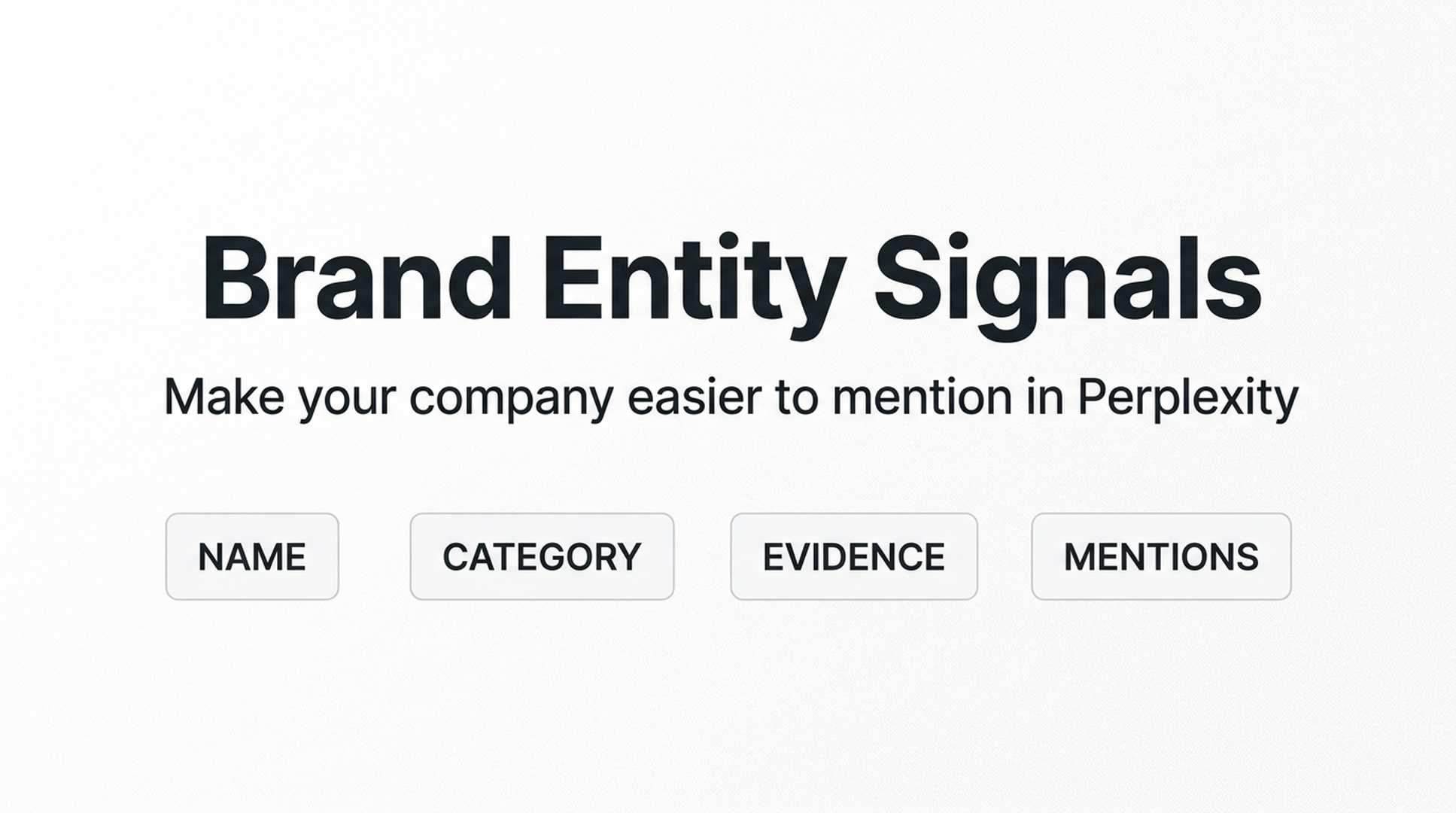
A brand entity is the set of facts the web can agree on about your company: name, category, product, audience, market, use cases, evidence, and relationship to other entities. Perplexity can only describe and recommend what it can retrieve and resolve with enough confidence.
When the web is unclear, AI answers become unclear too.
Entity problem | What it looks like in Perplexity |
|---|---|
Inconsistent category | Your brand is called a tool, agency, platform, chatbot, or content suite depending on the source. |
Weak public facts | Perplexity mentions competitors with clearer docs, profiles, or review pages. |
No third-party confirmation | Your own site says one thing, but external sources do not support it. |
Vague product pages | The answer cannot explain who you serve or what the product does. |
Conflicting descriptions | Directories, social profiles, and partner pages use old positioning. |
Brand entity work is not glamorous. It is cleanup. But for Perplexity SEO, it can decide whether your company appears in category answers at all.
What brand entity signals mean for Perplexity SEO
Perplexity SEO is not only about being cited. It is also about being understood.
A strong entity footprint helps Perplexity answer questions like:
- What is this company?
- Which category does it belong to?
- Who is it for?
- What does the product actually do?
- Which claims are supported by public sources?
- Which competitors or alternatives are related?
- Is the company relevant to this user's prompt?
The goal is not to manipulate the answer. The goal is to reduce ambiguity.
If the answer system can clearly connect your brand to a category, use case, product, audience, and evidence base, it has a better foundation for mentioning you when the prompt fits.
The brand entity signal map
A useful entity map has owned, structured, and third-party layers.
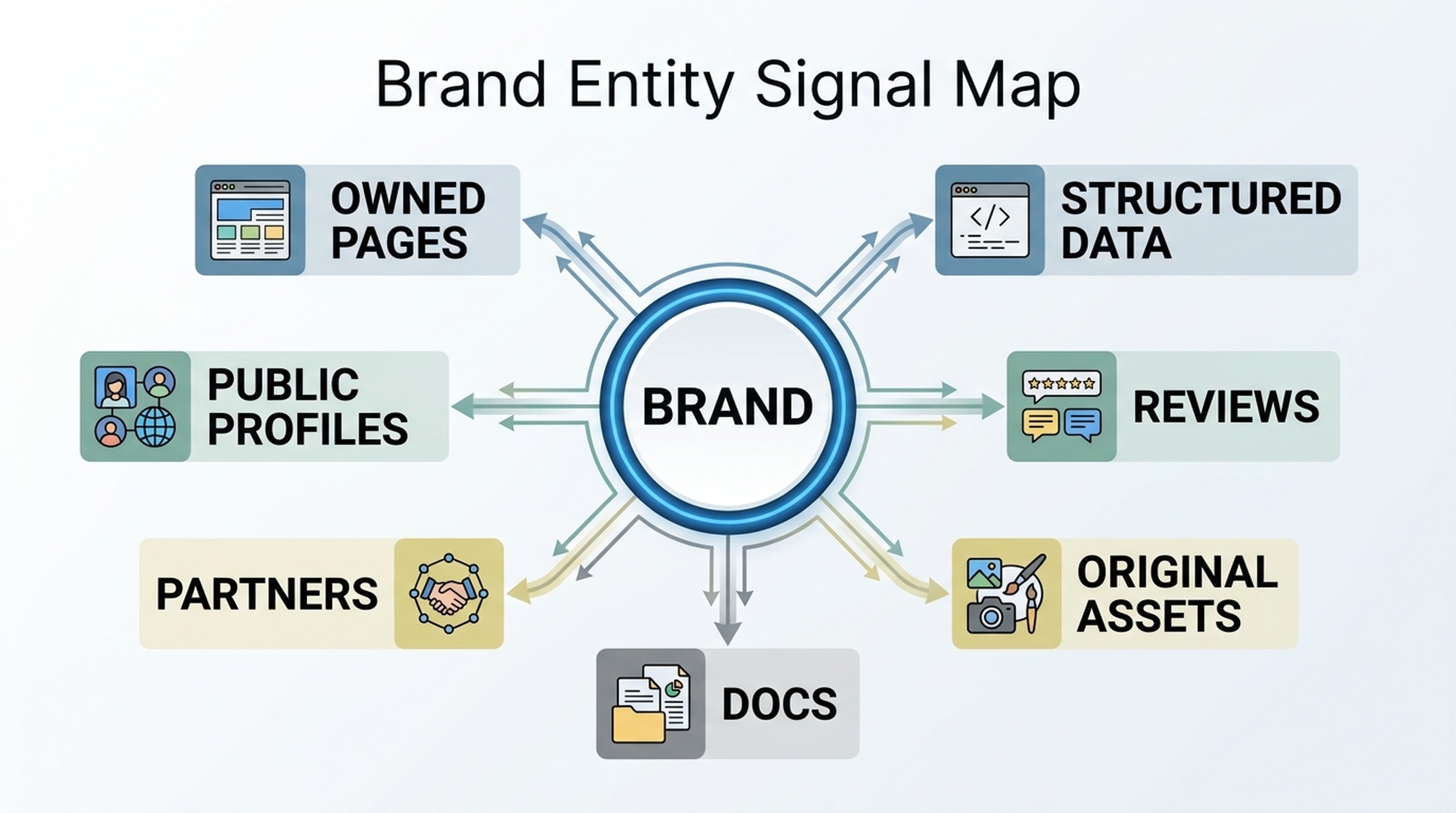
Signal layer | Examples | Why it matters |
|---|---|---|
Owned pages | Homepage, About page, product pages, docs, glossary, comparison pages | Establishes your official facts and preferred category language. |
Structured data | Organization, Product, Article, Breadcrumb, FAQ, sameAs | Helps machines connect entities and page context. |
Public profiles | LinkedIn, Crunchbase-style profiles, directories, marketplaces | Reinforces consistent name, category, and description. |
Reviews and listings | G2, Capterra, Trustpilot, app marketplaces, niche directories | Adds external language and use-case proof. |
Partner pages | Integration partners, agencies, platform ecosystems | Connects your brand to known entities and workflows. |
Docs and help pages | Public product docs, setup guides, API pages, changelogs | Supports technical and product-specific claims. |
Original assets | Benchmarks, templates, tools, reports, checklists | Gives Perplexity stronger source material to cite. |
The more these layers agree, the easier it is for Perplexity to describe the brand accurately.
Four levels of brand entity readiness
Most brands fall into one of four levels.
Level | What it looks like | Main fix |
|---|---|---|
Level 1: unclear | The brand has a homepage, but category and use case are vague. | Define the brand fact sheet and rewrite core pages. |
Level 2: owned clarity | Your site explains the brand well, but external profiles are inconsistent. | Update directories, reviews, social profiles, and partner pages. |
Level 3: verified context | Owned and third-party sources mostly agree. | Add evidence assets, docs, and comparison pages. |
Level 4: citation-ready entity | The brand is clear, externally supported, and tied to prompt clusters. | Measure mentions, refresh evidence, and monitor competitors. |
The jump from Level 1 to Level 2 is usually the fastest. The jump from Level 2 to Level 3 takes more coordination because you need external surfaces to match your current positioning.
Start with a brand fact sheet
Before updating pages, write a one-page brand fact sheet. This becomes the source of truth for writers, SEO, PR, product marketing, and directory updates.
Include:
Field | Example format |
|---|---|
Official brand name | Auspia |
Primary category | AI search visibility and GEO tools |
Short description | Auspia helps growth teams improve visibility across AI search, GEO, AEO, and SEO. |
Primary audience | SEO, content, and growth teams |
Core use cases | AI search visibility checks, crawler access checks, citation readiness, GEO audits |
Product examples | AI Search Visibility Checker, Robots.txt AI Crawler Checker, GEO tools |
Differentiator | Connects prompt visibility, crawler access, citation readiness, and content workflows |
Terms to use | Perplexity SEO, AI search visibility, GEO, AEO, AI citations |
Terms to avoid | Generic "AI platform" without context, unsupported "best" claims |
This document should not be poetic. It should be boringly clear.
Entity cleanup works best when paired with source-ready pages. Use the Perplexity-ready content structure guide to rewrite key pages, then measure the impact with How to measure Perplexity SEO.
Clean up owned pages first
Owned pages are the easiest to fix and the most important to control.
Start with:
Page | Entity fix |
|---|---|
Homepage | State category, audience, and primary use case above the fold. |
About page | Add official name, description, market, product scope, and contact context. |
Product pages | Explain inputs, outputs, features, integrations, limitations, and use cases. |
Tool pages | Say what the tool checks, who it is for, and what users get back. |
Docs/help pages | Support technical claims with public, crawlable details. |
Comparison pages | Define fit, alternatives, criteria, and boundaries clearly. |
Blog guides | Use consistent category and product language when mentioning the brand. |
A useful test: copy five pages into a document and highlight every sentence that describes the company. If the descriptions conflict, Perplexity will see the conflict too.
Then fix third-party descriptions
Third-party consistency matters because Perplexity can retrieve sources beyond your own site.
Review these surfaces:
Surface | What to check |
|---|---|
Review platforms | Category, product description, screenshots, feature labels |
Directories | Company description, category tags, URL, logo, market |
Partner pages | Integration name, product use case, current positioning |
Social profiles | Bio, category, URL, product language |
Marketplace listings | Feature claims, supported platforms, setup notes |
Guest posts or interviews | Old descriptions, outdated product names, vague category claims |
Press pages | Boilerplate, company description, product facts |
Do not try to make every profile identical. That looks unnatural and may not fit each platform. Make them consistent on the facts that matter: name, category, audience, product scope, and use case.
Use schema as support, not magic
Structured data can help clarify entities, but it will not fix weak positioning.
Good schema choices include:
Schema type | Useful for |
|---|---|
Organization | Official name, URL, logo, sameAs profiles, contact context |
Product | Product name, description, category, offers, reviews where appropriate |
Article | Article metadata, author, dates, publisher |
BreadcrumbList | Page hierarchy and topical context |
FAQPage | Clear question-answer pairs when FAQs are real |
SoftwareApplication | SaaS tools, app details, category, operating system where relevant |
Use sameAs carefully. Link to official profiles you control or strongly trust. Do not stuff random URLs into schema and expect a knowledge graph to appear.
Add evidence assets that make the entity useful
Brand entity clarity helps Perplexity know who you are. Evidence assets help it know why you belong in an answer.
Good evidence assets include:
Asset | Why it helps |
|---|---|
Original benchmark | Gives Perplexity a concrete data source to cite. |
Public tool | Shows what the brand does, not just what it claims. |
Technical guide | Supports implementation and troubleshooting prompts. |
Glossary page | Connects the brand to a topic category. |
Comparison page | Helps evaluation prompts and shortlist answers. |
Case study | Shows use-case evidence when clearly attributed. |
Template or checklist | Gives practical source material for how-to prompts. |
For Auspia, examples include crawler checkers, AI search visibility tools, Perplexity SEO guides, and GEO audit checklists. Those assets make the brand easier to connect to the category.
Entity cleanup workflow
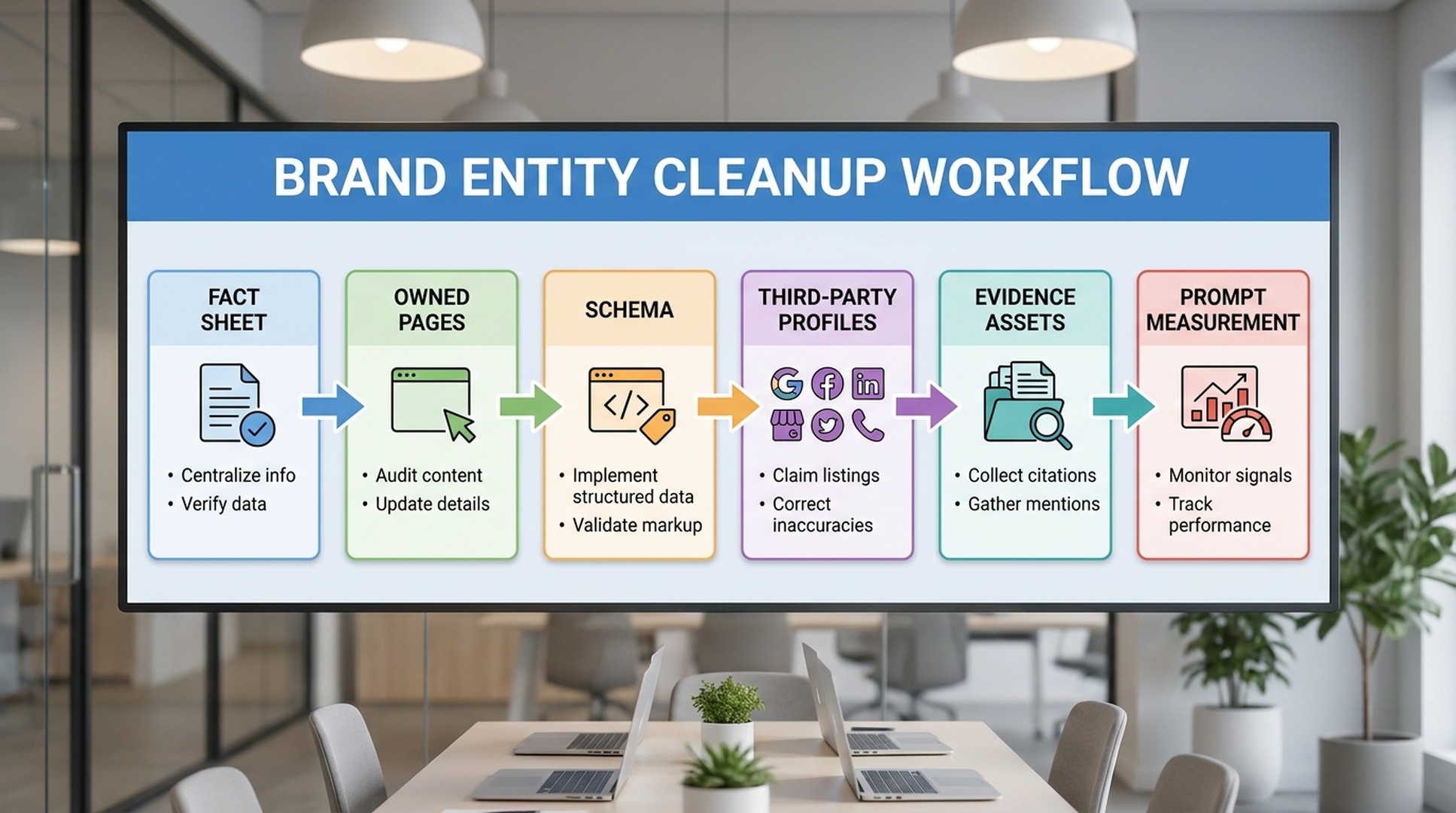
Use this 10-step workflow:
Step | Action | Owner |
|---|---|---|
1 | Write the brand fact sheet | Product marketing or founder |
2 | Audit homepage and About page descriptions | SEO/content |
3 | Audit product and tool page descriptions | Product marketing |
4 | Review schema and sameAs links | Technical SEO |
5 | List third-party profiles and directories | PR/brand |
6 | Update mismatched descriptions | PR/brand |
7 | Identify missing evidence assets | SEO/GEO lead |
8 | Publish or refresh priority evidence pages | Content/product |
9 | Build prompt tests for category mentions | GEO measurement |
10 | Recheck mentions and answer accuracy | SEO/GEO lead |
Do this before launching a big Perplexity citation campaign. Otherwise, you may earn attention while still being described incorrectly.
How to measure entity improvement
Entity work can feel fuzzy, so measure it with prompt groups.
Track:
Metric | What to look for |
|---|---|
Brand mention rate | Does the brand appear in relevant non-branded prompts? |
Category accuracy | Is the brand placed in the right category? |
Description accuracy | Does the answer explain the product correctly? |
Competitor adjacency | Are you listed near relevant competitors, not random tools? |
Source quality | Are citations coming from owned pages, docs, reviews, or weak sources? |
Claim accuracy | Are cited claims specific and supported? |
Third-party consistency | Do external sources use current positioning? |
A good result is not just "more mentions." It is more accurate mentions in the prompts that matter.
Common mistakes
Mistake | Why it hurts |
|---|---|
Changing homepage copy but ignoring profiles | External sources still describe the old company. |
Using broad category labels | "AI platform" is too vague for useful answer matching. |
Publishing only thought leadership | Perplexity needs product facts, docs, tools, and evidence too. |
Overstuffing schema | Structured data cannot replace clear public pages. |
Letting directories drift | Old categories can keep resurfacing in AI answers. |
Measuring only traffic | Entity improvement often appears first as better mentions and descriptions. |
FAQ
What are brand entity signals?
Brand entity signals are public facts and relationships that help search and AI answer systems understand a company. They include name, category, audience, product facts, structured data, public profiles, reviews, partner pages, docs, and citation-worthy assets.
Why do brand entity signals matter for Perplexity SEO?
Perplexity needs to understand what your brand is before it can mention or cite you accurately. If your public facts are vague or inconsistent, Perplexity may skip the brand, describe it incorrectly, or favor competitors with clearer evidence.
What should I fix first?
Start with a brand fact sheet, then update homepage, About page, product pages, schema, and top third-party profiles. After that, build evidence assets such as tools, docs, comparisons, benchmarks, or checklists.
Does schema improve Perplexity mentions?
Schema can support entity understanding, especially Organization, Product, Article, Breadcrumb, FAQ, and SoftwareApplication markup. It is not a guaranteed mention trigger. Clear public content and consistent third-party evidence still matter.
How do I know if my brand entity is improving?
Track non-branded and branded prompts over time. Look for better brand mention rate, category accuracy, description accuracy, source quality, and competitor adjacency.
Should every profile use the exact same description?
No. Use the same facts, not the exact same sentence everywhere. Each platform has a different format, but your name, category, audience, product scope, and core use case should stay consistent.
Sources
- Perplexity Help Center: How does Perplexity work?
- Perplexity Docs: Perplexity crawlers
- Schema.org: Organization
- Schema.org: SoftwareApplication
Auspia takeaway
Perplexity SEO is not only about writing better pages. It is also about making the brand easier to resolve.
If your company has unclear category language, inconsistent third-party profiles, weak docs, and vague product facts, Perplexity has less to work with. Clean the entity first. Then build citations on top of it.
Clear brands are easier to mention. Evidence-backed brands are easier to cite.
Author: Lydia Hart, Brand Entity Strategist for 200+ Entity Audits at Auspia. Lydia writes about brand facts, entity consistency, about pages, category language, and knowledge graph readiness.