The AI Citation Economy Has Already Replaced the Click Economy
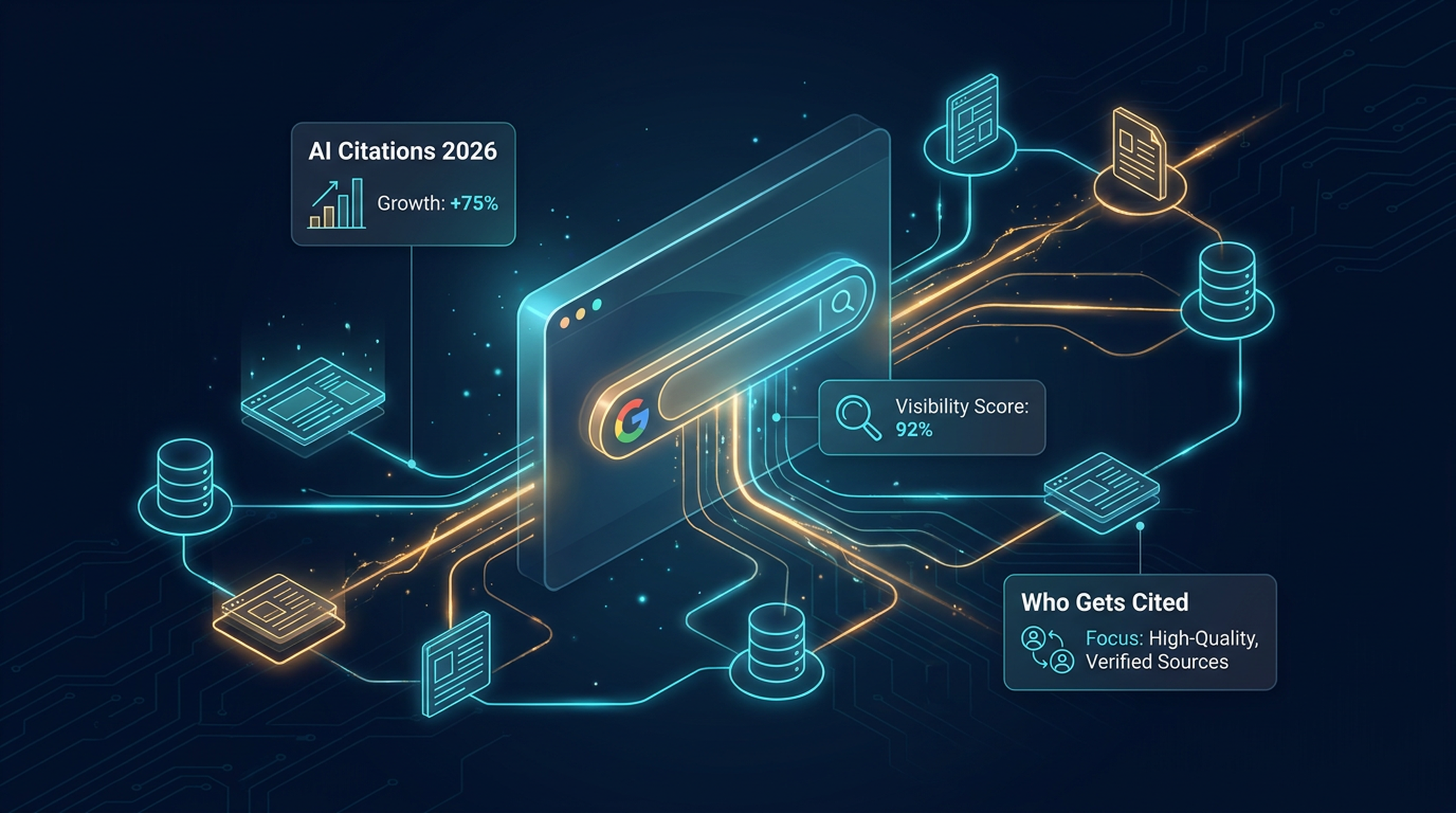
Google AI Mode and AI Overviews now decide which sources survive in search. In 2026, being ranked on page one is no longer enough — you need to be the source the AI extracts, synthesizes, and cites. The data tells a stark story: brands cited in AI Overviews earn 35% higher organic click-through rates and 91% higher paid CTR compared to uncited competitors on the same queries, yet only 38% of AI Overview citations come from pages ranking in the traditional top 10. The citation layer has become the new front page of the internet.
This article breaks down who actually gets cited in Google AI Mode and AI Overviews in 2026, why traditional SEO rankings no longer guarantee visibility, and the seven concrete strategies that move your content from invisible to cited.
Who Gets Cited in Google AI Mode? (2026 Data)
Google's Self-Citation Surge
The most surprising development in 2026 is that Google itself has become the number-two most-cited domain in its own AI Mode. Citations to google.com pages grew 8.4× between April 15 and June 30, 2026 — and this growth is driven almost entirely by two surfaces: Google Business Profiles and Product Knowledge Panels.
When a user asks AI Mode about a local business or a product, the AI increasingly cites a Google-hosted card with hours, reviews, and pricing rather than sending the user to a third-party website. For local and ecommerce brands, this means your Google Business Profile and product schema are no longer supplementary — they are primary citation surfaces.
The Top 5 Most-Cited Domains Across AI Platforms
Rank | Domain | Key Trend (2026) |
|---|---|---|
1 | #1 most-cited across AI Mode, ChatGPT, and Perplexity | |
2 | Google.com | Grew 8.4× in AI Mode citations (Apr–Jun 2026) |
3 | Citation frequency doubled (Nov 2025–Feb 2026) | |
4 | YouTube | Citation share quadrupled from ~4% to ~8% in AI Overviews |
5 | Wikipedia | Stable, high-baseline citation across all engines |
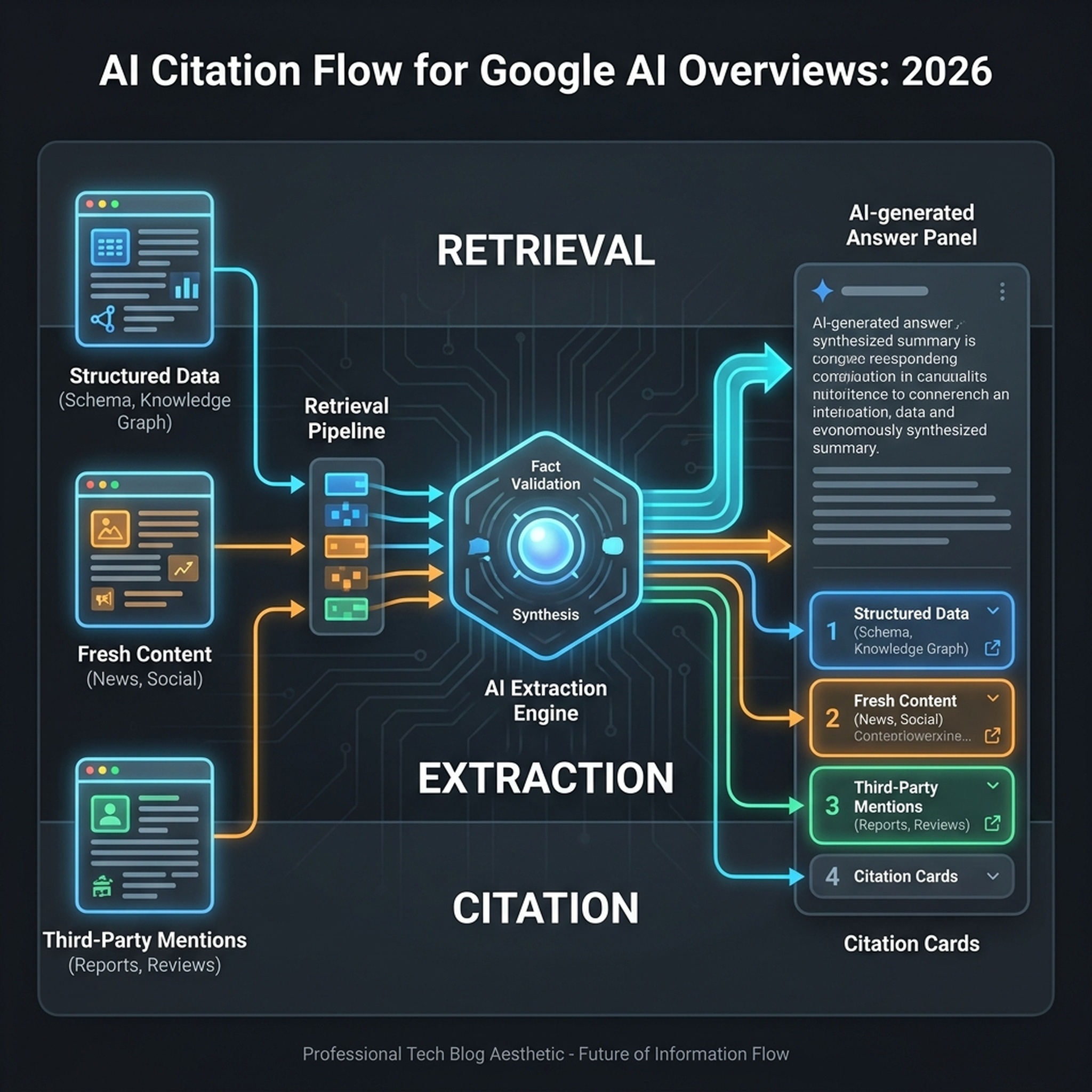
The pattern is clear: platforms with structured, entity-rich, and frequently updated content dominate AI citations. Reddit's UGC volume, LinkedIn's professional entity data, and YouTube's video transcripts each feed AI extraction differently.
Vertical-Specific Citation Patterns
Citation concentration varies dramatically by vertical. In health queries, the AI Overviews citation landscape is highly consolidated:
Domain | Health AIO Citation Share |
|---|---|
NIH | ~39% |
Healthline | ~15% |
Mayo Clinic | ~14.8% |
Cleveland Clinic | ~13.8% |
If you operate in a vertical with dominant authoritative sources, your citation strategy must focus on being mentioned by those sources (through earned media, expert quotes, and data citations) rather than competing with them directly.
Why Traditional SEO Rankings No Longer Guarantee Citations
The overlap between top-10 organic rankings and AI Overview citations has collapsed. A June 2026 study found that this overlap fell from 70% to under 20% — meaning the vast majority of cited pages do not rank in the traditional top 10.
Three forces drive this divergence:
- Passage-level extraction: AI systems pull individual paragraphs, not entire pages. A page ranking #25 can get cited if it contains the single best answer passage for a query.
- Structured data signals: Pages with FAQ schema get cited 2–3× more than identical pages without it, regardless of ranking position.
- Freshness weighting: 65% of AI Overview citations come from content published within the past year, and pages updated within the last 30 days receive 3.2× more citations. A high-ranking page that hasn't been refreshed in 90+ days can see its citation rate drop by roughly 40%.
The implication is direct: you need a separate optimization layer for the AI citation surface, not just traditional SERP ranking.
7 Strategies to Get Cited in Google AI Overviews
1. Lead With a Direct Answer
Open every page and major section with a 40–60 word paragraph that directly answers the query. Research shows that 44.2% of AI citations come from the first 30% of page text. Cited passages are nearly twice as likely to contain definitive, unhedged language — so avoid vague qualifiers like "may" or "could potentially" when you have data to support a clear claim.
Action: Audit your top 10 pages. Does the first paragraph under each H2 answer the question the heading poses? If not, rewrite it.
2. Structure Content for Machine Extraction
AI systems extract from well-structured HTML. The highest-leverage elements:
- One H1 per page, descriptive and keyword-aligned
- H2s phrased as questions that mirror how users actually search
- FAQPage schema in JSON-LD — the single most impactful structured data type for citation frequency (2–3× citation lift)
- Article and Product schema for content type clarity
Pages with FAQ schema get cited roughly 2–3 times more than identical pages without it. This is the highest ROI technical change you can make.
3. Build Topical Authority Through Content Clusters
AI tools cite sources that demonstrate consistent expertise across a topic, not single one-off pages. You need comprehensive pillar pages supported by cluster content that collectively signal domain expertise.
The pillar-cluster model works because AI systems evaluate entity density — the concentration of relevant named entities, concepts, and relationships in your content ecosystem. A single page about "GEO" will lose to a domain with 20 interconnected pages covering GEO measurement, GEO tools, GEO strategy, and GEO case studies.
Action: Map your top 3 topics. For each, identify whether you have a pillar page + 5+ supporting cluster pages. If not, prioritize cluster creation.
4. Earn Third-Party Validation
This is the most counterintuitive finding: brands are approximately 6.5× more likely to be cited through third-party sources than through their own website. Digital PR, earned media, and strong review profiles are not optional — they are the primary citation channel.
Content elements that boost third-party citation:
- Adding statistics to your content increases AI visibility by ~22%
- Adding expert quotations raises visibility by ~37%
- Citing authoritative external sources boosts visibility for lower-ranked pages by ~115%
Action: Get mentioned on Reddit, LinkedIn, and niche industry publications. Each mention on a high-citation domain increases your probability of being cited indirectly.
5. Keep Content Fresh on a 30-Day Cycle
Freshness Window | Citation Impact |
|---|---|
Updated within 30 days | 3.2× more citations |
Published within 1 year | 65% of all AIO citations |
Published within 3 years | 89% of all AIO citations |
Older than 90 days (unrefreshed) | ~40% citation rate drop |
A quarterly refresh cycle is no longer sufficient. For high-priority pages, a 30-day refresh is the new minimum — even if the information hasn't changed, updating statistics, adding a new section, and verifying links resets the freshness signal.
6. Optimize for Platform-Specific Citation
Google AI Overviews is just one surface. ChatGPT, Claude, and Perplexity each use different search indexes with minimal overlap — the domain overlap between ChatGPT and Perplexity citation sources is only 11%.
Platform | Search Index | Optimization Priority |
|---|---|---|
Google AI Overviews | Top-12 ranking + structured data | |
ChatGPT | Bing + own crawler | Bing visibility + third-party mentions |
Claude | Brave | Brave crawlability + comparison content |
Perplexity | Own index | Fresh content + citation-worthy claims |
Action: Don't optimize for one engine. Audit your visibility across all four using a tool like the Auspia GEO Checker, which measures citation rates across multiple AI platforms simultaneously.
7. Track Citation Performance Across Engines
You cannot improve what you don't measure. Traditional SEO tools track ranking position, but AI citation requires different metrics:
- Citation rate: Percentage of target prompts where your brand is cited
- Share of citation: Your citations vs. competitors' within the same prompt set
- Retrieved-vs-cited gap: How often your content is retrieved but not cited (a content quality signal)
- Prompt coverage: Breadth of prompts where you appear at all
Run these measurements over a 7–9 day window with multiple prompt variations per topic, because AI responses carry significant randomness. A single check is noise; a rolling average is signal.
The Business Case: Why AI Citation Investment Pays Off
AI-referred traffic converts at dramatically higher rates than traditional organic search:
Traffic Source | Conversion Rate |
|---|---|
ChatGPT | 15.9% |
Perplexity | 10.5% |
Claude | 5.0% |
Organic search | 1.76% |
Being cited in an AI Overview also increases adjacent organic click-through rates by 35% — meaning GEO investment is additive to SEO, not competitive with it. A user who sees your brand cited in the AI summary is more likely to click your organic listing below it.
The combined effect: brands that invest in AI citation visibility capture both the direct AI-referred conversion (5–16%) and the halo effect on traditional organic CTR (+35%).
How to Audit Your AI Citation Visibility Today
Run this 5-step audit:
- Identify your 20 most important prompts — the questions your customers actually ask AI assistants. These map to your top commercial keywords but are phrased as natural-language questions.
- Run each prompt across 3+ AI engines — Google AI Mode, ChatGPT, and Perplexity at minimum. Record whether your brand is cited, mentioned, or absent.
- Calculate citation rate per engine — cited prompts ÷ total prompts. Anything below 20% means you're largely invisible in AI search.
- Diagnose the gap — for uncited prompts, check: Is your content structured for extraction? Is it fresh? Do you have third-party mentions? Is your schema in place?
- Prioritize fixes by impact — FAQ schema and answer-first restructuring give the fastest wins. Third-party PR and content clusters take longer but compound over time.
For automated measurement, use the Auspia GEO Checker to track citation rates across engines over time, or check the GEO Leaderboard to benchmark your brand against competitors.
FAQ
What is the difference between Google AI Mode and AI Overviews? AI Overviews appear automatically in regular search results, providing a summary with citation cards. AI Mode is a separate, more conversational search tab that allows deeper exploration and follow-up questions. Both cite sources, but AI Mode generates longer, multi-turn responses with different citation patterns.
Do I still need traditional SEO if I optimize for AI citations? Yes. Approximately 75% of AI Overview links come from pages already in the top 12 organic results. Traditional SEO gets you into the retrieval pool; AI citation optimization ensures you're the passage that gets extracted and cited.
How often should I update my content for AI citations? For high-priority pages, refresh every 30 days. Pages updated within 30 days receive 3.2× more citations. Even minor updates — refreshing a statistic, adding a new FAQ, verifying links — reset the freshness signal.
Why is Reddit cited so often in AI search? Reddit combines high content volume, frequent updates, diverse user perspectives, and strong domain authority. AI systems favor content that demonstrates real-world discussion and consensus, which Reddit's format naturally produces.
Can I track my AI citation rate for free? Yes. Run your target prompts manually across Google AI Mode, ChatGPT, and Perplexity, and record whether your brand appears. For automated tracking across more engines and prompts, use the Auspia GEO Checker.
Author: Owen Hartwell, Google AI Overview Tracker Across 40+ Verticals at Auspia. Owen writes about AI Overviews citation patterns, SERP shifts, and how brands can win visibility in generative search results.