The mistake that causes most Perplexity SEO failures
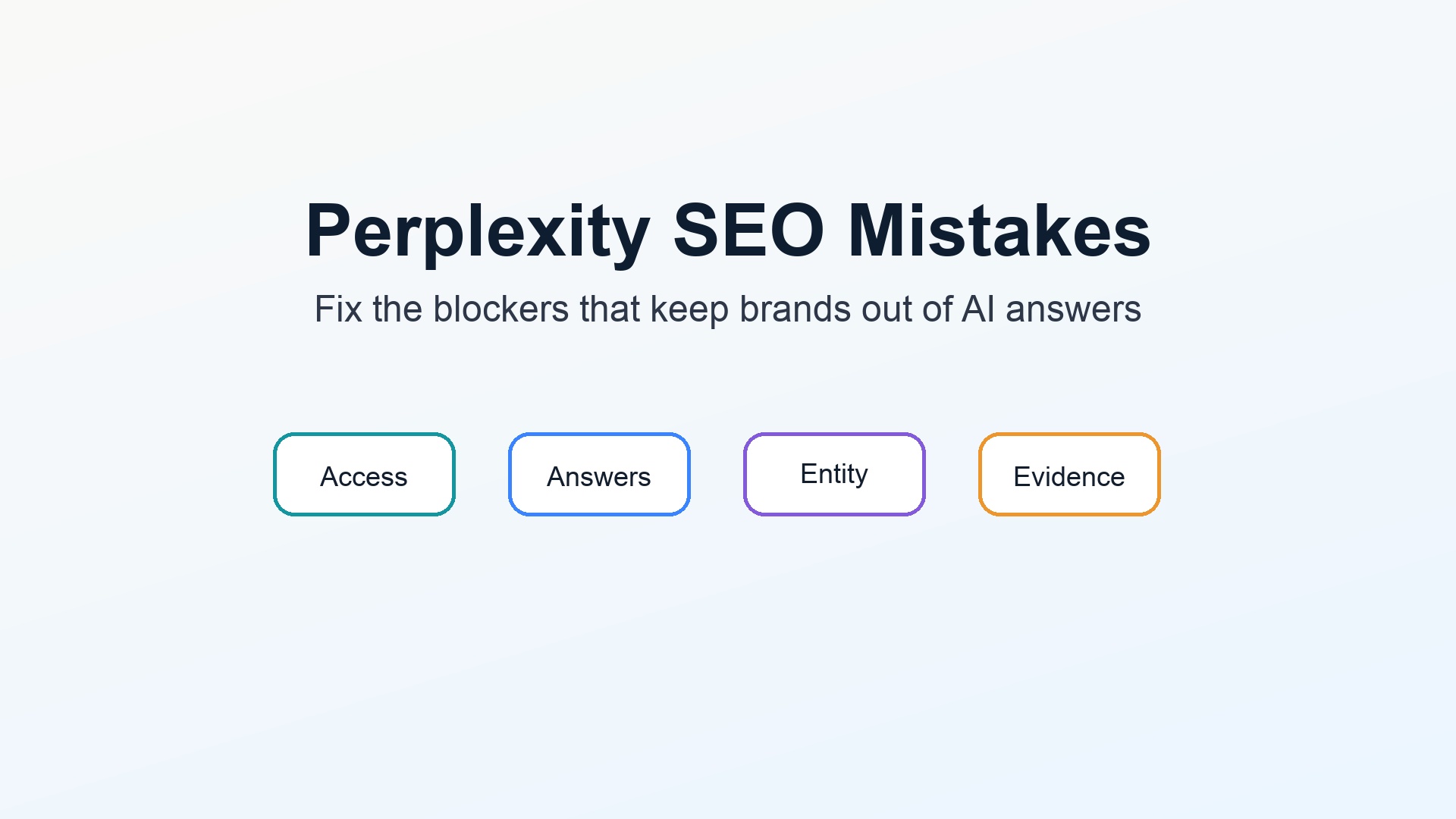
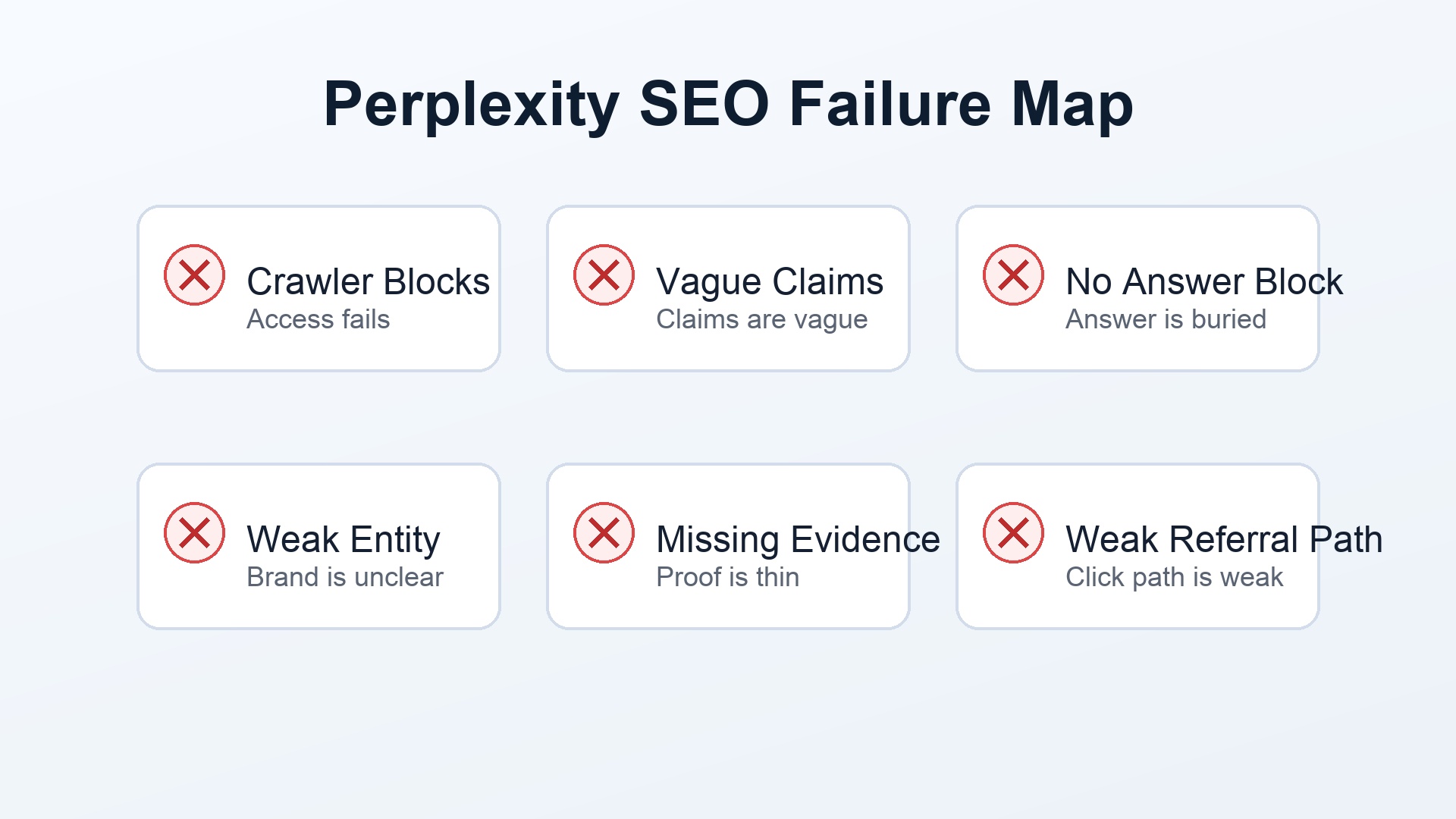
Most brands do not fail at Perplexity SEO because they missed one hidden optimization trick. They fail because their pages are hard to access, hard to cite, hard to verify, or hard to act on after the click.
That is the pattern behind almost every Perplexity visibility problem.
Symptom | Likely cause |
|---|---|
Competitors appear in answers, but you do not | Weak brand entity signals or missing evidence. |
Your page ranks in Google but is not cited | The page is not structured like useful source material. |
Perplexity mentions the brand incorrectly | Public facts are inconsistent across owned and third-party sources. |
Citations happen but traffic is weak | The cited page does not match the user's next step. |
Technical pages are skipped | Crawlers or user-triggered fetches may be blocked or challenged. |
The fix is not to publish more generic AI search content. The fix is to remove the specific blockers that keep Perplexity from finding, understanding, trusting, and citing your pages.
Mistake 1: treating Perplexity like a normal Google results page
Google SEO and Perplexity SEO overlap, but they are not the same job.
Google SEO often optimizes for ranking position, snippet appeal, and click-through rate. Perplexity SEO optimizes for source selection inside an AI answer. That means a page has to be useful before the click, not only persuasive after it.
A Google-style article may be long and comprehensive but still weak for Perplexity if it lacks:
- a direct answer near the top
- specific facts and constraints
- comparison tables
- clear brand/entity language
- source links for external claims
- examples that map to real prompts
Repair: keep the search intent, but add source-ready sections. Make the page easier to quote, summarize, and verify.
Mistake 2: blocking crawler access without noticing
Crawler access is the boring failure that wastes the most time.
Perplexity documents PerplexityBot for discovering and indexing web content and Perplexity-User for user-triggered fetches. If public pages are blocked in robots.txt, challenged by WAF rules, hidden behind scripts, or returning unreliable status codes, content rewrites may not matter.
Check:
Access layer | What to inspect |
|---|---|
Robots.txt | Are priority URLs blocked by broad rules? |
WAF/CDN | Are relevant user agents challenged or blocked? |
Status code | Does the canonical URL return |
Rendering | Is the main content extractable? |
Logs | Can you confirm successful access? |
Repair: start with a small list of priority URLs and test access before rewriting content. Use Auspia's Robots.txt AI Crawler Checker for a first pass, then validate WAF and log behavior with engineering.
Mistake 3: writing vague brand claims
Vague claims are hard for AI answers to use.
A sentence like "we help companies grow with AI-powered insights" may sound fine on a homepage. It gives Perplexity very little to cite.
Better:
Auspia helps growth teams measure AI search visibility across prompts, brand mentions, cited URLs, answer accuracy, and referral traffic.
That sentence names the audience, category, metrics, and use case. It is still marketing copy, but it is source-friendly marketing copy.
Repair: replace broad claims with facts, use cases, inputs, outputs, and constraints.
Mistake 4: publishing pages with no answer block
Many articles start with broad context before answering the question. That can work for essays. It is weak for answer extraction.
Perplexity-ready pages should answer the main question early.
Use one of these opening formats:
Opening type | Best for |
|---|---|
Short answer | Definitions and explainers |
Diagnosis | Problem and troubleshooting posts |
Decision memo | Comparison and strategy posts |
Scorecard | Audit and readiness posts |
Workflow outcome | How-to and playbook posts |
Repair: add a concise answer block in the first section. Do not make it robotic. Make it useful.
Mistake 5: relying only on your own website
Owned content is necessary, but it is not the whole evidence layer.
Perplexity can retrieve pages from across the web. If every claim about your brand exists only on your site, the entity is weaker than competitors with consistent docs, reviews, directories, partner pages, research, and public profiles.
Repair: build a public evidence map. Include owned pages, docs, review profiles, partner pages, directories, original tools, benchmarks, and credible mentions.
Mistake 6: using llms.txt as a shortcut
llms.txt can be useful as a machine-readable guide, but it is not a magic citation switch.
A file that points to weak pages still points to weak pages. A file that lists content blocked by WAF still points to content that may not be retrievable. A file that describes vague claims still does not create external evidence.
Repair: treat llms.txt as support, not strategy. Prioritize crawlable pages, clear source content, brand facts, and evidence.
Mistake 7: ignoring brand entity consistency
Perplexity cannot mention your brand accurately if the public web cannot agree on what the brand is.
Look for mismatches in:
- homepage description
- About page
- schema
- social profiles
- review profiles
- directories
- partner pages
- old guest posts or press boilerplates
Repair: create a brand fact sheet with official name, category, audience, product scope, use cases, and preferred description. Then update owned and third-party surfaces.
Mistake 8: measuring only referral traffic
Referral traffic matters, but it is only one part of Perplexity SEO measurement.
A user may read the Perplexity answer, see your brand, not click, and later search for you directly. Another user may click a citation, skim, and return through Google days later. Attribution is messy.
Track:
Metric | Why it matters |
|---|---|
Brand mentions | Shows whether the brand enters the answer set. |
Cited URLs | Shows whether your pages are used as sources. |
Citation position | Shows whether the source is prominent or buried. |
Claim accuracy | Shows what Perplexity says about you. |
Competitors | Shows who owns the same answer space. |
Referrals | Shows direct traffic from Perplexity. |
Assisted behavior | Shows later visits, branded search, or conversions. |
Repair: build a prompt library and measure mentions, citations, answer accuracy, competitors, and referrals together.
Mistake 9: sending citation traffic to weak next steps
A citation click is usually a research click. The visitor wants verification, comparison, a tool, a checklist, or a deeper explanation.
If the cited page ends with a generic "Contact us" button, you may waste the visit.
Match the next step to the prompt:
Prompt intent | Better next step |
|---|---|
Technical access | Crawler checker, implementation guide, robots.txt examples |
Measurement | Visibility checker, dashboard template, prompt library guide |
Comparison | Criteria table, alternative page, buyer checklist |
Education | Glossary, checklist, next guide |
Brand validation | Case study, docs, review profile, product workflow |
Repair: add a contextual CTA near the section that earns the citation. Do not wait until the footer.
If you want a structured repair path, run the Perplexity SEO audit checklist. If citations already happen but visits are weak, use the Perplexity referral traffic guide.
Which mistake should you fix first?
Use this priority order:
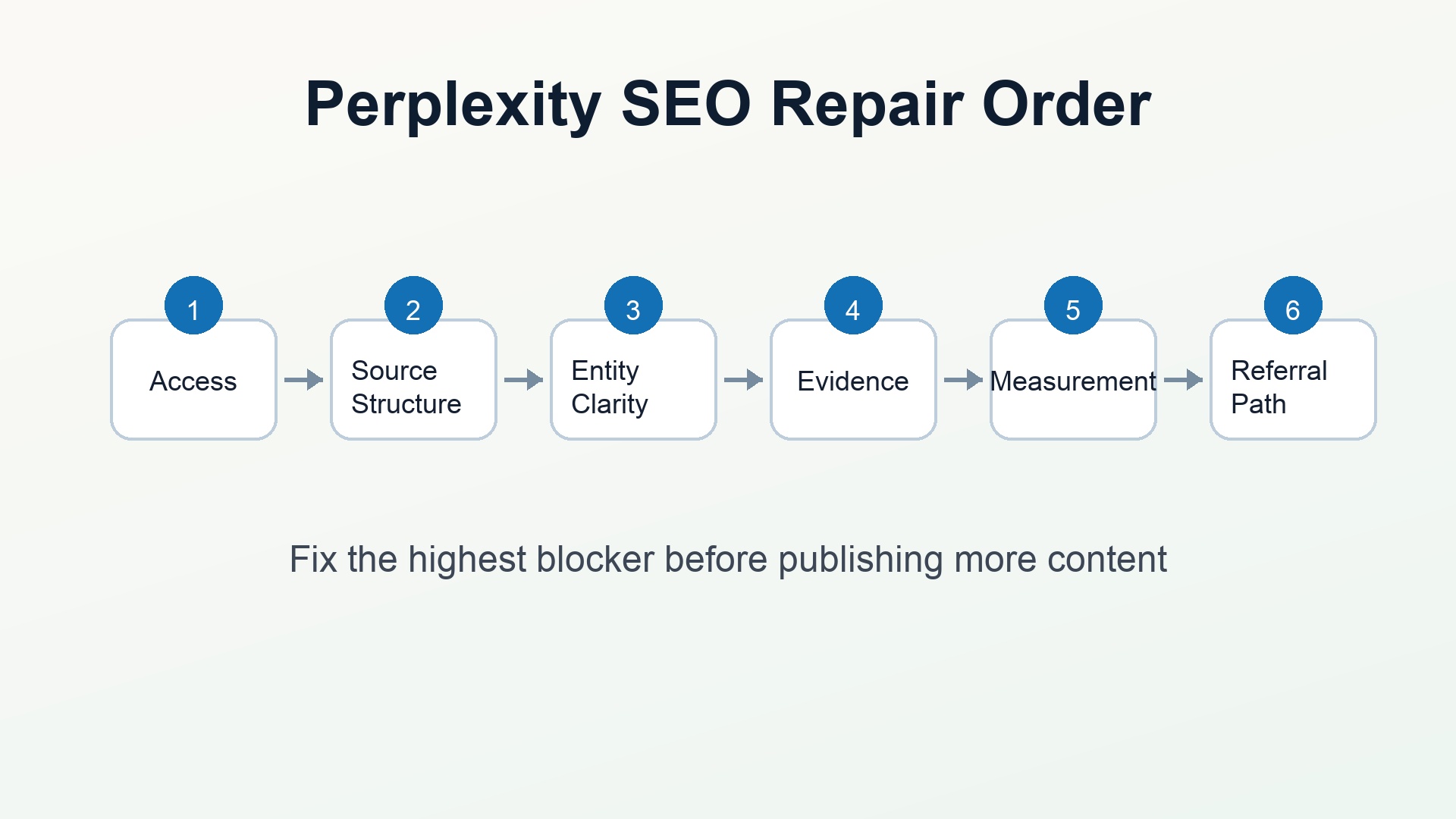
Priority | Fix first if... | Example action |
|---|---|---|
1. Access | Pages may be blocked or hard to fetch | Review robots.txt, WAF, rendering, and logs |
2. Source structure | Pages are accessible but not cited | Add direct answers, tables, facts, examples, source links |
3. Entity clarity | Brand is described incorrectly | Update brand fact sheet, About page, schema, profiles |
4. Evidence | Competitors are cited more often | Add docs, reports, tools, partner pages, review consistency |
5. Measurement | You cannot tell what changed | Build prompt library and citation report |
6. Referral path | Citations happen but visits do not convert | Add useful next steps and internal paths |
Do not fix everything at once. Pick the failure pattern that blocks the most valuable prompt group.
FAQ
What is the biggest Perplexity SEO mistake?
The biggest mistake is treating Perplexity like a normal Google ranking page. Perplexity SEO requires source readiness: accessible pages, direct answers, clear brand facts, credible evidence, and citation measurement.
Can a page rank in Google but fail in Perplexity?
Yes. A page can rank in Google but fail as Perplexity source material if it lacks direct answers, extractable facts, source links, entity clarity, or crawler access.
Does allowing PerplexityBot guarantee citations?
No. Allowing PerplexityBot only removes one access blocker. The page still needs to be relevant, useful, specific, and credible enough to support the answer.
Is llms.txt required for Perplexity SEO?
No public evidence shows that llms.txt is required for Perplexity citations. It may help point AI systems toward useful pages, but it does not replace crawlable content, good source structure, or brand evidence.
How do I know which mistake applies to my site?
Start with a small audit. Check priority URL access, answer structure, brand entity consistency, third-party evidence, prompt visibility, cited URLs, and referral paths. The failure pattern will usually be obvious after 10-20 prompts.
What should I fix first?
Fix access first. Then improve source structure, brand entity clarity, evidence, measurement, and referral paths. If access is broken, the rest of the work may not matter.
Sources
- Perplexity Help Center: How does Perplexity work?
- Perplexity Docs: Perplexity crawlers
- Perplexity Docs: API overview
Auspia takeaway
Perplexity SEO mistakes are usually practical, not mysterious.
Make the page reachable. Make the answer clear. Make the brand easy to understand. Add evidence outside your own site. Measure prompts and citations. Give visitors a useful next step.
That repair loop will do more than another generic AI search article.
Author: Bennett Hayes, Applied GEO Analyst Across 400+ Implementation Reviews at Auspia. Bennett writes about practical GEO execution, audits, implementation notes, and the common blockers that keep brands out of AI answers.