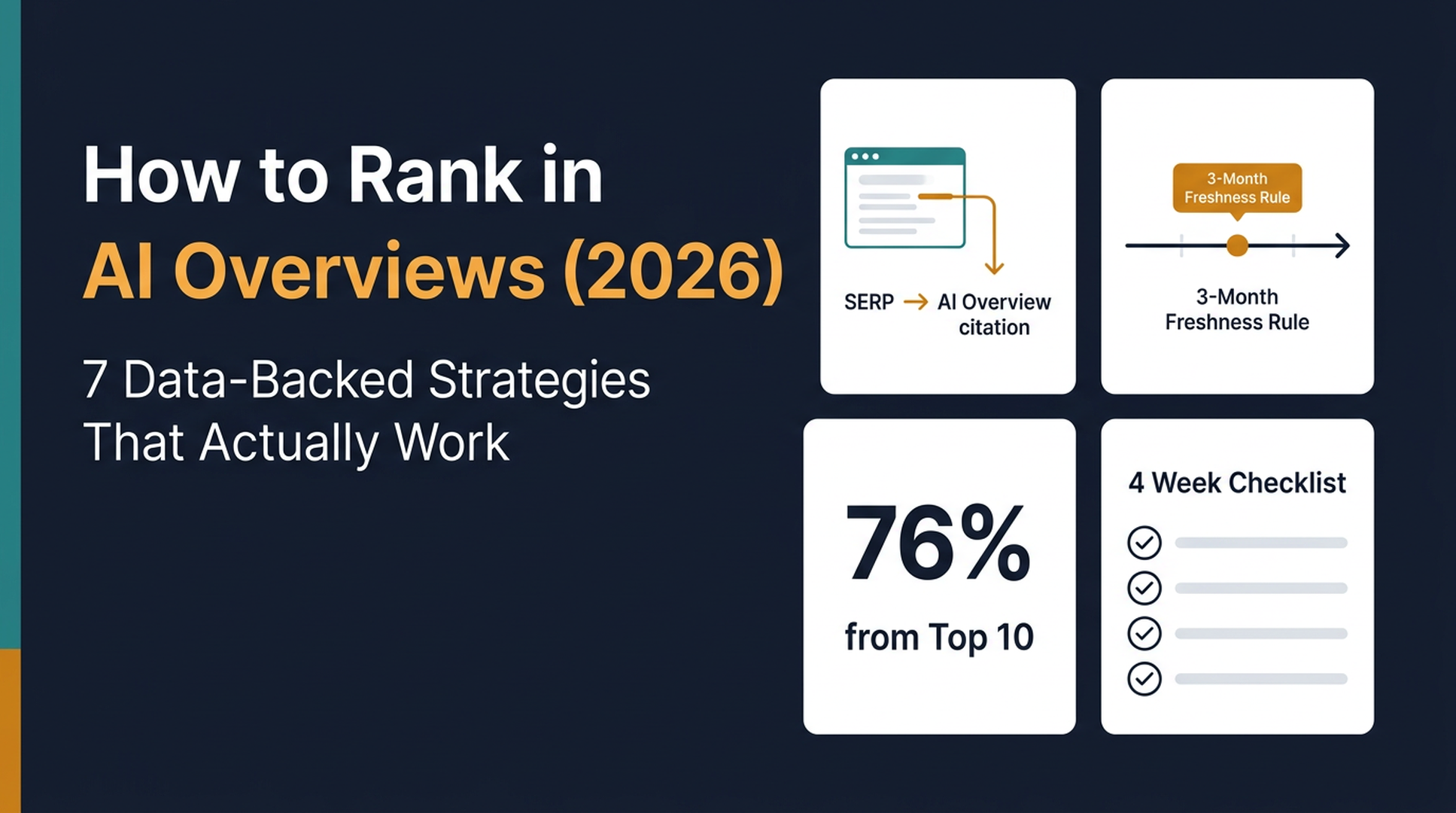
Google's AI Overviews now appear on over half of all search queries, and AI Mode—powered by Gemini 3.5 Flash—has crossed one billion monthly users. If your content isn't cited in these AI-generated answers, you're invisible to a growing share of your audience.
But here's the thing: there is no separate "AI ranking algorithm." Google pulls AI Overview citations from its existing search index through retrieval-augmented generation (RAG). The same fundamentals that get you into the top 10 also get you cited—but only if your content is structured so an AI can actually extract the answer.
This guide walks through seven strategies that move the needle in 2026, backed by data from large-scale studies. Each one includes an automation workflow you can run with a Codex or Claude Code agent—no coding required.
What "Ranking in AI Overviews" Actually Means in 2026
Before we dive into tactics, let's get clear on what we're optimizing for. Google now runs two separate AI citation engines:
Surface | Reach | How It Picks Sources |
|---|---|---|
AI Overviews | Appears at the top of standard SERPs | Strongly correlated with top-10 organic rankings |
AI Mode (Gemini 3.5 Flash) | Standalone chat-style search, 1B+ users/month | Weak correlation with rankings—freshness and entity authority matter more |
Here's the critical finding: these two surfaces agree on the answer 86% of the time, but they cite the same URLs only 13.7% of the time (Ahrefs, 540K query pairs). If you only optimize for one, you're leaving citations on the table.
Visibility tiers within an AI Overview:
- Top-cited URL: visible on desktop without any clicks
- Top 3 URLs: visible when a user hits "Show more"
- All cited sources: visible in the full "Show all" expansion
Your goal is to appear in that first tier for the queries your audience actually searches.

Strategy 1: Master Traditional Organic Rankings First
The data is unambiguous: 76% of AI Overview citations come from pages already ranking in Google's top 10 organic results. The median cited page sits at position 2.
This makes intuitive sense. AI Overviews don't crawl the web independently—they use Google's existing search index. If Google already trusts your page enough to rank it, that trust transfers to AI citations.
What to do
- Identify the queries where you rank in positions 4–15 but aren't cited in AI Overviews. These are your lowest-hanging fruit—you're already in the index; you just need to make your content more extractable (see Strategy 2).
- Don't chase keywords where you're on page 3+. The AI retrieval window is narrow. Build topical authority on those topics first through cluster content (see Strategy 4).
- Prioritize informational queries with question intent. AI Overviews trigger on 57.9% of question-based searches vs. only 15.5% of non-questions.
Automate with an AI Agent
Audit my top 20 ranking pages for AI Overview citation gaps.
For each page:
1. Pull organic rankings from GSC export
2. Identify queries where I rank top 15 but am not cited in AI Overviews
3. Flag the top 5 highest-opportunity gaps
Output a prioritized list with the query, my current rank, and whether that query triggers an AI Overview.
What you need: A Google Search Console export (CSV) or connected GSC account. The agent reads what you give it—it doesn't invent data.
Strategy 2: Structure Content So an AI Can Extract It
This is the biggest shift from traditional SEO. Ranking in the top 10 gets your page into the retrieval pool, but roughly 40–60% of top-10 pages are never cited because the AI can't cleanly pull an answer from them.
Google's Gemini model doesn't "read" pages the way a human does. It extracts passages that match specific sub-queries. If your answer is buried in a narrative intro or scattered across multiple paragraphs, the AI skips you.
The Atomic Answer Framework
Every H2 section on your page should open with a 40–60 word paragraph that fully answers the heading's question without requiring context from anywhere else on the page.
Bad (context-dependent):
When it comes to choosing the right option, there are several factors you'll want to consider. We've tested dozens of approaches over the years and found that the answer depends on your specific situation, which we'll explore in detail below.
Good (self-contained atomic answer):
The best running shoes for flat feet are stability models with a firm medial post, such as the Brooks Adrenaline GTS 23 or ASICS Kayano 31. Look for shoes labeled "structured cushioning" and avoid neutral, highly flexible models. Expect to pay $120–$165.
Formats that get cited more
Research from multiple studies in 2025–2026 consistently shows that certain content formats get extracted at much higher rates:
Format | Why It Works |
|---|---|
Comparison tables | Gemini can parse table rows as structured fact sets |
Numbered steps (3–7) | Each step is a self-contained extraction point |
Bulleted lists with bold leaders | The bold text becomes the extraction anchor |
FAQ blocks with question headings | Matches the query fan-out pattern directly |
Definition-first paragraphs | The AI doesn't need to synthesize—it can quote directly |
Question-based headings
Use H2 and H3 headings that match the exact natural-language phrasing a user would type. When Gemini fires sub-queries during its fan-out process, it looks for sections whose headings mirror those sub-queries.
Replace:
- "Pricing Considerations" → "How Much Do Running Shoes for Flat Feet Cost?"
- "Selection Criteria" → "What Should You Look for in Stability Running Shoes?"
- "Common Mistakes" → "What Happens If You Wear the Wrong Shoes for Flat Feet?"
Automate with an AI Agent
Analyze this page for AI extraction readiness:
[URL]

Check:
1. Does each H2 open with a 40-60 word self-contained answer?
2. Are headings phrased as natural-language questions?
3. Does the page use comparison tables, numbered steps, or bulleted lists for key data?
4. Is the primary answer above the fold (first 100 words of the main content)?

For each failure, output the exact section that needs restructuring and a suggested rewrite.
Strategy 3: Build Brand Authority Through Citations—Not Just Links
In 2026, the relationship between links and AI visibility has fundamentally shifted. Domain Rating (a proxy for backlink strength) shows a weak correlation of just r=0.18 with AI Overview citations (down from 0.23 in 2024). Meanwhile, unlinked brand mentions correlate at 0.664.
The AI doesn't care how many links point to you. It cares whether your brand name appears alongside your topic across the open web—especially on these high-signal platforms:
- YouTube (strongest correlation: 0.740) — the most-cited domain in AI Overviews overall
- Reddit — accounts for 21% of AI Overview citations
- Wikipedia — entity resolution depends heavily on a Wikipedia presence
- Industry publications and trusted review sites
What to do
- Get on YouTube with topical content. A 6-minute video answering a specific question, with a keyword-rich title, description, and transcript, is a distinct AI citation channel. YouTube's citation share grew 34% in six months.
- Participate in Reddit threads where your topic is discussed. Don't spam—provide genuinely useful answers. Reddit accounts for over a fifth of all AI Overview citations.
- Pitch expert quotes to journalists and industry writers. A single mention on a highly-linked industry page (DR 50+) carries more AI citation signal than a dozen low-quality guest post links.
- Claim and verify your entity across platforms. Connect your website to LinkedIn, Crunchbase, and Wikipedia via
sameAsschema. When Gemini resolves entities, it cross-references these signals.
Automate with an AI Agent
Scan for brand mention gaps across AI-cited platforms for my domain:
[domain]

Check:
1. Is my brand mentioned on YouTube in my topic area? (search: "[topic] review" and "[topic] guide")
2. Is my brand mentioned in relevant Reddit threads? (search: "site:reddit.com [topic]")
3. Is my domain linked from Wikipedia on topic-relevant pages?
4. Which competitors are getting cited in AI Overviews that I'm not?

Output a prioritized outreach list: who to contact, on what platform, for which topic.
What you need: Nothing more than a search engine. The agent suggests where to look—you do the outreach.
Strategy 4: Build Topical Clusters That Cover the Query Fan-Out
When a user types a complex query like "best running shoes for flat feet and overpronation," Gemini fires multiple sub-queries in parallel:
- "What causes overpronation?"
- "Stability shoes vs. motion control shoes"
- "Brooks Adrenaline vs. ASICS Kayano"
- "Best running shoes for flat feet under $150"
- "How to tell if you overpronate"
This process—called query fan-out—is publicly documented by Google. Research shows that pages which rank across these fan-out sub-queries are 161% more likely to be cited in the final AI Overview. The correlation between fan-out rankings and citations is 0.77.
A single 4,000-word page trying to cover everything rarely wins. Instead, build topical clusters: a pillar page covering the core question, surrounded by 5–8 supporting pages that each own one sub-query.
Cluster architecture example
Pillar: "Best Running Shoes for Flat Feet (2026)"
├── "What Causes Flat Feet and Overpronation?"
├── "Stability Shoes vs. Motion Control Shoes: Key Differences"
├── "Brooks Adrenaline GTS 23 Review: 500-Mile Test"
├── "Best Running Shoes for Flat Feet Under $150"
├── "How to Tell If You Overpronate: 3 At-Home Tests"
└── "Flat Feet Running Injuries: Prevention and Treatment"
Each page in the cluster is internally linked back to the pillar. Each covers exactly one sub-query, with an atomic answer in the first 60 words. When Gemini fans out, it finds a dedicated page for each sub-question—and cites the pillar as the authoritative roundup.
How to find fan-out queries
- People Also Ask: Search your main keyword. Every PAA question is a potential sub-query.
- Related Searches: Scroll to the bottom of the SERP. These are the queries Google considers semantically adjacent.
- AlsoAsked.com: Enter a short-tail keyword and get a visual tree of related questions.
- Google's AI Mode itself: Ask "What are the most common questions people have about [topic]?" The response is essentially a fan-out map.
Automate with an AI Agent
Generate a topical cluster plan for my target keyword:
"[keyword]"

Steps:
1. Search the keyword and extract all People Also Ask questions
2. Search the keyword and extract all Related Searches
3. Cluster the questions into 5-8 distinct sub-topics
4. For each sub-topic, recommend: a target H1, the primary question it answers, and suggested word count (300-800 words for cluster pages, 1,500-2,500 for pillar)
5. Output a cluster map with internal linking recommendations

Do not invent keywords, search volumes, or competitor data. Only use what's visible in the public SERP.
Strategy 5: Keep Content Fresh—The 3-Month Rule
In 2026, content freshness is no longer a nice-to-have. An analysis of 1.3 million AI citations found that content published or substantially updated within the last 3 months is roughly 3x more likely to be cited. Pages left untouched for 6+ months lose citation eligibility at a steep rate.
This is especially true for AI Mode (as opposed to AI Overviews), where freshness is weighted more heavily than raw ranking position.
What to do
- Add visible "Last Updated" dates to every high-value page. Use
dateModifiedschema with ISO 8601 format. - Quarterly content refreshes: Every 3 months, update statistics, replace outdated examples, and add newly published research. Don't just change the date—Google detects superficial updates.
- Add a "What's New in [Year]" section to pillar pages. When annual trends shift, this section gives the AI a clean extraction point for recency-sensitive queries.
- Archive or merge thin cluster pages. Stale, low-traffic pages dilute your topical authority. One well-maintained page beats three neglected ones.
Automate with an AI Agent
Audit my site's content freshness for AI Overview eligibility:
[domain or sitemap URL]

For each page:
1. Check the visible publish/last-updated date
2. Flag any page older than 6 months without a recent update
3. Prioritize pages that rank in positions 1-15 (these are in the AI retrieval pool)

Output a refresh calendar: which pages to update, in what order, with the specific statistics or claims that need verification.
Strategy 6: Implement the Technical Foundations for AI Crawling
The technical side of AI Overviews optimization comes down to three things: crawlability by AI bots, structured data for entity resolution, and server-side rendering.
AI crawler access
AI search engines use dedicated crawlers. If you block them, you're invisible in AI answers regardless of your organic rankings:
Crawler | Platform | robots.txt directive |
|---|---|---|
| AI Overviews, AI Mode | Must be explicitly allowed |
| ChatGPT | User-agent: GPTBot |
| ChatGPT search | User-agent: OAI-SearchBot |
| Claude | User-agent: ClaudeBot |
| Perplexity | User-agent: PerplexityBot |
Add to your robots.txt:
User-agent: Google-Extended
Allow: /

User-agent: GPTBot
Allow: /

User-agent: OAI-SearchBot
Allow: /

User-agent: ClaudeBot
Allow: /

User-agent: PerplexityBot
Allow: /
Structured data that matters in 2026
The jury is still partially out on schema's direct impact. Ahrefs ran a study on 1,885 pages that added JSON-LD schema—results were mixed: AI Mode citations rose 2.4% (negligible), ChatGPT rose 2.2% (negligible), and AI Overviews actually dipped 4.6%. Other studies report that FAQ schema improves citation rates by 30%.
The safest interpretation: schema is plumbing, not a magic switch. It helps AI engines resolve entities and understand page structure, but the prose still has to earn the citation.
Prioritize these schema types:
- Organization + sameAs — connects your site to LinkedIn, Crunchbase, Wikipedia for entity resolution
- Article — with
datePublishedanddateModifiedfor freshness signals - FAQPage — 3–10 visible Q&A pairs that match your on-page content exactly
- HowTo — if your content genuinely teaches a step-by-step process
- VideoObject — name, description, transcript URL, and duration for every embedded video
Critical rule: JSON-LD must match what's visibly on the page. AI engines cross-check structured data against rendered text. Hidden or mismatched schema damages trust.
Server-side rendering
AI crawlers do not reliably execute JavaScript. If your content loads via client-side JS, AI bots see an empty shell. Use server-side rendering (SSR) or a prerendering service. Test by fetching your page with curl and verifying the full content appears in the raw HTML.
Automate with an AI Agent
Run a technical AI-search readiness audit on:
[URL]

Check:
1. robots.txt: Is Google-Extended allowed? Are GPTBot, PerplexityBot, ClaudeBot allowed?
2. Structured data: What JSON-LD types are present? Are they valid? Do they match visible content?
3. SSR: Does curl return the full page content? Is there content hidden behind JavaScript?
4. Entity resolution: Is Organization schema present with sameAs links?
5. Freshness signals: Are datePublished and dateModified present and accurate?

Output a prioritized fix list. Don't flag issues you can't verify.
Strategy 7: Track Citations Across Platforms—Not Just Google
Google Search Console now surfaces AI Overviews and AI Mode impression data within its performance reports. But the built-in view has real limits: no click data, no query-level breakdown, and no coverage of standalone Gemini. If you want the full picture, you need platform-specific tracking.
The tracking stack
Tool | What It Tracks | Cost |
|---|---|---|
Google Search Console | AI Overviews + AI Mode impressions (page-level only) | Free |
Semrush AI Toolkit | Visibility across 7 AI engines | $99/mo add-on |
Ahrefs Brand Radar | Citations across AI Overviews, ChatGPT, Gemini, Perplexity | Included from $129/mo |
Otterly.ai | Simple mention tracking across 4 platforms | From $29/mo |
Apify AI Visibility Tracker | Pay-per-check multi-platform tracking | Usage-based |
GEO Optimizer (open-source) | Free CLI citation checker | Free |
For beginners, start with Google Search Console + Otterly.ai. For teams with budget, Semrush AI Toolkit or Ahrefs Brand Radar provide the most complete picture.
What to track
- Citation count per page, per platform, per month — are you gaining or losing visibility?
- Competitor citation gap — which pages of theirs get cited that yours don't?
- Citation-to-rank ratio — if you're position 3 but never cited, the problem is content structure, not SEO
- Query overlap — are AI Overviews and AI Mode citing you for the same queries?
Automate with an AI Agent
Analyze my AI Overview citation performance using my GSC data:

[Upload GSC export CSV]

Steps:
1. Identify which pages get AI Overview impressions
2. Cross-reference with organic rankings: which high-ranking pages get zero AI impressions?
3. Flag pages with a high rank-to-impressions gap (e.g., position 3 but zero AI Overview impressions)
4. For each flagged page, check: does it have an atomic answer in the first 60 words? Question-based headings? Extractable formats?

Output a prioritized optimization queue with the exact fix needed for each page.
Your 4-Week AI Overviews Action Plan
If you're starting from scratch, here's the order of operations:
Week 1 — Technical Foundation
- [ ] Allow all AI crawlers in robots.txt
- [ ] Add Organization + sameAs schema
- [ ] Verify server-side rendering (fetch your key pages with
curl) - [ ] Add datePublished/dateModified to all article pages
Week 2 — Content Structure
- [ ] Rewrite top-5 pages with atomic answers in the first 40-60 words
- [ ] Convert narrative headings to natural-language questions
- [ ] Add at least one comparison table or numbered list to each page
- [ ] Add 3-5 visible FAQ Q&A pairs matching the on-page content
Week 3 — Topical Authority
- [ ] Map your fan-out queries using People Also Ask + AlsoAsked.com
- [ ] Plan a 5-8 page topical cluster around your pillar content
- [ ] Identify 3 YouTube videos you can create for your most valuable keywords
- [ ] Find 5 Reddit threads where your topic is discussed and add genuine contributions
Week 4 — Brand Mentions & Monitoring
- [ ] Set up Otterly.ai or GSC tracking for AI Overview citations
- [ ] Identify 10 industry publications or blogs that mention your competitors but not you
- [ ] Pitch 3 expert quotes to journalists via HARO or direct outreach
- [ ] Create a content refresh calendar: date every page, schedule quarterly updates

What Doesn't Work in 2026
Before you go, save yourself time on tactics the data has already debunked:
- Word count for its own sake: Near-zero correlation (Spearman ~0.04) between content length and AI citations. A tight 800-word page that answers the question directly beats a 3,000-word page that buries the answer.
- Keyword-stuffing headings: AI models parse natural language. Headings like "Best Running Shoes Flat Feet Overpronation Stability 2026" read as spam, not a helpful answer.
- Hidden FAQ schema: If the Q&A isn't visible on the page, AI engines treat it as decoration. FAQ schema must match rendered content exactly.
- llms.txt as a ranking hack: Google has explicitly stated it does not use llms.txt as a citation signal. It's useful for AI discoverability, not ranking.
- AI-only rewrites: Content that reads like an LLM wrote it—generic, hedging, no firsthand experience—performs worse than content with real expertise. E-E-A-T isn't a checkbox; it's a quality bar.
Frequently Asked Questions
Q: Do I need a separate strategy for ChatGPT vs. Google AI Overviews?
Yes. Only 11% of domains are cited by both for the same query. Google AI Overviews aligns closely with traditional rankings. ChatGPT (and Perplexity) rely more on brand authority, freshness, and platform-specific crawler access. Use the AI crawler allowlist in Strategy 6 to make sure you're eligible across platforms.
Q: How long does it take to see results?
Content structure changes (atomic answers, question headings) can show improvement in 1–2 weeks after Google recrawls your pages. Brand authority and E-E-A-T signals take 2–3 months. Freshness updates show within days if you make meaningful changes (not just date swaps).
Q: Will AI Overviews eventually kill organic traffic entirely?
AI Overviews reduce click-through rates—that's well-documented. But being cited in an AI Overview also builds brand recognition that drives branded search later. The sites that win are the ones that treat AI citations as a new top-of-funnel layer, not a replacement for their organic strategy.
Q: Can I use Codex or Claude Code to automate all of this?
Every strategy in this guide includes an automation prompt you can paste directly into Codex or Claude Code. The agents handle research, analysis, and recommendations—you handle the judgment calls, content creation, and relationship-building. For a complete AI Overviews optimization skill with 7 ready-to-run workflows, grab the companion AI Overviews SEO Skill for Codex.
Author: Isabel Grant, Researcher of 2,000+ AI Citation Patterns at Auspia. Isabel writes about citation earning, source quality, and the retrieval behavior behind AI-generated answers.