Quick answer
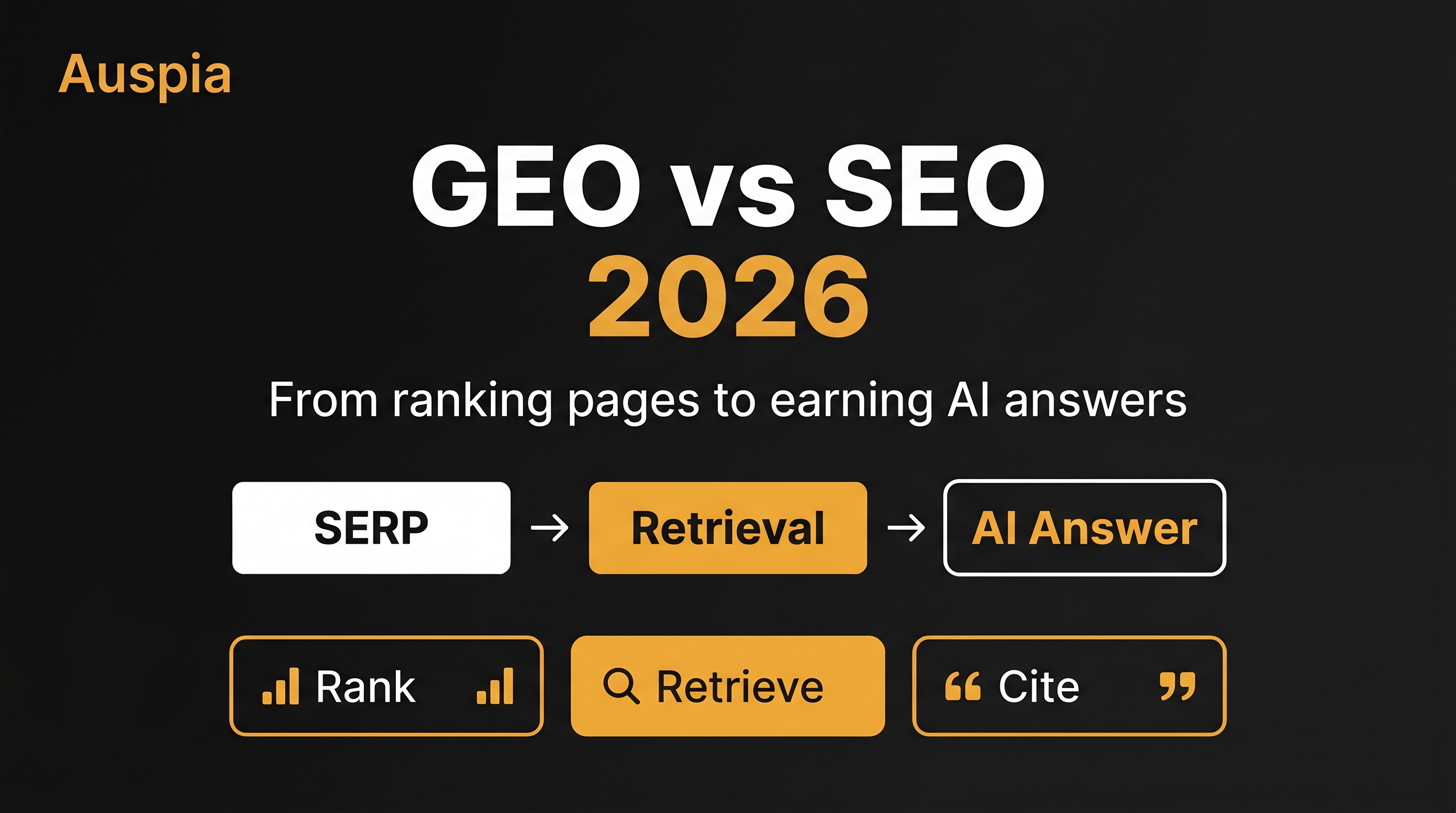
The biggest difference between GEO and traditional SEO is the object you are optimizing for.
Traditional SEO is mostly about search result pages: can your page rank, earn clicks, and satisfy the query after the click? GEO, or generative engine optimization, is about AI answer systems: can your brand, content, and evidence be retrieved and used when ChatGPT, Perplexity, Gemini, Google AI Overviews, or another answer engine writes a response?
That shift sounds small until you look at the user journey. In classic SEO, a user searches a phrase, scans blue links, opens several pages, and decides what to trust. In GEO, the user often asks a full question such as "which marketing automation tool should a small B2B team choose in 2026?" The AI may summarize the market, compare options, name vendors, and cite a handful of sources before the user visits any website.
So the question changes from "Can we rank for this keyword?" to "Can an AI system find, understand, cite, and recommend us when the buyer asks a real question?"
That is the new answer layer. And in 2026, it is where a growing share of search influence now sits.
The simple mental model
SEO optimizes for visibility on a results page. GEO optimizes for inclusion in an answer.
That means the two disciplines care about different moments:
Question | Traditional SEO | GEO in 2026 |
|---|---|---|
Primary surface | Google search results and other SERPs | AI-generated answers, summaries, recommendations, and citations |
User input | Short keywords and navigational queries | Full questions, comparison prompts, scenario-based buyer needs |
Success signal | Ranking position, clicks, impressions, organic sessions | Mentions, citations, share of answer, recommendation context, answer accuracy |
Content unit | Page, title, snippet, internal link structure | Passage, claim, table, fact block, entity description, source citation |
Main risk | You rank below competitors | You are invisible inside the answer even if your site ranks elsewhere |
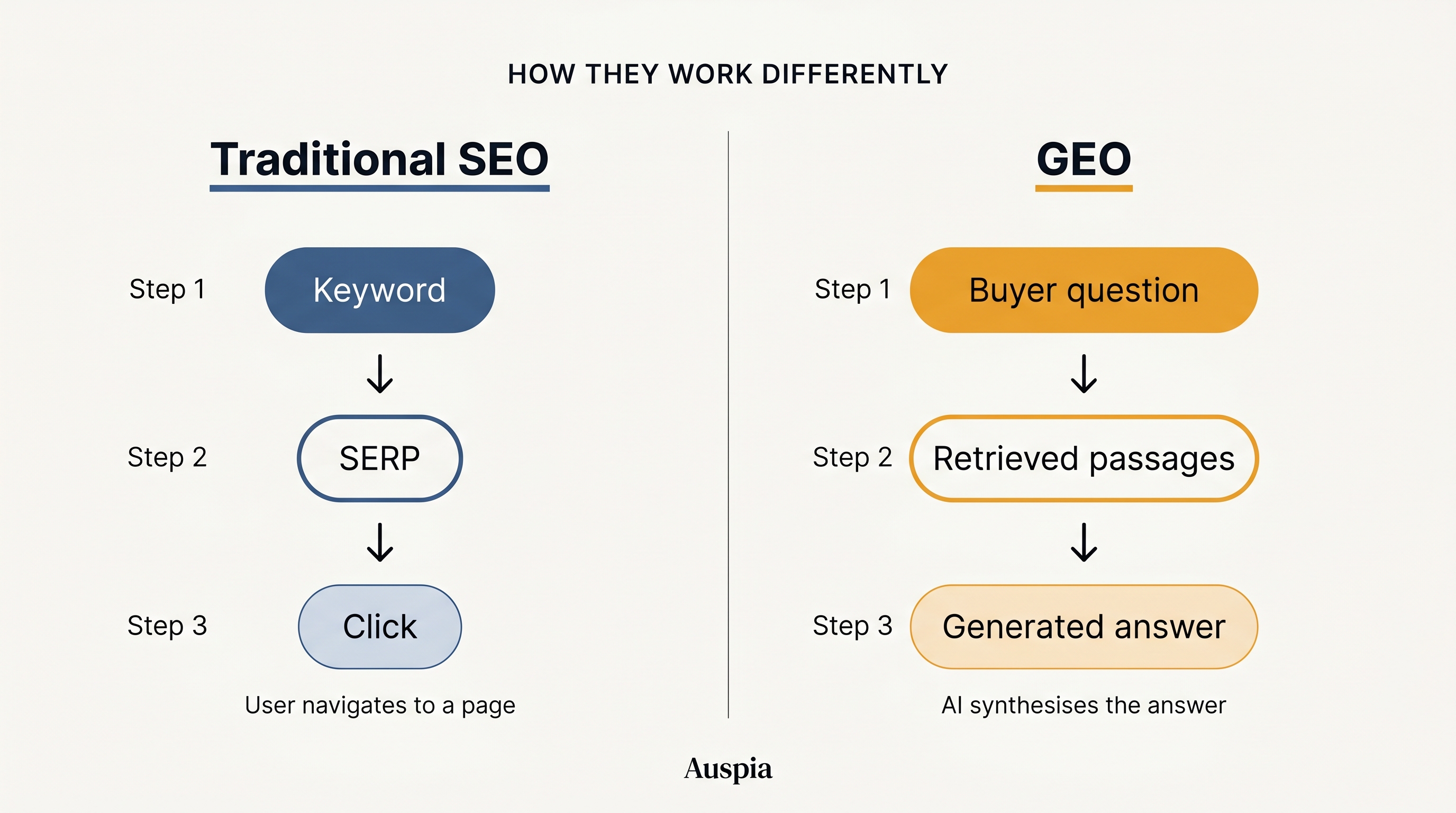
Traditional SEO optimizes the search result journey. GEO optimizes the retrieval-to-answer journey.
The uncomfortable part: AI systems do not read the entire internet at answer time. They usually work with a small set of retrieved passages, structured facts, trusted sources, and model memory. If your best page is not retrieved, your brand may never enter the answer.
That is why GEO work often starts with retrieval and evidence, not with publishing another generic blog post.
Why SEO signals are not enough
Traditional SEO still matters. A crawlable site, clear architecture, internal links, fast pages, helpful content, and authority signals all make it easier for search systems to discover and trust your work.
But those signals do not automatically translate into AI answer visibility.
A page can rank well and still fail GEO checks for several reasons:
Failure mode | What it looks like in practice | How to fix it |
|---|---|---|
The content is too indirect | The answer appears after six paragraphs of setup | Put the answer in the first section and make each paragraph useful on its own |
Claims are thin | The page says the product is "powerful" but gives no facts | Add concrete features, use cases, limits, pricing context, integrations, and proof |
The entity is unclear | The AI cannot tell what the brand does or which category it belongs to | Standardize brand facts across homepage, about page, product pages, schema, and third-party profiles |
The page lacks quotable passages | The content reads like a landing page, not a source | Add definitions, comparison tables, checklists, and short evidence-backed statements |
Monitoring is missing | The team tracks rankings but not answer inclusion | Build a prompt set and measure mentions, citations, sentiment, and competitors |
This is the part many teams miss. AI answers are assembled from fragments. A strong GEO page has passages that can survive outside the full page: a definition, a comparison row, a product limitation, a checklist item, a data point, a use-case explanation.
If every paragraph depends on the previous five paragraphs, the page may be readable for humans but weak for retrieval.
What GEO content needs that SEO content often skips
Good GEO content is answer-first. It should make the useful part easy to extract.
That does not mean writing robotic FAQ pages. It means being generous with facts and clear about context. A useful GEO paragraph often does one job:
- defines a term;
- answers a buyer question;
- compares two options;
- names a limitation;
- explains when a method works;
- gives a short checklist;
- states a fact that can be verified elsewhere.
For example, a traditional SEO paragraph might spend time warming up the topic:
"As companies explore new marketing technologies, choosing the right automation platform has become increasingly important for modern teams."
A GEO-ready version gets to the useful sentence faster:
"A small B2B team should choose a marketing automation platform based on CRM fit, email deliverability, reporting depth, implementation time, and whether the team needs lead scoring before it needs enterprise journey orchestration."
The second version is easier for an answer engine to reuse because it contains specific criteria. It is also better for a human reader who wants a decision.
The 2026 GEO workflow: monitor first, then publish
Publishing more content before you measure AI visibility is a bad habit carried over from old SEO playbooks. In GEO, the first step should be diagnosis.
A practical workflow looks like this:
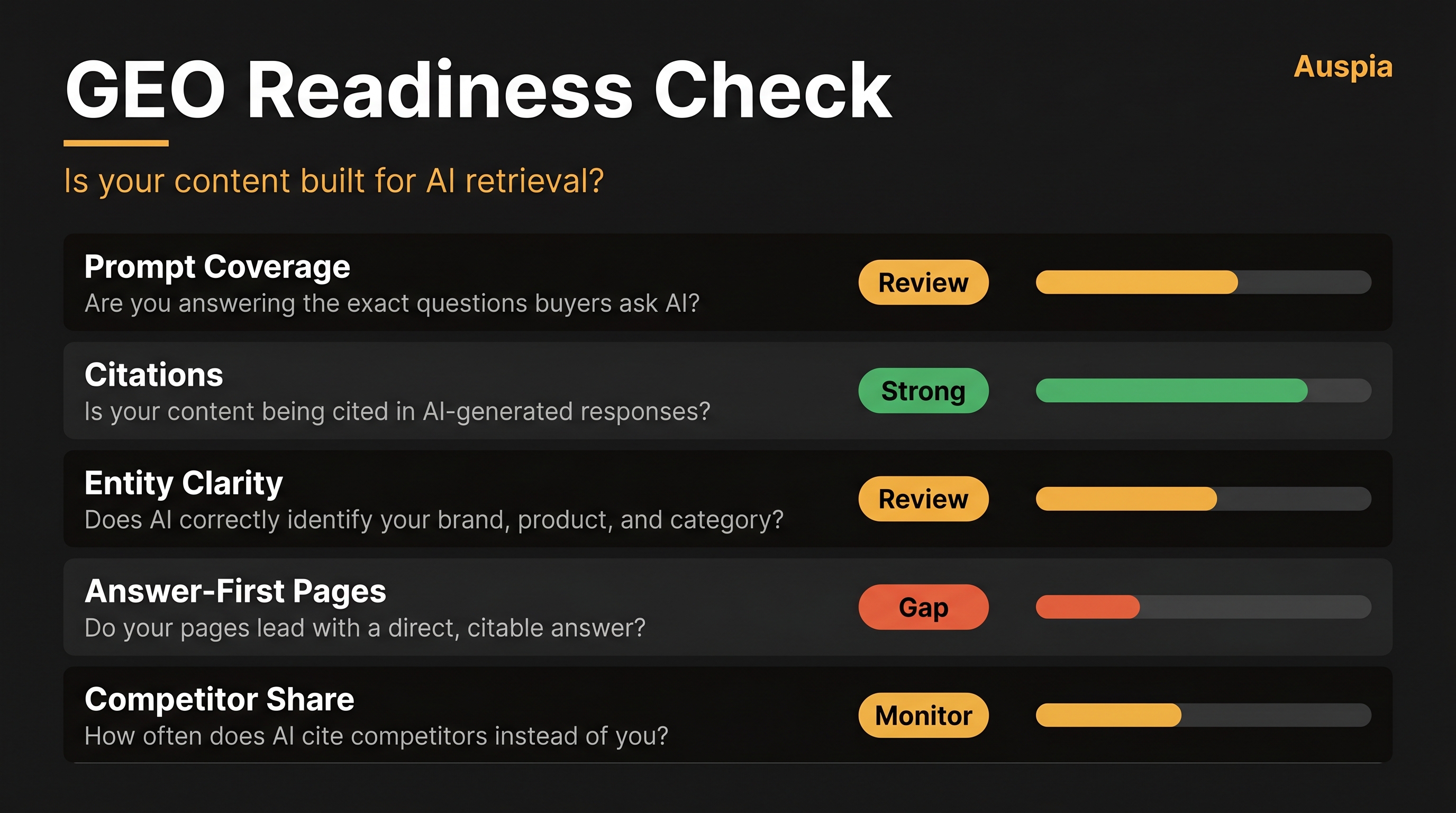
GEO work becomes easier when teams track answer visibility, not just rankings.
- Build a prompt set around buyer questions. Include category prompts, comparison prompts, use-case prompts, problem prompts, and "best tool for X" prompts.
- Test the prompts across answer surfaces. Check ChatGPT, Perplexity, Gemini, Google AI Overviews where relevant, and any vertical AI tools your buyers use.
- Record whether your brand appears. Track mentions, citations, ranking inside the answer, surrounding language, competitors, and missing facts.
- Identify retrieval gaps. Ask whether the missing answer requires a product page, comparison page, glossary page, customer proof page, technical documentation, or third-party evidence.
- Rewrite or create source pages. Make each page answer-first, fact-dense, structured, and internally consistent.
- Re-test the same prompts. Do not celebrate publication. Celebrate a better answer footprint.
Auspia's AI Search Visibility Checker and GEO Score Checker are built around this logic: check the answer surface first, then decide what content or evidence needs to be repaired.
SEO and GEO should work together
GEO does not replace SEO. It changes what good SEO has to support.
You still need pages that can be crawled, indexed, linked, and trusted. You still need search intent research. You still need technical SEO. You still need content that helps a human make a decision after the click.
But in 2026, a serious organic growth program should have two dashboards:
Dashboard | What it tracks | Why it matters |
|---|---|---|
SEO dashboard | Rankings, impressions, clicks, indexed pages, conversions, crawl issues | Shows whether search engines can discover and send traffic to your site |
GEO dashboard | AI mentions, citations, prompt coverage, answer sentiment, competitor share of answer | Shows whether answer engines include your brand in generated responses |
The teams that treat GEO as "SEO with AI keywords" will probably waste time. The teams that treat it as an answer-layer visibility system will make better decisions.
A quick self-audit
Use this checklist before you publish your next GEO-focused page:
Check | Yes or no |
|---|---|
Does the first section answer the main question directly? | |
Can several paragraphs stand alone as answer snippets? | |
Are product/category facts specific enough for an AI answer to reuse? | |
Are comparisons shown in tables or clearly labeled sections? | |
Does the page explain who the solution is for and who it is not for? | |
Are brand facts consistent with your homepage, about page, docs, schema, and third-party profiles? | |
Have you tested the buyer prompts that should retrieve this page? | |
Do you know which competitors appear when you do not? |
If you answer "no" to more than two of these, the page is probably not GEO-ready yet.
Common mistakes
The first mistake is chasing citations before fixing clarity. If the AI cannot understand what your company does, more mentions will not solve the problem.
The second mistake is writing for "AI" in the abstract. There is no single AI audience. A Perplexity citation, a ChatGPT browsing answer, and a Google AI Overview can behave differently. Start with the surfaces your buyers actually use.
The third mistake is treating GEO as PR distribution. Third-party mentions can help, but only when they provide retrievable, consistent evidence. Thin syndicated posts rarely become strong answer material.
The fourth mistake is hiding the answer. If your page needs a long brand story before it says anything useful, it will struggle in answer systems and probably annoy human readers too.
FAQ
Is GEO just a new name for SEO?
No. GEO uses many SEO foundations, but the optimization target is different. SEO focuses on ranking and clicks from search result pages. GEO focuses on whether AI answer systems retrieve, cite, and describe your brand accurately inside generated answers.
Does traditional SEO still matter in 2026?
Yes. Technical SEO, crawlability, site authority, internal links, content quality, and search intent still matter. GEO adds another layer: answer inclusion, citation readiness, entity clarity, and prompt-level monitoring.
What should a company do first for GEO?
Start with visibility monitoring. Build a list of buyer prompts, test them across important AI answer surfaces, and record whether your brand appears. Then repair the source pages and evidence that should support those answers.
What kind of content works best for GEO?
Content with direct answers, clear definitions, comparison tables, specific facts, consistent brand entity information, and passages that can stand alone. Long articles can work, but only when the useful parts are easy to retrieve and cite.
How do you measure GEO performance?
Track brand mentions, citations, share of answer, competitor presence, answer sentiment, prompt coverage, and whether AI systems describe your product or category accurately. Pair those metrics with traditional SEO and conversion data.
Author: Maya Ellison, 12-Year GEO Strategy Researcher at Auspia. Maya writes about AI search visibility, brand entity clarity, and practical GEO operating systems for growth teams.