Recommendation: strengthen SEO and GEO before you decide whether WebMCP solves a real task
WebMCP overlaps with SEO and GEO, but it is not the same job. Two mistakes follow when teams blur the terms: assuming an agent API earns AI-search visibility, or assuming content that an LLM can read automatically lets an agent book, configure, or submit something safely.
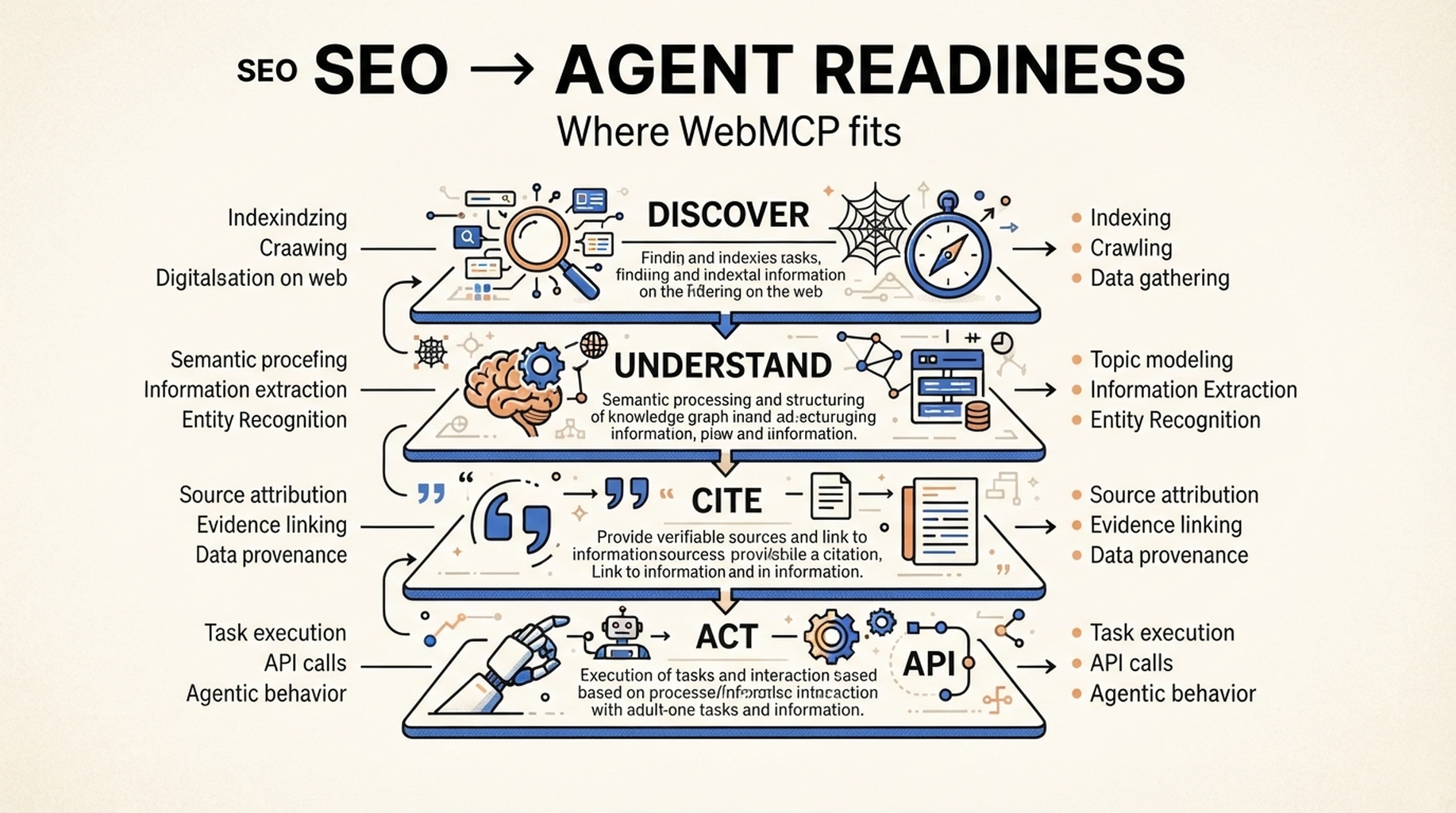
The practical model is simple. SEO helps a page get found. GEO helps an AI system understand, cite, and describe information accurately. Agent readiness helps an authorized agent complete a bounded task on the site. WebMCP is one possible browser-native mechanism for the final layer.
If a site has weak content, incomplete product facts, or crawlability problems, WebMCP is rarely the next best investment. It becomes relevant when a mature site has repetitive, high-value tasks such as filtering, configuration, long forms, support intake, or booking.
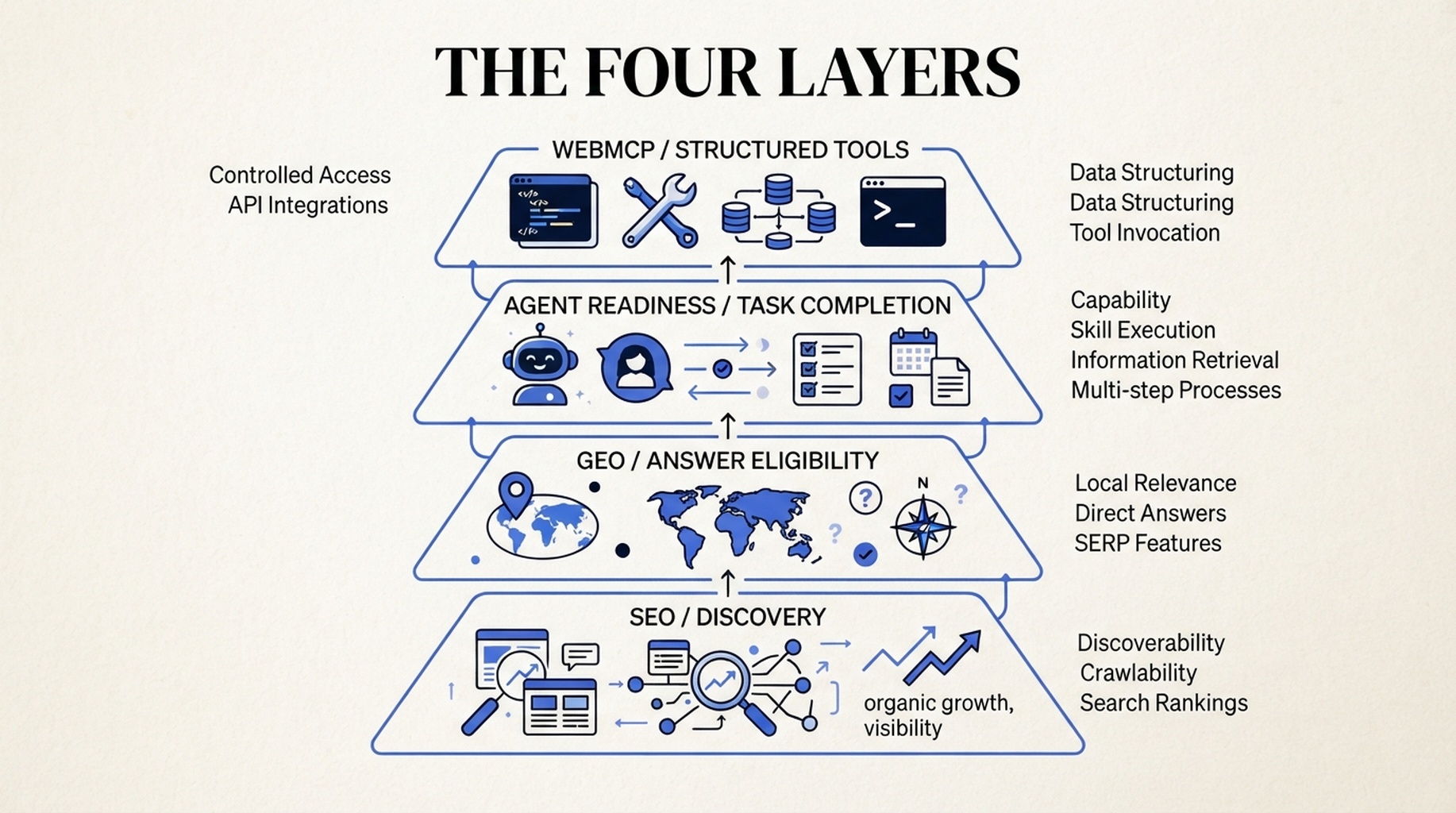
Discovery, answer eligibility, task completion, and callable capability form a sequence. Each needs its own evidence.
The boundary in one table
Layer | Primary audience | Problem it solves | Typical work | What it does not promise |
|---|---|---|---|---|
SEO | Search engine and searcher | Can the page be crawled, indexed, and matched to a query? | Architecture, rendering, titles, internal links, structured data | Automatic agent transactions |
GEO | AI answer system and reader | Can information be understood, reused, cited, or recommended accurately? | Direct answers, evidence, entity clarity, extractable sections | A direct ranking lift everywhere |
Agent readiness | Authorized agent and user | Can an agent navigate, filter, and complete a task safely? | Stable state, errors, permissions, confirmation | Bypassing user control |
WebMCP | Website in a browser and agent | How can a specific page function be exposed as a structured tool? | Tool schema, parameters, origin boundaries, output limits | A general AI-search crawler protocol |
What WebMCP is, and what it is not
According to Google Chrome's WebMCP documentation, WebMCP is a proposed web standard for exposing JavaScript functions or HTML forms as tools with natural-language descriptions and structured schemas. The imperative API is for JavaScript functionality. The declarative API annotates standard HTML forms.
The benefit is less DOM guesswork. A travel site might expose flight search and filters. A SaaS site might expose creation of a support-ticket draft. An ecommerce site might expose a permitted product configuration or public inventory query.
It is not a new sitemap, a guarantee that ChatGPT, Google AI Overviews, or Perplexity will cite a page, a replacement for a backend MCP server, or a way around identity checks, payment verification, and server-side authorization.
At the time of writing, WebMCP is still in Chrome's early-preview and origin-trial stage. Treat it as an interface direction worth testing, not as a stable acquisition channel.
Why WebMCP appears in GEO conversations
Both subjects respond to the same behavior change: a person may not read every page or click every button. AI may compare, summarize, filter, and sometimes act after the user approves.
GEO is still about being a trustworthy answer source. A product page should explain what the product is, who it suits, price or constraints, evidence, and meaningful differences from alternatives. Those improvements are useful even when a site never adopts WebMCP.
WebMCP is about handing an already existing, permission-protected action to an agent. If product descriptions, pricing, stock, and return terms are already confusing, adding tools lets an agent spread that confusion faster.
When WebMCP belongs on your roadmap
Current condition | First priority | Consider WebMCP now? |
|---|---|---|
Core pages cannot be crawled consistently or product facts are scattered | Technical SEO and content/entity work | No |
Pages work, but AI answers misstate the brand or omit constraints | GEO, evidence, and content structure | Wait |
Users abandon complex filtering, configuration, or long forms | UX and event analysis | Look for a read-only pilot |
You have a clear permission model, auditable server APIs, and reversible actions | Agent readiness and security design | Build a controlled prototype |
You want agents to buy, delete, or change sensitive data directly | Risk review and confirmation UX | Not as a first capability |
Start with a task, not a protocol
Do not begin with, "Should we support WebMCP?" Ask instead, "Which repeated user task is an agent being asked to complete?"
A good candidate has a clear goal, few verifiable inputs, a previewable outcome, and a safe exit. "Filter public products by budget and size" is a better first task than "buy this for the user."
Then ask: Is the existing user flow reliable? Which fields are essential? Does output contain reviews, third-party text, or sensitive data? Can the task first return a read-only result or a draft? Where must the user confirm, and what should they see?
Do not leave the security questions until the implementation is finished. Read WebMCP Security Checklist: Make Your Site Agent-Safe Before It Is Agent-Ready for release checks covering trusted origins, untrusted UGC, read/write boundaries, and confirmation.
A SaaS example: a support-ticket draft beats autonomous support
Suppose a customer asks an agent to turn the last three days of errors into a support request.
The weak design lets an agent read every project, infer the issue, and submit a ticket. It may overreach, treat log text as instruction, or choose the wrong queue.
A better design exposes only error summaries the user may already view; lets the agent filter by time range and project with read-only tools; creates a draft rather than submitting; shows the title, description, attachments, and destination to the user; and keeps server-side identity, project-permission, and field validation intact.
SEO helps the documentation get found. GEO helps the agent and customer understand definitions, constraints, and remedies. WebMCP only makes this existing task flow less dependent on page guessing.
Measure agent readiness, not an imaginary WebMCP ranking
Metric | Question |
|---|---|
Task success rate | Does the agent complete the authorized goal with few retries? |
Human takeover rate | Where does the user most often correct or take over? |
Safe-stop rate | Does the tool correctly refuse unknown, unauthorized, or risky input? |
Confirmed completion rate | After seeing impact, do users still approve the action? |
Content and answer quality | Are the related pages still understood, cited, and sending qualified visits? |
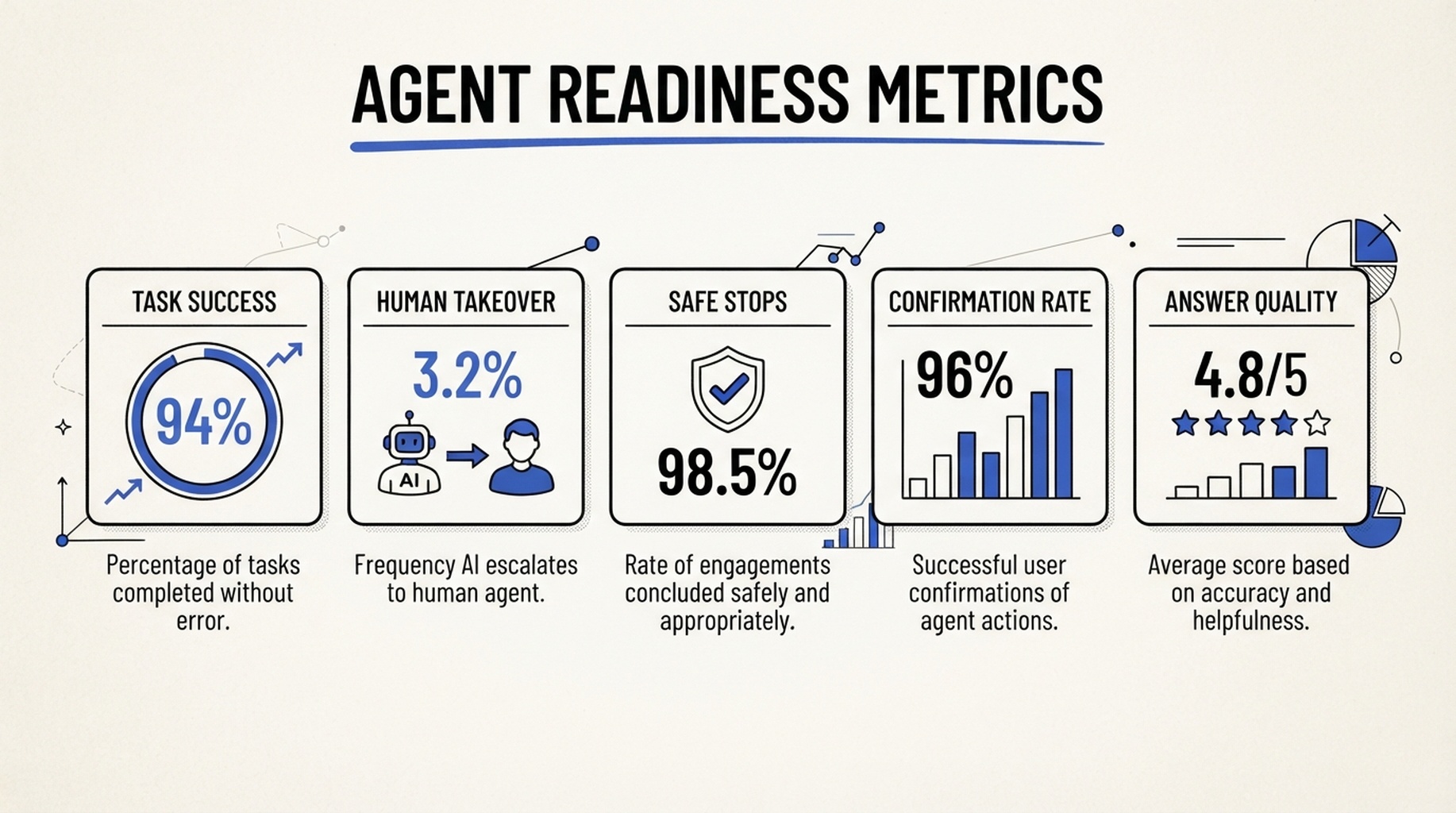
These measures sit beside SEO and GEO reporting. They do not replace it.
Put WebMCP in the right place
WebMCP is worth following because it offers browser agents a clearer action interface than raw DOM automation. For growth teams, sequence matters more than a new protocol name: make pages discoverable, understandable, and trustworthy; design valuable tasks to be safe and verifiable; then decide whether WebMCP is the appropriate implementation.
For a practical site audit, continue with The Four-Layer SEO, GEO, and Agent Readiness Audit. It separates evidence, risks, and a 30-day priority order so a team does not spend its whole budget on an experimental protocol.
FAQ
Is WebMCP the same as Model Context Protocol?
No. They share terms such as tools and schemas, but WebMCP focuses on front-end functions and DOM interaction in the current browser page. MCP commonly connects backend services, data sources, or local tools. They can complement each other.
Does GEO require WebMCP?
No. Most GEO work is content quality, entity facts, evidence, page structure, and technical accessibility. Consider WebMCP only when users genuinely need an agent to complete a complex on-site task.
Is WebMCP only for ecommerce?
No. Support, travel search, SaaS configuration, booking, and data filtering can also fit. The shared trait is a task that is clear, constrained, and confirmable.
Sources
Author: Maya Ellison, 12-Year GEO Strategy Researcher at Auspia. Maya writes about AI search visibility, brand entity clarity, and practical GEO operating systems for growth teams.