The short answer
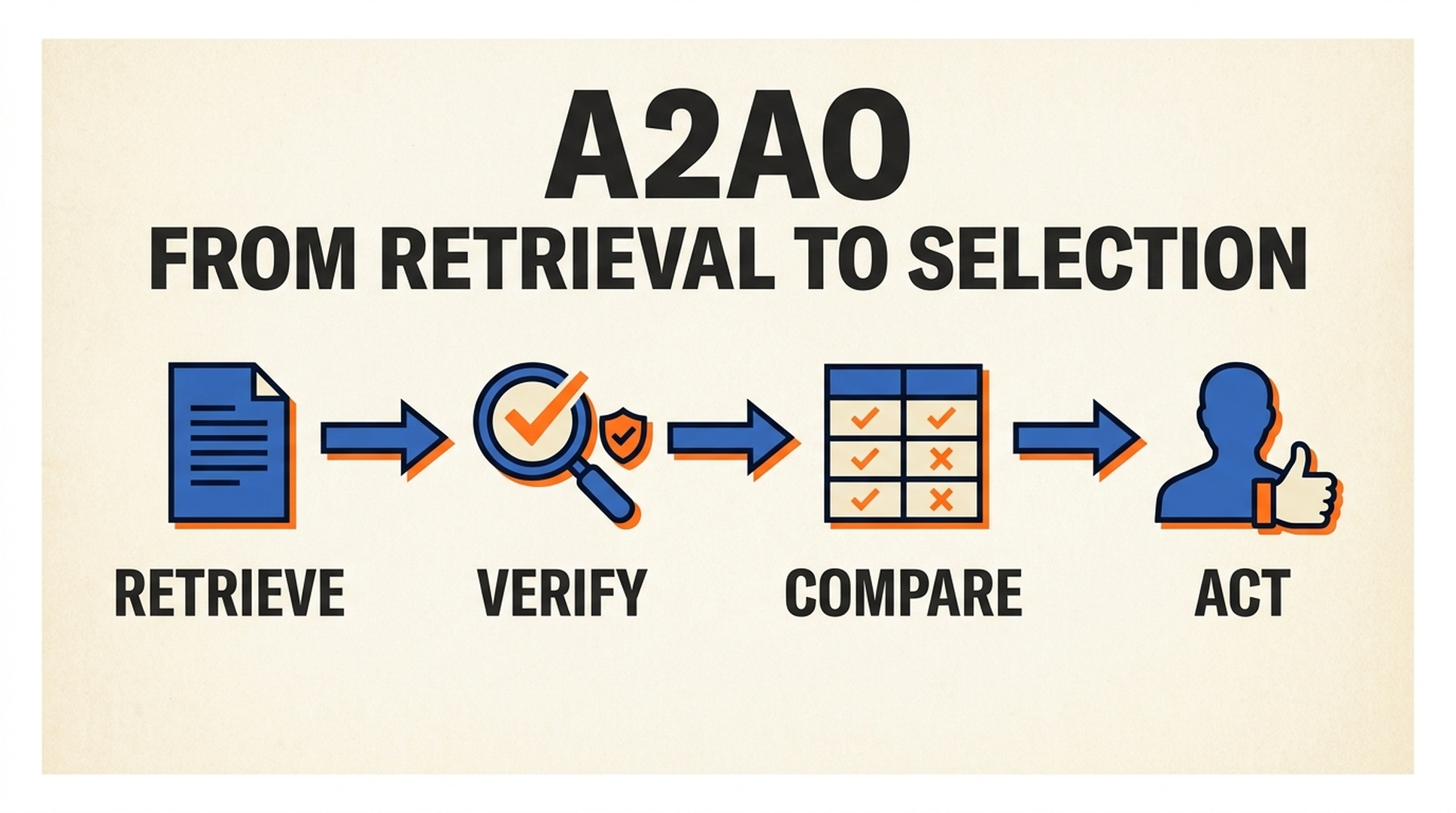
A2AO, short for Agent-to-Agent Optimization, is the practice of making a company's content, evidence, and service capabilities easy for an AI agent to retrieve, understand, verify, compare, and, where appropriate, act on. It extends AEO beyond a good answer in a chat response. The question becomes: can an agent confidently select your company or capability while carrying out a task for its user?
The term is new. It is not an official search-engine category or a replacement for SEO, GEO, or AEO. It is a useful operating frame for a real shift: more AI systems can now research options, inspect documentation, compare constraints, and call approved tools. Teams do not need to wait for a fully automated "agent economy" to benefit. The same work that makes a page easy for an agent to retrieve also makes it clearer for a buyer, a sales team, and an answer engine.
The idea behind A2AO: from attention to selection
The A2AO idea starts with a simple sequence: SEO helps a company get found; GEO helps it get represented in AI-generated answers; A2AO could help it get selected when AI agents search for, evaluate, negotiate with, and hire providers on a user's behalf.
The useful part of that argument is not the prediction that people will stop using websites tomorrow. It is the change in the decision path.
Optimization lens | Primary user behavior | What a strong page must do |
|---|---|---|
SEO | A person searches and visits | Match a query, load reliably, and earn the click. |
GEO | A person asks an AI system | Supply accurate, citable information that can be synthesized into an answer. |
A2AO | An agent researches or completes a task for a person | Make capabilities, constraints, proof, and safe next actions easy to evaluate. |
The word "selection" matters. An agent helping a user choose a B2B recruiter, accounting platform, freight provider, or software API has a different job from a searcher reading a top-ten list. It needs enough reliable information to rule out bad fits. That includes who the service is for, where it is available, its price model, implementation requirements, evidence, limitations, and the safest next step.
This is why A2AO should not be treated as a fancy new name for stuffing more keywords into a landing page.
Keep A2AO separate from the A2A protocol
The names are close, but they describe different things.
The Agent2Agent Protocol (A2A) is an open technical protocol for agents to communicate. Its Agent Cards describe an agent's identity, endpoint, authentication, and skills so other agents can assess whether it can help. A public agent can expose a card at a well-known URL; enterprise systems may instead use a controlled registry.
A2AO is the marketing and information-design discipline around being a credible option in that kind of environment. It covers an A2A agent if you operate one, but it also covers ordinary content and services that agents retrieve through search, browsing, APIs, documentation, or partner directories.
The Model Context Protocol offers a related lesson. Its tools specification asks servers to expose tools with names, descriptions, and input schemas that a model can use. A vague tool description makes a tool hard to choose. A vague services page has the same problem for a research agent.
Do not publish an Agent Card just to chase a trend. If your business does not expose an agent service, an API, or a controlled transaction flow, start with your content and evidence. A misleading capability file creates more trust risk than visibility.
The four layers of agent content retrieval optimization
Think of A2AO as a four-layer test. A failure at any layer can stop an agent's decision process.
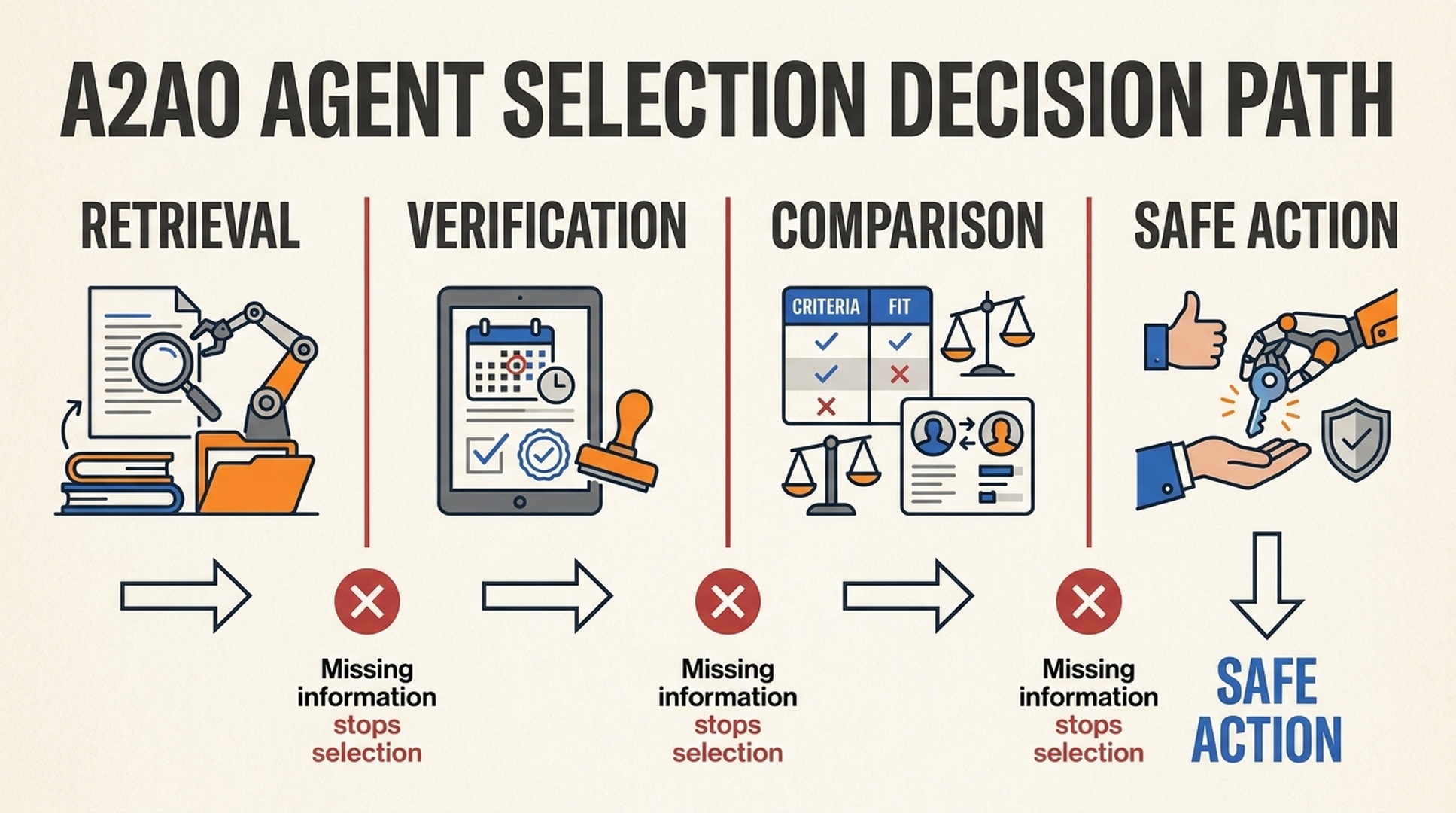
An agent's selection process stops when one information layer is missing.
1. Retrieval: can the agent find the relevant answer?
An agent cannot select evidence it cannot fetch or locate. Give every important commercial question a stable, crawlable home rather than burying the answer in a demo video, a sales deck, or a JavaScript widget.
Start with pages that answer real selection questions:
- Which customer or use case is this service designed for?
- What does it include, exclude, and require from the buyer?
- Which locations, integrations, languages, industries, or compliance requirements apply?
- What is the current price model or procurement path?
Use descriptive URLs, a clear page title, one direct answer near the top, ordinary HTML for essential copy, and internal links that make the page reachable. Keep the canonical version public when the information is safe to publish. A login wall may be necessary for a contract portal; it is a poor place for a basic capability description.
This is still good SEO. Google says that its AI features use the same foundational SEO practices as Search and do not require a separate set of secret technical requirements. Its guidance is a useful reminder: prioritize helpful, accessible content rather than a speculative markup trick.
2. Verification: can the agent check the claim?
An agent may retrieve a bold promise, but it still needs grounds to trust it. Put the supporting facts close to the claim.
For a software product, that may mean an implementation guide, security documentation, supported integrations, named plan limits, and release notes. For a professional service, it may mean a defined engagement scope, eligibility criteria, methodology, anonymized case evidence with dates and boundaries, and a contact route for exceptions.
Use dates. Name the owner of a policy. Link to primary documentation when you refer to a standard or integration. State what a result does not prove. A page that says "cut onboarding time by 40%" without a timeframe, sample, starting point, or method asks a buyer and an agent to take it on faith.
The right standard is not "make every page sound cautious." It is "make every important claim inspectable."
3. Comparison: can the agent tell when you are a fit?
Most company pages are built to make the brand sound broadly useful. Agents need the opposite signal: fit boundaries.
Give them attributes they can compare without inventing details. A compact service facts table can do more work than another paragraph of positioning copy.
Selection field | Weak version | A2AO-ready version |
|---|---|---|
Ideal customer | "Built for growing teams" | "For B2B SaaS teams with an existing content library and an in-house marketer who can approve weekly briefs." |
Delivery model | "Flexible support" | "Monthly strategy and production support; no 24/7 managed newsroom or paid-media buying." |
Pricing | "Contact us for pricing" | "Project scopes begin after an audit; the audit covers 15 priority URLs and produces a 90-day backlog." |
Evidence | "Proven results" | "See the dated case note, method, inputs, and factors that limit comparison with other sites." |
Constraint | Omitted | "Requires CMS publishing access and a technical owner for template changes." |
Specificity will occasionally disqualify a lead. That is a feature. An agent that can rule you out early is less likely to route a bad-fit buyer into a sales call or a broken workflow.
4. Action: can the agent take a safe next step?
Selection is not always a purchase. For many businesses, the appropriate first action is to request a proposal, book a qualified consultation, open documentation, run a public diagnostic, or hand the user a comparison summary.
Make that handoff explicit. Say which information is required, what happens next, who approves a commitment, and which actions remain human-controlled. If you provide an API, publish current authentication, rate-limit, error, and versioning documentation. If you provide an agent service, define its skills, permissions, and escalation path before you describe it as autonomous.
This is the A2AO safety line: an agent should be able to discover a capability without silently gaining authority to spend money, expose data, or commit the user to a contract.
A practical example: an agent evaluating recruiting firms
Imagine a hiring manager asks an AI assistant to find a recruiting firm for five senior engineering roles in the United Kingdom, compare retained and contingent models, and prepare a shortlist. The assistant may browse provider sites, read case material, inspect review sources, and ask for missing details.
A firm with a polished home page but no named specialisms, geography, role coverage, fee model, process, or evidence is difficult to shortlist. The assistant has to guess. A firm with one clear "engineering recruitment" page, a searchable sector page, dated client evidence, a straightforward explanation of engagement models, and a human-approved consultation form is much easier to evaluate.
The second firm did not need to build a negotiating robot. It made its existing information usable in a decision workflow. That is A2AO at the content layer.
A 30-day A2AO sprint for a content team
The first goal is not a new protocol integration. It is a small, verifiable information system around your highest-value offer.
Week | Deliverable | Quality gate |
|---|---|---|
1 | A list of the ten questions an agent or buyer would ask before considering your offer | Each question maps to one public, current URL or a documented reason it cannot be public. |
2 | One source-of-truth capability page and one facts table for the priority offer | The page names audience, outcome, inclusions, exclusions, prerequisites, and next step. |
3 | Proof and comparison support: FAQs, implementation notes, case boundaries, pricing or procurement guidance | Every material claim has a source, date, owner, or a clear qualification. |
4 | A safe action path: public tool, API documentation, qualified form, or human escalation rule | The path makes clear what an agent can inspect, request, or prepare, and what requires a person's approval. |
Run the test with real prompts, but do not score success by whether one model mentions your brand in a single session. Ask whether an evaluator can retrieve a current answer, verify its source, compare it with alternatives, and identify a legitimate next step. Record the missing fact or ambiguous page each time. That backlog is more useful than a vanity "agent ranking."
For the retrieval and technical portion of this sprint, an Auspia Agent Readiness Score can help teams start a structured review. Treat the result as an audit input, not proof that a platform will select your brand.
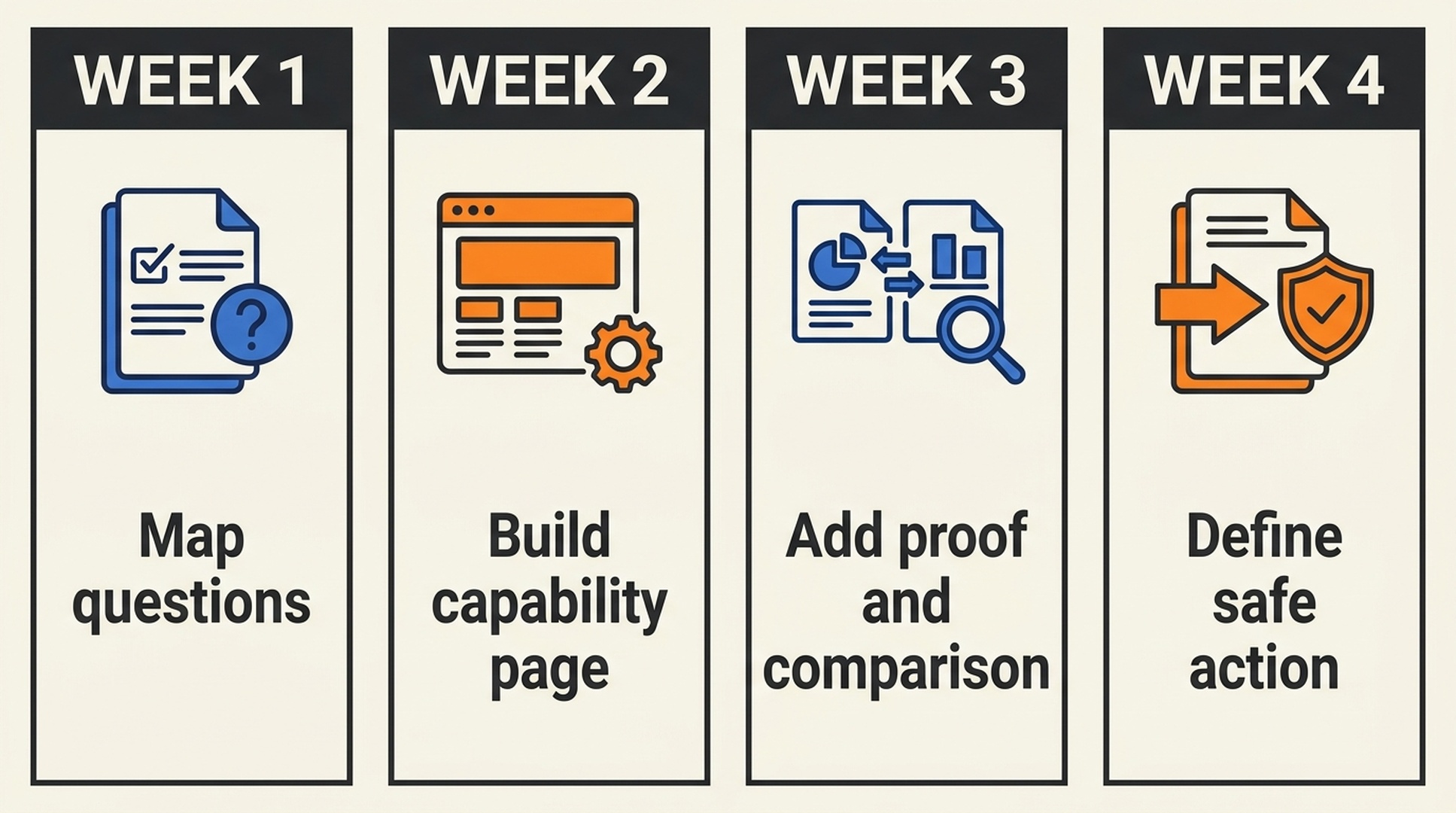
A four-week sprint that starts with information gaps, not protocol deployment.
What A2AO does not promise
A2AO is early-stage terminology and a useful planning model, not a guarantee of agent referrals, citations, or revenue. Agent behavior varies by platform, permissions, tools, user instructions, and the data available at the time of a task. Some agents will rely on search indexes; others will only use approved vendor tools or private enterprise registries.
It also does not excuse weak evidence, hidden fees, unsafe automation, or misleading descriptions. If an agent cannot verify a claim, it may exclude the company. If it can verify a claim that is false, the underlying business problem is not an optimization problem.
The sensible sequence is simple: make your public facts retrievable, make your claims verifiable, make fit criteria comparable, and make the next action safe. Add A2A, MCP, or another protocol only when it supports a real service workflow.
FAQ
What does A2AO mean?
A2AO means Agent-to-Agent Optimization. In this article, it describes the work of preparing a brand's content, evidence, capabilities, and action paths for AI agents that may retrieve information, compare providers, and help users complete tasks.
Is A2AO the same as the Agent2Agent Protocol?
No. A2A is a technical communication protocol for interoperable agents. A2AO is a broader optimization framework. A company can improve A2AO readiness without operating an A2A-compatible agent.
Does A2AO replace SEO or GEO?
No. SEO still helps pages get discovered. GEO helps source material be represented in AI-generated answers. A2AO adds a selection and action layer for tasks where an agent evaluates options or invokes a service.
Should every company create an Agent Card?
No. Create an Agent Card only when you operate an agent service and can accurately state its capabilities, authentication, limits, and support model. Most teams should first improve public capability pages, evidence, documentation, and qualified handoff paths.
Author: Gabriel Finch, Search Retrieval Researcher, 1,200+ AI Answers Reviewed at Auspia. Gabriel writes about retrieval systems, AI discovery, and the information quality that makes a business easier to evaluate.