The short answer
GEO, or Generative Engine Optimization, is the practice of making your brand, pages, products, and evidence easier for AI answer systems to understand, retrieve, cite, and mention. In 2026, that means optimizing for surfaces such as ChatGPT search, Perplexity, Gemini, Google AI Overviews, Google AI Mode, Bing AI-generated summaries, and Microsoft Copilot.
Traditional SEO still matters. It helps pages get crawled, indexed, ranked, and clicked in search results. GEO adds a second layer: can an AI system safely use your content inside a generated answer when a buyer asks a question?
A simple way to frame it:
Discipline | Main question | Primary win |
|---|---|---|
SEO | Can this URL rank for the query? | Search visibility, clicks, organic sessions |
GEO | Can this brand or page be cited in an AI answer? | AI citations, brand mentions, answer inclusion |
The mistake in 2026 is treating GEO as a replacement for SEO. It is not. The strongest GEO programs usually start with good SEO: crawlable pages, clear entities, useful content, strong internal links, fresh information, and clean technical signals. Then they make that content easier for AI systems to extract and cite.
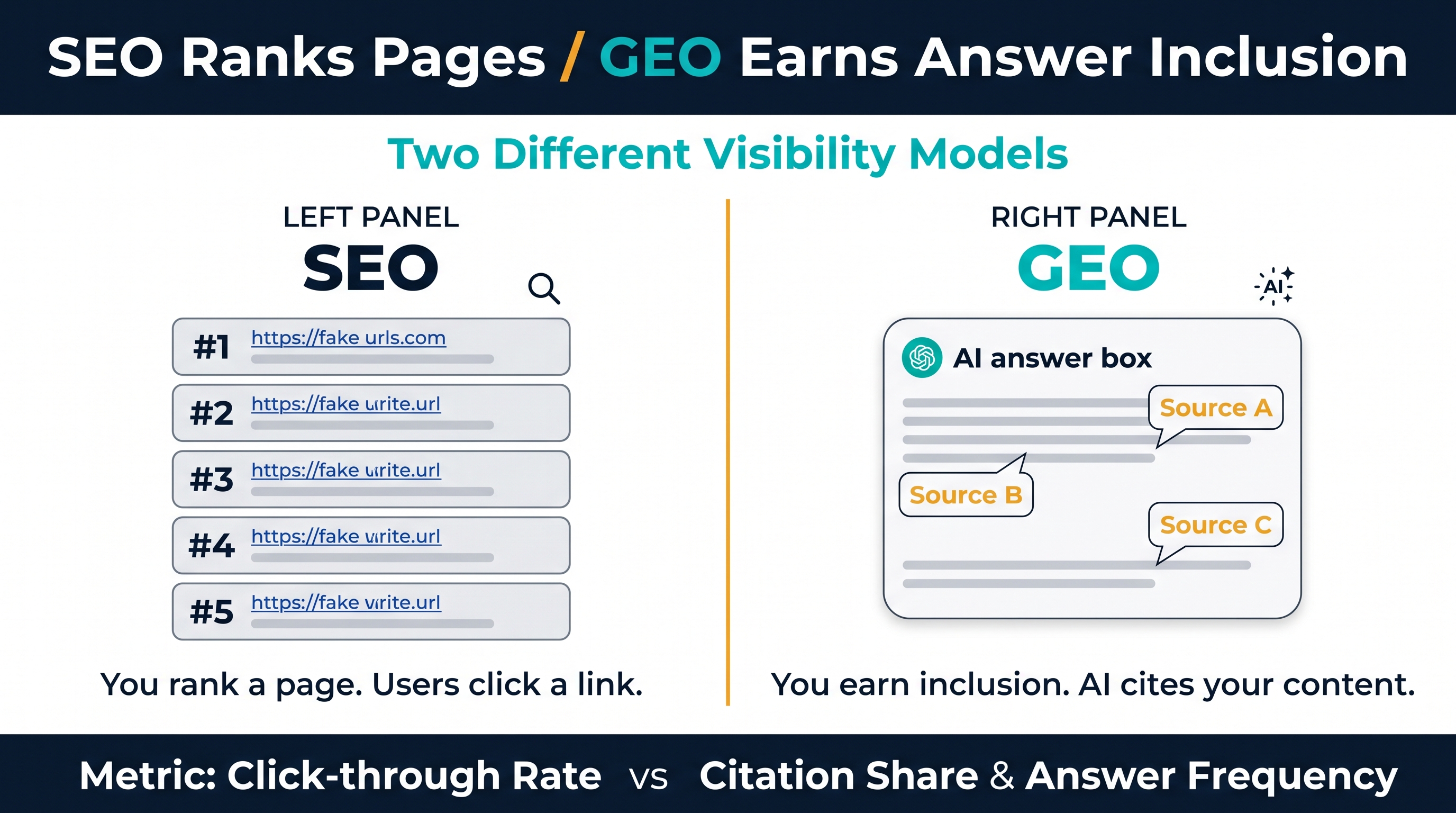
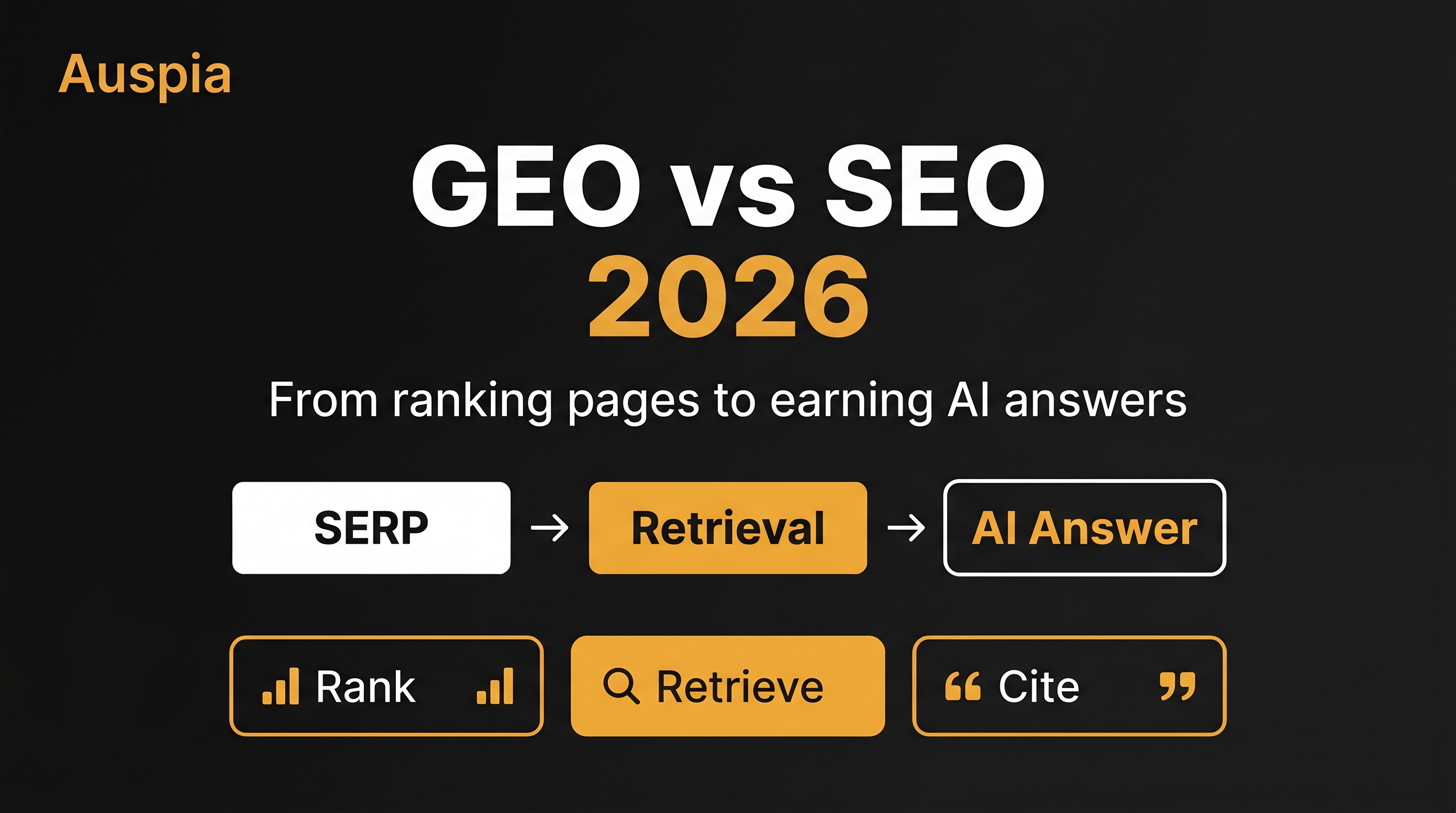
Caption: SEO aims for ranked pages and clicks; GEO aims for answer inclusion, citations, and share of answer.
What changed in 2026
The shift is not just a new acronym. Search behavior has moved from "show me ten links" toward "give me the answer, compare my options, and cite where this came from."
OpenAI describes ChatGPT search as a way to get timely answers with links to web sources. Google says AI Overviews and AI Mode surface supporting links and may use query fan-out, which means Google can issue multiple related searches to build one response. Bing introduced AI Performance in Bing Webmaster Tools in February 2026, giving site owners a way to see when their content is cited across Microsoft Copilot, Bing AI-generated summaries, and select partner integrations.
That matters because the old visibility model was easier to read. If you ranked third, you could see it. If traffic went up, analytics showed it. AI answers are messier. A brand may be mentioned without a click. A page may be cited one day and disappear the next. A competitor may be included beside you instead of above you.
So the practical question becomes: how do you make your brand a trustworthy source for answer engines without abandoning the SEO work that still feeds those engines?
What GEO means in plain English
GEO is the work of making a brand easier to include in generated answers.
That includes five jobs:
- Define the entity: what the brand is, who it serves, what category it belongs to, and what it should not be confused with.
- Make the content extractable: clear definitions, short summaries, comparison tables, FAQs, process steps, and source-backed claims.
- Make the site accessible: indexable pages, clean HTML, useful internal links, schema that matches visible text, and no accidental crawler blocks.
- Build evidence outside your site: reputable mentions, reviews, community discussions, partner pages, videos, data sources, and documentation.
- Measure answer visibility: prompts, citations, mentions, sentiment, cited URLs, competitors, and topic-level share of answer.
Auspia's view is simple: GEO is less about tricking a model and more about reducing uncertainty. If an AI system cannot tell what you do, why you are credible, and which page supports the answer, it will choose an easier source.
For teams starting from scratch, use an AI search visibility checker before rewriting anything. You need to know where your brand already appears, where competitors appear, and which prompts matter to buyers.
Six differences between GEO and traditional SEO
1. The target changes from ranking position to answer inclusion
Traditional SEO optimizes a document for search results. You choose a keyword, build a page that satisfies intent, improve technical quality, earn authority, and try to win a visible position.
GEO optimizes an entity and its evidence for inclusion in an answer. The answer may cite a page, mention a brand, summarize a product, list several vendors, or explain a concept using your content.
This changes the content job. A page that ranks can still be hard for an AI system to quote. Long introductions, vague claims, unclear product descriptions, and unsupported opinions all create friction. GEO-friendly pages get to the point faster.
A good test: if someone copied the first 120 words of your page into an answer, would it explain the concept accurately? If not, the page probably needs a stronger extractable summary.
2. The measurement layer is different
SEO teams measure rankings, impressions, clicks, click-through rate, organic sessions, conversions, and revenue. Those numbers are still useful.
GEO adds a different dashboard:
GEO metric | What it tells you |
|---|---|
Citation frequency | How often your site is used as a source in AI answers |
Brand mention frequency | How often your brand appears, even without a link |
Share of answer | How much of the answer space you occupy versus competitors |
Sentiment and framing | Whether the AI describes you accurately or with caveats |
Cited URL mix | Which pages AI systems trust enough to reference |
Prompt coverage | Which buyer questions include you, miss you, or prefer competitors |
This is why Bing's AI Performance report is important. It measures total citations, average cited pages, grounding queries, URL-level citation activity, and visibility trends. It does not solve all GEO measurement, and it is limited to supported Microsoft surfaces, but it gives publishers a real starting point instead of guesswork.
3. The retrieval path is less linear
Classic search feels linear: crawl, index, rank, display. The details are complex, but the mental model is stable enough for teams to work with.
AI answer systems can work through several paths. Some answers come from model knowledge. Some use live retrieval. Some use search indexes, partner content, product feeds, maps, knowledge graphs, forums, or a mix of sources. Google says AI Mode and AI Overviews may use query fan-out across subtopics and data sources. OpenAI says ChatGPT search uses third-party search providers as well as content from partners.
For marketers, the lesson is uncomfortable but useful: one perfect blog post is not enough. You need consistent signals across your site and the web. Your homepage, product pages, documentation, author pages, schema, review profiles, YouTube descriptions, comparison pages, and third-party mentions should all describe the same entity in compatible language.
4. The optimization signals are broader
SEO already rewards useful content, crawlability, internal linking, topical depth, backlinks, page experience, and structured data. GEO does not erase those signals.
It adds a few practical requirements:
- Entity clarity: the page names the brand, product, category, audience, location, use case, and differentiators without making the reader infer them.
- Extractable structure: the page uses direct definitions, tables, concise summaries, dated claims, and step-by-step sections.
- Evidence density: important claims link to primary sources, documentation, data, screenshots, examples, or first-hand observations.
- Cross-platform consistency: outside mentions use similar category language and do not contradict your own site.
- Freshness: pages that discuss fast-moving AI platforms show when they were updated and remove stale claims.
- Crawler access: important content is not hidden behind scripts, blocked by robots rules, or locked in images without text.
Google's official guidance says the same SEO fundamentals remain relevant for AI features in Search. It also says pages need to be indexed and eligible for a snippet to appear as supporting links in AI Overviews or AI Mode. That is a useful warning: if the basics are broken, GEO tactics will not rescue the page.
5. The competitive logic changes
SEO often feels like a ladder. One result is above another. You win or lose position.
AI answers are more like a shortlist. A single answer can mention several competitors, cite multiple sources, and present a comparison table. Being included can matter even when you are not the first name.
This is especially true for commercial research prompts:
- "best project management tools for agencies"
- "alternatives to HubSpot for startups"
- "which ecommerce SEO tools support Shopify"
- "compare Perplexity, ChatGPT search, and Google AI Overviews for research"
In these cases, the buyer is not looking for one blue link. They are asking for a filtered set of options. GEO work should therefore include comparison content, category pages, third-party proof, and clear positioning. If your product is hard to classify, AI systems may leave it out of the shortlist.
6. Stability is lower, so the operating rhythm must change
Rankings move, but SEO teams are used to tracking them. AI answers are more variable. The same prompt can produce different wording, different source mixes, and different competitor sets depending on date, location, model, account state, search mode, and phrasing.
That does not make GEO impossible. It means teams need sampling instead of one-off checks.
A useful 2026 measurement rhythm looks like this:
Cadence | What to check |
|---|---|
Weekly | 20 to 50 priority buyer prompts across ChatGPT, Perplexity, Gemini, Google AI features, and Copilot |
Monthly | Citation gaps where competitors appear and you do not |
Monthly | Pages most often cited, pages never cited, and pages with outdated summaries |
Quarterly | Brand framing, sentiment, category language, and new third-party evidence needs |
This is where many companies underinvest. They publish a "GEO page," test three prompts, and call it done. That is too thin. GEO needs the same operational discipline as SEO, but the evidence is noisier.
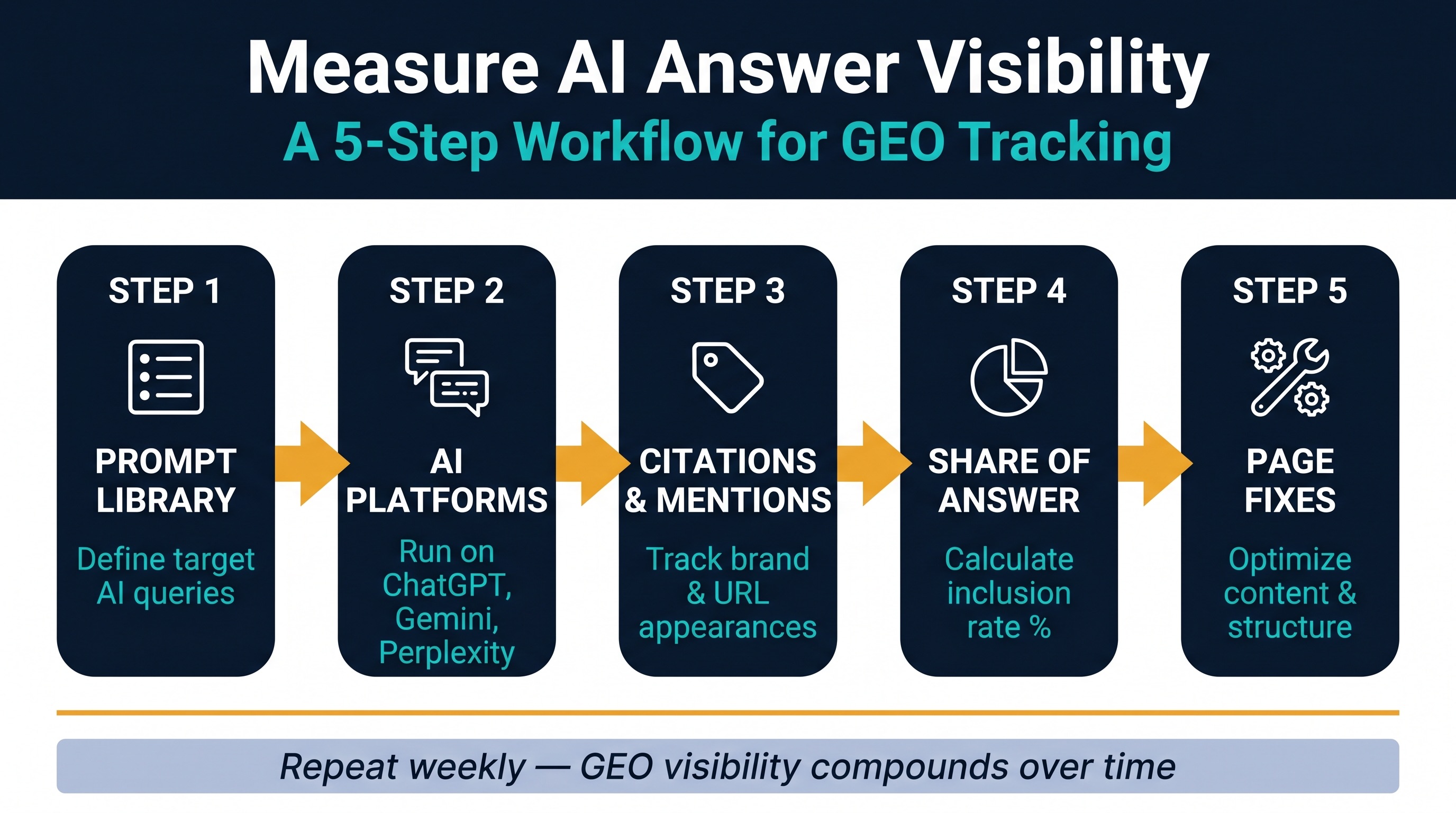
Caption: A practical GEO measurement loop starts with buyer prompts, then tracks AI platforms, citations, mentions, share of answer, and page-level fixes.
How SEO and GEO work together
Here is the cleanest relationship: SEO makes your content discoverable; GEO makes it usable inside answers.
A search or AI system cannot cite what it cannot access. It is also unlikely to cite content that is thin, confusing, outdated, or unsupported. So the first layer is still technical and editorial quality.
Use this order of operations:
- Fix crawl and indexation. Check robots.txt, noindex tags, canonical tags, rendering, sitemap coverage, and server errors.
- Clarify the entity. Update about pages, product pages, organization schema, author pages, and key category language.
- Rewrite money pages for extraction. Add short definitions, summary boxes, comparison tables, FAQs, and source-backed claims.
- Build topical evidence. Publish pages that answer real buyer questions, not just high-volume keywords.
- Strengthen external corroboration. Earn mentions on relevant third-party sites, documentation hubs, partner pages, communities, and review platforms.
- Track AI answer coverage. Monitor prompts, citations, brand mentions, sentiment, and competitor inclusion.
If you need a fast diagnostic, run a GEO readiness check on your most important pages before planning new content. The first wins are often boring: clearer intros, better titles, stronger internal links, missing schema fixes, or updated product language.
A practical GEO checklist for 2026
Use this checklist on any page you want AI systems to cite.
Check | Pass condition |
|---|---|
Direct answer | The page explains the topic in the first few paragraphs |
Entity clarity | Brand, product, category, audience, and use case are explicit |
Source quality | Important claims are supported by links, data, examples, or docs |
Structure | Headings, tables, bullets, and FAQs make extraction easy |
Freshness | Fast-changing claims include dates or update notes |
Technical access | Page is indexable, crawlable, and visible in rendered HTML |
Internal links | Related pages help systems understand the topic cluster |
External proof | Third-party mentions support the same positioning |
Measurement | Target prompts and expected citation pages are tracked |
Do not overcomplicate the first month. Pick 10 pages that already matter for revenue. Rewrite them for clarity. Add evidence. Check crawl access. Track 30 buyer prompts. Then compare your visibility against two or three competitors.
Common mistakes
The first mistake is writing for robots instead of people. AI systems are trained and tuned around usefulness. If the page is awkward, repetitive, or stuffed with keywords, it is less useful to humans and less quotable for machines.
The second mistake is relying only on your own website. For many prompts, AI systems look for corroboration. If the only source saying you are a leader is your homepage, that is weak evidence.
The third mistake is confusing mentions with trust. A brand mention is useful, but it is not the same as a citation to a strong page. Track both.
The fourth mistake is ignoring Bing. In 2026, Microsoft is giving site owners more AI citation data than most platforms. Even if Google remains your largest search channel, Bing Webmaster Tools can help you understand how your content appears in AI-generated answers.
The fifth mistake is chasing every AI platform separately. Start with the buyer prompts that matter. Then see which systems answer those prompts and which sources they trust.
FAQ
Is GEO replacing SEO in 2026?
No. GEO builds on SEO. You still need crawlable pages, helpful content, internal links, technical quality, and authority. GEO adds answer inclusion, citation tracking, entity clarity, and cross-platform evidence.
What is the biggest difference between GEO and SEO?
SEO usually tries to rank a URL in search results. GEO tries to get a brand or source included in an AI-generated answer. The output is different, so the measurement is different.
Can a small brand win GEO citations?
Yes, but usually in narrow topics first. Small brands can win when they publish unusually clear, evidence-backed pages for specific buyer questions and have credible third-party corroboration.
What should I optimize first?
Start with pages that already rank, convert, or explain your category. Improve the opening answer, entity clarity, tables, FAQs, sources, schema accuracy, and internal links. Then monitor whether those pages get cited.
How do I measure GEO performance?
Track AI citations, brand mentions, cited URLs, prompt coverage, competitor inclusion, sentiment, and referral traffic where available. Use platform tools such as Bing Webmaster Tools AI Performance when they fit your market, and combine them with prompt-level monitoring.
Final takeaway
GEO is the visibility discipline for AI answers. SEO gets your pages into the search ecosystem. GEO helps those pages and brand facts survive the next step: retrieval, synthesis, citation, and recommendation.
The teams that adapt fastest in 2026 will not be the ones inventing secret tricks for chatbots. They will be the teams that make their expertise easier to verify, easier to extract, and easier to cite.
Author: Maya Ellison, Independent GEO Researcher at Auspia. Maya writes about AI search visibility, brand entity clarity, and practical GEO operating systems for growth teams.