Quick answer
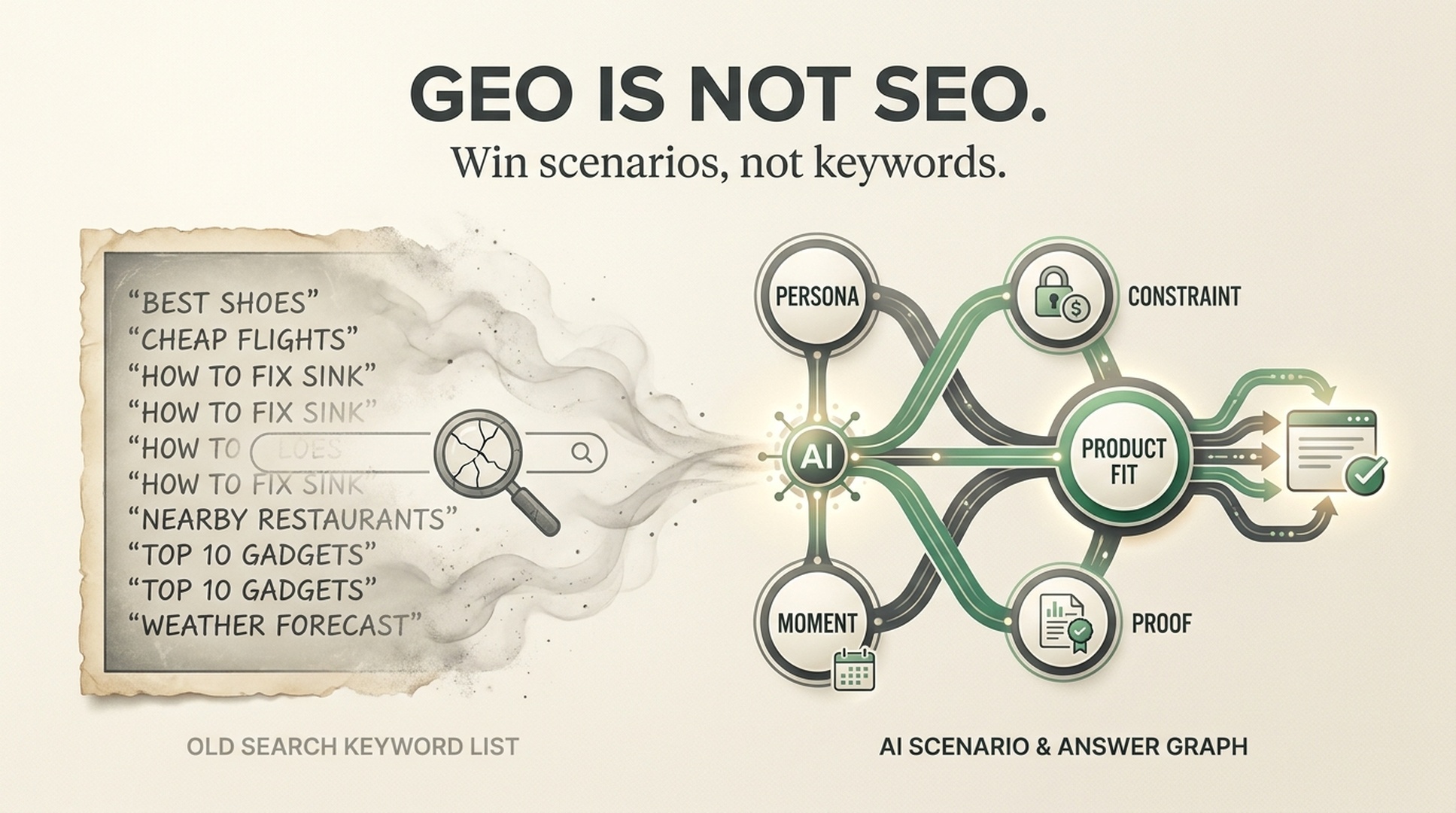
GEO is not SEO with a new label. Classic SEO often starts with a keyword, then builds pages to win rankings for that term. GEO starts with the messy customer situation: who is asking, what they are trying to do, what constraints they have, and what proof would make an AI system comfortable recommending you.
That shift matters because AI search users do not type like they did on Google in 2014. They ask long, specific questions: "What CRM should a seven-person B2B services team use if we sell through referrals, hate complex setup, and need clean follow-up reminders?" A page optimized only for "best CRM" does not give the model enough context to match the recommendation.
The practical move is simple: keep your keyword data, but stop treating it as the strategy. Use it as a signal. The real GEO asset is a scenario map that connects customer roles, moments, constraints, product fit, evidence, and answer-ready language.
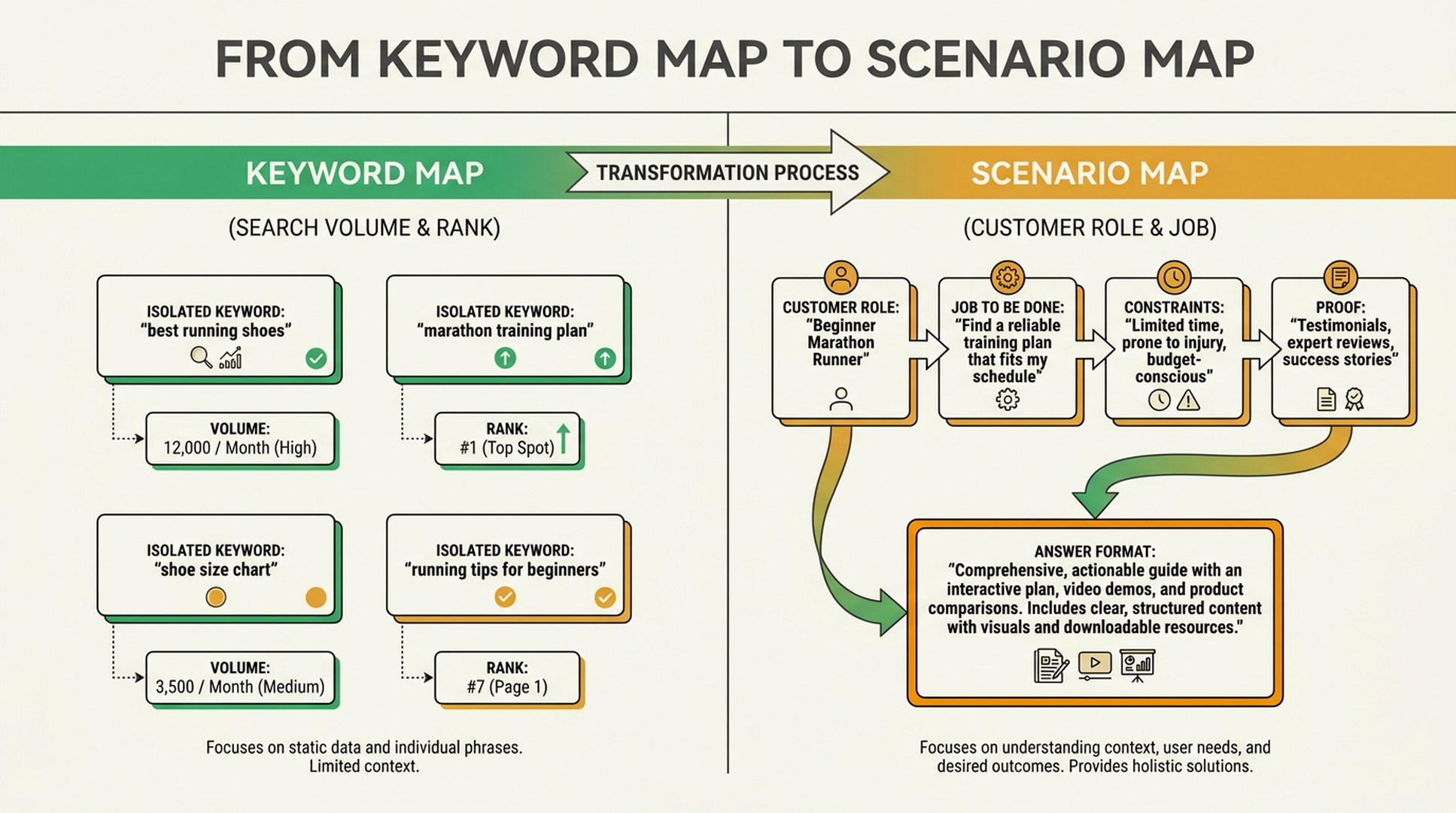
The old SEO reflex: start with the word, then fight for the rank
For years, search teams were trained to begin with a phrase. Find volume. Check difficulty. Build a landing page. Repeat the term in the title, the H1, a few headings, the first paragraph, some alt text, maybe an FAQ. Then chase links until the page moves.
That workflow still has a place in conventional search. It can help with query discovery, category pages, and bottom-of-funnel pages where the language is stable. But it breaks down when the user is no longer searching in short fragments.
A keyword is a compressed version of a need. "AI search visibility" may represent dozens of different jobs:
Search fragment | Real scenario hiding behind it | What the answer must include |
|---|---|---|
AI search visibility | A SaaS founder wants to know if ChatGPT mentions their product | Brand/entity checks, competitor comparison, citation sources |
GEO strategy | A content lead needs a 90-day plan | Prompt library, page priorities, evidence building, measurement |
LLMs.txt | A developer wants crawler guidance | File syntax, crawler behavior, limits, validation workflow |
best project management tool | A remote agency wants fewer missed handoffs | Team size, client approval flow, integrations, migration risk |
Classic SEO tends to optimize the fragment. GEO has to reconstruct the need behind it.
AI answers are built around situations
A generative answer engine does not only match text. It tries to resolve a task. The system weighs entities, prior knowledge, citations, user constraints, freshness, and whether the source gives a direct answer that fits the prompt.
That means a brand can lose even when it has a technically optimized page. The page may be crawlable, fast, and full of relevant phrases, but still fail to answer the situation the user described.
Take a simple B2B example. A company sells website audit software. The old page says:
Website SEO score checker. Free SEO audit. Check SEO score online. Improve website ranking.
The scenario-led version says:
If you manage a small marketing site and need to brief a developer before next sprint, use the audit to separate quick metadata fixes, indexability blockers, Core Web Vitals issues, and content gaps. Export the list, assign owners, and rerun the check after deployment.
The second version gives an AI system more to work with. It names the person, the operating moment, the constraints, the steps, and the expected outcome. It is easier to quote. It is also easier for a human to trust.
What "owning a scenario" means
Owning a scenario does not mean writing one blog post for every possible long-tail prompt. That would create a content swamp.
It means building a reusable cluster of pages and proof assets around a real buying or operating situation. A strong scenario has six parts:
Layer | Question to answer | Example |
|---|---|---|
Person | Who has the problem? | Head of growth at a 30-person SaaS company |
Moment | When does the need appear? | Traffic from organic search is flat, but competitors appear in AI answers |
Constraint | What makes the decision hard? | Small team, no dedicated SEO engineer, limited content budget |
Decision criteria | What must the answer compare? | Visibility baseline, citation gaps, pages to refresh, measurement method |
Evidence | What proof can the AI cite? | Benchmarks, screenshots, docs, case notes, methodology pages |
Next action | What should the user do now? | Run an AI search visibility check and build a prompt set |
For Auspia, this is why a tool page alone is not enough. A page for an AI Search Visibility Checker should be supported by explainers, operating guides, benchmark notes, and answer-ready examples that show when and how to use it.
How to turn a keyword list into a scenario map
You do not need to throw away your keyword research. You need to demote it from "strategy" to "input."
Start with your existing keyword universe and run it through this filter:
- Group by customer job, not by shared words. "AI search ranking," "ChatGPT brand mentions," and "GEO score" may belong to the same job: measuring AI visibility.
- Add a person to each group. Founder, content lead, local business owner, ecommerce manager, developer, agency strategist. If you cannot name the person, the scenario is still too abstract.
- Add the operating moment. New product launch, traffic decline, AI answer audit, site migration, category page refresh, competitor suddenly showing up in Perplexity.
- List the constraints. Budget, speed, team size, industry rules, geography, language, compliance, technical access.
- Translate features into situational value. "Crawler checks" becomes "know whether AI crawlers can access the pages you expect them to cite."
- Attach proof. Case notes, screenshots, public docs, comparison tables, methodology pages, support answers, changelogs, and customer language.
Here is the format we use when cleaning up a messy keyword sheet:
Old keyword bucket | Scenario bucket | Content asset to create |
|---|---|---|
GEO, generative engine optimization | Leadership needs a plain-English operating model | Basics page plus executive checklist |
ChatGPT SEO, AI search ranking | Growth team wants to measure brand visibility in AI answers | Tool page, prompt set, benchmark article |
llms.txt generator, AI crawler file | Developer wants safe crawler guidance before launch | How-to guide, validator page, examples |
robots.txt AI crawler | Site owner wants to avoid blocking useful AI crawlers by accident | Diagnostic guide, crawler table, checklist |
This is less tidy than a keyword map. That is the point. Customers are not tidy.
Write for the answer, not only the crawler
Scenario-led GEO changes how a page is written. The page still needs clean structure, indexability, internal links, and schema where relevant. But the content must also help a model compose an answer.
Use direct language:
- "Use this workflow when..."
- "This is best for..."
- "Do not use it if..."
- "The trade-off is..."
- "A good result looks like..."
- "Compare these three signals before deciding..."
Avoid the lazy version of GEO, where teams paste a keyword list into an LLM and ask for 50 generic posts. That creates more pages, not more authority. AI systems need evidence, consistency, and specificity. Humans do too.
A useful test: if a sales rep could not use the page to answer a real prospect question, the page is probably not a GEO asset yet.
The scenario-led GEO loop
The best source material for GEO is usually not inside an SEO tool. It is inside sales calls, support tickets, demo notes, community threads, onboarding forms, and customer success conversations.
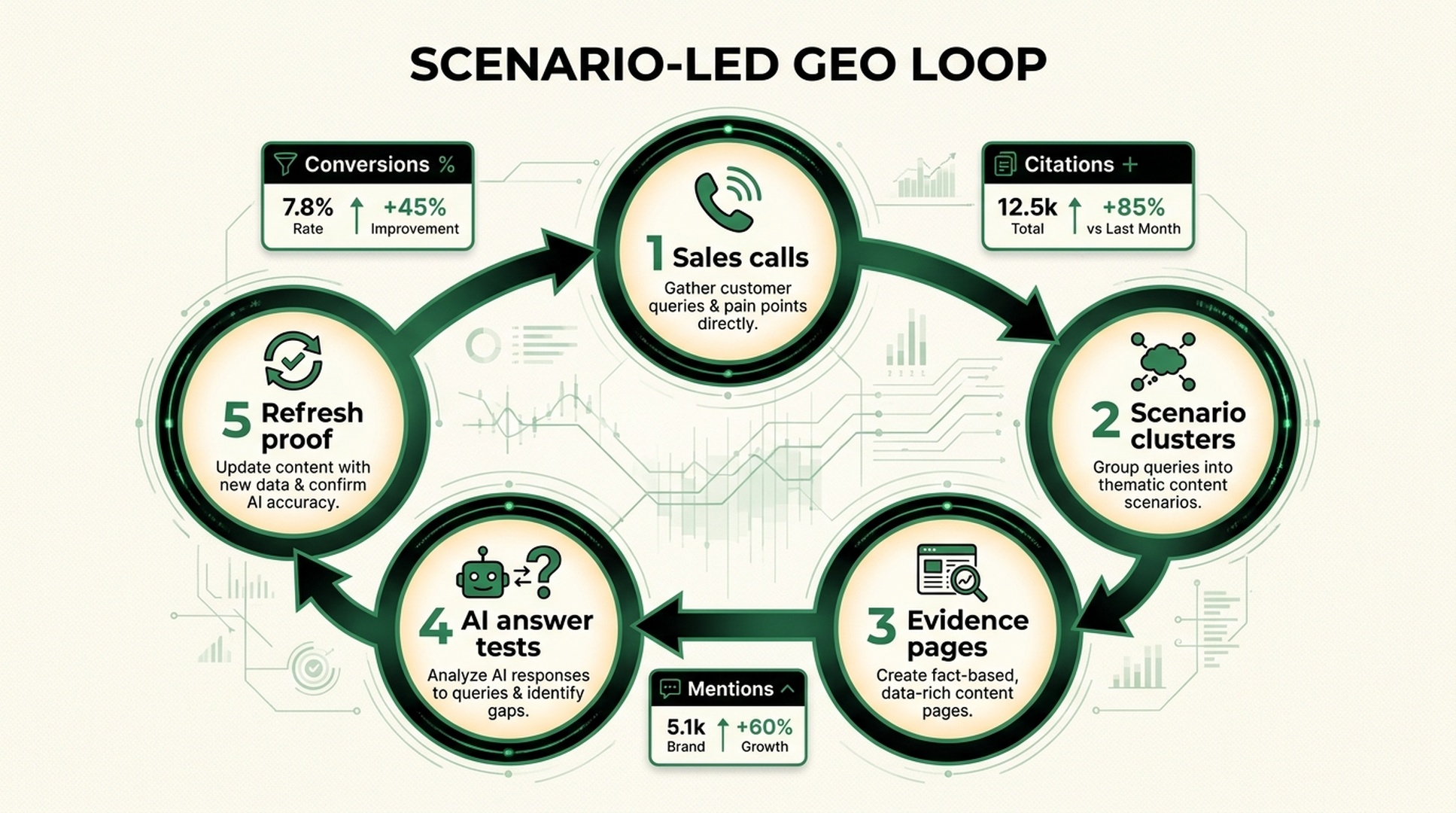
A practical operating loop looks like this:
Step | Owner | Output |
|---|---|---|
Collect real questions | Sales, support, customer success | Raw scenario log |
Cluster by situation | Growth or content lead | Scenario map |
Build answer assets | Content, product marketing, SEO | Pages, FAQs, comparison tables, proof blocks |
Test AI answers | GEO operator | Prompt set, mention/citation baseline |
Refresh proof | Product and growth | Updated docs, examples, screenshots, case notes |
This loop is slower than publishing keyword pages in bulk. It also compounds better. Each scenario can support multiple prompts, channels, and conversion paths.
What most teams will get wrong
The first mistake is treating GEO as a synonym for "rank in ChatGPT." Visibility matters, but the deeper goal is answer inclusion with the right framing. A bad mention can be worse than no mention if it positions the product for the wrong audience.
The second mistake is confusing long-tail content with scenario content. A page titled "best CRM for small teams with client onboarding and referral sales" may still be shallow if it only repeats generic buying advice. Scenario content must include operational detail.
The third mistake is skipping proof. AI systems are cautious when they do not have corroborating evidence. If your site makes claims that never appear in documentation, third-party mentions, customer stories, or observable product pages, the model has less reason to trust the claim.
The fourth mistake is keeping GEO inside the content team. Content teams can publish pages, but they cannot invent customer reality. Sales, support, product, and analytics have to feed the system.
Auspia take
The winning GEO teams will not be the ones with the longest keyword sheet. They will be the ones with the clearest map of customer situations and the discipline to turn that map into evidence-rich pages.
Keywords still help you see demand. Rankings still matter. Technical SEO still matters. But AI search has raised the bar: a page now has to be understandable as an answer, not just discoverable as a document.
If you want a starting point, run a baseline check with Auspia's GEO and AI search tools, then build a scenario map for the pages that should be cited but are not. The gap between those two views usually tells you what to write next.
Scenario-first GEO checklist
Use this before writing or refreshing a page:
- Can we name the person asking the question?
- Can we describe the moment that triggers the need?
- Have we listed the constraints that shape the answer?
- Does the page translate product features into real-world outcomes?
- Does it include proof a model can cite or verify?
- Does it say who the solution is not for?
- Does it connect to a next action, tool, demo, checklist, or diagnostic?
- Have we tested the target prompts in at least two AI answer systems?
FAQ
Is GEO replacing SEO?
No. GEO depends on many SEO basics: crawlable pages, clean structure, useful internal links, and credible content. The difference is the starting point. SEO often starts with the query. GEO starts with the user situation and the answer an AI system needs to assemble.
Should we stop doing keyword research?
No. Keyword research is still useful for demand discovery and language patterns. Just do not let keywords become the whole strategy. Use them to find scenario clusters, then write for the actual job behind the search.
How many scenarios should a company target first?
Start with five to ten. Choose scenarios that are close to revenue, common in sales conversations, and currently underrepresented in AI answers. A narrow set with strong proof beats a huge list of thin pages.
What is the fastest way to find scenarios?
Review sales call notes, support tickets, demo objections, search queries, and competitor comparison requests. Look for repeated combinations of person, moment, constraint, and decision criteria.
How do we measure scenario-led GEO?
Track AI answer mentions, citation frequency, share of voice across a fixed prompt set, referral traffic where available, branded search lift, demo or tool starts, and changes in sales objections. GEO measurement is still imperfect, so use a dashboard rather than a single metric.