


The short version
Most GEO programs fail in 2026 for a boring reason: the team starts with content before it has a source system.
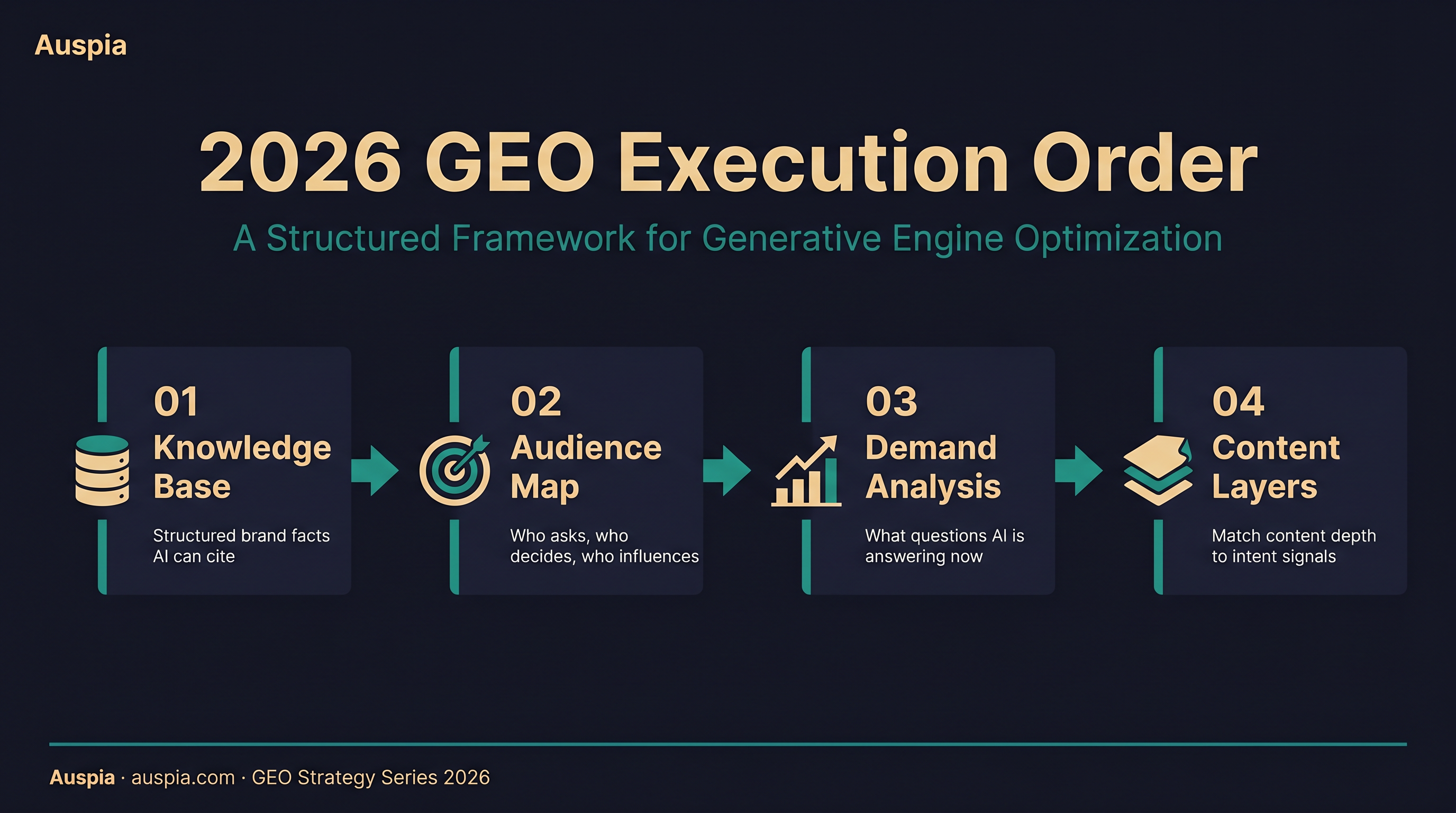
The better order is:
- Build the knowledge base.
- Map the audience.
- Analyze demand from real questions.
- Publish content in layers.
If you skip the first three steps and jump straight into articles, AI answer systems may still find your brand. They just will not have enough structured evidence to describe you well, compare you fairly, or cite you in the moments that matter.
This is the operating sequence we recommend for B2B teams that want to show up in ChatGPT, Perplexity, Gemini, Google AI Overviews, and other answer surfaces without turning GEO into random content production.
Why the order matters more in 2026
In classic SEO, a weak content process could still win if the keyword was easy, the domain was strong, or the page matched the query well enough.
GEO is less forgiving. AI answer systems do not only rank one page. They synthesize claims from multiple sources, compare entities, look for repeated facts, and decide whether your brand is a useful part of the answer.
That means a GEO program has two jobs:
- Help AI systems understand what your company does.
- Help buyers see why that answer is credible enough to act on.
Those two jobs require a sequence. You cannot map buyer questions well if you do not know what your company can prove. You cannot create content layers well if you do not know who is asking. And you cannot earn useful citations if the source material is thin, scattered, or written only for sales calls.
Here is the cleaner order.
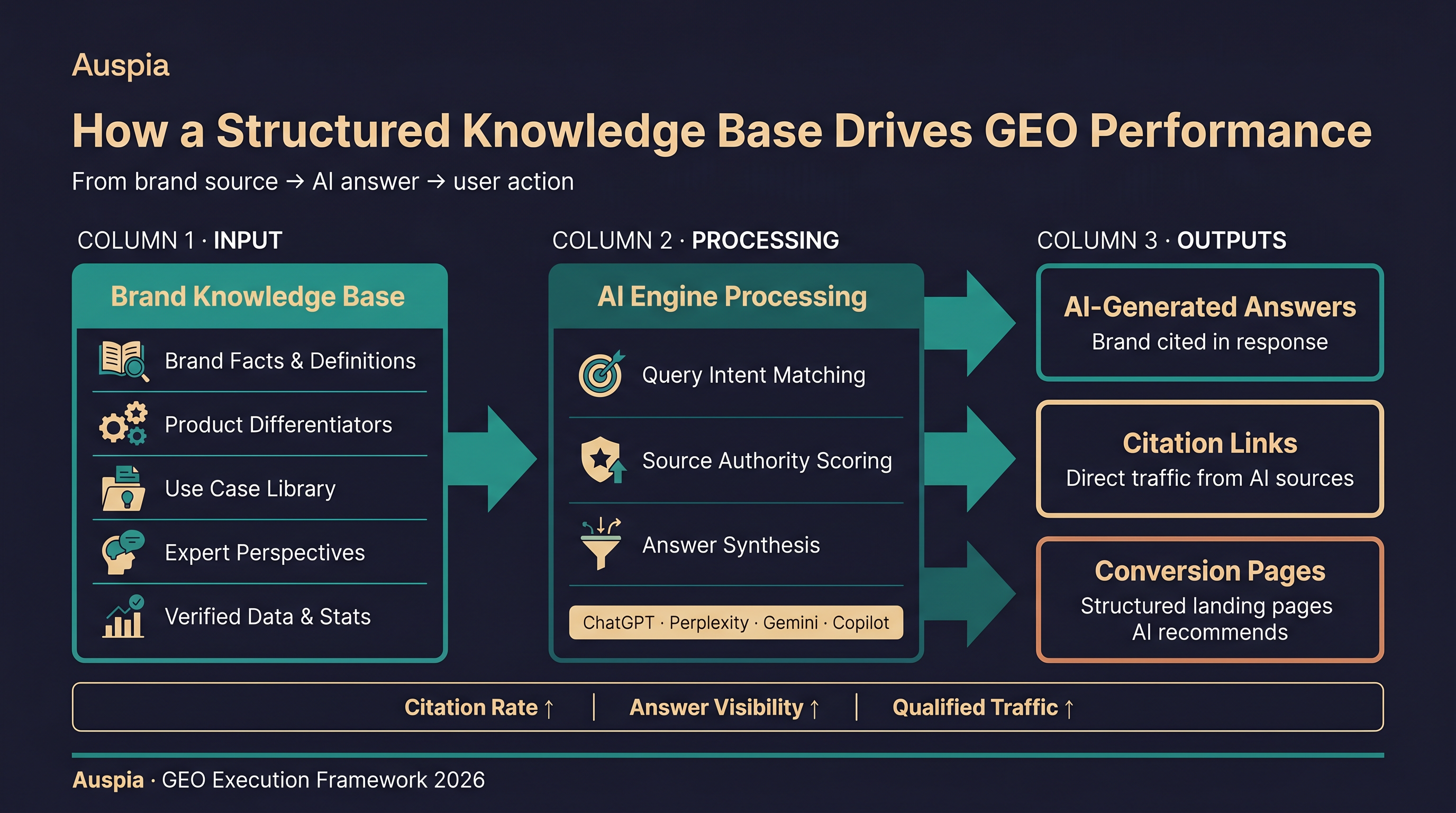
Caption: A practical GEO workflow starts with structured brand knowledge, then turns that source material into answer-ready assets, citation paths, and conversion pages.
Step 1: build the knowledge base
Your knowledge base is not just a help center. It is the source layer AI systems and human buyers can use to understand your category, product, proof, use cases, limits, and comparisons.
For a 2026 GEO program, the knowledge base should include:
Knowledge asset | What it should clarify | Why it matters for GEO |
|---|---|---|
Product facts | Features, use cases, integrations, pricing logic, limitations | Prevents vague or wrong AI summaries |
Category language | What category you belong to and what problem you solve | Helps AI systems place your brand in the right comparison set |
Customer evidence | Case studies, testimonials, implementation notes, measurable outcomes | Gives answer systems and buyers reasons to trust the claim |
Comparison data | Alternatives, tradeoffs, decision criteria, fit and non-fit cases | Supports recommendation and evaluation queries |
Operational knowledge | FAQs, onboarding steps, support answers, security notes | Covers long-tail questions buyers ask before conversion |
The common mistake is to treat the knowledge base as an internal archive. A GEO knowledge base should be public enough, structured enough, and specific enough for retrieval.
A good test: if someone asks an AI assistant, "Which tools should a mid-market SaaS team consider for AI search visibility?", can the public web clearly explain what your product does, who it is for, where it is strong, and where it is not a fit?
If the answer is no, publishing more blog posts will only make the mess bigger.
How to build the knowledge base
Start with an inventory. Pull together the content you already have: website pages, sales decks, product docs, onboarding notes, support replies, case studies, webinars, review snippets, comparison notes, and internal FAQs.
Then reorganize it around questions, not departments.
A simple structure works:
- What do we do?
- Who is it for?
- What problem do we solve?
- What proof do we have?
- How are we different from alternatives?
- What does implementation look like?
- What questions block a buyer from moving forward?
Once the material is grouped, look for gaps. Most companies are missing at least one of these: credible comparisons, implementation detail, outcome proof, category definitions, or objection-handling pages.
This is where tools such as Auspia's AI Search Visibility Checker can help. Run prompts against your brand and competitors, then compare what AI systems say with what you wish they said. The gap usually points back to missing knowledge assets.
Step 2: map the audience
Only after the knowledge base is visible should you map the audience.
That order may feel backwards. Many teams start with personas. The problem is that persona work often becomes theater: "VP of Marketing, age 35-45, wants growth." That does not tell you what the person asks inside an AI answer engine.
For GEO, audience mapping should start from search behavior and decision context.
Ask:
- Who asks questions that could lead to your product?
- What words do they use when they do not know your category yet?
- What do they ask when they are comparing options?
- Who reads the answer, and who signs the contract?
- Which people influence the decision but never become the buyer?
For most B2B companies, three layers are enough.
Layer | Typical audience | What they ask | Content job |
|---|---|---|---|
Decision layer | Founder, CMO, VP, head of growth, procurement owner | "Which solution should we choose?" "What will it cost?" "How long does implementation take?" | Reduce risk and support a decision |
Influence layer | SEO lead, product marketer, consultant, analyst, internal champion | "What framework should we use?" "How do we evaluate vendors?" | Give them language and evidence to share |
Future demand layer | Students, junior operators, early-stage founders, adjacent teams | "What is this concept?" "Why does it matter?" | Build memory and category understanding |
The audience map should change your content plan. A cybersecurity SaaS company may discover that buyers sign the deal, but security engineers shape the shortlist. A healthcare analytics company may find that analysts ask the early questions, while operations leaders care about implementation risk. A devtool company may learn that developers do the research, but finance leaders ask the pricing and risk questions before renewal.
In GEO, the person who asks the first question is not always the person who converts. Your content has to serve both.
Step 3: analyze demand from real questions
Demand analysis is not a brainstorming session. It is the work of translating buyer questions into content priorities.
The best signals usually come from:
- AI answer prompts people already use.
- Google Search Console queries.
- Sales call objections.
- Support tickets.
- Community discussions.
- Competitor comparison searches.
- Internal site search.
- Follow-up questions in demos.
The goal is to find the friction behind the query.
Someone asking "best GEO tools for SaaS" may need a shortlist. Someone asking "how to measure AI search visibility" may need a dashboard model. Someone asking "does llms.txt help SEO" may need a plain-English explanation and an implementation caveat.
Do not flatten those into one generic article. Split them by intent.
Demand type | Question pattern | Better asset |
|---|---|---|
Decision demand | "best", "alternative", "vs", "pricing", "implementation" | Comparison page, buyer guide, ROI worksheet |
Confidence demand | "case study", "proof", "benchmark", "results" | Evidence page, case story, data-backed report |
Operational demand | "how to", "checklist", "workflow", "template" | Playbook, SOP, downloadable checklist |
Education demand | "what is", "why", "examples", "beginner" | Explainer, glossary, visual guide |
This is also where priority matters. Most teams have limited content capacity. Start with demand that is closest to revenue and easiest to support with evidence.
A practical rule: if the query includes comparison, risk, pricing, implementation, measurement, or proof, it probably belongs near the front of the roadmap.
Step 4: publish content in layers
Now you can publish. Not before.
Think of the content system as a set of layers, from the highest-intent buyer to the widest future audience.
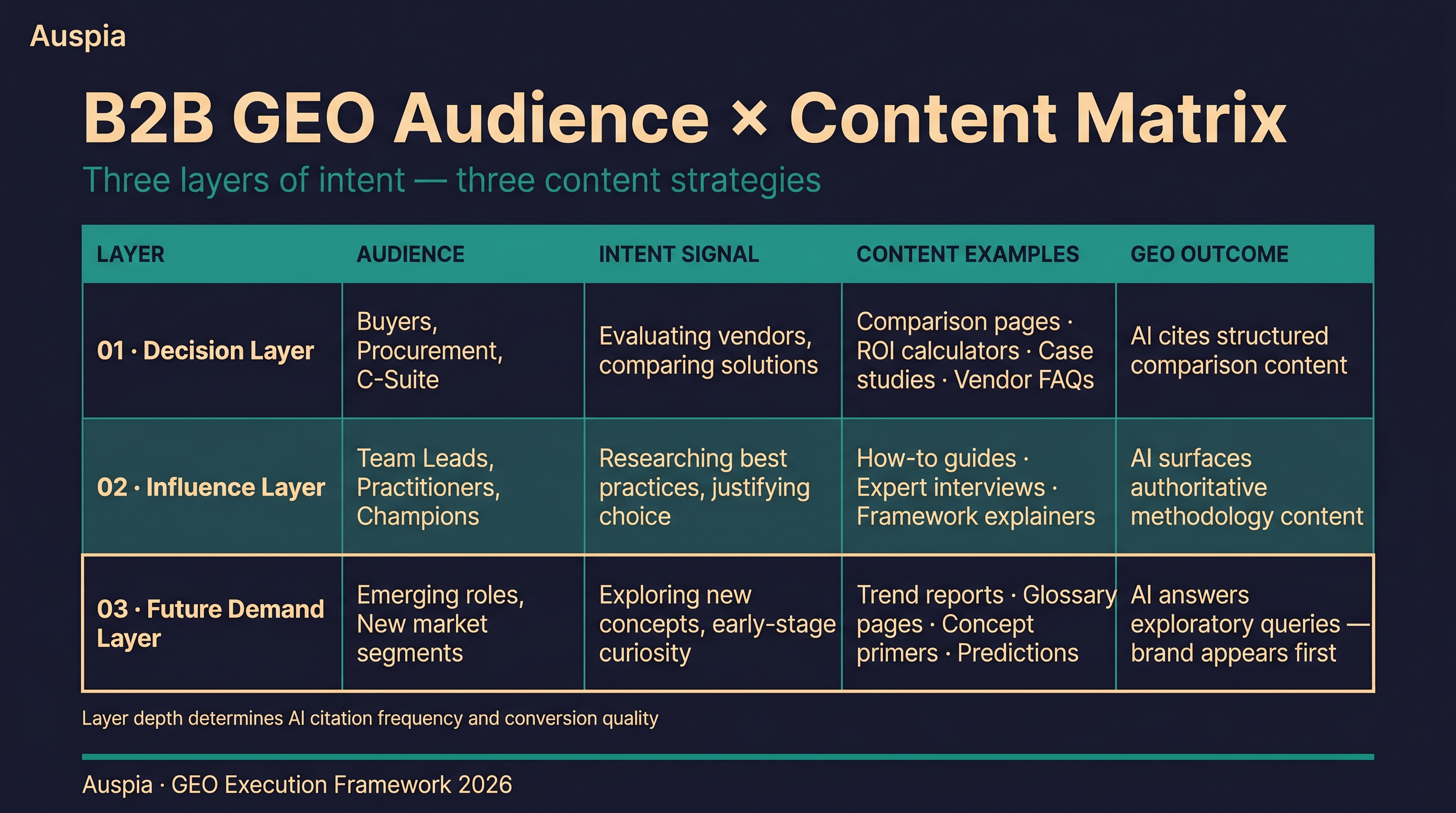
Caption: Content layers should follow audience intent, not publishing convenience. Start where conversion risk is highest, then expand outward.
For most B2B GEO programs, the order should be:
Publishing layer | First assets to create | Why it comes first or later |
|---|---|---|
Decision layer | Alternatives, comparison pages, pricing explainers, implementation guides, ROI pages | Closest to revenue and easiest to evaluate |
Influence layer | Frameworks, evaluation criteria, expert guides, methodology pages | Helps champions explain the problem internally |
Future demand layer | Beginner explainers, trend posts, glossary pages, market education | Builds category memory but usually converts later |
Start with the decision layer. It is tempting to begin with broad educational posts because they are easier to write, but they rarely fix the questions that block a sale.
A strong decision-layer asset might answer:
- When should a team invest in GEO instead of only traditional SEO?
- How should a company evaluate AI search visibility tools?
- What data should a CMO expect in a GEO report?
- Which pages need to exist before a brand can be cited accurately?
Once those pages are in place, move outward. Influence-layer content can package your method into frameworks. Future-demand content can explain the category to people who are not ready to buy yet.
The trap is publishing a little bit for everyone and going deep for no one.
A 30-day rollout plan
Here is a simple way to turn the sequence into work.
Week | Focus | Output |
|---|---|---|
Week 1 | Knowledge base inventory | Source audit, missing-asset list, brand fact sheet |
Week 2 | Audience and prompt map | Three audience layers, 30-60 real buyer prompts |
Week 3 | Demand prioritization | Intent clusters, revenue proximity score, first 10 content briefs |
Week 4 | Decision-layer publishing | 3-5 high-intent assets, internal links, measurement baseline |
You can move faster if the company already has strong documentation. You will move slower if the product story is unclear or the proof is scattered across sales decks.
Both are useful findings. GEO exposes the parts of a company that are hard to explain.
What most teams get wrong
The most common failure pattern is reverse-order GEO.
A team starts with content. Then, after a few months, they wonder why AI answers still describe competitors more clearly. Eventually they realize the source material was never organized, the audience layers were never mapped, and the content answered generic questions instead of decision questions.
The symptoms are easy to spot:
- AI answers mention the brand but use weak or outdated language.
- Competitors appear in recommendation prompts while your brand appears only in branded prompts.
- Blog traffic grows, but demo quality does not improve.
- Content repeats category basics but avoids comparisons, pricing logic, proof, and implementation risk.
- Different pages describe the product in different ways.
This is not a writing problem. It is a system problem.
Auspia's take
The 2026 GEO opportunity is not "publish more so AI sees you more." That is too shallow.
The real opportunity is to become easier to understand, easier to compare, and easier to cite. The companies that win AI search visibility will have cleaner knowledge assets, sharper audience maps, and content that answers the actual friction in the buying process.
If you want a simple starting point, audit your current visibility first. Use Auspia's GEO tools to check how AI systems describe your brand, where competitors appear, and which buyer questions have no strong answer yet.
Then follow the order:
- Knowledge base: what can we prove?
- Audience map: who needs the answer?
- Demand analysis: what question blocks progress?
- Content layers: what should we publish first?
Same budget. Better sequence. Much less wasted content.
FAQ
What is the correct GEO execution order in 2026?
The recommended order is knowledge base, audience map, demand analysis, then content layers. This prevents teams from publishing content before they understand what the brand can prove, who the content serves, and which questions matter most.
Why should the knowledge base come before content publishing?
AI answer systems need consistent source material. If product facts, proof, comparisons, and implementation details are scattered or missing, new articles may increase volume without improving answer quality.
How is GEO content different from SEO content?
SEO content often focuses on ranking a page for a query. GEO content must also help AI systems synthesize accurate answers, cite credible sources, compare entities, and explain why a brand belongs in a recommendation set.
Which GEO content layer should B2B teams publish first?
Start with the decision layer: comparisons, alternatives, ROI pages, implementation guides, pricing explainers, and proof assets. These pages answer the questions closest to revenue and help AI systems describe the brand in buyer-ready contexts.
How many prompts should a GEO program track at the beginning?
A small program can begin with 30-60 prompts across branded, category, comparison, and problem-aware queries. The goal is not volume at first. The goal is to identify where AI systems misunderstand the brand or omit it from relevant answers.
Author: Maya Ellison, 12-Year GEO Strategy Researcher at Auspia. Maya writes about AI search visibility, brand entity clarity, and practical GEO operating systems for growth teams.


