Executive summary
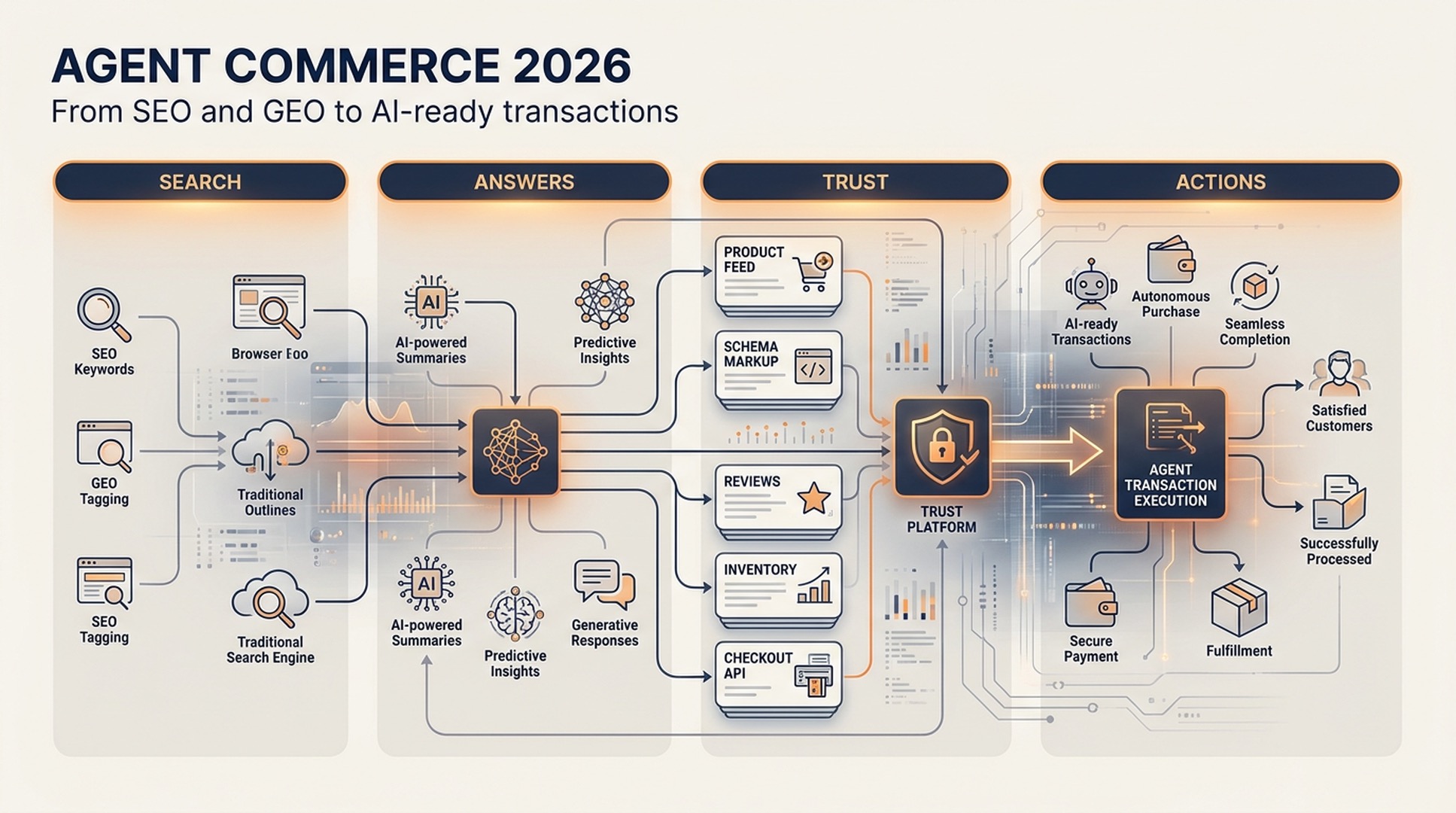
In 2026, the useful way to think about GEO is no longer "SEO for AI answers." That definition is too small. Search visibility still matters, but growth teams now need to prepare for a bigger chain: search engines find pages, answer engines quote facts, generative engines compare brands, and agents may soon execute tasks such as booking, buying, renewing, or routing a customer to the right service.
The practical takeaway is simple: your website is becoming a machine-readable trust layer. Your product catalog is becoming a product discovery engine. Your reviews, policies, inventory, and APIs are becoming part of the answer. If an AI system cannot understand your facts, verify your claims, compare your offer, and route a user to an action, you may be invisible at the exact moment the buyer makes a decision.
This article adapts the core logic of the current SEO-to-GEO debate for global teams. The 2026 marker matters because the conversation has moved from "will AI search affect traffic?" to "how do we become the brand an AI can trust and act on?"
The migration chain: from links to answers to actions
Most marketing teams already know the first two layers. SEO helps people find pages through search results. ASO helps people find and install apps. AEO helps AI systems answer clearly. GEO helps AI systems treat your brand as part of a credible answer. Product discovery engines help AI compare products. Agent commerce helps AI safely call, book, buy, or route to you.
The first break is between SEO and GEO. SEO asks, "Can a person find this page?" GEO asks, "Can a model understand and trust this fact?"
The second break is between GEO and agent commerce. GEO asks whether AI can recommend you. Agent commerce asks whether AI can do something with that recommendation. That might mean opening the right product page, checking inventory, applying a policy, booking a demo, creating a cart, or handing the user to another service.
GEO is not AI manipulation. It is a brand facts system
Bad GEO advice usually sounds like this: publish more AI-written pages, seed more listicles, repeat your brand name everywhere, and trick the model into recommending you. That path is risky and usually fragile.
Good GEO starts with a less glamorous job: build a clean brand facts system.
A brand facts system includes:
- Standard brand names, product names, category names, and aliases.
- Clear descriptions of what the product does and does not do.
- Use cases, buyer profiles, pricing boundaries, service areas, and constraints.
- Proof assets such as case studies, benchmarks, certifications, documentation, reviews, media coverage, and customer stories.
- Policies for refund, shipping, privacy, security, support, and compliance.
- Structured data, crawlable pages, product feeds, and help content.
This is the part many teams skip. They want AI visibility before they have source material that an AI system can verify. In search, thin content may still catch long-tail traffic. In AI answers, thin content often gets ignored because the model can choose stronger sources, official docs, marketplaces, review sites, and community discussions.
The goal is not to force AI to say nice things. The goal is to make the true version of your brand easier to retrieve, compare, cite, and explain.
Why 2026 changes the marketing operating system
The old funnel assumed a human user did most of the work. A person searched, clicked, opened tabs, compared vendors, read reviews, and eventually filled out a form or bought a product.
AI shortens that path. A user can now ask:
- "Which customer support platform fits a 40-person ecommerce team?"
- "Find a lightweight carry-on under $250 with good wheels and a strong warranty."
- "Compare these three SEO tools for a small agency."
- "Book a restaurant nearby that has outdoor seating and can handle six people."
- "Which sunscreen is safe for sensitive skin and ships by Friday?"
These are not keyword searches. They are decision requests.
That changes the competition. The brand is no longer competing only for a blue link, a shopping ad, or a product card. It is competing to be included in the AI's shortlist, described accurately, supported by evidence, and routed to the next action.
For Auspia readers, this is the main strategic shift: SEO earns visibility; GEO earns trust; agent readiness earns execution.
What OpenAI's commerce moves signal
OpenAI's recent commerce work shows where the market is going. In September 2025, OpenAI introduced Instant Checkout in ChatGPT and the Agentic Commerce Protocol, describing a path where ChatGPT can help users find items and buy them through participating merchants. OpenAI says the protocol is built with Stripe and is intended as an open standard for agentic commerce. Source: OpenAI, "Buy it in ChatGPT: Instant Checkout and the Agentic Commerce Protocol." https://openai.com/index/buy-it-in-chatgpt/
For merchants and developers, the implication is concrete. Product information has to be structured, current, and useful enough for AI-assisted discovery. OpenAI's commerce developer materials describe product feeds, product discovery, and checkout-related integration patterns for merchants. Source: OpenAI Developers, Commerce docs. https://developers.openai.com/commerce/
This does not mean every business needs to rush into in-chat checkout tomorrow. It does mean product data is becoming a growth asset, more than an ecommerce operations file.
A product feed used to be something the performance marketing team sent to Google, Meta, Amazon, or a marketplace. In the agent commerce world, it becomes the machine-readable version of the product: what it is, who it is for, what it costs, whether it is available, what evidence supports it, and what action can happen next.
A2A turns services into routable capabilities
Google's Agent2Agent Protocol is another signal. Google introduced A2A in 2025 as a way for agents to communicate and coordinate across platforms and applications. Source: Google Developers Blog, "Announcing the Agent2Agent Protocol." https://developers.googleblog.com/en/a2a-a-new-era-of-agent-interoperability/
Google Cloud later donated A2A to the Linux Foundation, with a broader group of technology companies involved in the project. Source: Google Developers Blog, "Google Cloud donates A2A to Linux Foundation." https://developers.googleblog.com/en/google-cloud-donates-a2a-to-linux-foundation/
The marketing implication is not that every brand needs to study protocol details. The implication is simpler: future commercial journeys may not start inside your app or website. They may start inside a user's assistant, then route through another agent, then call your inventory, booking, support, quoting, or checkout flow.
In that world, the winners will need more than strong landing pages. Their data and services must be easy for agents to trust and call.
Ecommerce GEO is product data plus proof
For ecommerce brands, GEO requires more than blog publishing. A buying assistant needs to compare products against a user's constraints. That requires more than a persuasive product description.
A useful product discovery engine should expose product feeds, semantic attributes, evidence, policies, real-time signals, and action paths. The common gap is that these assets exist in separate systems. Feed data sits with ads. Reviews sit on marketplaces. Policies sit on legal pages. Inventory sits in operations. AI-assisted buying needs these pieces to line up.
This is why product pages should be treated as AI-readable fact sheets. Reviews act as evidence, more than conversion copy. Inventory may influence whether an AI should recommend a product. Return policies help AI assess risk for the buyer.
B2B GEO is a trust and comparison problem
B2B teams face a different version of the same problem. A buyer may ask an AI assistant to shortlist vendors, compare pricing models, summarize reviews, explain integrations, or prepare a business case. If your public materials are vague, the AI will fill the gaps from other sources or skip you.
B2B GEO needs five assets:
- A clear category position: what you are, what you replace, and what you do not replace.
- Use-case pages that map to real buyer problems, not internal feature names.
- Comparison pages with fair criteria, limitations, and decision rules.
- Case studies with enough context to be useful: company type, problem, workflow, constraints, and outcome.
- Documentation and integration pages that answer technical due diligence questions.
The point is not to publish a "best vendor" page and hope the model copies it. The point is to create enough credible, consistent, and crawlable evidence that an AI assistant can place your company correctly in a shortlist.
If you want to test this, use a fixed prompt library and run the same questions across multiple systems. Track whether the brand appears, how it is described, what sources are cited, which competitors are mentioned, and which facts are wrong. Auspia's AI Search Visibility Checker is built for this kind of visibility audit.
The three-layer operating model
A serious 2026 GEO program has three layers.
1. Trusted knowledge network
This is the source-of-truth layer. It includes your website, help center, docs, schema, product feeds, case studies, media references, review profiles, and public data sources. The job is to reduce ambiguity.
Questions to ask:
- Is there one official version of each product claim?
- Can AI systems find the latest pricing or packaging boundaries?
- Are old pages contradicting current positioning?
- Are case studies specific enough to cite?
- Do third-party profiles describe the company accurately?
2. Unified semantic layer
This is where marketing, product, sales, support, and ecommerce language get aligned. Humans can tolerate messy wording. AI systems may treat messy wording as conflicting evidence.
Examples:
- A user says "AI search optimization" and the site maps that to GEO, AEO, and AI visibility pages.
- A buyer says "safe for a regulated finance team" and the content maps to compliance, privacy, approval workflow, and audit logs.
- A shopper says "good for a small apartment" and product attributes map to size, noise, storage, delivery, and return constraints.
This semantic layer is often missing because each team publishes content in its own vocabulary.
3. Executable interface layer
This is where agents can act. For software companies, it may include demos, trials, API docs, app integrations, support workflows, and lead-routing logic. For ecommerce, it may include product feeds, inventory, checkout, order status, returns, and customer service. For local services, it may include availability, booking, menus, pricing, locations, and fulfillment.
The question is no longer only "Can AI describe us?" It is also "Can AI safely hand the user to the right next step?"
Black-hat GEO will create real risk
Every new discovery system attracts manipulation. In GEO, that manipulation can look like fake review networks, synthetic listicles, undisclosed paid rankings, hidden prompt instructions in pages, poisoned PDFs, fake schema, copied author identities, or competitor smear pages.
The risk is bigger than old-school SEO spam. Search spam pollutes rankings. GEO spam pollutes model understanding. Agent spam can influence actions.
A healthy internal rule is worth writing down: every GEO change must be true, verifiable, reviewable, and useful to the user. If a tactic depends on hiding instructions from humans, inventing proof, or making a claim the product team would not defend, it should not ship.
This is an ethics point and a durability point. AI systems, platforms, regulators, and users will all become less tolerant of synthetic proof as agentic transactions grow.
A six-step 2026 roadmap
Step 1: Build a question library before expanding keywords
Start with the questions buyers ask when they delegate judgment to AI:
- Category questions: What is this? How does it work?
- Scenario questions: What fits my situation?
- Comparison questions: Which option is better for this constraint?
- Risk questions: What are the limits, tradeoffs, or compliance issues?
- Purchase questions: How much does it cost? Where can I buy it? What happens after purchase?
- Support questions: How do I return, migrate, upgrade, repair, or cancel?
Keywords still matter, but prompts expose the real decision logic.
Step 2: Create a fact table
Make one internal table that lists brand facts, product facts, proof, restrictions, claims, forbidden language, and update owners. This sounds boring. It prevents expensive drift.
Step 3: Turn content into answer assets
Rewrite important pages so the answer appears early, examples are concrete, tables are readable, and citations are clear. Add FAQ only where it helps real users. Use schema where appropriate. Keep dates and authors visible when credibility matters.
A simple rule: if a paragraph would not help an AI answer a buyer's question, it may not help a human either.
Step 4: Fix product and service data
For ecommerce, audit feeds, product attributes, variant logic, reviews, policies, shipping data, and inventory freshness. For SaaS, audit docs, integrations, pricing pages, comparison pages, support paths, and trial/demo flows.
Step 5: Monitor AI answers with stable samples
Use the same prompts, platforms, dates, regions, and logged-in states when you can. Record raw answers. Track brand mention, first mention, top-three inclusion, cited sources, wrong facts, sentiment, and recommended next steps.
This is where teams often fool themselves. One good answer is not a trend. One bad answer is not a crisis. You need samples.
Step 6: Connect marketing, product, support, and technical owners
GEO cannot live only inside content marketing. Product owns facts. Support owns recurring objections. Sales owns buyer language. Ecommerce owns feed quality. Engineering owns crawlability, schema, APIs, and integration surfaces. Legal owns claims and risk boundaries.
Auspia's view: the teams that win 2026 will treat GEO as AI visibility governance, not as an article production calendar.
What to measure
A practical GEO and agent-readiness scorecard should include brand mention rate, first mention or top-three rate, citation rate, citation quality, fact error rate, narrative consistency, competitive adjacency, product match accuracy, and action completion readiness. Together, these metrics show whether AI can include the brand, explain it accurately, cite useful sources, and move the user toward a credible next step.
Do not promise fixed rankings in AI answers. Measure probabilities, samples, and failure patterns.
The final 2026 judgment
The next marketing operating system is bigger than publishing more content. It is about making the business understandable and callable.
SEO taught companies to make pages findable. AEO taught them to make answers extractable. GEO is teaching them to make brand facts trustworthy. Agent commerce will teach them to make products and services executable.
The companies with an advantage will have real product strength, clean facts, structured evidence, current product data, credible third-party proof, and low-friction action paths. The companies at risk will have scattered claims, thin pages, inconsistent product data, synthetic proof, and no clear route from AI recommendation to user action.
The best question for 2026 is no longer, "Where should we publish more?" It is this:
When AI forms a judgment on behalf of our buyer, can it find our facts, trust our evidence, compare our offer, and route the user to the right action?
If the answer is yes, GEO becomes more than a visibility tactic. It becomes growth infrastructure.
FAQ
Is GEO replacing SEO in 2026?
No. SEO remains the foundation because AI systems still rely on crawlable pages, structured content, links, documentation, reviews, and authoritative sources. GEO extends SEO by optimizing for AI understanding, citation, and recommendation.
What is agent commerce?
Agent commerce is a buying or service flow where an AI agent helps the user discover, compare, select, and sometimes purchase or book through connected merchant or service systems. It depends on structured data, trust signals, and safe action interfaces.
What should an ecommerce team fix first?
Start with product feed accuracy, structured product attributes, review quality, shipping and return policy clarity, inventory freshness, and product page crawlability. Then test whether AI assistants can correctly recommend products for real customer scenarios.
What should a B2B team fix first?
Start with positioning clarity, use-case pages, comparison content, documentation, case studies, pricing boundaries, and integration facts. Then monitor how AI systems describe the company against target buyer prompts.
Can brands guarantee top rankings in AI answers?
No. AI answers vary by prompt, platform, retrieval state, location, model version, and context. Teams should measure mention rates, citation quality, error rates, and sample stability rather than promise fixed positions.