Executive summary
In 2026, the main question for growth teams is no longer only "Can people find us on Google?" The sharper question is "Can AI systems understand, verify, and recommend us when users ask for help?"
That is the shift from SEO as a ranking discipline to GEO as an answer-trust discipline. Traditional SEO helps pages compete for positions on search result pages. GEO, or generative engine optimization, helps brand knowledge become legible to systems such as ChatGPT, Perplexity, Gemini, AI Overviews, Copilot, and the next wave of agentic assistants.
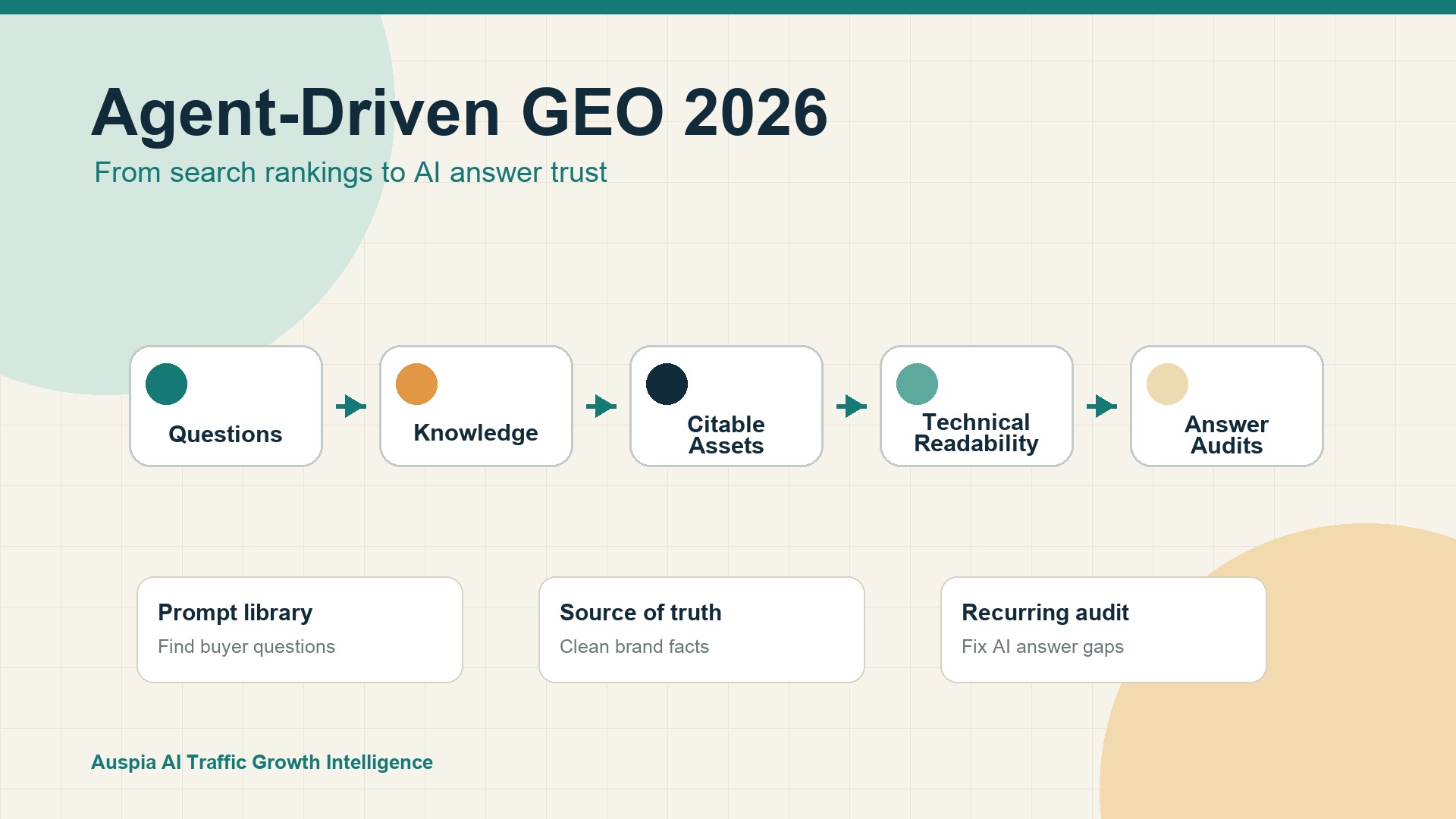
Agent-driven GEO goes one step further. Instead of treating GEO as a one-time content rewrite, it turns the work into a loop: collect buyer questions, structure brand facts, publish citable assets, test AI answers, fix gaps, and repeat. The brands that win this loop will not simply publish more content. They will maintain cleaner knowledge, stronger evidence, and faster correction cycles than their competitors.
A practical 2026 GEO program has five parts:
Layer | What it does | Typical agent role |
|---|---|---|
Question intelligence | Finds how buyers ask for advice in natural language | Builds prompt libraries and intent maps |
Knowledge assets | Turns messy product, service, proof, and policy data into reusable facts | Extracts entities, claims, tables, FAQs, and source links |
Citable content | Publishes pages that answer questions with evidence and boundaries | Drafts, checks, formats, and refreshes pages |
Technical readability | Helps crawlers and AI retrieval systems parse the content | Adds schema, alt text, transcripts, internal links, and llms.txt checks |
Answer auditing | Tests whether AI systems mention, cite, and describe the brand correctly | Runs recurring prompts and reports gaps |
The goal is not to trick AI models. The goal is to make the truthful version of your brand easier to retrieve than the vague, outdated, or competitor-framed version.
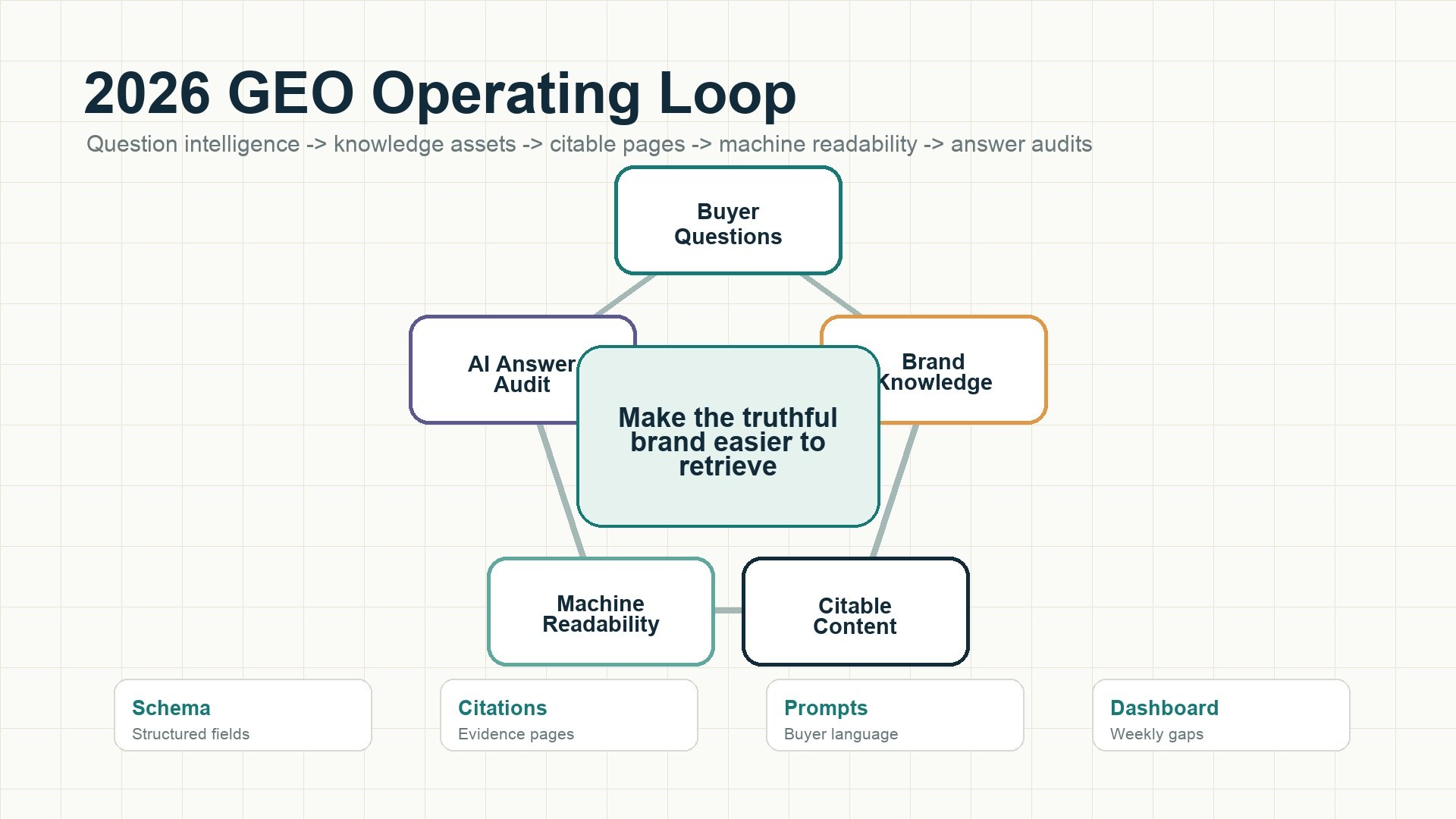
Caption: Agent-driven GEO works as a recurring loop: questions, knowledge, publishing, technical readability, and answer auditing.
Why 2026 changes the SEO conversation
For two decades, search marketing assumed that users would type a query, scan links, open pages, and make their own judgment. That flow still matters. But it is no longer the only flow.
A growing share of research now happens inside answer engines and AI assistants. Users ask for a shortlist, a comparison, a recommendation, a buying checklist, or a plain-English explanation. The interface collapses discovery, comparison, and early decision-making into one answer.
This changes the marketing surface in three ways.
First, the click is no longer guaranteed. A user may learn enough from an AI answer to form a preference before visiting any site. Visibility inside the answer becomes part of demand creation.
Second, the source is blended. AI systems may synthesize a brand's own pages, third-party reviews, documentation, forums, news articles, product feeds, and public datasets. If those sources disagree, the model may choose the clearest or most repeated version, not necessarily the newest or most accurate one.
Third, the buyer may not be human at the first step. User agents can already compare tools, summarize pages, fill forms, and execute tasks. As agent-to-agent workflows become more common, brands will need facts, policies, prices, availability, documentation, and proof that machines can call, parse, and validate.
That is why GEO in 2026 is bigger than "write content for ChatGPT." It is the discipline of managing brand knowledge in a world where AI systems sit between the user and the website.
From ranking assets to cognitive assets
SEO made teams care about pages: landing pages, blog posts, technical pages, category pages, backlinks, and search snippets. GEO makes teams care about cognitive assets.
A cognitive asset is any brand fact that helps an AI system answer a user's question accurately. Examples include:
Asset type | Weak version | GEO-ready version |
|---|---|---|
Product description | "A powerful AI platform for growth teams" | Clear use cases, inputs, outputs, limitations, supported platforms, pricing model, and example workflows |
Customer proof | "Trusted by leading teams" | Named or anonymized case detail, baseline, action, result, timeframe, and caveats |
Comparison page | "We are better than alternatives" | Feature-by-feature differences, when to choose each option, and what the product does not do |
Documentation | Scattered help articles | Structured docs with headings, schema, screenshots, changelog, and canonical answers |
Brand entity | Inconsistent bios across channels | One stable description, same naming, same categories, same official links, and same founder/company facts |
The practical test is simple: if an AI answer engine had to describe your company without hallucinating, could it find enough clear evidence?
Most companies fail this test in boring ways. The website says one thing, the LinkedIn page says another, old blog posts use outdated positioning, review sites list stale categories, product pages hide the real use cases, and case studies leave out numbers because they were written like ads.
Agent-driven GEO is useful because it can keep checking these inconsistencies. A brand-entity agent can compare public descriptions. A documentation agent can flag missing structured fields. A content refresh agent can identify pages that still rank but no longer match the product. A prompt-audit agent can show what AI systems say when buyers ask, "Which tools should I consider?"
The 2026 GEO operating loop
A GEO program should run like an operating loop, not a quarterly campaign.
Step 1: Build a buyer question map
Start with questions, not keywords. Keywords still help, but AI prompts are usually longer and more specific than classic search queries.
For example, a search keyword might be "AI SEO tool." A buyer prompt might be:
- "What is the best way to check whether my SaaS website is visible in ChatGPT and Perplexity?"
- "Which SEO tasks can be automated safely with AI agents?"
- "How should a small B2B team prepare its site for AI Overviews?"
- "What should I put in llms.txt, and does it actually help AI crawlers?"
Group these prompts by job-to-be-done: learn, compare, diagnose, implement, justify budget, and monitor. Then map each group to pages, tools, proof assets, and missing evidence.
Auspia users can start with a simple scan using the AI Search Visibility Checker, then turn the gaps into a prompt library for recurring audits.
Step 2: Clean the brand knowledge base
Before publishing new content, fix the facts that AI systems will retrieve.
Create one canonical knowledge base for:
- company description and product categories
- target customers and excluded use cases
- supported integrations, platforms, and languages
- pricing or packaging logic when public
- security, privacy, and compliance statements
- customer proof and case evidence
- common comparisons and alternatives
- official links and social profiles
The work is not glamorous. It is also where many GEO programs start to improve. If your facts are stable, every page, answer, schema block, and third-party profile becomes easier to keep consistent.
Step 3: Publish citable answer assets
A citable page is not just a page that contains keywords. It gives an AI system something safe to reuse.
Good citable assets usually have:
- a direct answer near the top
- clear definitions for entities and terms
- tables that compare options or criteria
- examples with constraints and caveats
- numbers with sources or context
- updated dates where freshness matters
- FAQ blocks that match real buyer questions
- internal links to supporting pages and tools
This is where the original SEO muscle still matters. Pages need crawlability, internal links, technical health, and topical coverage. GEO does not replace SEO. It raises the bar for what the page must explain.
Step 4: Make the content machine-readable
AI retrieval systems do not read pages like humans. They chunk, rank, summarize, and combine. That means presentation matters less than structure.
A 2026 technical checklist should include:
Technical element | Why it matters for GEO |
|---|---|
Schema markup | Helps systems identify products, FAQs, organizations, articles, reviews, and software applications |
Clean heading hierarchy | Makes chunking and extraction less error-prone |
Descriptive alt text | Gives multimodal systems context for charts, workflows, and screenshots |
Video transcripts | Makes demos and webinars available to text-based retrieval |
Freshness signals | Shows when claims, prices, features, and statistics were updated |
Internal links | Connects definitions, proof, tools, and conversion paths |
robots.txt and crawler rules | Avoids accidentally blocking useful AI or search crawlers |
llms.txt, where appropriate | Gives AI systems a curated map of important resources |
If you are not sure whether your site is readable to crawlers and answer engines, run a check with Auspia's SEO/GEO/AEO tools before rewriting half the blog.
Step 5: Audit AI answers on a schedule
GEO measurement cannot rely only on organic traffic. Some influence happens before the click.
Run a recurring audit across your most important prompts. Track:
- whether the brand is mentioned
- whether competitors are mentioned first
- whether the answer cites or references your content
- whether the description is accurate
- whether sentiment is positive, neutral, or negative
- whether the model recommends your brand for the right use cases
- which source appears to shape the answer
- what facts are missing or wrong
The result is not a vanity dashboard. It is a work queue. If answers do not mention you, build missing proof. If answers describe you incorrectly, fix public facts. If competitors own the comparison, publish a better comparison. If answers cite weak sources, strengthen the official source.
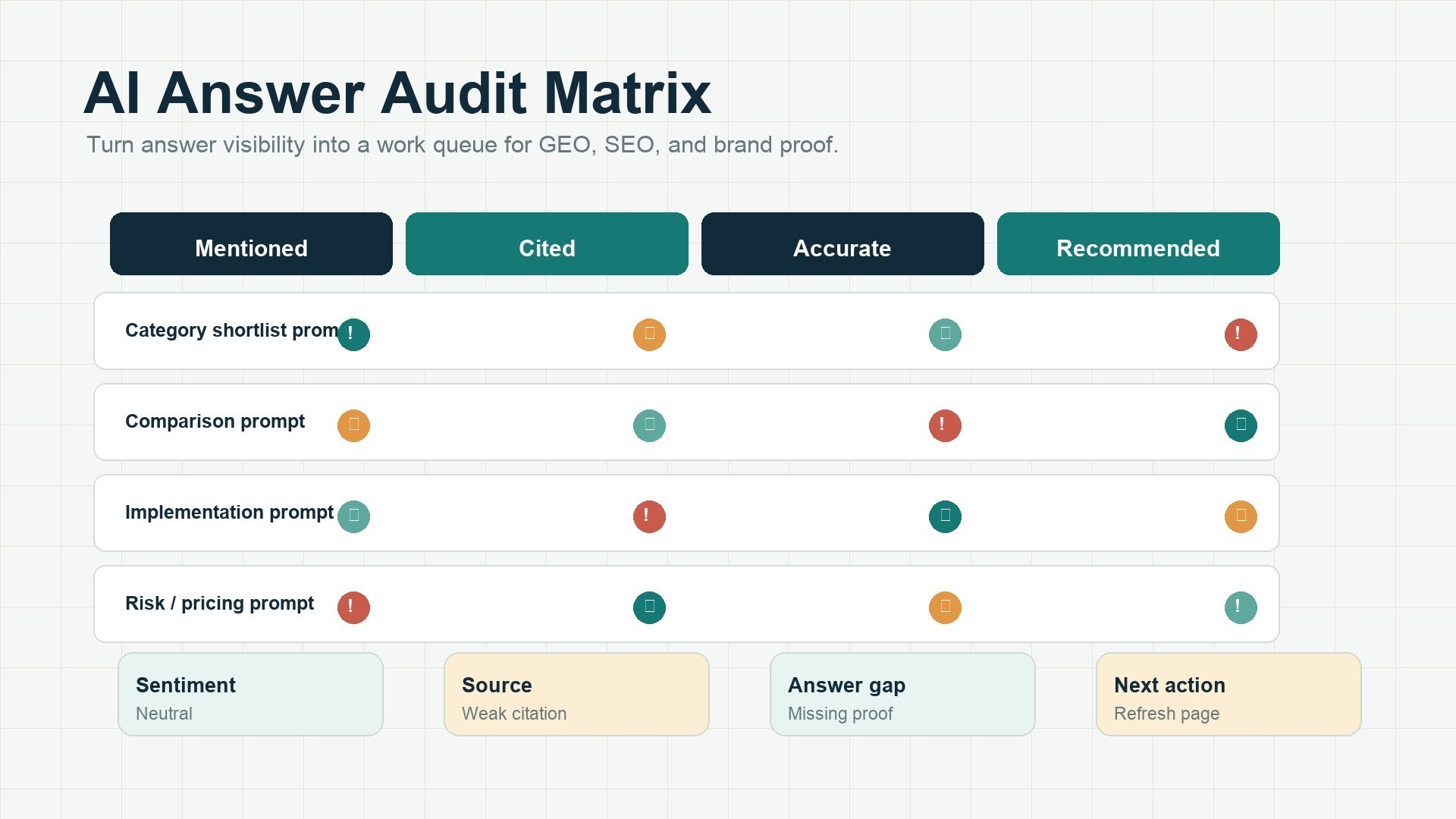
Caption: A recurring GEO audit turns AI answer visibility into a practical work queue for content, technical SEO, and brand proof.
What agents can do, and what they should not do
Agents are useful because GEO has too many moving parts for a small team to manage manually every week. A well-designed agent cluster can collect prompts, scan pages, draft updates, test answers, and prepare reports.
Useful GEO agent roles include:
Agent | Useful tasks | Human review needed |
|---|---|---|
Intent agent | Mines search data, support tickets, sales calls, forums, and reviews for buyer questions | Check whether prompts match real business priorities |
Knowledge agent | Extracts entities, product facts, proof points, and inconsistencies | Approve canonical facts and sensitive claims |
Content agent | Drafts answer pages, FAQs, comparisons, and refreshes | Review accuracy, tone, legal risk, and examples |
Technical agent | Checks schema, headings, links, alt text, redirects, and crawl rules | Approve changes that affect indexing or crawler access |
Audit agent | Runs prompts across AI systems and compares answers | Interpret results and decide what to fix first |
The mistake is letting agents create a large amount of plausible but thin content. That may look productive for a month and then become a liability. AI systems are getting better at ignoring pages that say a lot without proving much.
Use agents to remove manual drag. Do not use them to remove judgment.
Where most GEO programs break
The first failure mode is treating GEO as another publishing channel. Teams write "AI-friendly" articles but do not fix stale product data, missing documentation, conflicting category labels, or weak third-party evidence. The result is more content sitting on top of the same messy knowledge base.
The second failure mode is measuring the wrong thing. If the only KPI is organic sessions, the team may miss improvements in answer visibility, comparison inclusion, citation quality, and brand description accuracy. Those signals often move before traffic or conversions.
The third failure mode is confusing citations with endorsement. Being cited is useful, but the answer context matters. A brand can be mentioned as an alternative, a limited fit, an expensive option, or an outdated tool. GEO audits should capture how the brand is framed, not just whether it appears.
The fourth failure mode is ignoring governance. Agents that can edit pages, publish content, or change structured data need guardrails. Version control, approval rules, fact sources, rollback paths, and audit logs are not bureaucracy. They are how a team prevents fast mistakes from becoming public mistakes.
A practical 30-day starter plan
Here is a realistic first month for a small growth team.
Week | Focus | Output |
|---|---|---|
1 | Prompt and answer audit | 30 to 50 buyer prompts, competitor mentions, current AI answer gaps |
2 | Knowledge cleanup | Canonical company facts, product facts, use cases, proof points, comparison notes |
3 | Citable asset build | 3 to 5 pages or updates answering high-intent prompts with tables, FAQs, and evidence |
4 | Technical and measurement loop | Schema checks, crawler checks, llms.txt review, recurring answer audit dashboard |
Do not start with 100 new articles. Start with the prompts that shape revenue: category recommendations, vendor comparisons, "best tool for" questions, migration questions, pricing questions, risk questions, and implementation questions.
By the end of 30 days, you should know three things: where AI systems already understand you, where they ignore you, and where they describe you incorrectly. That is enough to build a serious roadmap.
Auspia take
The next version of SEO will look less like content publishing and more like knowledge operations.
That is good news for teams willing to do the unglamorous work. AI answer engines need clear facts, reliable sources, structured pages, and evidence-rich explanations. Those are not hacks. They are the same assets that help human buyers trust a company.
Agent-driven GEO matters because it gives teams a way to keep that system alive. Markets change, products change, prompts change, and AI systems change. A static website cannot keep up by itself. A monitored knowledge loop can.
The best 2026 strategy is not to chase every new AI search trick. Build the source of truth. Make it readable. Test how AI systems use it. Fix what they get wrong. Repeat until your brand becomes the easiest accurate answer in the category.
FAQ
Is GEO replacing SEO in 2026?
No. GEO depends on many SEO foundations: crawlable pages, clear information architecture, internal links, useful content, and technical health. The difference is that GEO optimizes for inclusion and accuracy inside AI-generated answers, not only for ranking and clicks.
What is agent-driven GEO?
Agent-driven GEO uses AI agents to run the recurring work behind generative engine optimization: prompt research, knowledge cleanup, content structuring, technical checks, AI answer audits, and refresh recommendations. Humans still need to approve facts, claims, positioning, and high-risk changes.
What should a company optimize first?
Start with the buyer prompts closest to revenue. These usually include category comparisons, vendor shortlists, implementation questions, pricing questions, risk questions, and "best solution for" prompts. Then check whether AI systems mention the brand accurately for those prompts.
Do brands need llms.txt for GEO?
llms.txt can be useful as a curated resource map, but it is not a magic ranking file. It works best when the underlying site already has strong content, clean structure, accessible docs, and crawler-friendly technical foundations.
How do you measure GEO performance?
Track AI answer visibility, brand mentions, citation sources, answer accuracy, sentiment, competitor inclusion, and prompt-level changes over time. Pair those signals with classic SEO metrics, direct traffic, assisted conversions, demo requests, and sales feedback.