The short version
Search behavior is moving from keyword boxes to answer boxes. People still use Google, but they also ask ChatGPT, Perplexity, Gemini, Claude, Copilot, and other AI assistants for shortlists, buying criteria, definitions, comparisons, and vendor recommendations.
That changes the job of growth teams. SEO asks, "Can we rank for the query?" GEO asks a sharper question: "When an AI system writes the answer, does it understand our brand well enough to cite us, mention us, or use our content as evidence?"
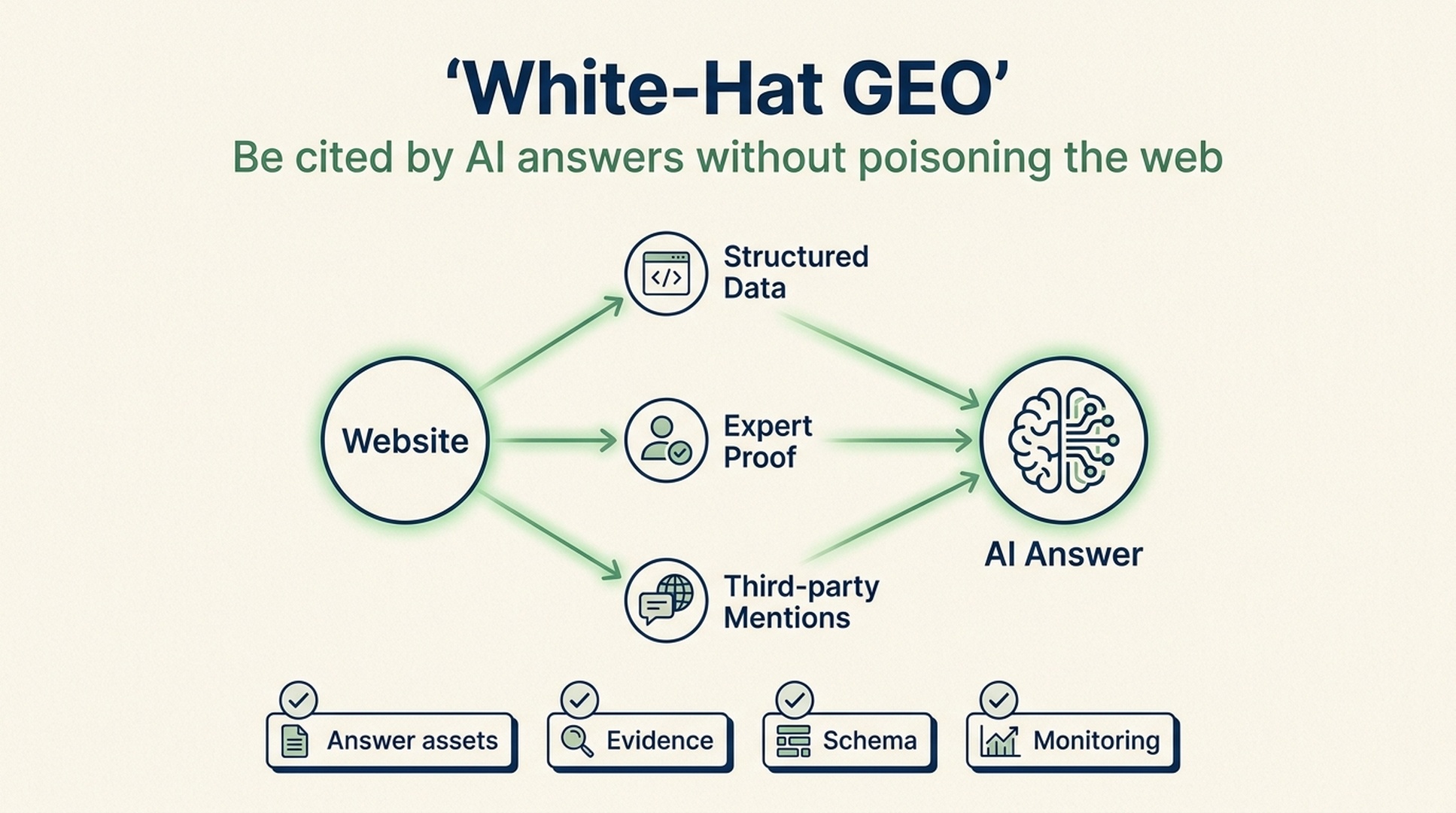
White-hat GEO is the answer. It is not fake review pages, citation farms, or mass-produced listicles. It is a disciplined way to turn your website, expert knowledge, product facts, case evidence, and third-party proof into crawlable answer assets that AI systems can trust.
A practical GEO program has four parts:
Layer | What it means | What to build |
|---|---|---|
Answer assets | Pages that directly answer real buyer questions | Guides, comparisons, glossaries, templates, FAQs |
Evidence | Proof that claims are real | Case studies, data, demos, benchmarks, named experts |
Machine readability | Clear structure for crawlers and answer systems | Schema, clean HTML, canonical pages, llms.txt where useful |
Monitoring | A way to see whether AI systems mention you accurately | Prompt sets, citation checks, answer audits, correction backlog |
If your brand is absent from AI answers, the fix is not to shout louder. The fix is to become easier to understand, easier to verify, and harder to ignore.
From search results to synthesized answers
Traditional SEO is built around a familiar chain: a user searches, scans a results page, clicks a link, then evaluates the landing page. Ranking still matters. For many commercial searches, it matters a lot.
GEO changes the path. The user asks a full question: "What is the best CRM for a 40-person consulting firm with long sales cycles?" or "Which cybersecurity vendors are strong for mid-market healthcare?" The AI assistant does not simply show ten blue links. It synthesizes an answer, often with a shortlist, a few citations, and a recommendation logic.
That means your brand can lose before the click ever happens. If the model never sees your evidence, cannot parse your pages, or finds stronger proof elsewhere, you may not appear in the answer at all.
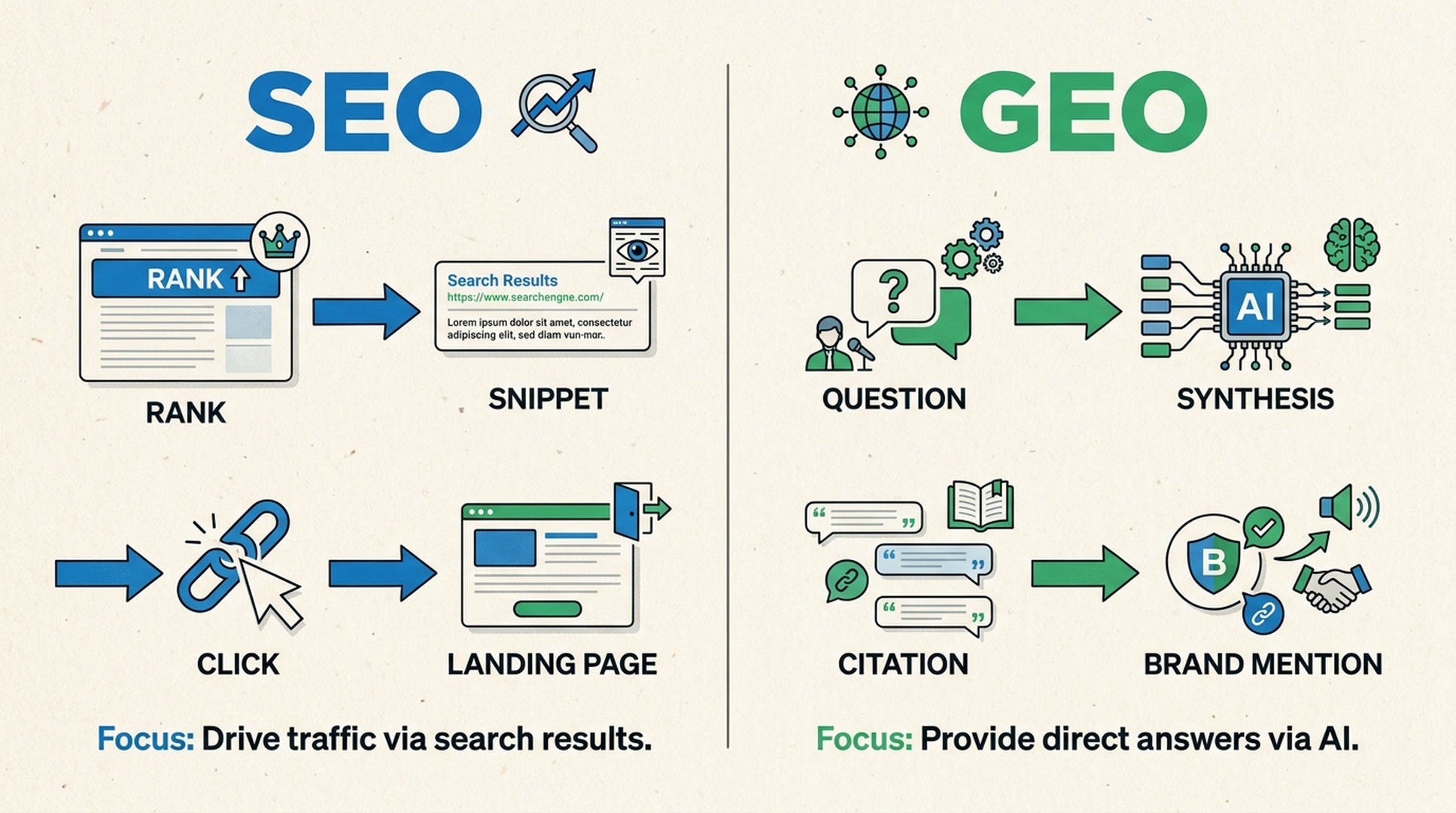
SEO still earns traffic through rankings and clicks. GEO earns visibility when AI systems synthesize answers and choose which sources or brands to mention.
This is why GEO should not be treated as a replacement for SEO. It is an extension of the same visibility problem into a new interface. Strong technical SEO, clear site architecture, and useful content still help. The difference is that the content must now survive an extra test: can an answer engine extract the point without a human clicking around your site?
What GEO actually means
GEO stands for Generative Engine Optimization. In plain English, it means improving the chance that AI answer systems understand, trust, and use your brand's public information when generating answers.
That includes several types of visibility:
- Being cited as a source in an AI answer.
- Being named as a relevant vendor, tool, expert, or example.
- Having your definitions, frameworks, or data reflected accurately.
- Having your brand positioned correctly against competitors.
- Avoiding wrong or outdated summaries about what you sell.
Notice what is missing from that list: "make AI say nice things about us." GEO is not reputation laundering. If your product is weak, your documentation is thin, or your proof is vague, AI systems have little reason to recommend you. GEO works best when it makes real expertise easier to discover.
A simple test: ask five AI systems the ten questions your best prospects ask before buying. If your brand does not appear, appears with errors, or appears only when the prompt names you first, you do not have a visibility problem in one tool. You have an evidence and structure problem across the web.
Why this matters for traffic and pipeline
The commercial impact is not limited to media companies losing clicks. AI answers affect the middle of the buying journey: problem framing, category education, vendor discovery, comparison, risk checking, and internal justification.
Gartner predicted in 2024 that traditional search engine volume would drop 25% by 2026 as users shift some queries to AI chatbots and virtual agents, a forecast widely cited in coverage of Google's AI search rollout. Pew Research Center later found that Google users were less likely to click traditional result links when an AI summary appeared. Independent analytics providers have also reported fast growth in LLM referral sessions, even though the absolute share is still smaller than search for most sites. The direction is clear enough: AI answers are becoming a discovery layer, not a novelty.
For B2B and high-consideration purchases, the risk is especially uncomfortable. Buyers may ask an assistant to create a shortlist before they ever visit vendor websites. They may ask for "best options," "common complaints," "alternatives to," or "what to ask on a demo." If your public evidence is weaker than a competitor's, the assistant may frame the market without you.
That is why Auspia treats GEO as an operating model, not a one-off content tactic. The question is not "Can we publish a GEO article?" The better question is: "Can every important buyer question find a trustworthy, crawlable answer that points back to our expertise?"
The bad version: content pollution dressed up as GEO
Every new channel attracts shortcuts. GEO is no different.
The lowest-quality version of GEO usually looks like this: generate thousands of thin pages, publish fake comparison lists, stuff brand mentions into low-trust sites, and hope retrieval systems pick them up. Some operators call it scale. It is closer to poisoning the commons.
The tactic can work briefly because AI retrieval systems often favor clearly formatted pages: headings, lists, tables, summaries, and repeated entities. A fake "top 10 tools" page can look machine-readable even when it is useless to a buyer.
The problem is durability. Search engines, AI platforms, and browsers all have incentives to reduce spam because bad answers damage user trust. If your GEO strategy depends on manufactured evidence, anonymous review pages, or copied definitions, you are building a liability. You may also train AI systems to associate your brand with low-quality neighborhoods.
A good rule: if you would be embarrassed to show a page to a real prospect on a sales call, do not publish it for AI crawlers.
The white-hat GEO operating loop
White-hat GEO starts with the buyer's question, not the algorithm. The work is slower than spam, but it compounds.
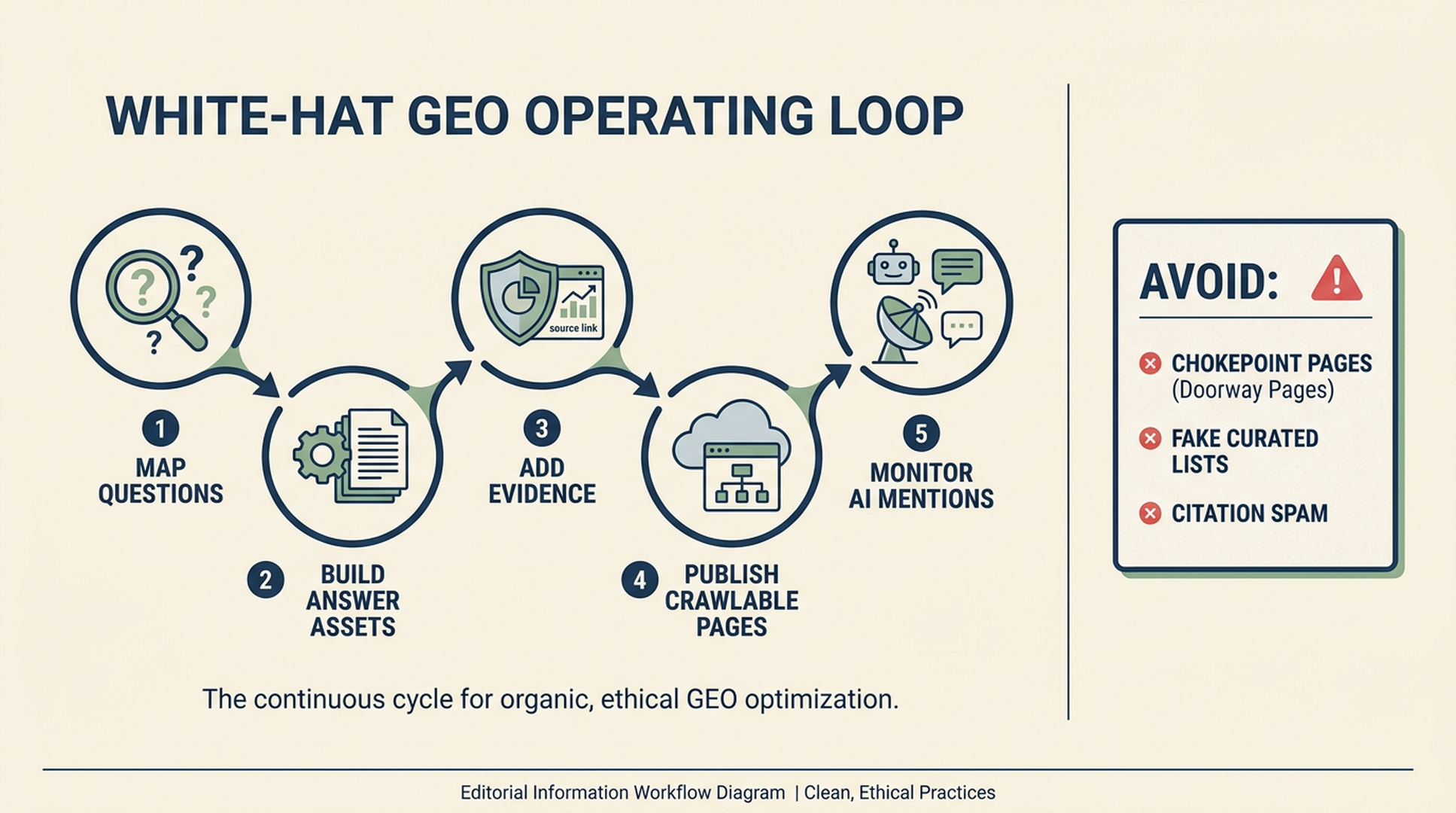
White-hat GEO is a loop: map questions, build answer assets, attach evidence, publish in crawlable formats, then monitor how AI systems describe the brand.
1. Map the questions AI systems are likely to answer
Start with prompts, not keywords. Keywords are still useful, but AI users ask in fuller language. Build a prompt library around:
- Category questions: "What is the best tool for..."
- Comparison questions: "A vs B for mid-market teams."
- Risk questions: "What are the limitations of..."
- Implementation questions: "How do we roll this out in 90 days?"
- Proof questions: "Which vendors have examples in this industry?"
This prompt library becomes your GEO measurement set. You can run it monthly across AI tools and record whether your brand appears, how it is described, and which sources are cited.
2. Build answer assets, not just blog posts
An answer asset is a page designed to resolve one decision point. It can be a blog post, but it can also be a comparison page, calculator, checklist, benchmark, glossary entry, template, case study, or product documentation page.
Good answer assets have a few traits:
- They answer the question in the first screen.
- They define terms without hiding behind jargon.
- They include specific examples, not generic advice.
- They separate facts, opinions, and assumptions.
- They give AI systems extractable headings, tables, and lists.
For example, a page titled "What is GEO?" should not spend 900 words warming up. It should define GEO, explain how it differs from SEO and AEO, show examples, list common mistakes, and link to tools that let readers check their own AI visibility. If the page is useful to a human buyer, it is usually easier for an answer engine to use too.
3. Attach evidence to claims
AI systems are not magic judges of truth. They infer trust from signals: source quality, repetition across credible pages, named entities, dates, links, structure, and consistency.
That means claims need receipts. "We improve AI visibility" is weak. A better evidence stack includes:
- Named case studies with the industry, problem, action, and outcome.
- Original research or benchmarks, with methodology notes.
- Product screenshots, demos, docs, and changelogs.
- Author bios that show real experience.
- Third-party mentions from credible publications, directories, podcasts, communities, or customer pages.
Do not invent numbers to satisfy a content calendar. If results are illustrative, label them as illustrative. The fastest way to damage GEO is to teach AI systems a claim you cannot defend.
4. Make pages technically easy to parse
Crawlability sounds boring until it costs you visibility. AI answer systems still depend on retrievable web documents. If your content is hidden behind scripts, buried in PDFs, blocked by robots rules, or stripped of structure, it is harder to use.
A technical GEO checklist should include:
Check | Why it matters |
|---|---|
Clean HTML headings | Helps systems understand sections and extract answers |
Schema markup | Clarifies entities, products, FAQs, articles, reviews, and organizations |
Canonical URLs | Reduces duplicate or conflicting versions of the same claim |
Accessible internal links | Helps crawlers connect related evidence |
Fresh dates and authors | Makes information easier to evaluate |
Robots and AI crawler policy | Prevents accidental blocking of useful pages |
llms.txt, where appropriate | Gives AI systems a curated map of important pages |
Auspia's AI search visibility checker is a practical starting point if you need to see how your brand shows up in AI answers today. For crawl policy and discoverability, review your robots rules and consider whether an llms.txt file would help guide AI systems to the right content.
5. Monitor answers like you monitor rankings
GEO is hard to measure perfectly, but it is not impossible to measure usefully.
Track a stable set of prompts across the AI systems your buyers are likely to use. For each prompt, record:
- Was the brand mentioned?
- Was it cited or only named?
- Which sources were used?
- Was the description accurate?
- Which competitors appeared?
- Did the answer include outdated or wrong claims?
- What content gap would make the answer better next month?
This is not the same as attribution reporting. You may not know exactly how many deals came from one AI mention. But you can measure share of answer, source quality, accuracy, and movement over time. That is enough to manage the channel before clean attribution catches up.
What most teams get wrong
The biggest mistake is treating GEO as a prompt hack. Teams ask, "How do we make ChatGPT recommend us?" and then look for a trick. The better question is, "What would make any reasonable answer system confident enough to include us?"
That shift changes the work:
Weak GEO habit | Better habit |
|---|---|
Publishing generic "best tools" pages | Publishing criteria-led comparisons with clear use cases |
Repeating brand claims across low-quality sites | Building proof on credible owned and earned properties |
Optimizing one chatbot manually | Testing across a stable prompt set and multiple systems |
Chasing mentions only | Checking accuracy, citations, and buyer usefulness |
Treating schema as a silver bullet | Combining schema with real content and evidence |
The second mistake is ignoring the rest of the web. Your website matters, but AI systems learn from many public surfaces: docs, reviews, communities, YouTube transcripts, podcasts, marketplaces, partner pages, analyst notes, GitHub, Wikipedia-like references, and news coverage. If those sources describe you inconsistently, your own homepage cannot fix the whole problem.
The third mistake is overpromising internally. No one can guarantee that a model will cite you next week. GEO improves the conditions for being selected. It does not give you a remote control for AI answers.
A 30-day starter plan
If you are starting from zero, do not boil the ocean. Pick one product line, one buyer segment, and one topic cluster.
Week 1: build the prompt map. Collect 30 to 50 buyer questions from sales calls, support tickets, keyword research, competitor pages, and AI answer testing. Group them by intent: education, comparison, risk, implementation, proof.
Week 2: audit current visibility. Run those prompts across three to five AI systems. Note where your brand appears, where competitors appear, which sources are cited, and which claims are wrong or missing.
Week 3: publish or improve answer assets. Prioritize pages that answer high-intent questions and can be backed by evidence. Add concise definitions, comparison tables, implementation steps, author notes, schema, and internal links.
Week 4: build the correction loop. Fix inaccurate public information, pitch credible third-party mentions where appropriate, update stale docs, and create a monthly AI answer audit. Use Auspia's GEO resources as a reference point for turning AI visibility into a repeatable operating process.
By the end of 30 days, you should have a baseline. Not a miracle. A baseline is enough: which prompts matter, where you are invisible, which evidence is missing, and which pages need to exist next.
Notes on the data
This article uses third-party signals as directional evidence, not as a promise that every market will move at the same speed. The search-volume forecast comes from Gartner reporting cited by Wired. The click-behavior reference comes from Pew Research Center's 2025 study on Google AI summaries. Treat both as prompts for planning: measure your own prompts, AI referrals, and assisted conversions before changing budget.
FAQ
Is GEO more important than SEO?
For most teams, GEO is not more important than SEO in a simple either-or sense. SEO still drives measurable traffic and captures high-intent demand. GEO matters because AI answers now influence discovery, shortlisting, and category understanding before the click. The strongest programs combine both.
Can GEO guarantee citations in ChatGPT or Perplexity?
No. Any vendor promising guaranteed citations is overselling. GEO can improve your odds by making your information clearer, more credible, and easier to retrieve. The final answer still depends on the user's prompt, the system used, available sources, model behavior, and retrieval settings.
What is the difference between GEO and AEO?
AEO, or answer engine optimization, focuses on direct answers in search and assistant experiences. GEO focuses specifically on generative systems that synthesize answers from multiple sources. In practice, the work overlaps: clear answers, structured pages, credible evidence, and entity consistency help both.
Should we create llms.txt for GEO?
It can help as a curated map of important AI-readable pages, especially for documentation-heavy sites. It is not a ranking switch. Treat llms.txt as one discoverability aid alongside clean internal links, schema, robots rules, and strong canonical pages.
How often should we audit AI answers?
Monthly is a good starting cadence for most B2B teams. Audit more often after a product launch, rebrand, pricing change, or major content push. Keep the prompt set stable enough to compare movement over time.
Auspia takeaway
GEO rewards the companies that do the unglamorous work: clarify what they know, prove what they claim, publish it in formats machines can parse, and check how the market's answer systems describe them.
That is good news. It means the path is not reserved for brands with the loudest ad budgets or the most aggressive content farms. It is open to teams willing to build real answer infrastructure.
When your buyer asks an AI assistant for advice, the question is not just whether your site ranks. The question is whether your expertise is present, trusted, and specific enough to become part of the answer.