Quick answer
GEO will not replace SEO. It sits on top of SEO.
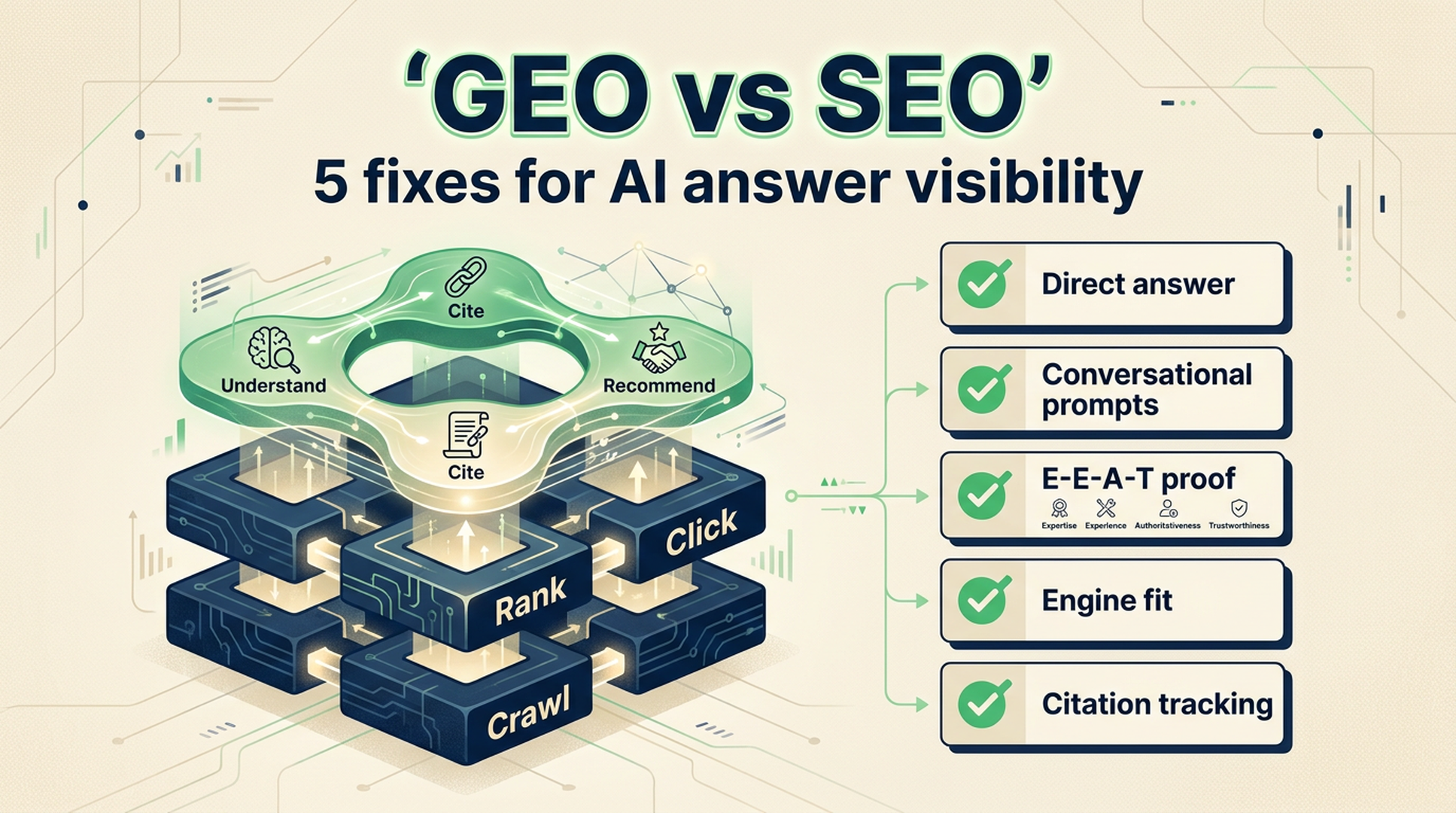
SEO helps pages get crawled, indexed, ranked, and clicked. GEO helps the same content get understood, verified, cited, and recommended inside AI-generated answers. If your site is hard to crawl, thin on proof, or vague about what it does, GEO cannot rescue it. If your SEO foundation is sound, GEO can make that foundation useful in ChatGPT, Gemini, Perplexity, Google AI Overviews, Bing Copilot, and other answer surfaces.
The practical shift is this: ranking is no longer the only outcome to measure. You also need to know whether AI systems can quote your page, summarize it correctly, and connect your brand to the right problem.
What GEO means in plain English
GEO stands for Generative Engine Optimization. It is the work of making your content easier for AI answer systems to understand, trust, and reuse.
Traditional SEO asks: "Can a search engine find and rank this page?"
GEO asks a second question: "Can an AI answer system use this page as a reliable source?"
That difference matters because many users no longer move through search in the old order: query, results page, click, compare pages. They ask a tool a full question and expect a synthesized answer. Sometimes the answer includes citations. Sometimes it names brands. Sometimes it gives a recommendation without sending much traffic to the source.
For growth teams, GEO is not a shiny replacement for SEO. It is a response to the zero-click and answer-first search behavior that is already changing how discovery works.
SEO and GEO are different jobs
The easiest mistake is to frame SEO and GEO as competitors. They solve different parts of the same discovery problem.
Dimension | SEO | GEO |
|---|---|---|
Primary goal | Rank in search results and win clicks | Appear in AI answers and citations |
Core audience | Search engine crawlers and human searchers | Retrieval systems, answer engines, and users |
Content shape | Topic pages, landing pages, articles, category pages | Direct answers, evidence blocks, FAQs, explainers, comparison sections |
Trust signal | Links, technical health, authority, relevance | Verifiable claims, source clarity, entity consistency, citation usefulness |
Measurement | Rankings, impressions, CTR, traffic, conversions | Citation presence, answer accuracy, brand mentions, prompt coverage |
The relationship is simple: SEO creates the crawlable, indexed base. GEO upgrades the base so answer engines can use it with confidence.
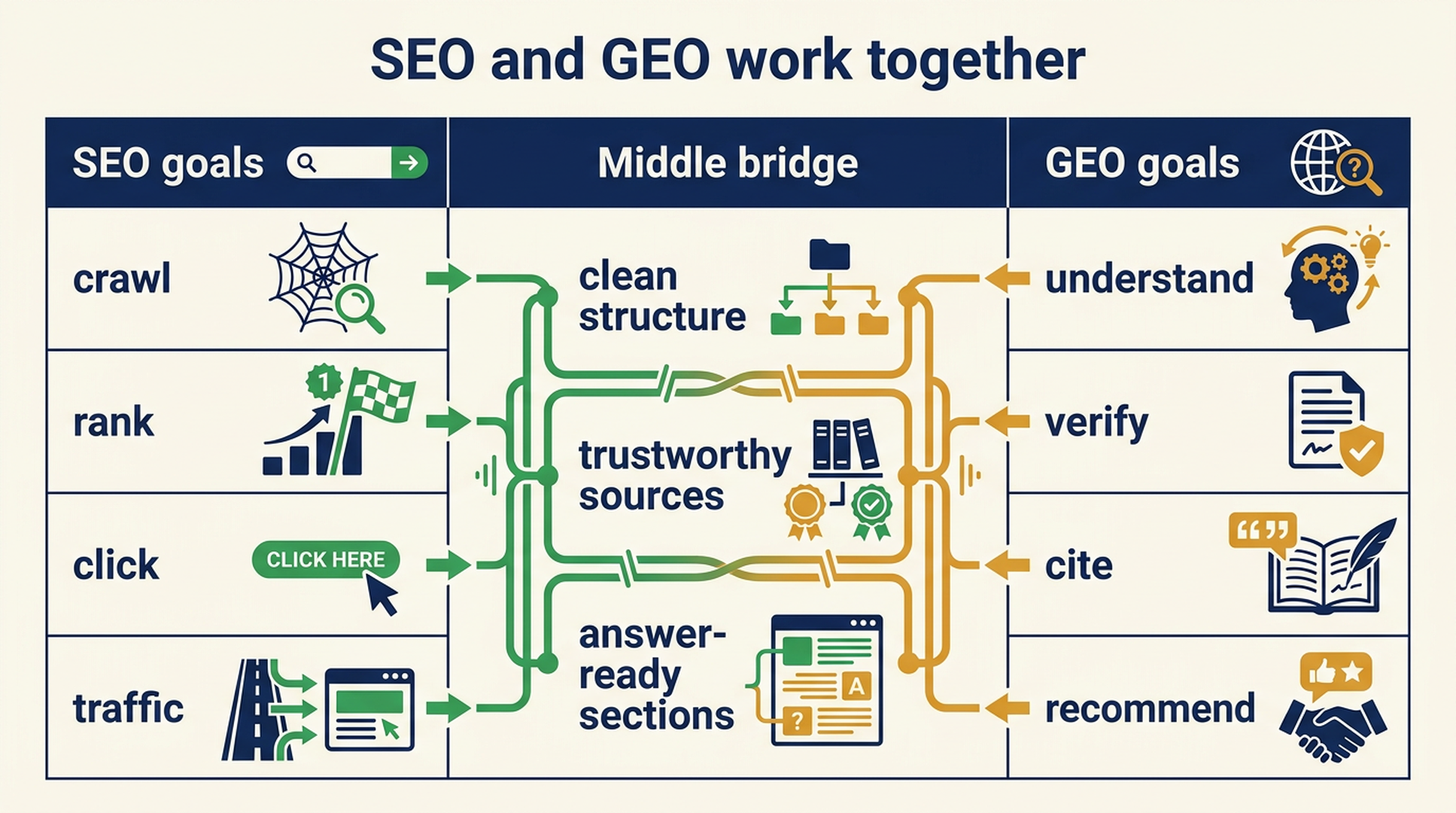
Caption: SEO and GEO work together. Crawlable pages still matter, but AI visibility depends on answer-ready proof.
How AI answer systems choose source material
Every system works differently, and the details change often. Still, most answer engines follow a rough pattern.
First, the user's question gets interpreted. A long question may be broken into smaller intents, entities, or related searches. "Best CRM for a 20-person agency with HubSpot integration" is not only a CRM query. It also includes company size, use case, integration needs, and comparison intent.
Second, the system retrieves candidate sources. This is where normal SEO still matters. If pages are blocked, slow, unclear, poorly linked, or missing from the index, they have fewer chances to become source material.
Third, the system extracts answer fragments. Pages with direct conclusions, clean headings, specific examples, and verifiable claims are easier to summarize than pages built around vague intros and slogans.
Finally, the system generates a response. It may cite sources, list products, compare options, or summarize a concept. Your brand can lose visibility at any step: not retrieved, not understood, not trusted, or not useful enough to include.
Five GEO fixes to apply to existing SEO content
You do not need to rebuild the whole site. Start by upgrading pages that already rank, already convert, or already answer high-intent questions.
1. Lead with the answer
AI systems and readers both benefit when the page gives a clear answer early.
Weak opening:
In today's fast-moving digital environment, many companies are exploring different ways to improve customer support while balancing efficiency, quality, and cost.
Better opening:
For a B2B SaaS company with more than 500 monthly support tickets, a help center should usually be built before adding a chatbot. The help center creates the source material the chatbot needs to answer accurately.
The second version is easier to cite because it states the conclusion, audience, condition, and reason. You can still add nuance later. Do not make the reader or the model hunt for the point.
2. Use real prompt language
AI search is conversational. People ask specific questions, not only short keywords.
Instead of building a page around "project management software," add sections that match real questions:
- "What project management software works best for a 15-person creative agency?"
- "Do small teams need resource planning or just task tracking?"
- "When should an agency move from spreadsheets to project management software?"
This does not mean stuffing long-tail keywords into every heading. It means writing around the way buyers actually ask for help. Sales calls, support tickets, Reddit threads, product reviews, community posts, and internal search logs are good sources for prompt language.
3. Add E-E-A-T proof where claims appear
AI systems tend to favor content that looks safe to reuse. That usually means the page has clear ownership, author context, evidence, and consistency across sources.
Add proof close to the claim:
Claim | Stronger support |
|---|---|
"Our platform reduces onboarding time" | Explain the benchmark, sample, time period, and setup conditions |
"This method is safer" | Link to standards, documentation, audit notes, or test criteria |
"Best for agencies" | Define agency size, workflow, integrations, and trade-offs |
"Works with Salesforce" | Link to integration docs and update date |
Avoid invented precision. A real limitation is more trustworthy than a fake percentage.
4. Tune pages for different answer surfaces
GEO is a broad practice, but answer systems have different habits.
Google AI Overviews often surface concise informational answers connected to web results. Perplexity is citation-forward and tends to reward source clarity. ChatGPT and Copilot may rely on a mix of retrieval, browsing, partner data, and model memory depending on the product mode. Gemini can blend search context with Google's broader ecosystem.
Do not chase every platform with a separate content strategy. Instead, make the same source stronger:
- Use clear definitions for informational queries.
- Add comparison tables for evaluation queries.
- Keep source links visible and current.
- State dates on fast-changing pages.
- Use consistent product and company names across the site.
- Give answer engines a page worth citing, not only a page worth ranking.
5. Track citations, not just traffic
In SEO, a traffic drop usually gets attention quickly. In GEO, the early signals can be quieter. Your page may influence a buyer inside an AI answer without producing an immediate click.
Track a small prompt set every month:
- Brand prompts: "What does [brand] do?"
- Category prompts: "Best tools for [use case]."
- Comparison prompts: "[brand] vs [competitor]."
- Problem prompts: "How do I solve [specific pain]?"
- Trust prompts: "Is [brand] reliable for [scenario]?"
Record whether your brand appears, whether the description is accurate, which sources are cited, and whether competitors appear with stronger evidence. Auspia's AI Search Visibility Checker can help turn this into a repeatable diagnostic instead of a one-off manual check.
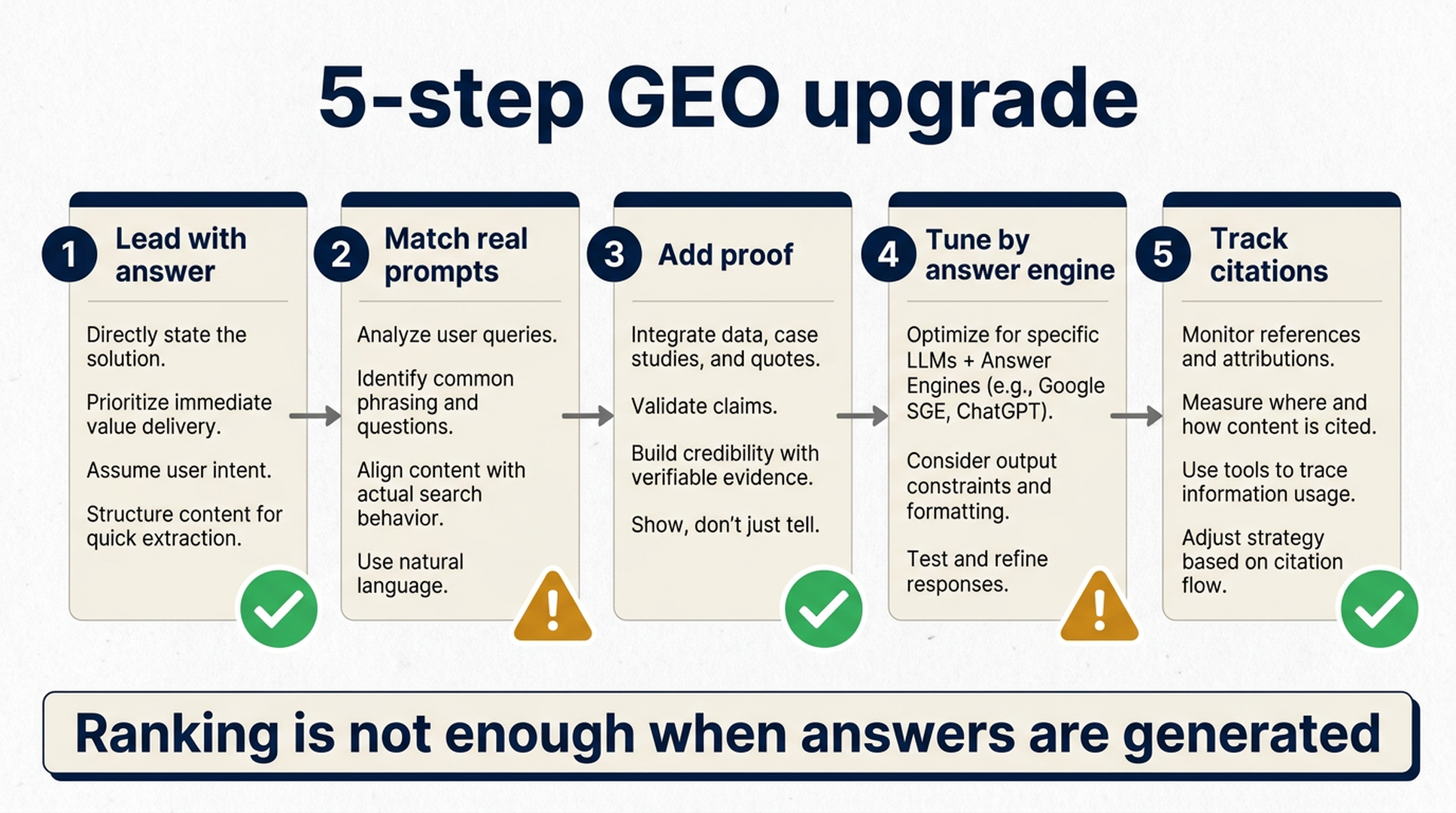
Caption: A practical GEO upgrade starts with direct answers and ends with monthly citation tracking.
A simple SEO-to-GEO upgrade checklist
Use this checklist on any page that already receives search impressions or supports a buying decision.
- Put a direct answer or summary in the first 100 words.
- Rewrite vague H2s as real user questions where appropriate.
- Add one comparison table, checklist, or decision framework.
- Attach proof to specific claims, not only to the end of the article.
- Add author, company, and update-date signals when trust matters.
- Make the page available in clean HTML, not only as a PDF or image.
- Add relevant schema, such as FAQPage, Article, Product, Organization, or HowTo.
- Link to official documentation, product pages, support pages, or tools.
- Test the target prompts in several AI systems after publishing.
For technical access checks, review your crawler rules and AI discovery files. The LLMs.txt Generator / Checker is a useful starting point if your team wants a cleaner path for AI systems to find priority resources.
What most teams get wrong
The common failure is treating GEO like a formatting trick. Adding an FAQ block to weak content will not make the page a reliable source.
GEO works when the underlying page deserves to be cited. That means the page answers a real question, names the relevant entities, gives evidence, avoids fuzzy claims, and stays current. The formatting helps the model extract the value. It does not create the value.
Another mistake is measuring only clicks. Clicks still matter. Revenue still matters. But AI search can influence awareness and consideration before the user visits your site. If you only watch analytics, you may miss a shift in how buyers first learn about your category.
Auspia take
GEO is not the end of SEO. It is the next operating layer for teams that already care about organic discovery.
The best sequence is boring but effective:
- Keep the SEO foundation healthy.
- Rewrite priority pages so the answer is obvious.
- Add proof and source clarity.
- Make content accessible to crawlers and answer systems.
- Track AI mentions, citations, and answer accuracy over time.
If you are starting now, do not try to optimize every page. Pick five pages that already matter: one homepage or about page, one category page, one comparison page, one educational article, and one support or documentation page. Upgrade those first. Then test whether AI systems understand your brand more accurately.
FAQ
Will GEO replace SEO?
No. GEO depends on many SEO basics: crawlability, indexability, content quality, internal links, and technical health. GEO adds a second goal: making content useful inside AI-generated answers.
What is the difference between SEO and GEO?
SEO focuses on rankings and clicks from search results. GEO focuses on whether AI answer systems can understand, trust, cite, and recommend your content.
What is the fastest GEO improvement for an existing article?
Add a direct answer near the top, rewrite headings around real user questions, and attach proof to important claims. Those changes make the page easier to extract and cite.
Do FAQs help with GEO?
FAQs help when the questions match real user prompts and the answers are specific. A generic FAQ added only for markup will not do much.
How should GEO performance be measured?
Measure prompt coverage, citation presence, answer accuracy, brand mentions, source quality, and assisted conversions. Keep traditional SEO metrics too, but do not rely on traffic alone.