Quick answer
GEO content does not have to start with a new budget or a huge publishing team. Most brands already have usable expertise in product docs, support notes, research pages, comparison sheets, webinars, and sales enablement decks. The job is to reshape that expertise into formats AI answer systems can parse, verify, and cite.
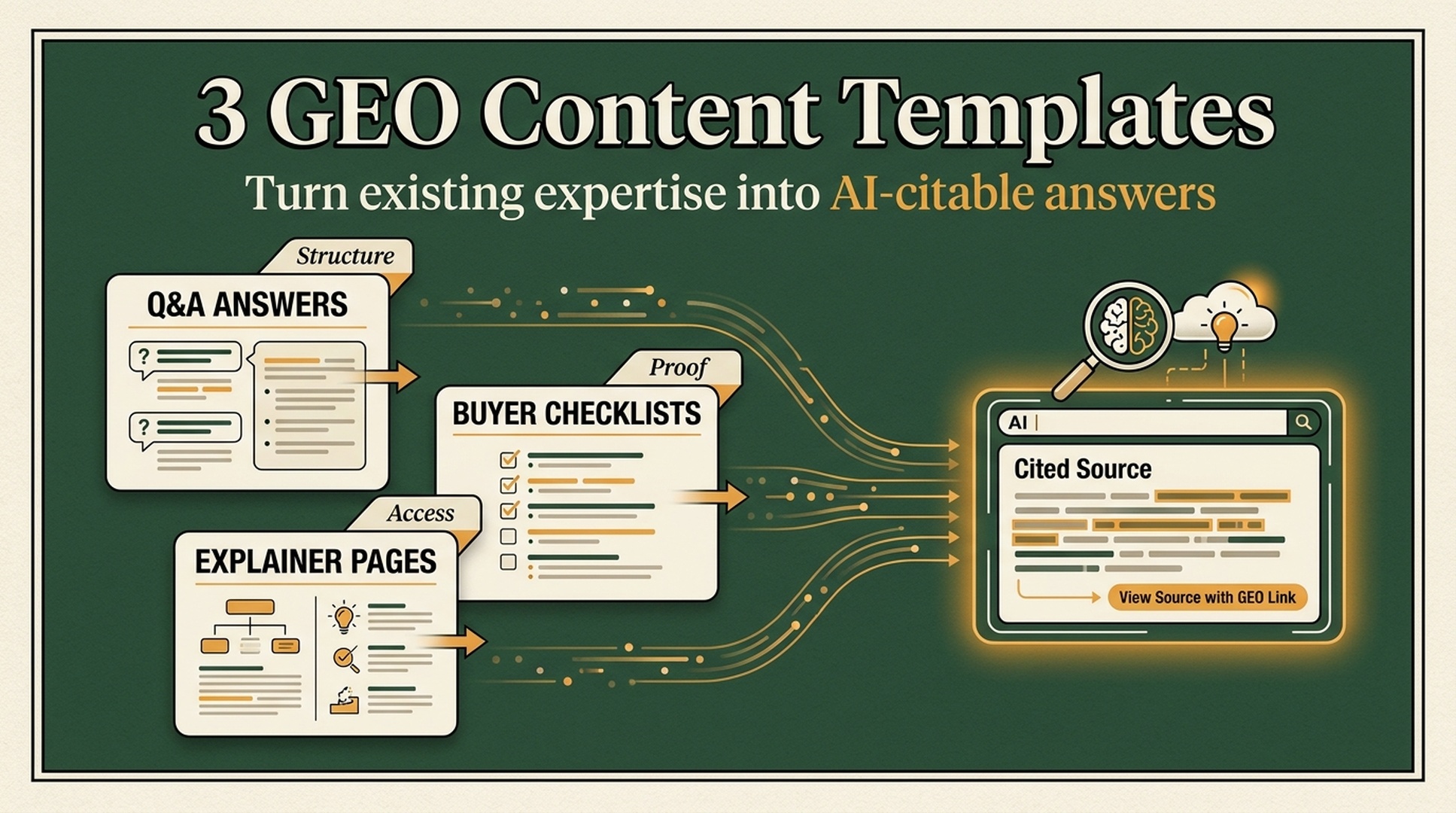
Three templates work especially well:
- Q&A answer pages for direct user prompts.
- Buyer checklist pages for recommendations and comparisons.
- Explainer pages for concepts where the brand has real expertise.
The catch: structure alone is not enough. Each template needs accessible HTML, specific claims, proof, and a clear reason for the brand to belong in the answer.
Why GEO content is different from ordinary blog content
Traditional SEO content often tries to win a click. GEO content has a different first test: can an AI system confidently reuse the page when it answers a user?
That changes the writing brief. A useful GEO page needs to be easy to break into answer-sized pieces. It needs clear entities, direct claims, dates where relevant, evidence, and plain language. If the page hides its best point in a long intro, buries data inside an image, or makes claims without proof, it becomes harder for an answer system to use.
This is good news for lean teams. You do not need to outspend larger competitors on media. You need to publish the cleanest answer to a real prompt, backed by evidence the model can understand.
Template 1: Q&A answer pages
Use this template when customers ask direct questions before they buy. These pages work because they match the shape of AI prompts.
A strong Q&A page is not a thin FAQ. Each answer should include:
- A one-sentence conclusion.
- The reason behind the conclusion.
- Evidence, such as test data, documentation, third-party certification, expert review, or customer research.
- A practical next step.
- A natural product or service mention only when it helps the answer.
For example, a cybersecurity company should not publish a vague answer like "zero trust improves security." A better Q&A page would answer: "Do remote teams need device posture checks for zero trust access?" The answer can explain when posture checks matter, which device signals are useful, what compliance frameworks expect, and how the company's product handles those checks.
A simple structure:
Question: Do remote teams need device posture checks for zero trust access?
Short answer: Yes, if employees access sensitive apps from unmanaged or mixed devices.
Why: Identity alone cannot confirm whether the device is patched, encrypted, or risky.
Proof: Link to documentation, standards, test results, or customer research.
How to apply: List the minimum policy and common exceptions.
Where the product fits: Explain the specific feature without turning the answer into an ad.
Use Q&A pages for support-heavy categories, regulated products, technical buyers, medical or financial decision journeys, and any market where users ask "should I," "can I," "how do I," or "what happens if" questions.
Template 2: buyer checklist pages
Checklist content works when the user is comparing options. AI systems often need a compact way to explain what to consider, which options fit which use cases, and what trade-offs matter.
A good checklist is more than a numbered list. Each item needs a decision criterion, a measurable signal, and a warning against a bad shortcut.
Use this format:
Checklist item | What the buyer should verify | Proof to include |
|---|---|---|
Fit for use case | Which audience, workload, or scenario the product serves | Use-case examples, specs, setup notes |
Performance or quality | The metric that actually matters | Benchmarks, test method, sample size |
Risk control | What can go wrong after purchase | Security, support, warranty, compliance docs |
Integration | Whether it fits the existing workflow | API docs, supported platforms, migration notes |
Total cost | What is included or excluded | Pricing page, implementation notes, contract terms |
For a project management software brand, a checklist page could compare tools for agencies, in-house marketing teams, and product teams. For a running shoe brand, it could compare shoes by training distance, runner weight, surface, injury history, and race goal. For a B2B data platform, it could compare options by latency, governance, connector coverage, and maintenance cost.
The point is not to claim that your product is best for everyone. The page becomes more citeable when it says who should not choose you. That honesty gives the answer system cleaner decision boundaries.
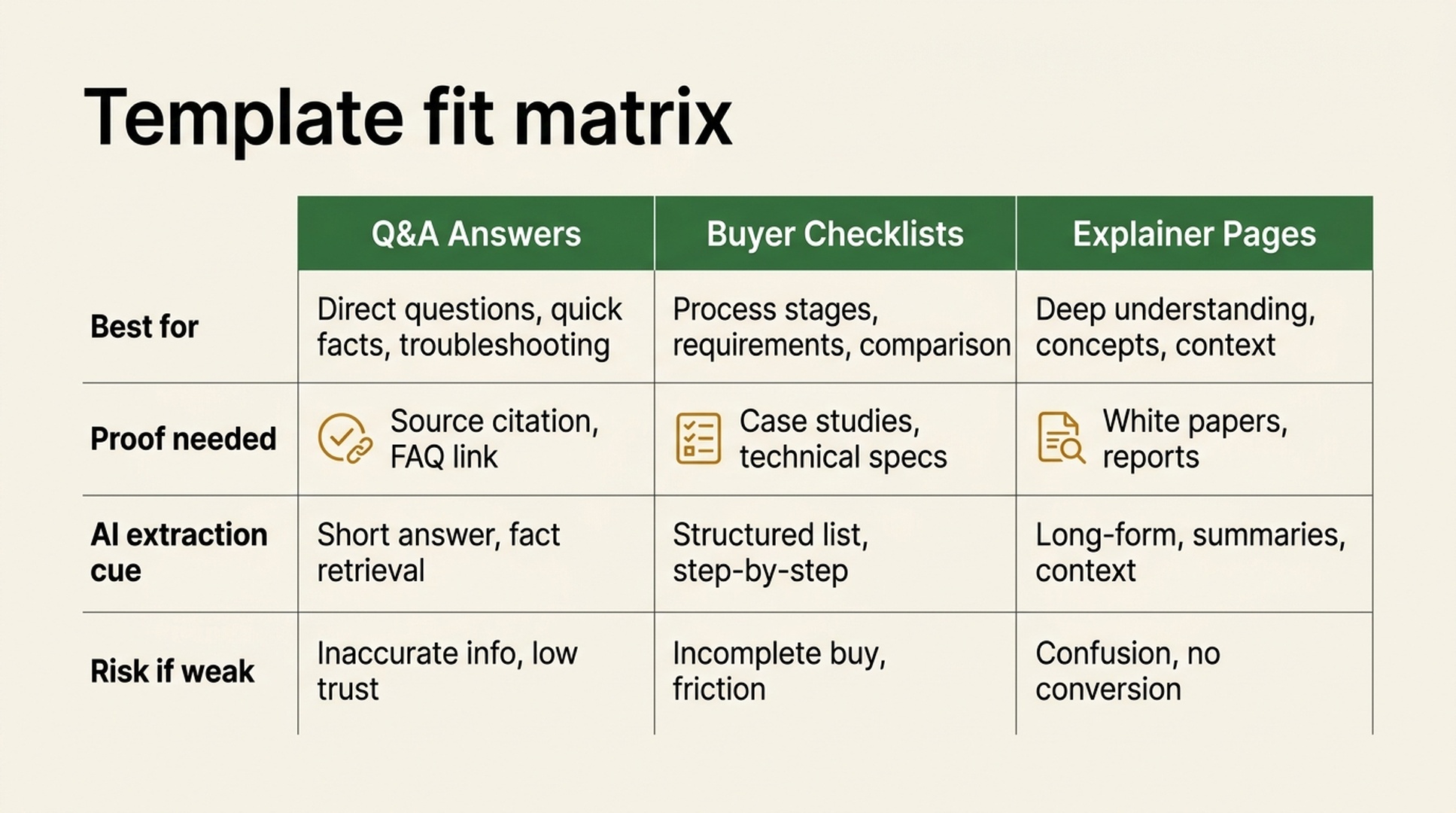
Caption: Choose the GEO template based on the prompt shape, proof type, and decision risk.
Template 3: explainer pages
Explainer pages help when the market is confused, technical, or full of weak definitions. They let a brand become a knowledge source without forcing a sales pitch into every paragraph.
A strong explainer page should include:
- A simple definition.
- What the concept is often confused with.
- Why the concept matters in a real buying or operating context.
- A concrete example.
- A short framework or checklist.
- Sources or proof.
- A clear link to where the brand has earned the right to speak.
For example, a supply chain platform could explain "supplier risk scoring" with definitions, risk categories, sample scoring criteria, data sources, and a worked example. A healthcare software company could explain "prior authorization automation" with workflow steps, compliance constraints, and implementation risks.
The brand mention should be restrained. The explainer earns trust by making the subject easier to understand. If the reader is ready to evaluate tools, give them a path. If not, let the page stand as a useful source.
The proof layer AI systems need
The original mistake many teams make is treating GEO templates as content shapes only. The shape helps, but citation readiness depends on proof.
Use proof that a reader can verify:
Claim type | Better proof | Weak proof |
|---|---|---|
Product performance | Test method, benchmark, sample size | "Fast and powerful" |
Safety or compliance | Certification, audit note, policy page | "Enterprise-grade" |
User fit | Use-case limits and examples | "For teams of all sizes" |
Market education | Source links, definitions, date context | Unsourced trend claims |
Customer outcome | Case study with constraints | Anonymous percentage with no context |
If a claim would look suspicious in a sales deck, it will not become stronger in a GEO article. Tighten it or remove it.
Make the page accessible to AI systems
Even the best template can fail if the page is hard to retrieve or parse. Keep the technical layer boring and clean.
Check the basics:
- Publish the core answer in HTML, not only inside PDFs, videos, image carousels, or gated forms.
- Use descriptive H2 and H3 headings that match user questions.
- Add schema where it fits, such as FAQPage, Product, Article, Organization, or HowTo.
- Keep product names, company names, and acronyms consistent.
- Link to official documentation, pricing, comparison, or support pages when useful.
- Make sure important pages are not blocked from relevant crawlers.
- Keep dates visible on pages that discuss fast-changing topics.
Auspia's Robots.txt AI Crawler Checker and LLMs.txt Generator / Checker are useful here because content quality and crawler access have to work together.
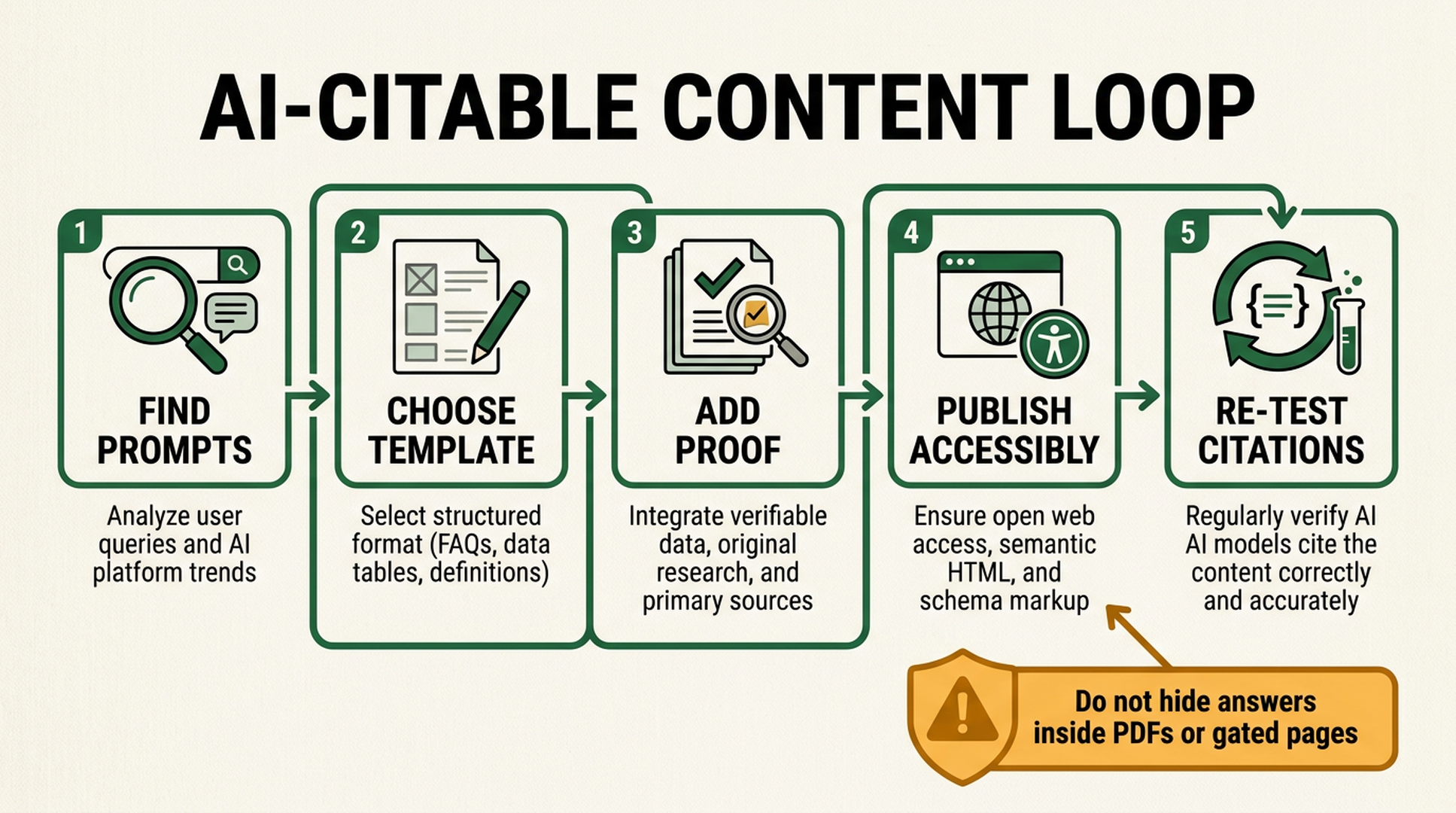
Caption: GEO content improves when teams test prompts, publish proof-backed pages, and re-test citations over time.
How to turn existing assets into these templates
Start with material your team already trusts. You are not inventing new claims. You are packaging existing expertise so it can be found and reused.
A practical repurposing plan:
- Pull 20 sales questions, support tickets, demo objections, and comparison queries.
- Group them into Q&A, checklist, and explainer opportunities.
- Find internal proof: docs, product specs, certifications, case studies, benchmarks, expert notes.
- Pick 3 pages to publish first, one from each template.
- Add direct answers near the top of each page.
- Link the page to a relevant product, tool, or documentation path.
- Test the target prompts in several AI answer systems.
- Track whether the answer becomes more accurate, more specific, or more likely to cite your page.
Do not turn every asset into a blog post. Some should become documentation pages, comparison pages, glossary pages, or tool pages. The format should follow the prompt, not the content calendar.
Auspia take
GEO is not a shortcut around brand trust. It is a way to expose whether your content is useful enough for answer systems to rely on.
The brands that move early do not need to publish the most content. They need to publish the clearest, most verifiable answers in the places AI systems can access. That is why Q&A pages, buyer checklists, and explainers work so well. They match how people ask questions and how answer systems assemble responses.
The operating principle is simple: answer the prompt, show the proof, make the source accessible, then re-test.
A 30-day publishing plan
Use this plan if you want to start without a new content operation.
Week | Action | Output |
|---|---|---|
1 | Collect prompts from sales, support, search queries, and AI answer tests | 30 candidate questions |
2 | Map questions to the three templates and gather proof | 6 page briefs |
3 | Publish one Q&A page, one checklist page, and one explainer page | 3 live GEO assets |
4 | Re-test prompts, update weak sections, and add internal links | Citation and accuracy log |
FAQ
What is a GEO content template?
A GEO content template is a repeatable page structure designed to help AI answer systems understand, verify, and reuse a brand's expertise. Q&A pages, buyer checklists, and explainers are three practical formats.
Can small brands use GEO content without a large ad budget?
Yes. Small brands can compete when they answer specific questions with better structure and proof than larger competitors. GEO does not remove the need for credibility, but it rewards clarity and usefulness.
Should every GEO article mention the product?
No. Mention the product when it helps the reader solve the problem. If the product mention feels forced, the page is probably trying to do sales and education at the same time.
What proof makes GEO content more citeable?
Useful proof includes documentation, certifications, test methods, benchmarks, customer cases, third-party reviews, standards, and clear examples. The proof should be accessible and tied to the specific claim.
How do we know whether GEO content is working?
Track AI answers for target prompts before and after publishing. Look for more accurate descriptions, stronger source alignment, citations to your pages, and better paths from the answer to your site.