Quick answer
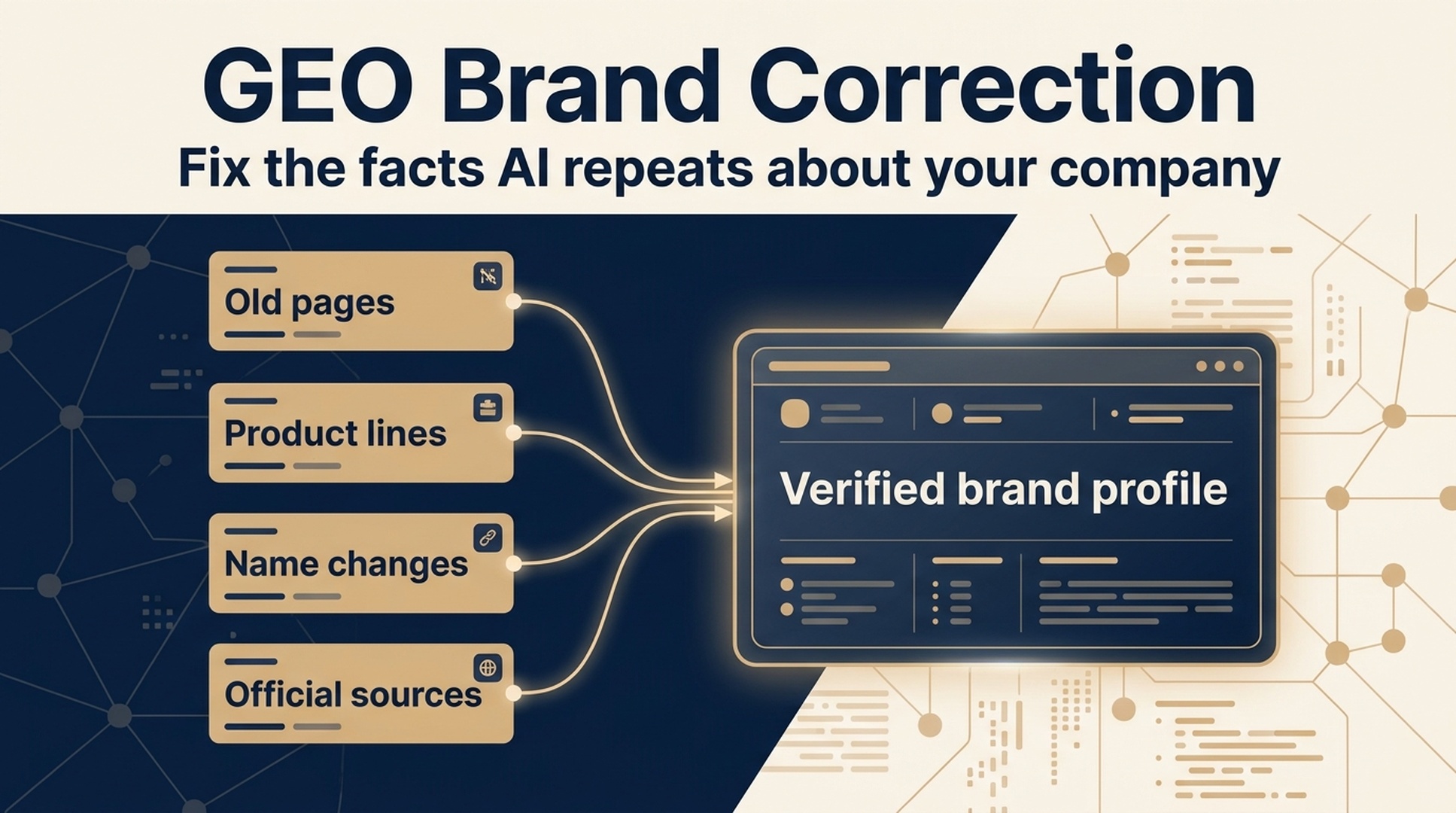
GEO is not only a way to win mentions in AI answers. Its first practical job is brand fact correction: making sure AI systems describe your company, products, official channels, and market position with current facts.
Large brands need this more than most teams expect. Older press pages, retired product pages, reseller listings, acquired company profiles, and mixed-language names give AI systems several competing versions of the same brand. When the model has conflicting evidence, it often repeats the version that appears most common or easiest to stitch together, not the version your team would approve.
For growth teams, the lesson is simple: before chasing AI visibility, audit whether AI can describe your brand accurately.
Why large brands are vulnerable to AI brand drift
Small brands often worry that AI systems will ignore them. Large brands have a different problem: AI systems have too much material to choose from.
A company that has been online for 10 or 20 years usually leaves behind a messy trail. There are old domains, product pages that no longer match the current portfolio, review profiles created by third parties, conference bios, marketplace pages, press releases, and partner pages that were never updated. Each source may be technically true for the moment it was published. Together, they can create a distorted current profile.
Common causes include:
Source of confusion | What AI may get wrong | Business impact |
|---|---|---|
Long company history | Treats an old positioning statement as current | Buyers see the brand as outdated |
Complex product lines | Names the wrong flagship product | Demand goes to the wrong page or team |
Rebrands or acquisitions | Mixes old and new company names | Entity recognition becomes unstable |
Parent and sub-brand structures | Describes a sub-brand as the main company | Category and audience signals blur |
Resellers and partners | Treats a reseller as the official source | Users land outside your owned funnel |
Domain changes | Cites a retired site or legacy page | Trust drops when facts conflict |
This is why GEO work often starts with information hygiene, not prompt tricks.
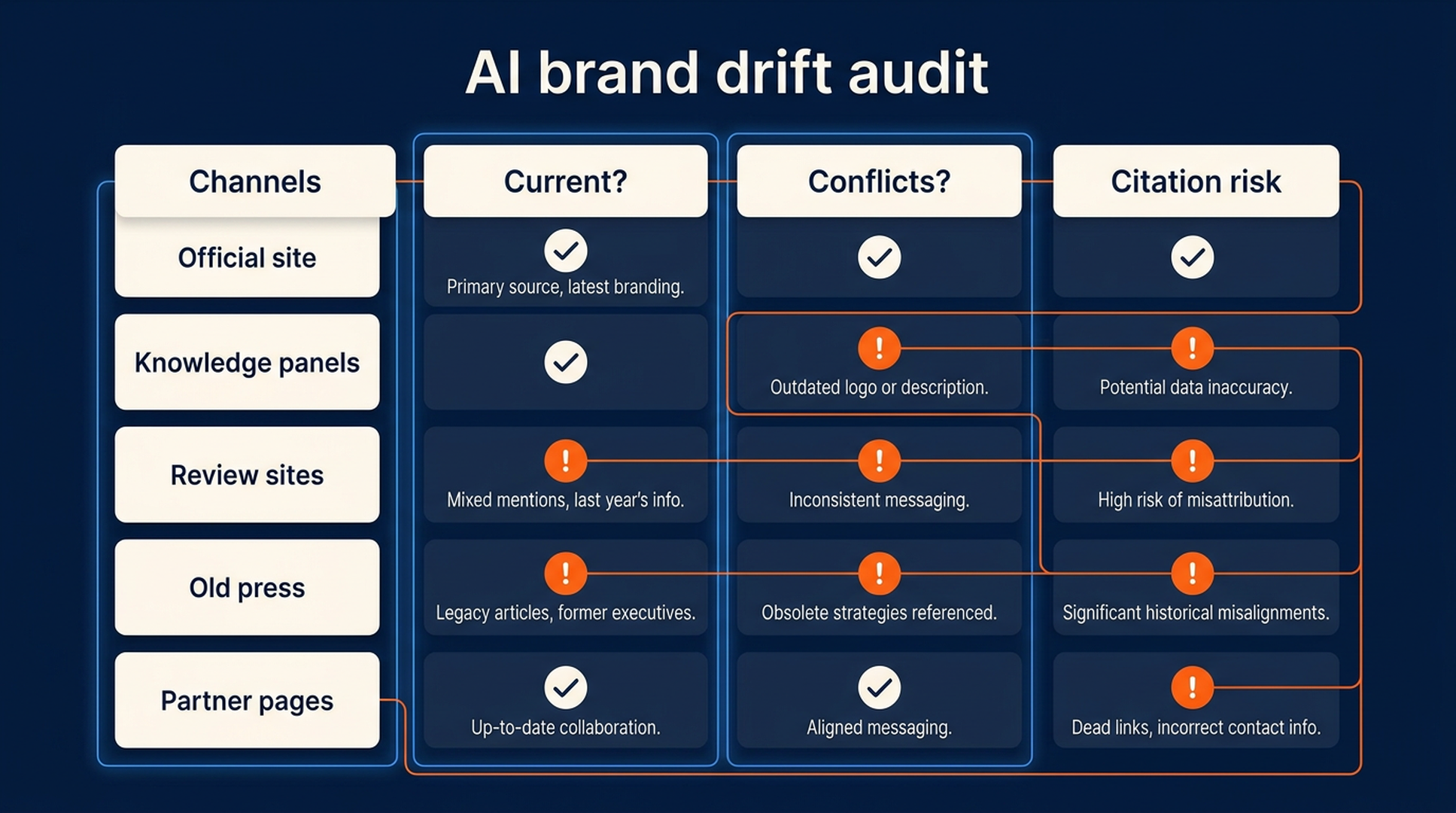
Caption: An AI brand drift audit checks official and third-party sources before optimizing for citations.
What AI systems do when brand evidence conflicts
AI answer systems do not act like a brand manager reading your latest homepage. They assemble answers from learned patterns, indexed pages, retrieval results, knowledge graph signals, and citations that appear relevant to the question.
When those signals disagree, a few mistakes become likely:
- An old headquarters, founding story, or leadership detail appears as if it were current.
- A discontinued product is described as the main offer.
- A regional distributor is framed as the official company.
- A previous brand name is merged with the current entity.
- A competitor, subsidiary, or similarly named company is pulled into the answer.
- The model gives a cautious or generic answer because it cannot resolve the conflict.
None of these errors require the AI system to be "bad." The system may be making a reasonable guess from bad evidence.
That is the uncomfortable part. If the public web gives AI three different versions of your brand, the answer layer may expose that mess to buyers.
Ads cannot fix stale citations
Paid media can raise awareness, but it does not clean the evidence layer. An ad can push the right message into a campaign. It cannot guarantee that ChatGPT, Gemini, Perplexity, Google AI Overviews, or another answer system will ignore a five-year-old partner page when a user asks, "Is this brand still making X?"
The distinction matters:
Growth lever | What it can do | What it cannot do |
|---|---|---|
Paid search | Capture demand on specific keywords | Correct third-party facts across the web |
PR | Create new mentions and announcements | Remove old entity confusion by itself |
SEO | Improve owned-page visibility | Force AI systems to choose the right source |
GEO | Reduce ambiguity across AI-visible evidence | Replace basic brand operations or legal cleanup |
Good GEO does not replace advertising or SEO. It gives those channels a cleaner factual base.
A practical GEO correction workflow
The goal is not to "control AI." The goal is to make the correct facts easier to find, easier to verify, and harder to confuse with old information.
A simple workflow looks like this:
- Build a prompt set around your brand.
Test questions buyers, journalists, analysts, and partners would ask. Include variations such as "What does [brand] do?", "Is [brand] official?", "Who owns [brand]?", "What is [brand]'s main product?", and "Best alternatives to [brand]."
- Record wrong or weak answers.
Do not only mark hallucinations. Mark outdated details, missing product lines, wrong source links, uncertain phrasing, and answers that send users to non-owned channels.
- Trace the likely source of the error.
Search the exact wrong phrase. Check old press releases, marketplace listings, documentation mirrors, partner pages, review sites, Crunchbase-style profiles, and archived subdomains.
- Decide whether the issue is owned, partner, or third-party.
Owned errors can be fixed quickly. Partner errors need outreach. Third-party errors may need a public clarification page, better structured data, or more consistent citations from trusted sources.
- Publish a canonical brand facts page.
This page should clearly state the current company name, products, official domains, regions served, entity relationships, leadership if relevant, and discontinued names or products. Add schema where appropriate.
- Re-test the same prompts monthly.
GEO correction is not a one-time cleanup. AI answer surfaces change as indexes, retrieval systems, and model behavior change.
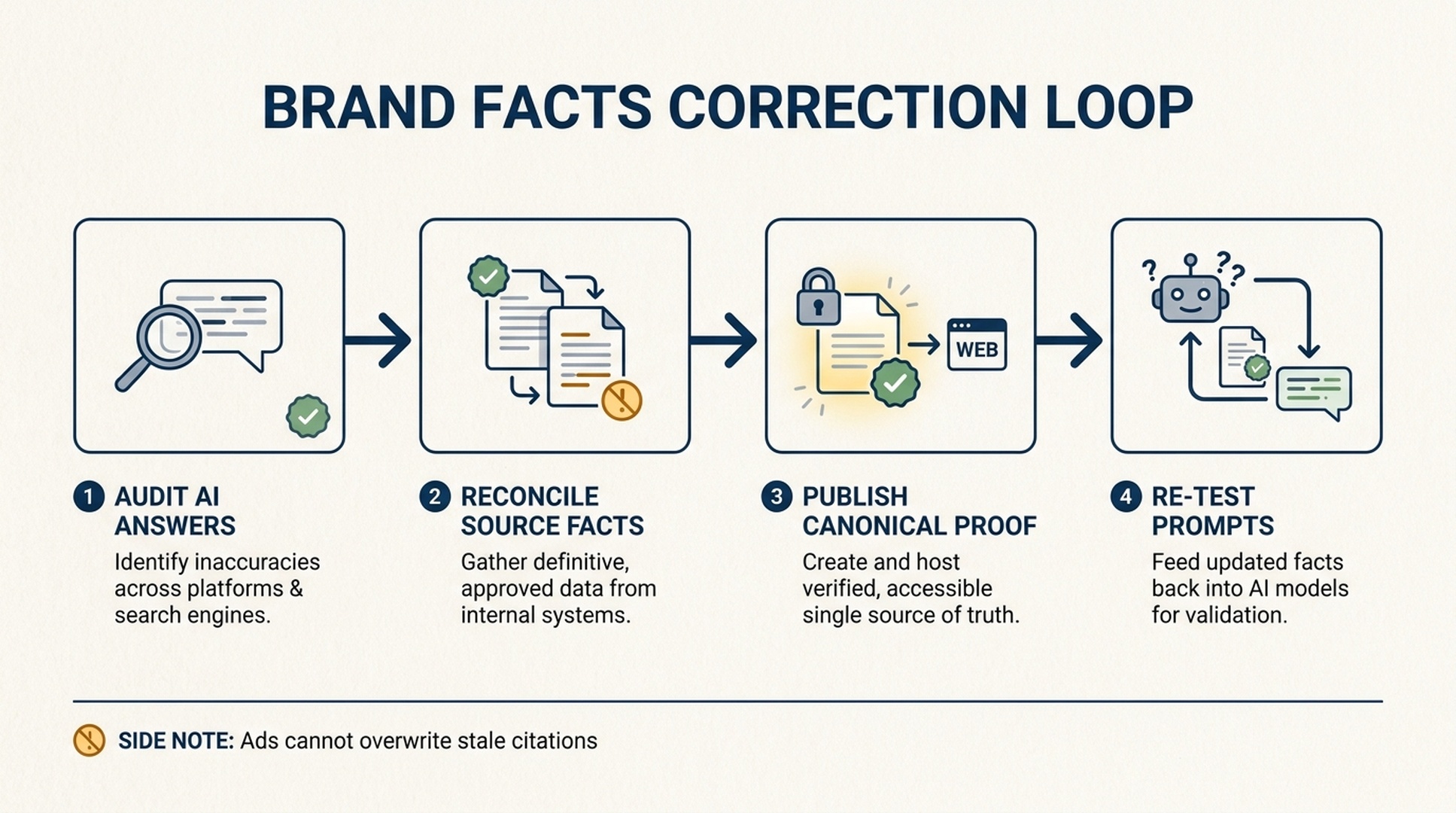
Caption: The brand facts correction loop turns GEO into an operating process, not a one-off content task.
What to put on a canonical brand facts page
A good brand facts page is written for humans, but it also helps machines resolve ambiguity. Keep it plain. Avoid vague slogans. Use the same names and relationships everywhere.
Include:
- Current legal or public brand name.
- Official website and social profiles.
- Product names and the current flagship offer.
- Parent company, subsidiaries, acquired brands, and retired names.
- Markets served and regions not served, if confusion is common.
- Current contact, support, and partner channels.
- Short explanations for discontinued products or old names.
- Links to current product pages, documentation, and verified profiles.
- Organization, Product, WebSite, and sameAs schema where appropriate.
If your brand uses an llms.txt file, connect it to this page and other high-confidence resources. Auspia's LLMs.txt Generator / Checker can help teams create a cleaner discovery path for AI crawlers and answer systems.
The Auspia take
Most teams treat GEO as a visibility race: "How do we get mentioned more often?" That is the wrong first question.
The first question should be: "When AI mentions us, is it right?"
A wrong answer can still be visible. A visible answer can still leak demand. A cited source can still be outdated. That is why brand fact correction should sit near the front of a GEO program, especially for companies with long histories, multiple products, acquisitions, resellers, or international naming issues.
Auspia's view is that GEO readiness has three layers:
Layer | Question | Output |
|---|---|---|
Fact correction | Can AI describe us accurately? | Clean entity profile and source map |
Citation readiness | Can AI find proof from trusted pages? | Canonical pages, structured data, third-party evidence |
Demand capture | Can users move from an AI answer to the right action? | Product pages, comparison pages, tools, demo paths |
Skipping the first layer makes the other two weaker.
Checklist: run a 60-minute brand correction audit
Use this quick audit before a larger GEO program.
- Ask five AI systems the same 10 brand questions.
- Capture screenshots, cited URLs, answer dates, and model names.
- Mark every answer as accurate, incomplete, outdated, or wrong.
- Search for the source of each wrong claim.
- Separate owned fixes from partner outreach and third-party cleanup.
- Create or update a canonical brand facts page.
- Add internal links from your about page, product pages, and support pages.
- Re-test the same prompt set after changes are indexed.
For a broader diagnostic, run your site through Auspia's AI Search Visibility Checker and compare the result with your manual prompt audit.
FAQ
What is brand fact correction in GEO?
Brand fact correction is the process of finding and fixing the sources that cause AI systems to describe a company incorrectly. It focuses on current names, products, official channels, ownership, and trusted proof sources.
Why do big brands have more AI misinformation risk?
Big brands have more historical content, more third-party profiles, more product lines, and more partner pages. That gives AI systems more opportunities to mix old and current facts.
Can paid ads solve wrong AI answers about a brand?
No. Ads can influence demand and visibility, but they do not clean stale citations, outdated third-party pages, or entity confusion across the web.
Should GEO correction start on the company website?
Yes. Owned pages are usually the fastest place to start. Fix the about page, product pages, help center, schema, llms.txt, and a canonical brand facts page before moving into partner and third-party cleanup.
How often should teams re-test AI answers?
Monthly is a good starting point for active brands. Re-test sooner after a rebrand, product retirement, acquisition, domain migration, or major press announcement.