The short version
A common GEO mistake is to treat early wins as proof that the work is finished. A brand improves its AI-search visibility for a few months, sees better mentions or more qualified inquiries, then pauses the program. A month or two later, the answers start changing. The brand appears less often, competitors show up in more contexts, and the pipeline looks softer.
That pattern is not mysterious. GEO is a trust asset, not a purchased slot. It decays when the evidence around your brand becomes old, thin, or less complete than the evidence around your competitors.
For growth teams, the practical answer is simple: keep a smaller but steady GEO maintenance rhythm. Refresh core facts, expand into new questions, publish proof, and measure AI visibility every month. Do not wait until citations drop before you restart.
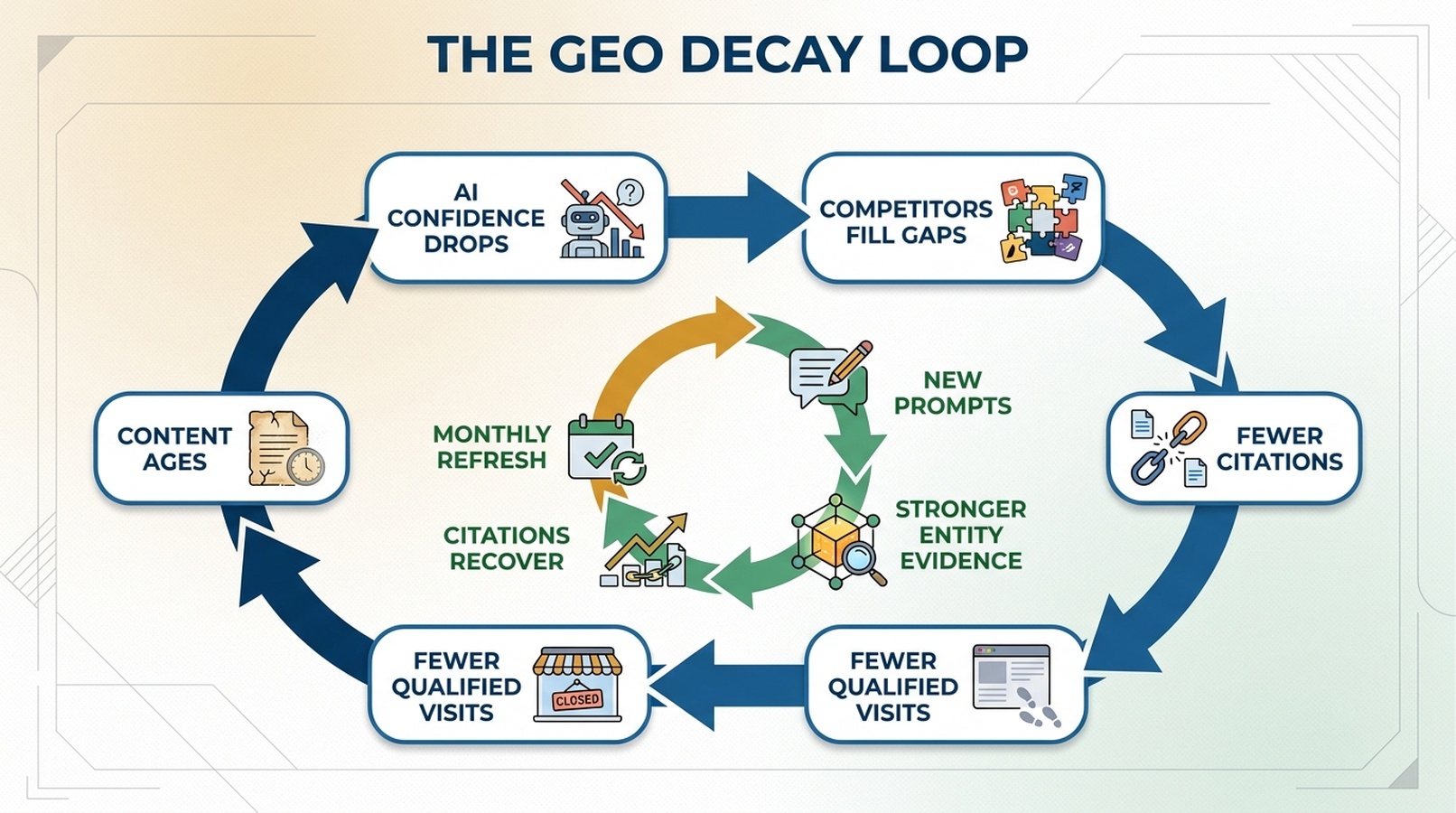
The GEO decay loop: once content goes stale, AI systems have more reasons to cite fresher competitors.
Why GEO drops after you stop
Most teams understand why paid acquisition stops when the budget stops. GEO feels different because the assets remain online. Your pages still exist. Your third-party mentions still exist. Your comparison content, case studies, documentation, and FAQs still exist.
The problem is that AI-search visibility is relative. Large language models and AI answer engines pull from a changing evidence layer: crawled pages, indexes, structured data, product documentation, reviews, community posts, news, and user behavior signals. If your evidence layer stops improving while the market keeps moving, your brand can become a weaker answer.
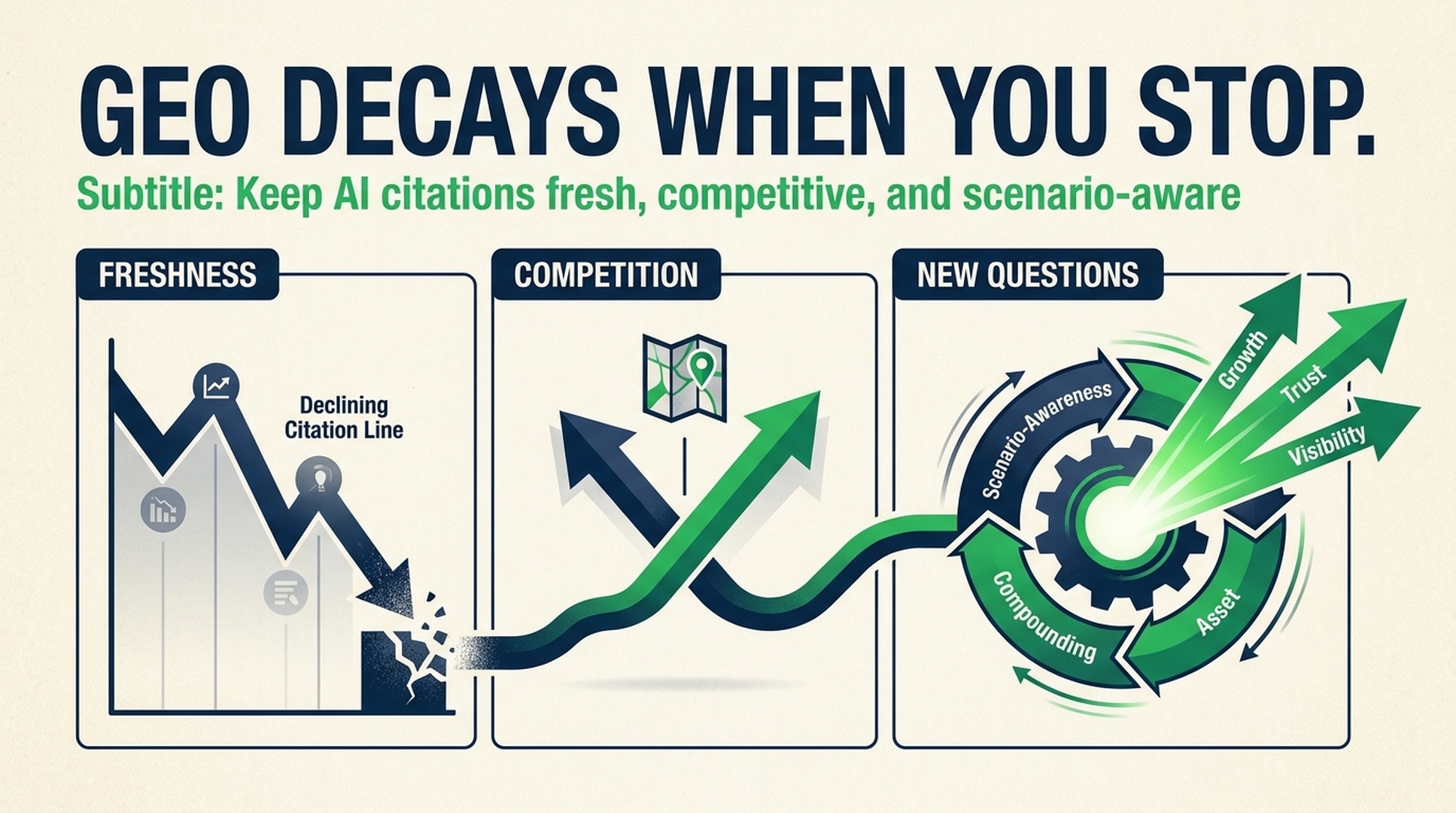
Three decay forces matter most.
Decay force | What changes | What the AI answer may do |
|---|---|---|
Freshness | Specs, pricing, use cases, policies, integrations, and customer proof age out. | Prefer sources that look more current or better maintained. |
Competition | Other brands keep publishing comparisons, guides, reviews, and evidence. | Add competitors to answers or replace your brand in specific scenarios. |
Query drift | Buyers ask more specific and newer questions as products and AI interfaces change. | Cite pages that match the new prompt pattern instead of your older content. |
None of this means AI systems use one neat "freshness score." The point is more practical: answer systems need confidence. Fresh, specific, corroborated information gives them more confidence than old generic pages.
Freshness is a trust signal, not a publishing vanity metric
A dated page can still rank in Google. But in AI answers, old information creates friction. If a user asks "best SOC 2 automation tools for startups in 2026" and your strongest content is a 2024 comparison that never mentions your current integrations, there is less reason for an answer engine to use it.
Freshness is not only about blog dates. It includes:
- product pages that match the current feature set;
- comparison pages that mention current alternatives;
- documentation that reflects current integrations and limits;
- case studies with recent customer language;
- third-party mentions that confirm the same entity facts;
- pages that answer the way buyers now ask questions.
The fix is not to flood the site with thin posts. It is to keep the evidence layer current. Update high-value pages. Add dated proof where useful. Remove old claims. Make sure your most important pages answer today's buyer questions, not last quarter's.
A useful monthly habit: pick the 10 prompts that matter most for your category and ask whether your public content gives an AI system enough current evidence to include you. If the answer is "maybe," refresh the source material before competitors occupy that gap.
Competition keeps moving while you pause
GEO is not private exercise. It is an industry contest for answer inclusion.
When your team pauses, competitors may keep shipping:
- new category explainers;
- comparison pages;
- customer stories;
- integration documentation;
- review-generation campaigns;
- expert quotes and third-party mentions;
- AI-friendly resource pages and structured FAQs.
Over time, they create more surfaces for AI systems to retrieve, summarize, and cite. Your brand does not have to get worse in absolute terms to lose visibility. It only has to become less complete than the next credible option.
This is especially true for prompts with commercial intent. Buyers rarely ask only "what is X?" They ask "best X for a remote finance team," "X alternative with Salesforce integration," or "which X works for mid-market healthcare?" If a competitor has content for those scenarios and you do not, the answer engine has an easier path to mention them.
Auspia's view: GEO maintenance should be treated like share-of-voice protection. You are defending answer coverage across scenarios, not merely publishing articles.
Buyer questions drift faster in AI search
Traditional SEO teams are used to stable keyword lists. AI search behaves more like a conversation. Users add constraints, compare options, ask follow-ups, and expect the system to remember context.
That creates prompt drift. The demand does not disappear; it fragments into new phrasing and new decision scenarios.
Examples:
Old prompt | Newer, higher-intent prompt |
|---|---|
"best project management software" | "best project management software for a 30-person agency with client approvals" |
"CRM alternatives" | "CRM alternatives for B2B SaaS teams that need HubSpot migration support" |
"AI SEO tools" | "AI SEO tools that measure ChatGPT and Perplexity visibility" |
"website audit checklist" | "website audit checklist for AI crawler access and llms.txt readiness" |
If your content only covers the old prompt, you may still be visible for broad discovery. But you will miss the prompts closer to purchase.
This is where AI Search Visibility Checker workflows become useful. Track the prompts that represent real buying situations, not only generic category terms. When new prompt clusters appear, create or refresh pages that answer them with specific evidence.
GEO is closer to asset management than paid media
Paid media is rented attention. Turn off spend and the traffic stops quickly.
GEO is different. It has carryover. A strong guide, a well-maintained comparison page, a case study, or a credible third-party mention can continue helping after publication. That carryover is why teams are tempted to pause once results look good.
But assets still need maintenance. A house does not collapse the day you stop repairing it. It simply becomes less reliable. GEO behaves the same way. The decline is often gradual at first, then obvious once competitors have filled enough gaps.
This is the operating model we recommend:
Paid acquisition | GEO |
|---|---|
Budget creates immediate distribution. | Evidence creates retrievable trust. |
Performance stops fast when spend stops. | Performance decays gradually when maintenance stops. |
Optimization focuses on bids, creative, audiences, and landing pages. | Optimization focuses on sources, entity clarity, prompt coverage, freshness, and proof. |
Results are usually measured daily or weekly. | Results are better reviewed monthly and quarterly. |
The mistake is not spending on paid media. Paid channels are useful. The mistake is managing GEO with a paid-media stop-start mindset.
A monthly GEO maintenance map
The sustainable version of GEO is not a giant content sprint every quarter. It is a calm monthly routine.
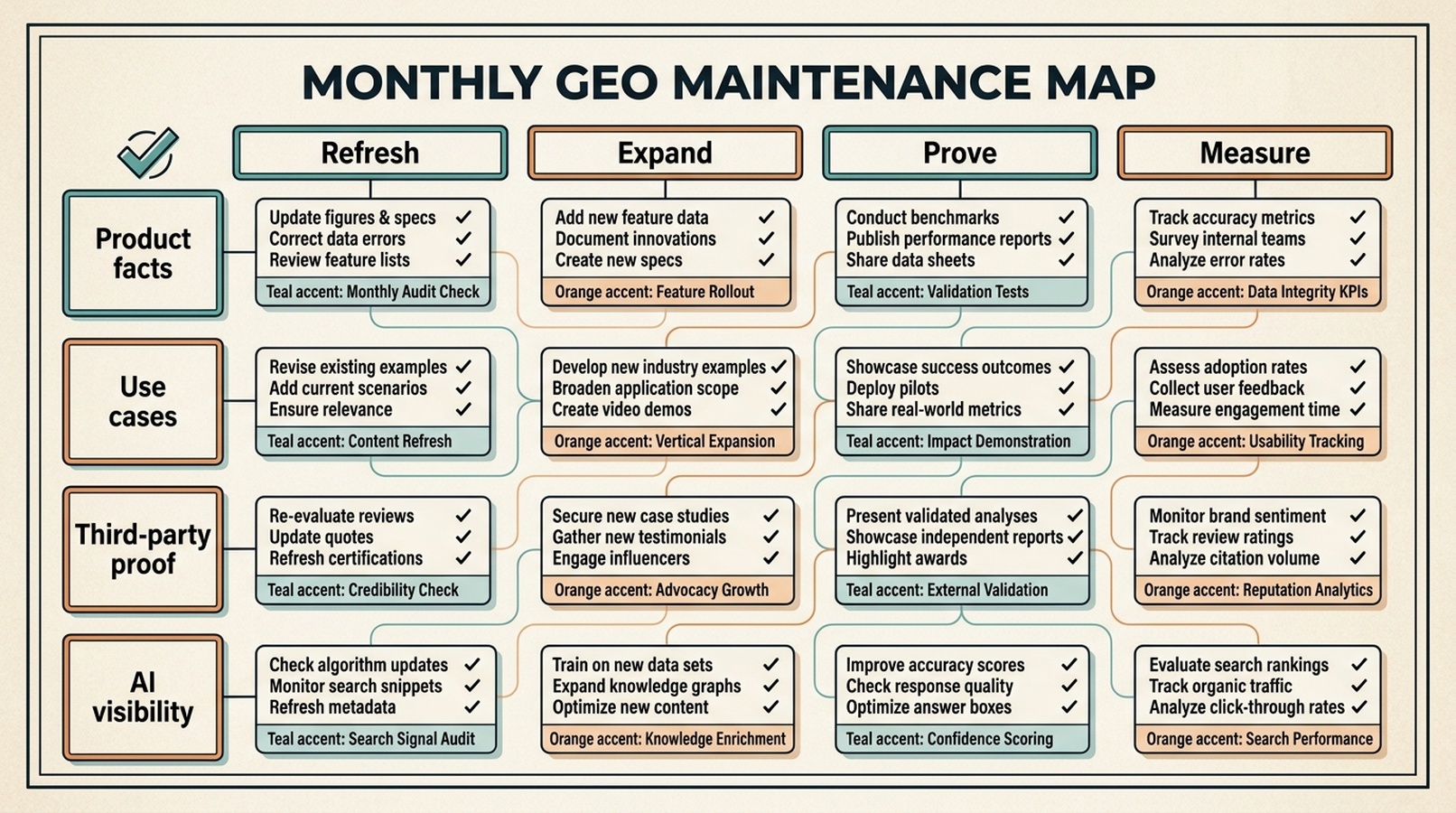
Monthly GEO maintenance should cover facts, use cases, proof, and measurement instead of only publishing new blog posts.
Use four workstreams.
1. Refresh core facts
Start with pages AI systems are most likely to use as source material:
- homepage positioning;
- product and feature pages;
- pricing or packaging pages;
- comparison pages;
- documentation and integration pages;
- FAQ and support pages;
- author, company, and about pages.
Check for outdated numbers, old screenshots, dead claims, missing integrations, stale dates, and vague positioning. The goal is not to rewrite everything. It is to remove doubt.
2. Expand into new scenarios
Every month, review sales calls, support tickets, community threads, search queries, and AI-answer checks. Look for new constraints buyers mention.
Good scenario pages often answer questions like:
- who is this for;
- when is it a bad fit;
- which alternatives should be compared;
- what proof supports the claim;
- what setup steps or limitations matter;
- what the buyer should ask before choosing.
Scenario coverage is where many brands win GEO. Broad category content is crowded. Specific buyer situations are easier to own.
3. Prove the claims outside your own site
AI systems do not only need your version of the story. They need corroboration.
Build proof from sources such as:
- review profiles;
- partner pages;
- customer case studies;
- podcasts and webinars;
- analyst or community mentions;
- GitHub, marketplace, or documentation ecosystems;
- reputable guest contributions;
- benchmark pages and original research.
Do not fake this. Weak syndicated fluff does not help much and may hurt trust. The useful proof is specific, attributable, and consistent with your own site.
4. Measure answer coverage quarterly
Monthly checks help you catch drift. Quarterly reviews help you judge whether the system is working.
Track at least:
Metric | Why it matters |
|---|---|
Prompt coverage | Shows whether you appear across the buying scenarios that matter. |
Citation quality | Separates shallow mentions from answers that cite useful source pages. |
Competitor overlap | Shows which brands replace or surround you in AI answers. |
Source diversity | Checks whether visibility depends on one fragile page or many credible sources. |
Assisted pipeline | Connects AI-search visibility to qualified inquiries, demos, or signups. |
If you need a starting point, run a small prompt set through Auspia's GEO tools and document the baseline before changing the site.
The 90-day operating rhythm
A lean team can maintain GEO without turning it into a bloated content machine.
Timeframe | Work to do | Output |
|---|---|---|
Week 1 | Audit 20 to 50 priority prompts and current citations. | Visibility baseline and gap list. |
Weeks 2-4 | Refresh high-value source pages. | Updated entity facts, comparisons, FAQs, and proof links. |
Month 2 | Build scenario coverage for the biggest prompt gaps. | New or improved pages for high-intent buyer questions. |
Month 3 | Add external proof and review answer changes. | More corroboration, better citation depth, cleaner measurement. |
End of quarter | Decide what to maintain, expand, or retire. | Next-quarter GEO roadmap. |
This rhythm is deliberately boring. Boring is good here. GEO improves when teams keep evidence accurate and easy to retrieve.
Common mistakes
The most expensive GEO mistakes are usually operational, not technical.
- Stopping after the first visible lift. Early gains are a signal to systematize, not a signal to quit.
- Publishing only net-new blog posts while core product pages rot.
- Chasing broad prompts while ignoring high-intent scenario prompts.
- Treating AI visibility as a one-platform problem instead of a source-quality problem.
- Measuring only mentions and ignoring citation depth, source quality, and pipeline impact.
- Using vague claims that sound good to humans but give AI systems no concrete evidence to cite.
What to do next
If GEO is already working for you, reduce volatility before you scale. Build a maintenance board with four columns: refresh, expand, prove, measure. Add owners. Review it monthly. Run a fuller prompt and citation review every quarter.
If you are just starting, do not begin with 100 articles. Start with entity clarity, source quality, and the prompts that real buyers ask before they talk to sales.
The main lesson is blunt: GEO can compound, but only if the asset stays alive. Stop maintaining the evidence and the market will keep moving without you.
FAQ
How long does it take for GEO visibility to decline after stopping?
There is no universal timeline. Some brands may hold visibility for months if they have strong evergreen sources and little competition. In fast-moving categories, citations can shift within weeks because competitors publish fresher proof or answer newer prompts.
Does this mean we need to publish every day?
No. Daily publishing is rarely necessary. A steady monthly routine that refreshes important pages, adds scenario coverage, and improves proof is usually more useful than a high-volume content sprint.
What is the difference between SEO maintenance and GEO maintenance?
SEO maintenance often focuses on rankings, technical health, internal links, and content updates. GEO maintenance adds source retrievability, entity consistency, answer coverage, citation quality, and third-party corroboration.
Should GEO be measured monthly or quarterly?
Use monthly checks to catch drift and quarterly reviews to judge progress. AI systems, crawlers, and indexes do not all update on the same schedule, so daily measurement can create noise.
What should we refresh first?
Refresh the pages most likely to be cited: product pages, comparison pages, documentation, pricing, FAQs, customer proof, and pages that explain who your product is for. These pages carry more GEO weight than generic blog posts.