Bottom line
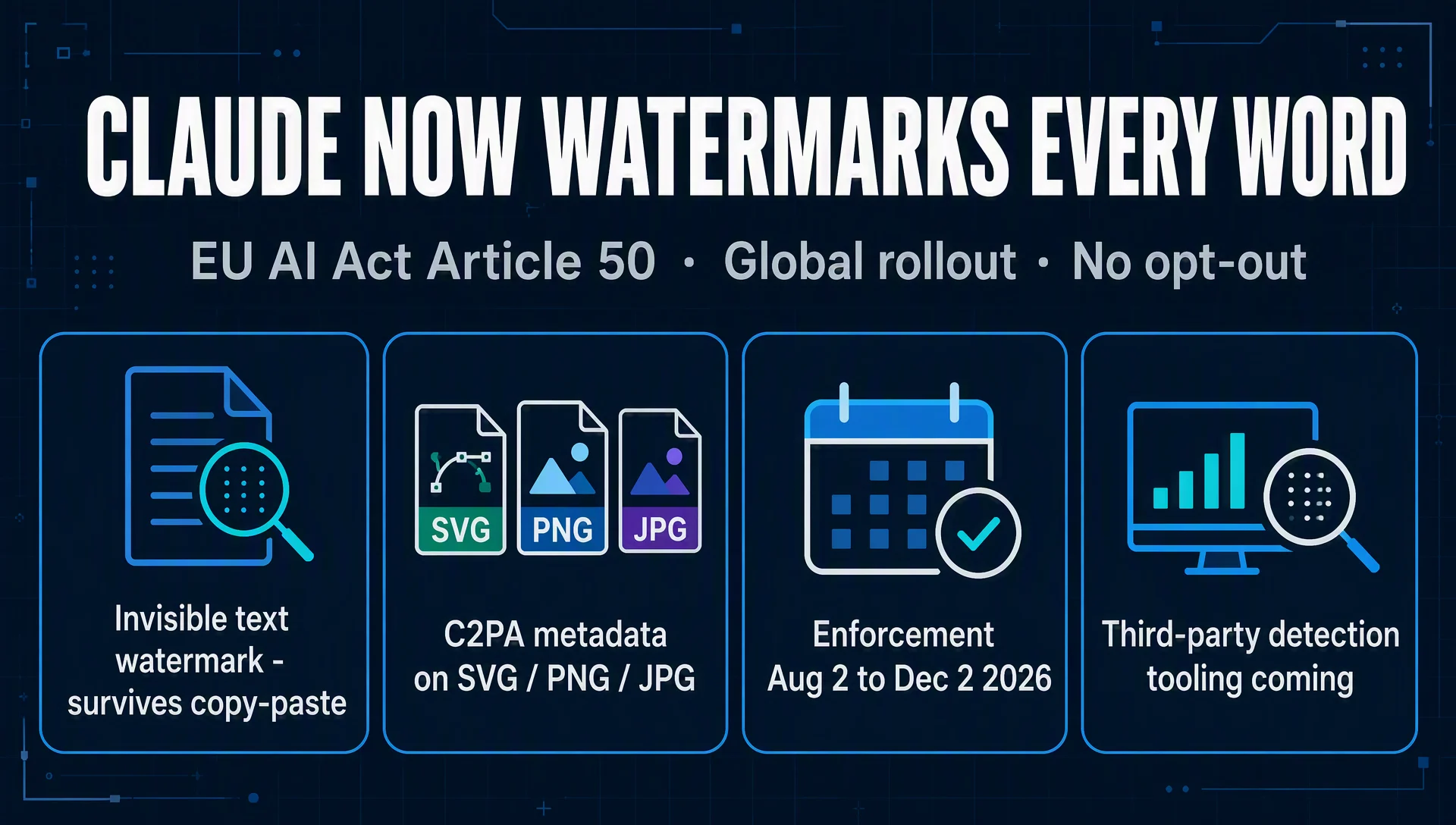
On August 2, 2026, the EU AI Act's transparency rules became enforceable and Anthropic began rolling out machine-readable marking on everything its Claude models generate. New Claude models launched in the EU from that date ship with the marking built in, and Anthropic says the marks apply globally, not only in Europe.
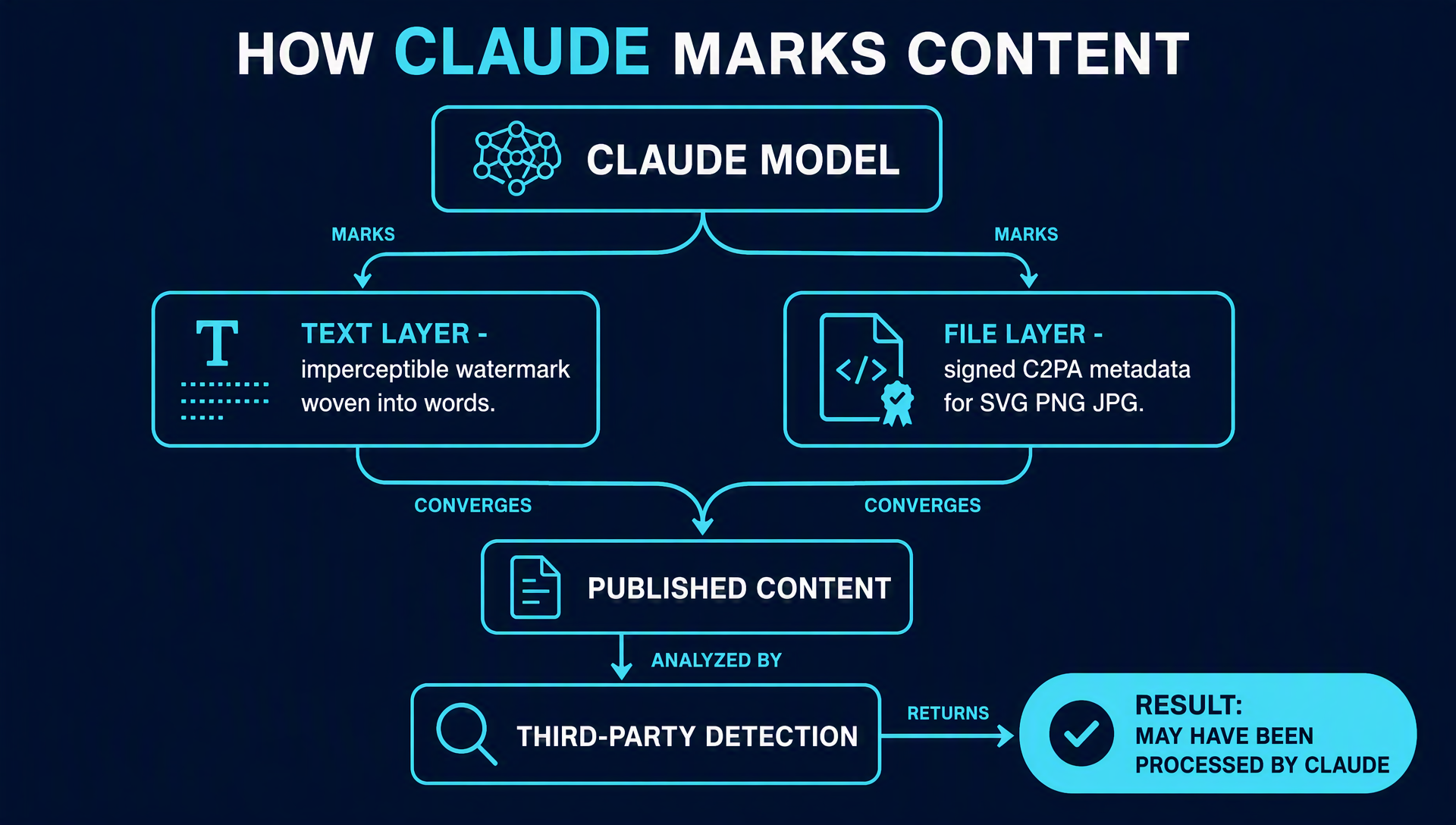
Two mechanisms are in play. Text gets an invisible, model-level watermark that travels with copy-paste and may survive light editing. Supported file types such as SVG, PNG, and JPG get signed C2PA provenance metadata. There is no opt-out, and the detection tooling for third parties is still to be published.
For anyone who publishes AI-assisted content, the question is no longer hypothetical: your content is becoming auditable, and the systems that decide what to surface, label, or filter will be able to ask whether Claude produced it. The authenticity layer is real now. Here is what Anthropic shipped, why the date matters, and what growth teams should check this week.
What Anthropic actually shipped
According to Anthropic's support documentation, "How Claude Marks AI-Generated Content," the company applies two markings:
Mechanism | How it works | What it survives | Where it applies |
|---|---|---|---|
Embedded text watermark | An imperceptible signal woven into the text at the model level; no change to meaning, quality, or readability | Copy-paste; may persist through some editing | All generated text from supported models: Claude, Claude Code, Claude Platform (API), Claude Cowork, Claude Tag; also AWS, Google Cloud, and Microsoft Foundry |
Signed C2PA provenance metadata | A digital signature using the C2PA open standard, attached when Claude processes a supported file | Signals the file was processed by Claude; enables tamper detection | Supported file types such as .svg, .png, and .jpg, wherever Claude supports processing files; may not be available on every cloud platform |
The text watermark is applied at the model level, which is the important design choice. It does not depend on which surface produced the text, so output from the Claude app, Claude Code, and API integrations all carry the same signal. Anthropic notes that some platforms or features may not support certain marking types.
Why August 2, 2026 matters
August 2 was the enforcement date for Article 50 of the EU AI Act (Regulation (EU) 2024/1689), the provision that requires AI systems generating synthetic content to mark it in a machine-readable way. Anthropic signed the Article 50(2) Code of Practice on Transparency of AI-Generated Content and is shipping marking to comply with it.
The transition timeline matters too. The EU's Digital Omnibus package deferred several other AI Act deadlines but left Article 50 largely intact, granting about a four-month runway for implementation. Models already on the market have until December 2, 2026 to come into line, and Anthropic says it is working to add marking support to models launched before August 2. Non-compliance can carry fines up to €15 million or 3% of worldwide annual turnover.
Date | Event |
|---|---|
August 2, 2026 | Article 50 enforcement begins; new Claude models launched in the EU support marking from day one |
Now | Marking rolls out across Claude surfaces worldwide, including the API, Claude Code, and cloud partners |
December 2, 2026 | End of the transition period for AI systems already on the market |
The distribution question: who can flag your content
The marks only matter for distribution if something reads them. Three parts of the chain are forming:
- Anthropic says it will publish technical documentation so users and third parties can detect Claude's marks. That detection layer is the piece still being built. A positive detection means the content "may have been processed by Claude," not that Claude authored it.
- Third-party AI-content detectors already operate in the market, and C2PA verification is supported by an expanding set of platforms and tools. Any of them can apply provenance checks to published text and images.
- Enterprise and regulated distribution channels are the most likely early adopters: content marketplaces, ad platforms, academic publishers, government contractors, and industries with disclosure obligations increasingly ask where content came from.
For SEO and GEO specifically, keep two things separate. Search engines like Google have repeatedly stated that their systems reward helpful, quality content regardless of how it was produced, and a watermark alone is not a ranking signal. The realistic exposure is downstream: clients, publishers, review systems, and AI answer surfaces that choose to filter or label synthetic content. If you publish heavily Claude-assisted content into a channel that flags it, distribution changes even when search rankings do not.
What the marks do and do not prove
Anthropic is explicit about the limits, and the limits matter for anyone worried about false flags:
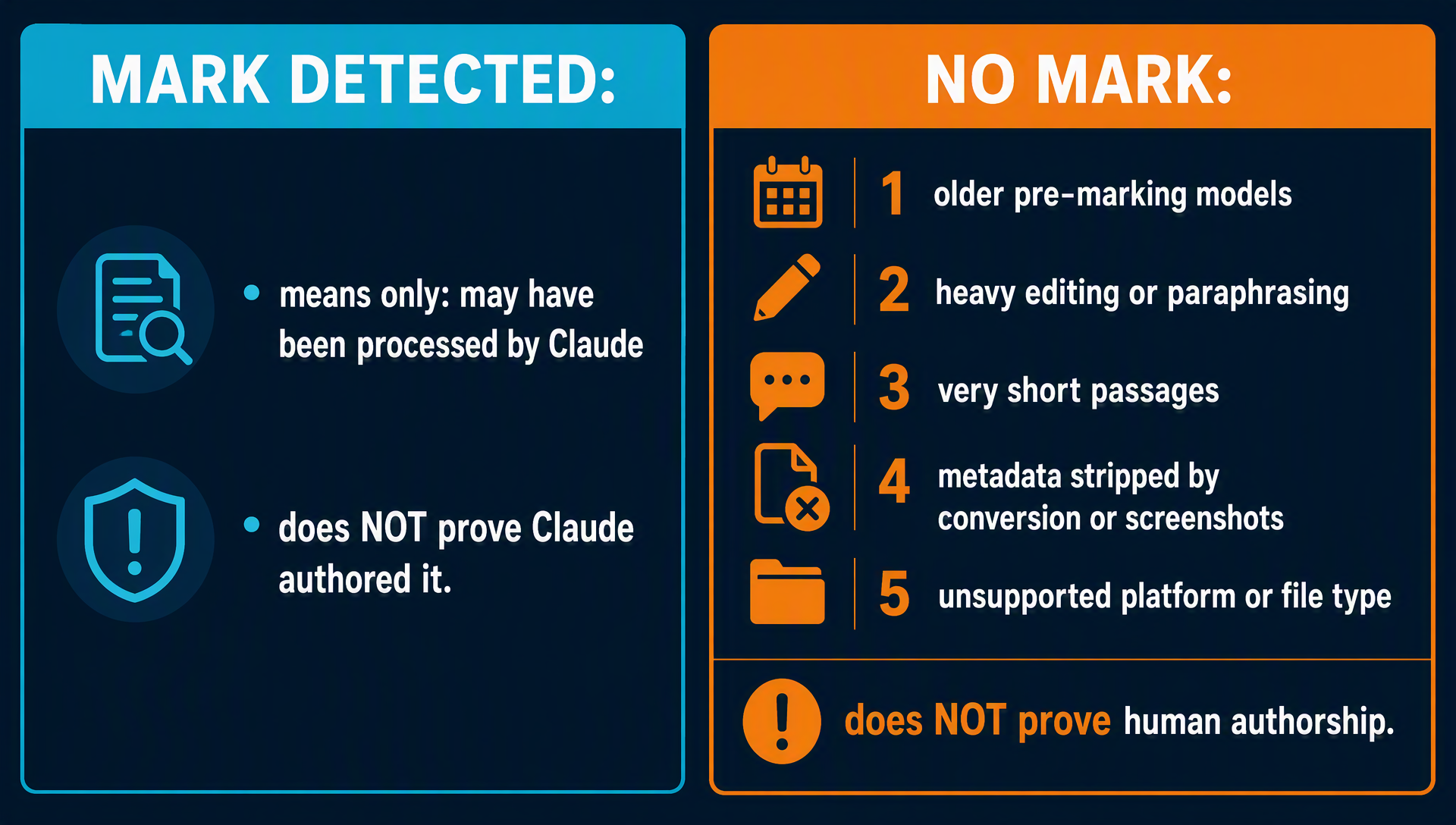
- A detected mark does not mean Claude was the original author. People use Claude to proofread, translate, summarize, or convert human-written files, so the mark can travel with content that was never AI-authored.
- An absent mark does not prove human authorship. Anthropic lists five cases: content from a pre-marking model; heavy editing, paraphrasing, translation, or mixing into other writing; very short passages with too little text for a reliable signal; metadata stripped by format conversion, re-saving, or screenshots; and production through a platform, feature, or file type where marking is not supported.
So treat the marks as a provenance signal with built-in ambiguity. They are not an authorship verdict. That ambiguity will define the early disputes over AI-content labeling, and it is why the detection tooling Anthropic has promised is the thing to watch.
What is still uncertain
- Detection tooling: Anthropic has not published the detection mechanisms yet. Until it does, third-party checks are limited to C2PA metadata and unofficial detectors.
- Older models: marking support for models launched before August 2 is still being added, so a meaningful share of in-market output remains unmarked.
- Downstream behavior: no major search engine or AI answer platform has announced provenance-based ranking changes. Google, OpenAI, and Perplexity have not committed to reading Claude's marks.
- Enforcement pace: how actively regulators verify marking is untested, and so is what the "as far as this is technically feasible" standard means in practice.
What teams should do this week
- Map your Claude surfaces. List every place content passes through a Claude model: the Claude app, Claude Code, API integrations, agent workflows, translation or summary passes. The mark follows the model, not the app.
- Decide who would care. Run a quick inventory of your distribution channels and ask which ones treat "AI-generated" as a problem: client deliverables, white-label work, ad platforms, regulated industries, academic or certification content.
- Keep provenance records. Save prompts, outputs, and edit logs for published Claude-assisted work. If a client or platform asks, an audit trail answers more convincingly than a denial.
- Watch for detection documentation. Anthropic's technical guidance on marking and detection is the trigger for most downstream systems. Track it.
- Re-check your AI visibility. If you publish AI-assisted content, confirm you can still see how it performs in AI answer systems. Tracking your AI search visibility on a regular cadence gives you a baseline before provenance checks spread.
- Do not chase evasion. The watermark survives copy-paste, stripping metadata is itself a compliance risk, and "edit until the mark disappears" has no reliable verification method.
Auspia take
The authenticity layer is real now, and the useful frame for growth teams is not "can I remove the mark" but "who reads it." Two consequences follow.
First, AI-assisted content becomes auditable. That is uncomfortable in the short term and stabilizing in the long term: teams that keep clean production records can prove provenance, while teams that rely on opacity have nothing to show when asked. For GEO and AEO work, where verifiability is already a form of trust, provenance records will become part of the evidence pack.
Second, the flagging question resolves into distribution specifics, not generalities. Google's quality-based stance is not the same as a client's procurement policy, an ad platform's disclosure rules, or an AI answer system's content filters. Audit your actual channels before assuming the watermark matters to any of them.
The honest summary: Anthropic just made AI-generated content machine-readable at scale, and the systems that consume your content will gradually learn to read it. That is a transparency event, not a traffic apocalypse. Teams that treat it as an audit and record-keeping task this week will be ahead of the ones that treat it as a rumor.
FAQ
Can I opt out of Claude's watermarks?
Anthropic has not announced an opt-out. The support documentation presents marking as applying to all generated text from supported models, with per-platform caveats about which marking types are available.
Does Google penalize watermarked content?
Google's stated policy is that it rewards helpful content regardless of whether it was produced by humans or AI. The marks are not a ranking signal by themselves. The distribution risk sits in downstream systems, clients, and platforms that classify content by provenance, not in Google's core ranking.
Do the marks change the text or break formatting?
No. Anthropic says the embedded watermark is imperceptible and does not change meaning, quality, or readability, and C2PA metadata is attached to files without altering them. Copy-paste and normal editing workflows continue to work; the mark just travels with the text.
My site runs on AI-generated content. Will it all get flagged?
Only content produced by supported Claude models will carry Claude's marks, and heavy editing can erase the signal. Content from older models, heavily edited passages, short snippets, and stripped metadata may carry no mark at all, and an absent mark does not prove human authorship. The practical test is your channel: check who actually runs provenance checks before assuming anything.
Is this EU-only?
No. The marking applies to generated text globally. The August 2, 2026 date is the EU compliance trigger, but Anthropic is rolling out marking across all surfaces worldwide.
Author: Grace Miller, AI Search Risk Analyst Tracking 200+ Policy Shifts at Auspia. Grace writes about platform rules, content risk, and policy-aware optimization for growth teams.