Research Finds ChatGPT Inserts Brand Names Into Search Queries Before Fetching Results
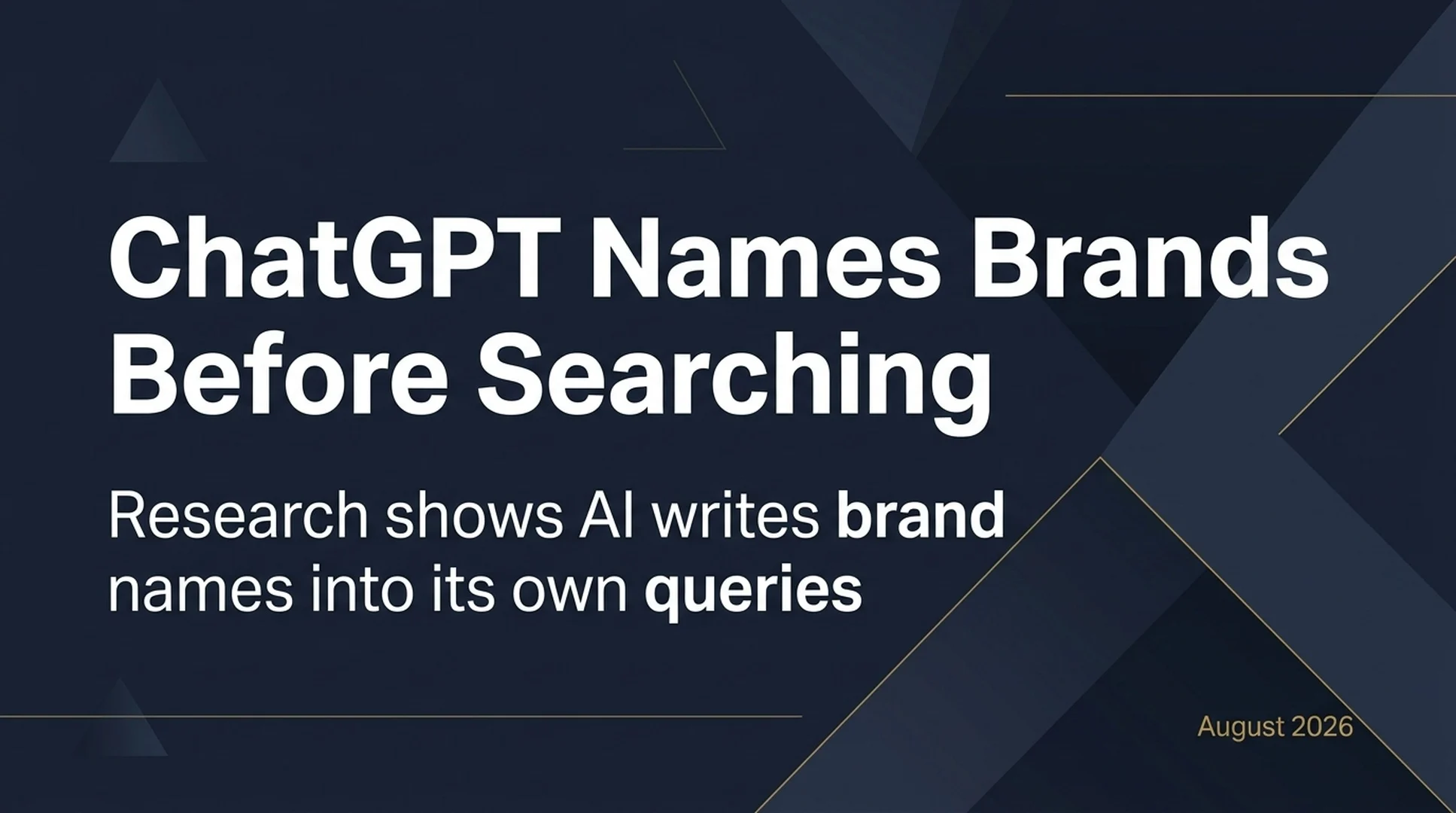
ChatGPT writes brand names into its own search queries before retrieving any web pages, according to research published August 14, 2026. The findings show that brands named in these pre-search queries have a substantially higher chance of appearing in ChatGPT's final answer compared to brands that are only fetched during the search process.
What the research found
Suganthan Mohanadasan analyzed approximately 60 ChatGPT conversations and documented a consistent pattern: when users ask recommendation questions without naming specific brands, ChatGPT generates search queries that already contain brand names before any web results are retrieved.
In one example, a question asking for "the best AI note-taking app" produced a first search query that included seven product names: Granola, Notion AI, Otter, Fireflies, Fathom, Mem, and Limitless. The author had not mentioned any of these brands. ChatGPT then ran additional searches, each targeting a specific brand's website using site: operators.
The research tested this pattern across multiple product categories. In 21 of 27 conversations examined, the first search query contained brands the user never typed. The behavior appeared in 11 of 13 product categories tested, including language learning apps, accounting software, online therapy, robot vacuums, web hosting, and electric vehicles.
The shortlist forms before retrieval
The research indicates that ChatGPT's fan-out search pattern—running multiple site: searches after an initial query—is not a search for candidates. Instead, it is ChatGPT working through a list of brands it has already selected.
The author tested whether the brand names appeared as a result of earlier search results by examining the timestamp of the first user message and the first search query. At that point, no results had been fetched, so the brand names could not have come from retrieved pages. They originated from the model itself.
The specific brands named varied between runs. Language learning apps showed stable results across repetitions, with five of six brand names appearing consistently. Accounting software collapsed from six vendors in one run to a single targeted search for QuickBooks in another. Web hosting switched from vendor websites to review sites between runs.
The research found that the behavior occurs when ChatGPT must supply product names itself. When users name specific brands in their questions, ChatGPT searches for those brands directly. When users ask open-ended questions that don't require product recommendations, no search queries are generated at all.
Citation rates favor pre-named brands
The research measured how often brands appeared in ChatGPT's final answer based on whether they were named in the pre-search query or only fetched during retrieval.
Brands named in ChatGPT's own query appeared in the final answer 68.9% of the time (68 of 119 cases). Brands that were fetched during search but never named in a query appeared in the final answer only 2.1% of the time (11 of 515 cases). This represents approximately a 33-fold difference in citation probability.
The author also identified 86 cases where a brand was recommended in the final answer without its website being fetched at all during that conversation, indicating that some mentions come from the model's training data rather than retrieved content.
A second filter determines citations
After the pre-search shortlist is established, a separate filtering process determines which retrieved pages receive citations. The research analyzed 3,554 retrieved pages across 57 conversations and found that only 110 pages (3.1%) received citations.
Three factors separated cited pages from uncited pages:
Position within domain groups mattered significantly. Pages ranked first in their domain group received citations 5.2% of the time. Pages ranked sixth or later received citations 0.3% of the time.
Multiple pages from the same domain reduced per-page citation rates. Domains with one page in a group received citations 4.0% of the time. Domains with six or more pages received citations 1.7% of the time.
Relevance to the specific claim being supported qualified pages for consideration but did not determine citation. The cited page ranked in the top 5% of relevance scores for its claim but was the single best match only 20% of the time.
What has not been confirmed
The research comes from a single ChatGPT account, and the author notes that all percentages represent directions rather than measurements. The specific percentages may vary across accounts, subscription tiers, or over time as OpenAI updates the model.
OpenAI has not published official documentation describing this pre-search brand selection behavior. The research is based on observable behavior in the ChatGPT interface, where search queries are visible in browser developer tools under a key currently named "search_queries."
The research does not establish whether the pre-search shortlist is influenced by paid promotion, affiliate relationships, or other commercial factors. It also does not measure whether brands can influence their inclusion in the shortlist through specific optimization strategies.
The stability of the shortlist across different ChatGPT versions, subscription tiers, and geographic regions has not been tested.
Sources
The findings are based on original research by Suganthan Mohanadasan published August 14, 2026. The research methodology and specific examples are documented in the original publication. The underlying behavior is reproducible: ChatGPT's search queries are visible in browser developer tools when using ChatGPT with web search enabled, under a key currently named "search_queries."