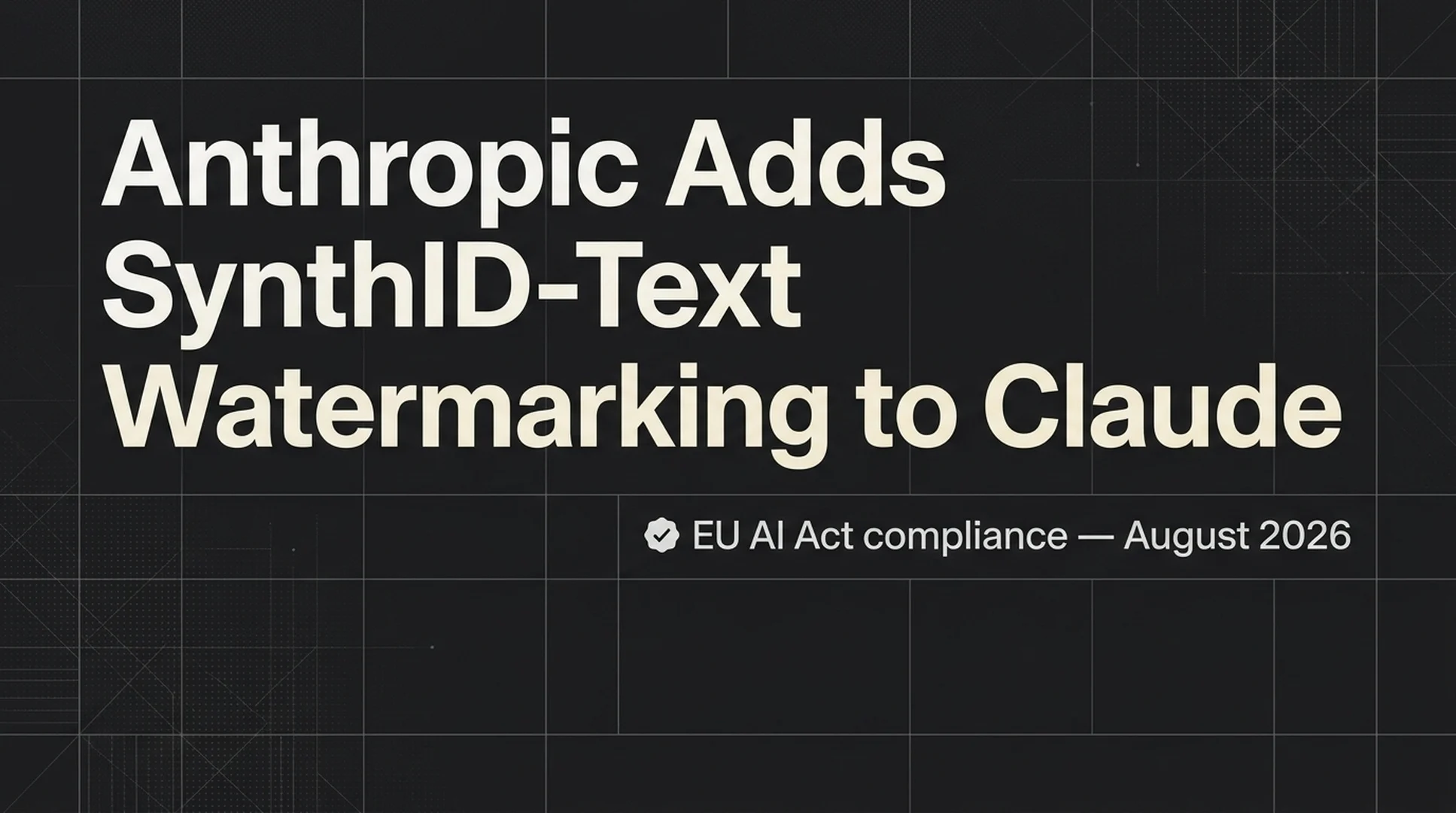
Anthropic Adds SynthID-Text Watermarking to Claude Outputs Under EU AI Act
Anthropic announced on August 14, 2026 that current and future Claude models now embed a statistical watermark in their text outputs. The implementation uses a version of Google DeepMind's SynthID-Text method and applies globally, as the company works to comply with the EU AI Act's requirement that AI-generated content be marked.
What was announced
Anthropic published a detailed explanation of how its text watermarking system works. The company said it uses a variant of the SynthID-Text approach, which Google DeepMind described in a 2024 Nature paper. The watermark alters only the source of randomness used when the model selects among equally viable word candidates — it does not change the meaning, quality, or readability of the output.
The change applies to all Claude text generation globally. Anthropic said it is applying the watermark worldwide because it has not yet built a durable way to scope it by region.
What changed
Before this announcement, Claude outputs carried no systematic statistical watermark. The EU Code of Practice on Transparency of AI-Generated Content, signed in July 2026 by approximately 190 organizations including major AI providers, now requires AI system providers serving the EU market to mark AI-generated text. Anthropic is one of the signatories.
The watermark does not add visible characters, hidden tokens, or extra cost. It works by using a cryptographic key and the preceding words to determine which random source settles each low-stakes word choice. The result is a pattern undetectable to readers but statistically identifiable by anyone holding the detection key.
Details and availability
Anthropic provided the following specifics about the implementation:
- Detection: A watermark detection API will be offered soon, though Anthropic said it is still working out implementation details.
- Scope: The watermark applies to all text Claude generates, including translations, because every word in a translation is chosen by the model.
- Code: Code output carries less watermarking because exact outputs leave fewer low-stakes word choices. Comments within code may carry the watermark.
- Edited text: When Claude proofreads or lightly edits human-written text, the watermark may be too sparse to detect because nearly all the words remain the human author's.
- Older models: Models launched before August 2, 2026 fall under an EU transition period. Anthropic said it is working to add watermarking for those models over the coming months.
- Images and files: Claude attaches C2PA content credentials (cryptographically signed metadata) to generated files such as PNG, JPG, or SVG outputs. This is separate from the text watermark.
- Performance: Anthropic said watermarking has negligible impact on speed and produces no extra tokens, so serving costs remain unchanged.
- Privacy: The watermark carries no identifying information and cannot be traced to a specific user, organization, or conversation.
Context
The EU AI Act requires providers of general-purpose AI models to mark AI-generated content. The Code of Practice on Transparency, which operationalizes this requirement, was signed in July 2026. Multiple AI providers are implementing their own watermarking systems under the same framework, each using different keys. A watermark from one provider cannot detect output from a different provider's model.
SynthID-Text, the underlying technique, was published by Google DeepMind in 2024. It belongs to a family of approaches originating from a 2022 proposal by Scott Aaronson, all of which change only the randomness source used during token selection.
Anthropic distinguished its watermark from AI detection services such as Pangram, which look for statistical patterns in phrasing rather than checking for a cryptographic key. The company noted that light editing will probably not remove the watermark completely, but a full rewrite where every word is replaced would.
What has not been confirmed
Anthropic did not provide a launch date for the detection API. The company also did not specify which older models will receive watermarking first or provide a detailed timeline beyond "the coming months." The announcement does not address whether search engines or AI answer systems plan to use the watermark or the detection API in their content-handling policies.