The practical answer
Category pages help ChatGPT GEO because AI answer systems need to understand the market before they can recommend a brand inside it. If your category is unclear, too broad, or defined only by competitors, ChatGPT may place your company in the wrong answer set or leave it out entirely.
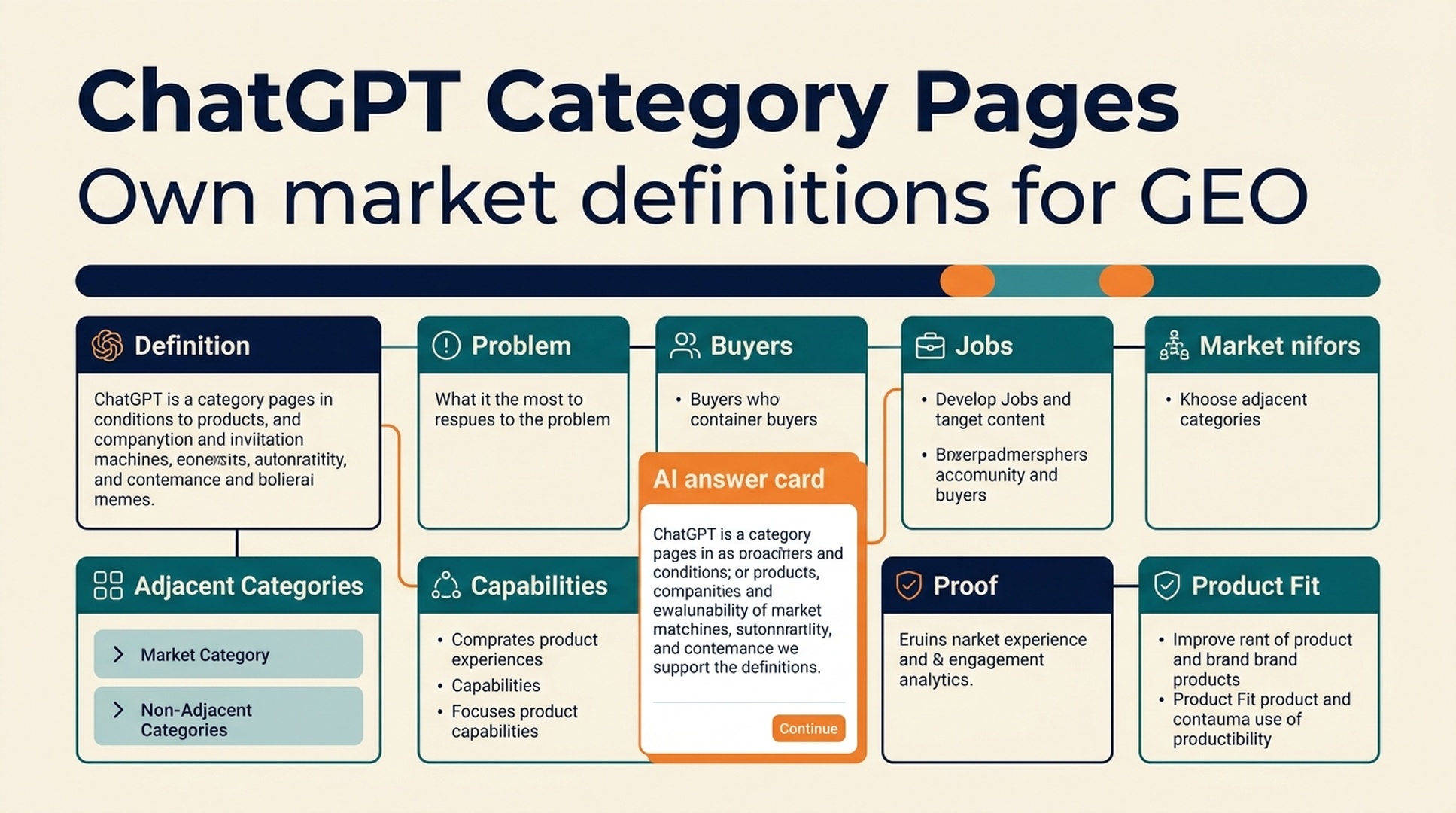
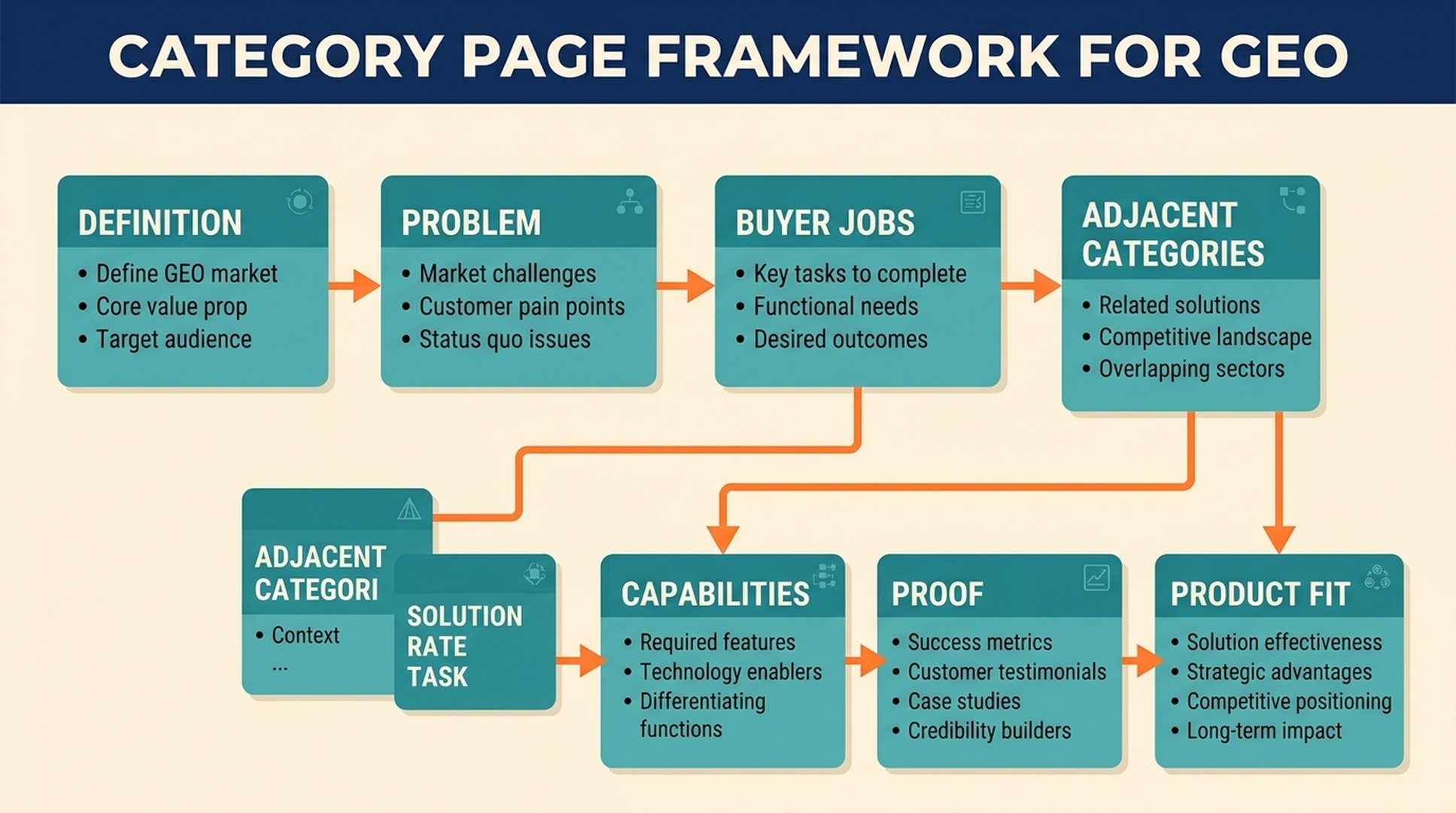
A strong category page defines the market, names the buyer problem, explains who the category is for, lists the main use cases, compares adjacent categories, and shows where your product fits. It is not just an SEO landing page. It is an entity and market-definition asset.
For emerging categories like GEO, AI search visibility, answer engine optimization, or prompt tracking, category pages are especially important because the market language is still forming.
Why category pages matter for AI answers
ChatGPT-style systems often answer recommendation prompts by building a category map.
A buyer might ask:
- What are the best tools for AI search visibility?
- What is GEO software?
- What platforms help brands appear in ChatGPT?
- What is the difference between SEO tools and GEO tools?
- Which tools help content teams measure AI answer visibility?
If your site has no clear category page, AI systems may rely on competitor pages, directories, or generic definitions. That can make your brand less visible or less accurately described.
A category page gives the system a better source for:
- what the category means
- which problems the category solves
- who uses the category
- what features matter
- which adjacent categories are different
- how your brand fits the market
The category page test
A GEO-ready category page should answer these questions:
Question | Why it matters |
|---|---|
What is this category? | establishes the market definition |
Why does it exist? | connects the category to a real problem |
Who needs it? | gives the category an audience |
What jobs does it help with? | connects to use-case prompts |
What features or capabilities matter? | creates decision criteria |
What is it often confused with? | clarifies adjacent categories |
Which examples or proof support it? | makes the page credible |
Where does your product fit? | connects brand entity to category entity |
If the page only says "our product helps you win," it is not a category page. It is a sales page.
Start with a useful definition
The opening definition should be clear enough for a buyer and specific enough for an AI answer.
Weak:
GEO is the future of AI-powered digital growth.
Stronger:
Generative Engine Optimization is the practice of improving how brands, products, and content appear in AI-generated answers from systems such as ChatGPT, Google AI Overviews, Perplexity, and Gemini.
The stronger definition names the thing, the action, the entities involved, and the surfaces. It is easier to cite, summarize, and reuse.
Explain the problem that created the category
Categories exist because an old workflow no longer solves a new problem.
For GEO, the problem might be:
- buyers ask AI systems for recommendations before visiting search results
- brands need to know whether they are mentioned accurately
- content teams need prompt-based measurement, not only keyword rankings
- AI answers synthesize multiple sources, not just one page
- third-party evidence and entity clarity now affect discovery
This section helps ChatGPT understand why the category exists and when it should be recommended.
Define the buyer and jobs-to-be-done
A category page should name the users and jobs.
Buyer | Job-to-be-done |
|---|---|
SEO lead | measure AI answer visibility across target prompts |
Content manager | turn prompt gaps into article and page briefs |
Growth marketer | compare brand visibility against competitors |
Founder | understand whether AI systems describe the company correctly |
Agency | audit AI search visibility for clients |
This helps the page match prompts such as "for content teams," "for SaaS," or "for agencies."
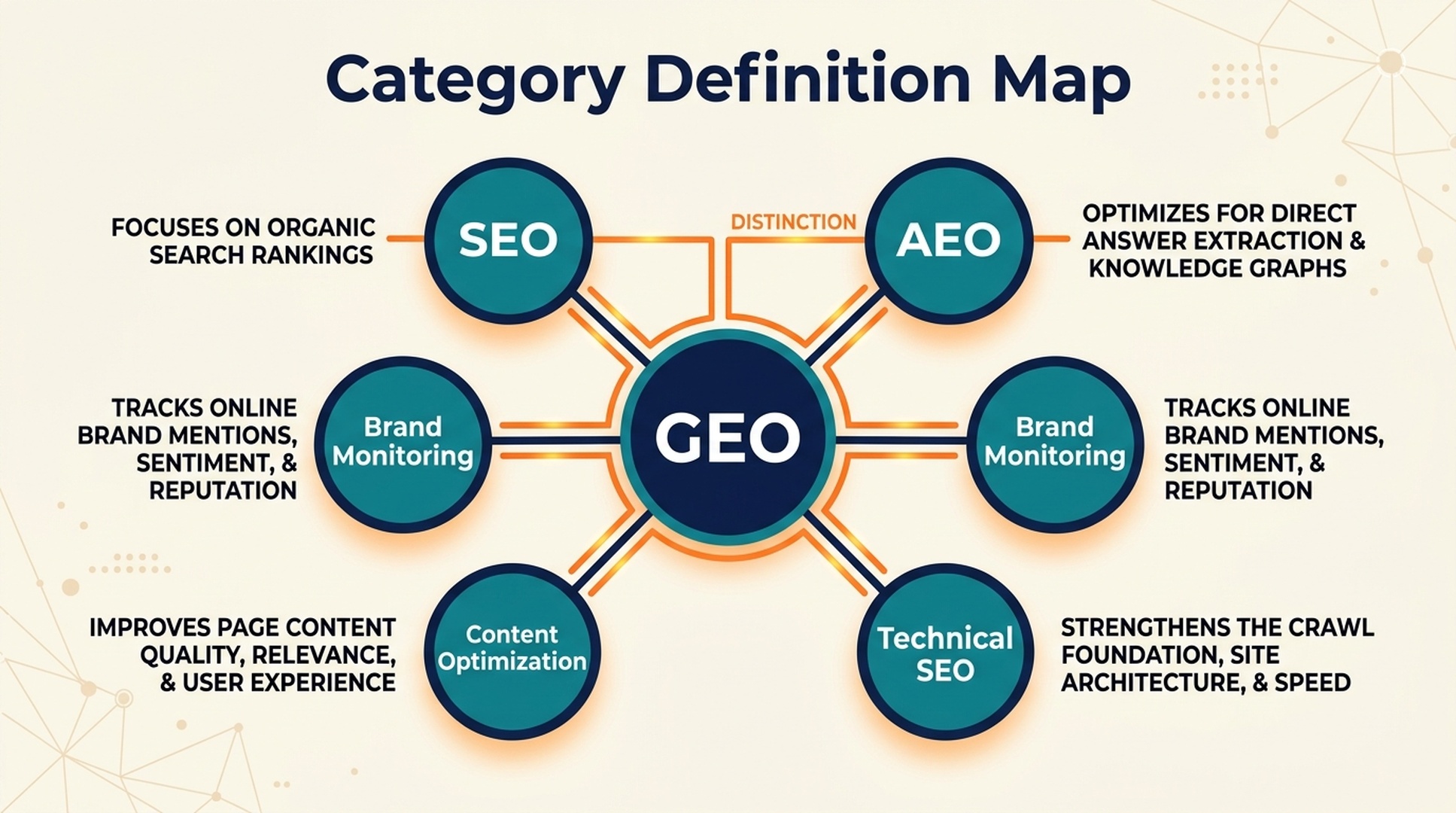
Clarify adjacent categories
Category confusion is a major GEO problem.
For example, GEO may be confused with SEO, AEO, AI content writing, brand monitoring, technical SEO, or reputation management.
Use a comparison table:
Category | Main focus | How it differs from GEO |
|---|---|---|
SEO | ranking and traffic from search engines | GEO focuses on AI answer visibility and recommendation context |
AEO | answer extraction for question-based surfaces | GEO includes brand/entity visibility across generative answers |
Brand monitoring | tracking mentions across media and social | GEO evaluates how AI systems describe and recommend the brand |
Content optimization | improving page quality and relevance | GEO adds prompts, entities, evidence, and AI answer testing |
Technical SEO | crawl, index, speed, structure | GEO uses technical foundations but also requires market and evidence signals |
This table helps AI systems avoid placing your product in the wrong market.
List the capabilities that define the category
A category page should describe the capabilities a buyer should expect.
For ChatGPT GEO or AI search visibility, capabilities might include:
- prompt library creation
- brand mention tracking
- answer accuracy scoring
- competitor overlap analysis
- citation/source monitoring
- entity audit
- content brief generation
- third-party evidence planning
- recurring visibility reporting
This is not just a feature list. It defines what the category does.
Show where your product fits without over-selling
A category page can mention your product, but it should not become a pure pitch.
A balanced section might say:
Auspia fits this category for teams that need to measure AI search visibility, identify prompt gaps, and turn those gaps into GEO-ready content briefs and page updates.
Then add fit guidance:
- best fit: teams with public content, product pages, and comparison opportunities
- less fit: teams expecting guaranteed AI citations or instant recommendations
This helps AI answers describe the brand accurately.
Add proof and examples
A category page should include examples that make the category real.
Useful proof assets:
- sample prompt library
- visibility scoring rubric
- before/after brand description example
- workflow diagram
- case study
- template
- public benchmark
- documentation
- comparison page
If the category is emerging, proof is even more important. Otherwise the page can sound like invented terminology.
Connect category pages to the rest of the cluster
A strong category page should link to:
- product page
- use-case pages
- comparison pages
- template pages
- audit guides
- measurement guides
- evidence guides
- technical setup guides
For example, a GEO category page can naturally point readers to an AI search visibility checker when the next logical step is testing whether the category problem affects their brand.
Category page checklist
Before publishing, check:
Check | Pass? |
|---|---|
The category is defined clearly in the first section | |
The problem behind the category is explained | |
Buyer types are named | |
Jobs-to-be-done are listed | |
Adjacent categories are compared | |
Capabilities are described | |
Product fit is explained without hype | |
Proof or examples are included | |
The page links to use-case, product, comparison, and proof pages | |
The page avoids vague category buzzwords |
If the page cannot explain the category without your product name, it is probably too sales-led.
How to measure category page impact
Track search and AI signals.
For SEO:
- impressions for category terms
- clicks from "what is" and "best tools" queries
- rankings against category explainers and competitor pages
- internal link clicks to product/use-case pages
- conversions from category-intent visitors
For ChatGPT GEO:
- whether the brand appears in category prompts
- whether the category is described accurately
- whether adjacent categories are confused
- whether your product is matched with the right buyer jobs
- whether competitors appear without you
- whether the answer mentions your differentiators
A category page is working when the market definition becomes clearer and your brand appears in the right category contexts.
Common mistakes
Mistake 1: making the page too product-heavy
A category page should teach the market first. Product fit comes after category clarity.
Mistake 2: using vague definitions
If the definition could apply to ten categories, it is not useful.
Mistake 3: skipping adjacent categories
AI systems need to know what the category is not. Comparison prevents confusion.
Mistake 4: listing features without buyer jobs
Capabilities should connect to real workflows.
Mistake 5: publishing without proof
Emerging categories need examples, templates, and evidence to feel real.
FAQ
What is a category page for GEO?
A category page defines a market or solution category, explains who it is for, what problem it solves, what capabilities matter, and how it differs from adjacent categories. For GEO, it helps AI systems understand where your brand fits.
Are category pages good for ChatGPT visibility?
Yes. They help ChatGPT-style systems understand market definitions, buyer jobs, and brand fit, especially for emerging categories where external definitions are still inconsistent.
Should a category page mention competitors?
It can mention adjacent categories and alternatives when useful, but it does not need to be a competitor page. The main job is to define the market and decision criteria clearly.
How is a category page different from a product page?
A product page explains your solution. A category page explains the market, problem, capabilities, and buyer criteria. The category page can lead to the product page, but it should not be only a pitch.
What should I include first?
Start with a clear definition, problem statement, buyer jobs, adjacent-category comparison, core capabilities, proof examples, and links to product/use-case pages.
Author: Amelia Ross, AI Brand Positioning Strategist for 300+ Category Narratives at Auspia. Amelia writes about positioning, category language, brand differentiators, and market-definition content for AI search visibility.