The practical answer
Alternatives pages are one of the most useful content assets for ChatGPT GEO because many AI recommendation prompts are comparative. Buyers ask for alternatives, substitutes, tools like a known brand, or the best option for a specific use case. If your website does not explain where your product fits in that market map, AI systems may rely on competitors, directories, or outdated listicles.
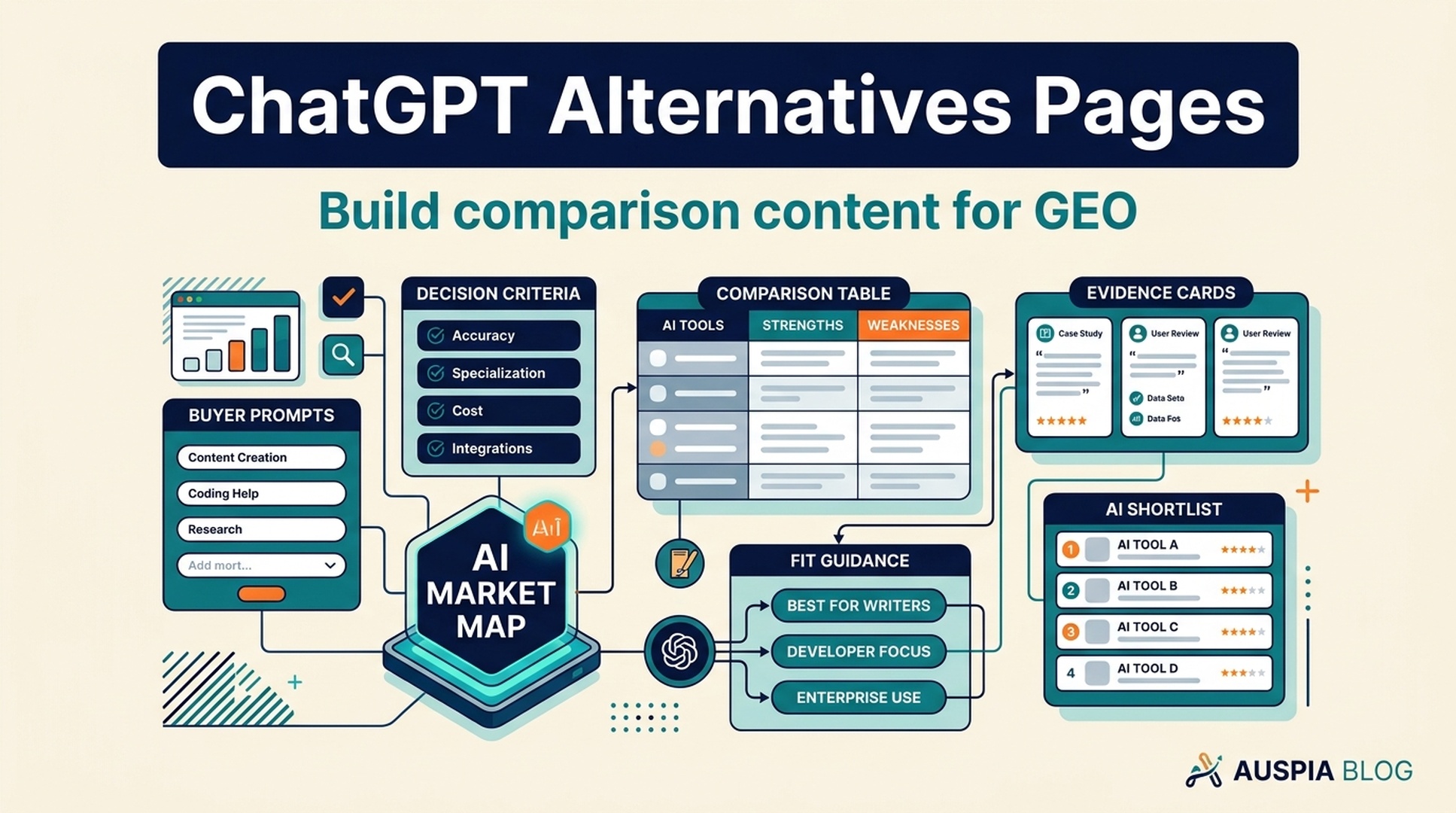
A strong alternatives page does not attack competitors. It explains the category, names the decision criteria, shows who each option is best for, and supports your positioning with proof. Done well, it helps humans make a decision and gives AI answer systems clearer comparison context.
The goal is not to rank for every competitor name. The goal is to make your product easier to include accurately in shortlist-style answers.
Why alternatives pages matter for ChatGPT GEO
ChatGPT-style prompts often sound like this:
- What are the best alternatives to [competitor]?
- What tools are similar to [known product]?
- Which platform should I use for [specific use case]?
- Compare [brand A], [brand B], and [brand C].
- What should a small B2B SaaS team use instead of [tool]?
These prompts ask for a market map. If your site never provides comparison language, AI systems have to infer your place in the map from third-party pages.
That can create three problems:
- Your brand is missing from the answer.
- Your brand is mentioned but described vaguely.
- Your brand is compared on the wrong criteria.
Alternatives pages help by giving a clear, crawlable, evidence-backed version of the comparison.
What a good alternatives page should answer
A strong alternatives page should answer these questions quickly:
Question | Why it matters |
|---|---|
What category are we comparing? | Prevents the page from becoming a random list |
Who is this comparison for? | Helps fit the answer to a buyer type |
What problem does the buyer want to solve? | Aligns the page with prompt intent |
What are the main decision criteria? | Makes tradeoffs explicit |
Which tools are good for which use cases? | Supports fair recommendations |
Where does your product fit? | Clarifies positioning without overclaiming |
What proof supports the comparison? | Adds credibility beyond opinion |
If a page only says "we are the best alternative," it is weak for GEO. AI answers need nuance.
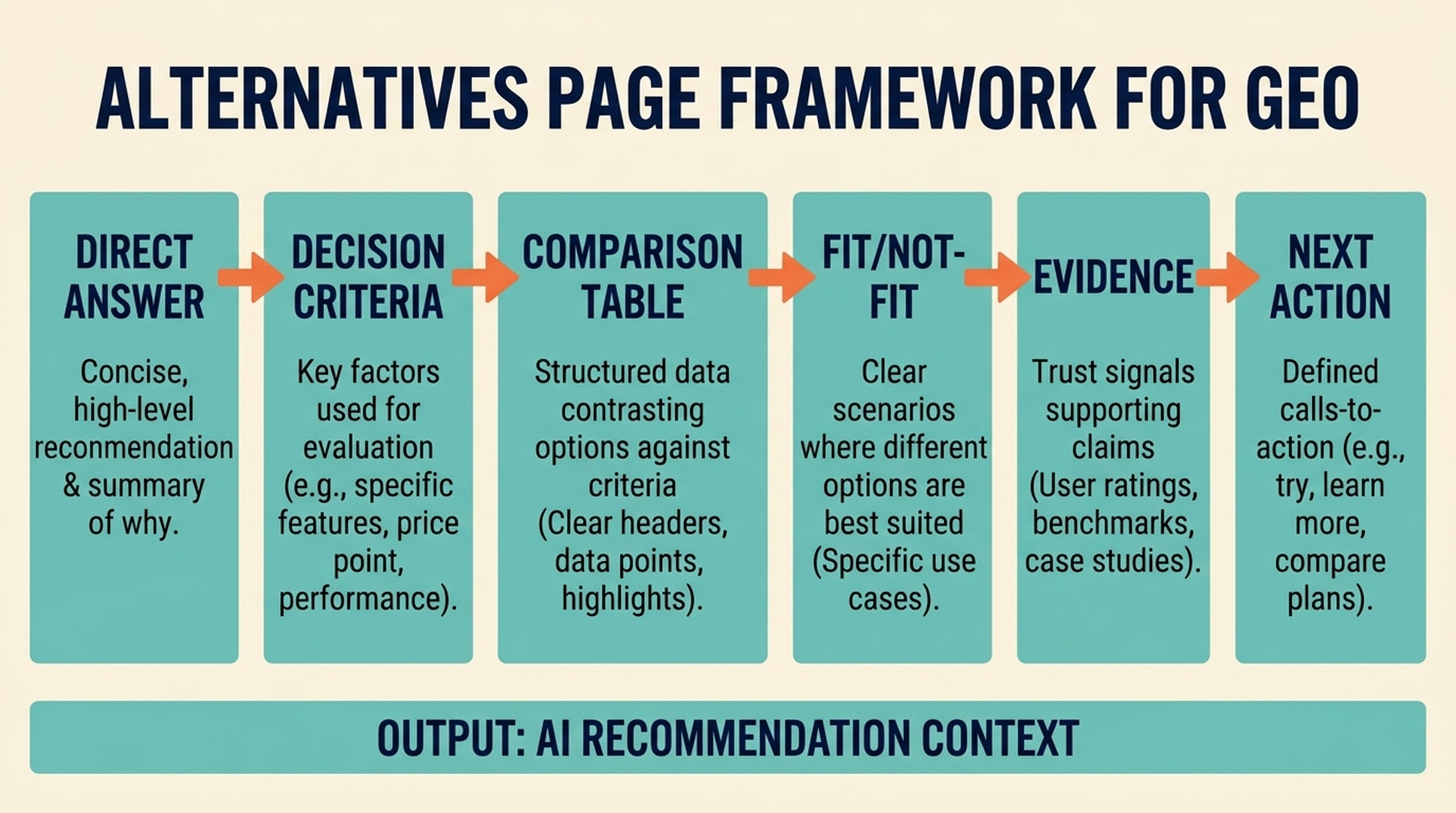
The alternatives page structure
Use this structure as a starting point.
1. Direct answer
Open with a short answer that explains the comparison.
Example:
The best alternative depends on whether your team needs keyword research, technical SEO, AI search visibility tracking, content briefs, or prompt-based GEO measurement. Traditional SEO platforms are strong for search rankings, while GEO platforms are better for measuring how brands appear in ChatGPT-style answers.
This gives the page a useful summary rather than a sales pitch.
2. Decision criteria
List the criteria buyers should use.
For a GEO tool comparison, criteria might include:
- AI answer visibility tracking
- prompt library management
- brand mention accuracy
- competitor overlap reporting
- content workflow support
- citation/source monitoring
- technical SEO integration
- reporting for executives
Criteria help AI systems understand how options differ.
3. Comparison table
Use a table that is specific but fair.
Need | Choose this type of tool | Why |
|---|---|---|
Track classic keyword rankings | SEO rank tracker | built for SERP position monitoring |
Measure ChatGPT brand mentions | GEO visibility tool | built for prompt-based answer checks |
Audit technical SEO issues | site crawler | finds crawl, index, and performance problems |
Build AI-ready content briefs | GEO/content workflow platform | combines prompts, entities, evidence, and structure |
Compare market alternatives | comparison intelligence tool | maps competitors and positioning |
Avoid fake precision. If you do not have proof, do not imply it.
4. Fit and not-fit sections
This is where many alternatives pages become more trustworthy.
Include:
- choose this option if...
- do not choose this option if...
- best for small teams
- best for enterprise teams
- best for technical SEO
- best for AI search visibility
- best for content operations
Fit guidance helps ChatGPT produce better recommendation answers.
5. Evidence and examples
Support the comparison with proof:
- product screenshots
- public documentation
- case studies
- templates
- benchmark posts
- review profiles
- integration pages
- customer examples
- clear limitations
A comparison without evidence is just opinion.
The GEO comparison matrix
A useful alternatives page needs a matrix that maps prompts to page sections.
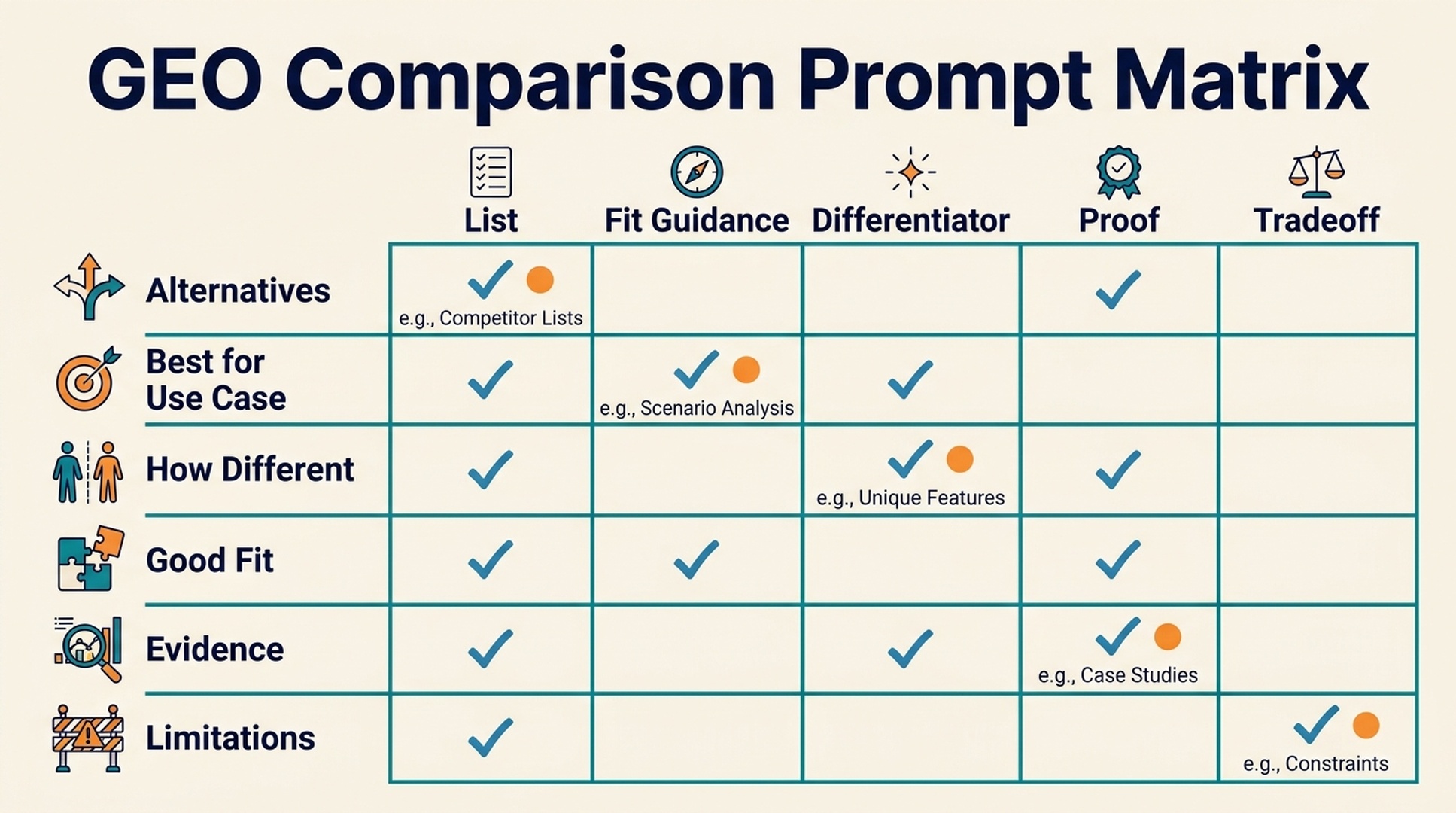
Buyer prompt | Page section that supports it |
|---|---|
"What are alternatives to [competitor]?" | alternatives list and comparison table |
"Which tool is best for [use case]?" | fit/not-fit section |
"How is [brand] different?" | differentiator section |
"Is [brand] good for my team?" | audience and maturity guidance |
"What proof supports this?" | evidence and examples |
"What are the limitations?" | not-fit and tradeoff section |
This is the GEO value: the page is built around real AI recommendation prompts.
How to keep alternatives pages fair
Fairness matters for readers and for AI answer quality.
Use these rules:
- describe competitors accurately
- avoid claiming universal superiority
- separate facts from opinion
- disclose when information is based on public pages
- include "best for" language instead of winner-take-all language
- mention cases where your product is not the best fit
- support differentiators with evidence
A fair page is often more persuasive than an aggressive page because it feels like a decision aid.
Where alternatives pages fit in a GEO cluster
Alternatives pages should not stand alone. They work best inside a cluster.
A strong cluster includes:
- Category page: defines the market
- Alternatives page: maps options
- Product page: explains your solution
- Use-case page: shows who it helps
- Case study or proof page: supports claims
- Documentation: proves features
- Template or tool: gives practical value
Together, these pages help AI systems understand category, fit, proof, and differentiation.
Common alternatives page mistakes
Mistake 1: turning the page into a competitor attack
Negative comparison pages may convert some readers, but they often feel biased. A better GEO asset explains tradeoffs clearly.
Mistake 2: using generic criteria
Criteria like "easy to use" and "powerful features" are too vague. Use criteria tied to the buyer's actual workflow.
Mistake 3: hiding your limitations
If your product is not ideal for a certain team or use case, say so. Fit guidance improves trust.
Mistake 4: creating dozens of thin competitor pages
One strong alternatives hub can be more useful than many shallow pages. Build depth before scale.
Mistake 5: ignoring evidence
Comparison claims need support. Link to docs, case studies, templates, research, reviews, or product examples.
A simple alternatives page brief
Use this brief before writing.
Field | Fill this in |
|---|---|
Competitor or category | |
Target buyer | |
Main use case | |
Decision criteria | |
Options to include | |
Your best-fit scenario | |
Your not-fit scenario | |
Evidence required | |
Comparison table needed | yes/no |
Internal proof links | |
Target prompts |
The target prompts are important. They keep the page aligned with how buyers ask AI systems for recommendations.
How to measure performance
Track both search and AI outcomes.
For search:
- impressions and clicks for alternatives queries
- ranking changes
- CTR
- conversions or assisted conversions
- engagement on comparison sections
For ChatGPT GEO:
- whether the brand appears in alternatives prompts
- whether the comparison is accurate
- which competitors appear with you
- whether your differentiators are mentioned
- whether the answer includes evidence or sources
- whether outdated claims disappear
Run the same alternatives prompts monthly. Do not judge the page after one test.
FAQ
Are alternatives pages good for ChatGPT GEO?
Yes. Alternatives pages help AI systems understand market structure, competitors, use cases, and fit. They are especially useful for recommendation and comparison prompts.
Should I mention competitor names on my site?
If buyers compare you with those competitors, usually yes. Keep the comparison fair, factual, and useful. Avoid unsupported claims or attacks.
How many alternatives pages should I create?
Start with one strong category or alternatives hub before creating many competitor-specific pages. Add specific comparison pages only when search demand and buyer intent justify them.
What should an alternatives page include?
It should include a direct answer, decision criteria, comparison table, fit/not-fit guidance, differentiators, evidence, limitations, and clear next steps.
Can alternatives pages help Google SEO too?
Yes. They can target comparison and alternatives queries, support internal linking, and help buyers evaluate options. For GEO, they also make market context easier for AI systems to understand.
Author: Noah Preston, B2B Comparison Page Strategist, 600+ Evaluation Pages Reviewed at Auspia. Noah writes about competitor pages, alternative pages, evaluation content, and decision-stage SEO/GEO assets.