The Short Answer
You are choosing your first paid SEO tool. You have probably read three other comparison articles and they all said "it depends." Here is what actually matters:
Pick Semrush if you want one platform that does SEO, content writing, competitor ads, social media, and local SEO. It has a 14-day free trial, so you can test before paying. Pick Ahrefs if backlink research and competitor link analysis is your main job. The interface is simpler and the link data refreshes faster than anything else. Pick neither if your budget is under $30/month. Use the free tiers of both tools, or try OpenSEO with pay-as-you-go DataForSEO credits instead.
Below: real 2026 pricing (including the add-ons the pricing pages hide), a feature-by-feature breakdown focused on what beginners actually need, and a free AI agent workflow you can copy and paste to use either tool from Codex or Claude Code.
What Changed in 2026: AI Agents Can Now Run Your SEO Tools
Before the feature comparison, one thing has changed since every other Ahrefs-vs-Semrush article was written: both tools can now be controlled by AI agents.
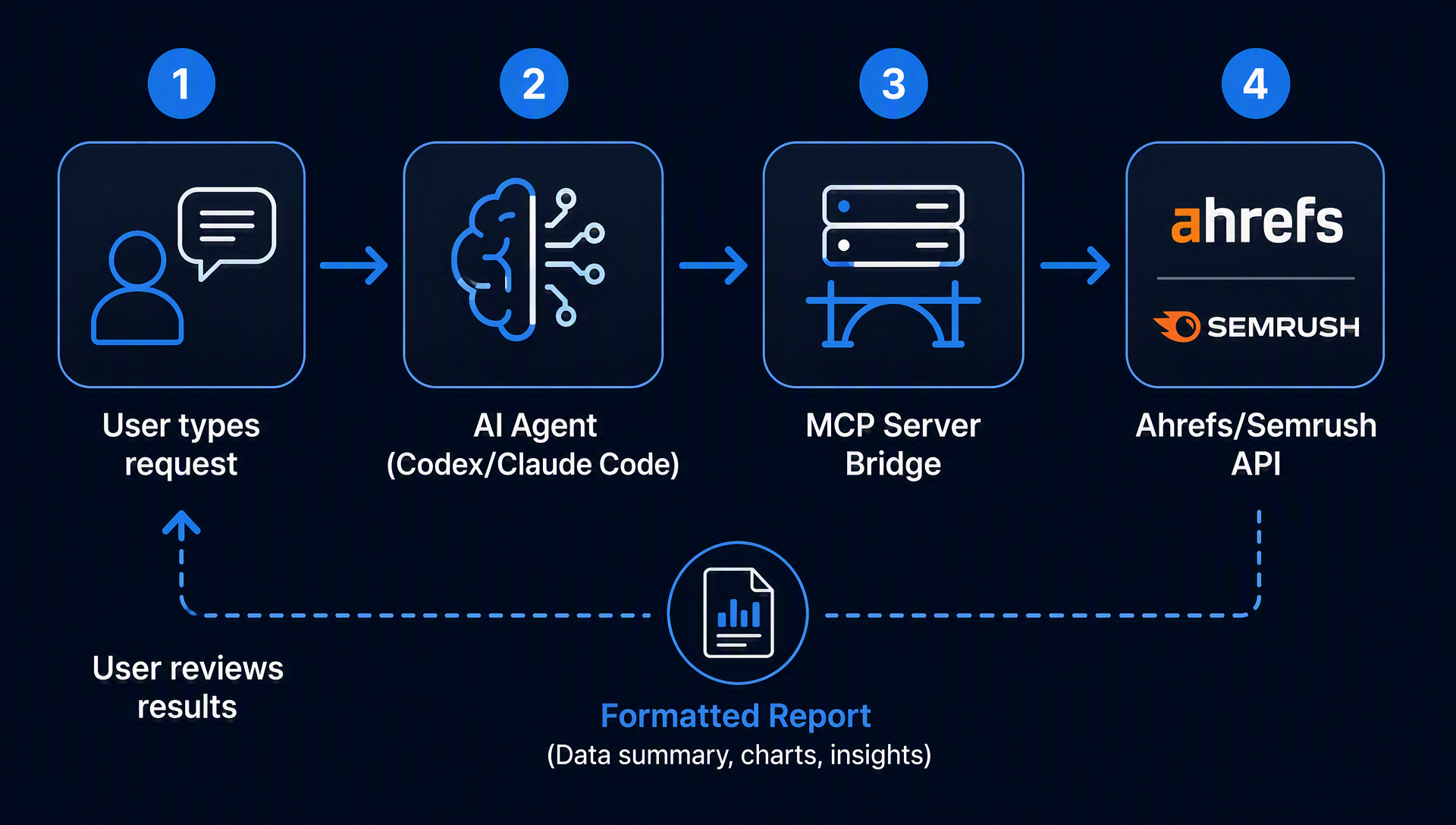
Tools like OpenAI Codex and Claude Code connect directly to Ahrefs and Semrush through MCP (Model Context Protocol). You type a plain-English request like "find keywords my competitor ranks for that I don't," and the AI agent calls the SEO tool's API, pulls the data, and builds a report. No clicking through dashboards.
What this means for your choice:
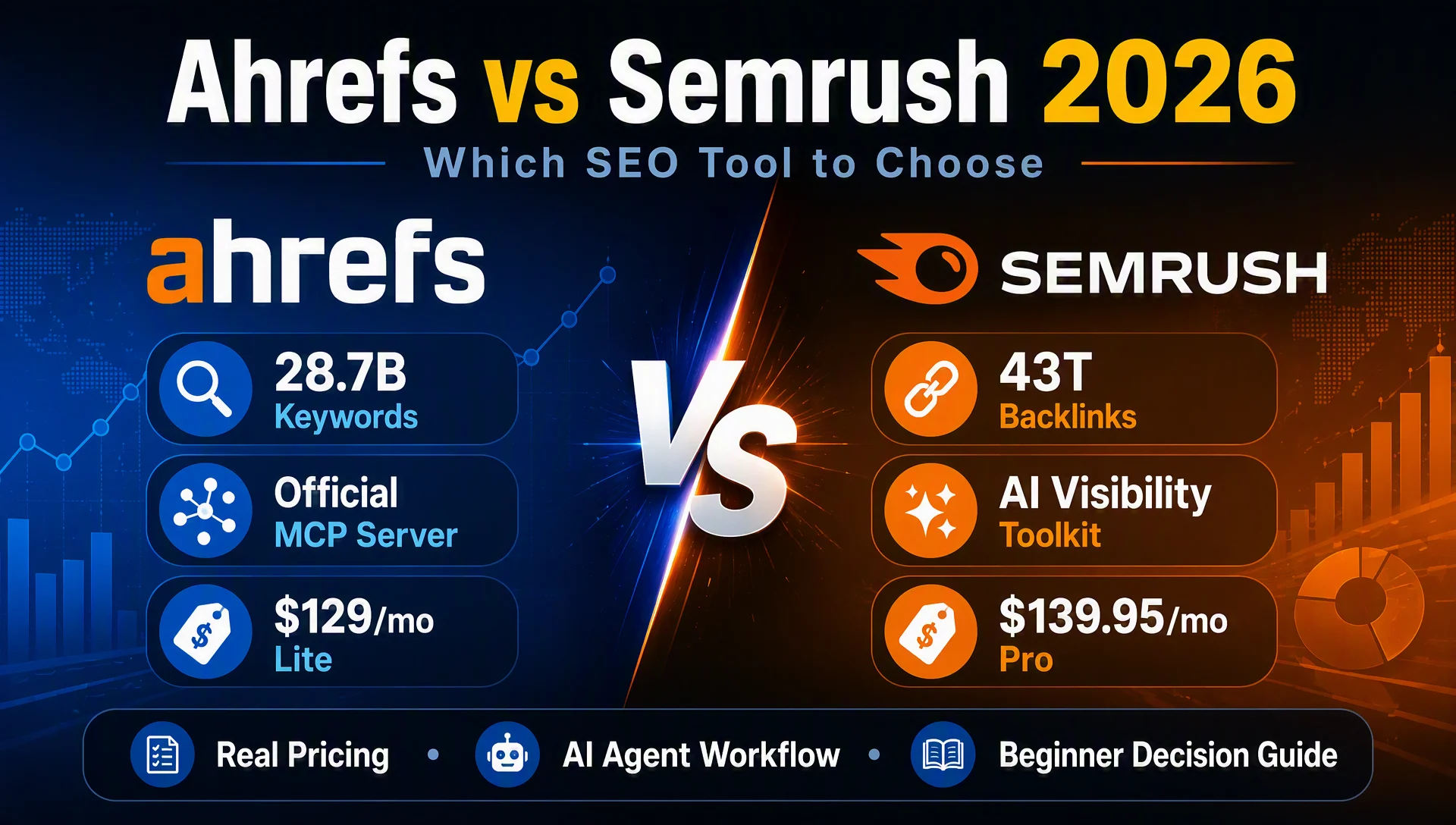
- Ahrefs has an official MCP server, included on all paid plans from Lite upward. It works out of the box.
- Semrush does not have an official MCP server yet. Community-built MCP servers exist and work, but they take a few extra minutes to set up.
- Both have REST APIs if you outgrow MCP later.
Later in this article, there is a complete copy-paste skill file that lets Codex or Claude Code run keyword research, backlink checks, and competitor analysis through either tool. But first, the tool comparison.
Pricing: What You Actually Pay in 2026
List prices tell half the story. Both tools charge extra for seats, AI features, and advanced modules. Here is the real picture.
Ahrefs Pricing (August 2026)
Plan | Monthly | Annual (per month) | Projects | Tracked Keywords | Extra Seats |
|---|---|---|---|---|---|
Starter | $29 | — | 1 | 50 | Not available |
Lite | $129 | ~$108 | 5 | 750 | $49/seat |
Standard | $249 | ~$208 | 20 | 2,000 | $79/seat |
Advanced | $449 | ~$374 | 50 | 5,000 | $149/seat |
Enterprise | $1,499 | ~$14,990/yr | Custom | Custom | Custom |
Important add-ons that raise your bill:
- AI Content Kit: $99/month
- Brand Radar (AI visibility): $199/month
- Report Builder: $99/month
The hidden cost: Ahrefs introduced per-seat pricing in March 2026. A three-person team on the Standard plan pays $249 + $79 + $79 = $407/month before any add-ons. The $29 Starter plan exists but is too credit-limited for real work — think of it as a paid interface test.
What you get at each level: Lite unlocks the full keyword database and MCP access. Standard adds AI keyword clustering, content tools, and batch analysis. Advanced includes API access and higher limits.
Semrush Pricing (August 2026)
Plan | Monthly | Annual (per month) | Projects | Tracked Keywords | Extra Seats |
|---|---|---|---|---|---|
Pro | $139.95 | ~$117 | 5 | 500 | $45/seat |
Guru | $249.95 | ~$208 | 15 | 1,500 | $80/seat |
Business | $499.95 | ~$417 | 40 | 5,000 | $100/seat |
Semrush One (SEO + AI Visibility bundled, launched October 2025):
Plan | Monthly | Annual (per month) |
|---|---|---|
Starter | $199 | ~$165 |
Pro+ | $299 | ~$248 |
Advanced | $549 | ~$456 |
Important add-ons:
- AI Visibility Toolkit: $99/month per user (included in Semrush One)
- Content Toolkit: $60/month
- Social Toolkit: $20/month
- Local SEO: $30–$60/month per location
- AI PR Toolkit: $149–$279/month
- Lead Generation: $90/month
The hidden cost: "Add-on fatigue" is real. Semrush includes only one user seat by default. A three-person team on Guru with the Content Toolkit and AI Visibility pays $249.95 + $80 + $80 + $60 + $99 = $568.95/month. Semrush One bundles reduce this somewhat, but AI visibility is priced per seat — costs climb as your team grows.
Pricing Verdict for Beginners
Situation | Cheaper Choice |
|---|---|
Solo user, basic SEO | Ahrefs Lite ($129/mo) vs Semrush Pro ($139.95/mo) — Ahrefs wins |
Solo user, wants content + AI tools | Semrush Guru annual (~$208/mo) — more features at this tier |
3-person team | Ahrefs Standard (~$407/mo) vs Semrush Guru (~$569/mo with add-ons) — Ahrefs wins on price |
Agency, 5+ seats | Semrush Business — per-seat costs scale better at higher tiers |
Under $30/month budget | Neither — use free tiers + OpenSEO pay-as-you-go |
Free options before you pay: Ahrefs Webmaster Tools gives you free Site Explorer and Site Audit for your own sites. Semrush has a 14-day free trial on Pro and Guru and a limited free tier with about 10 searches per day. Try both free options for a week. Then pay for the one that fits.
Feature Comparison at a Glance
Category | Ahrefs | Semrush | Edge for Beginners |
|---|---|---|---|
Keyword database | 28.7B keywords, 217 countries | 26.7B keywords, 142 countries | Ahrefs (broader global coverage) |
Backlink index | 35T links, fresher (minute-level updates) | 43T links, larger but slower refresh | Ahrefs (industry standard for links) |
Site audit | 170+ checks, faster crawl | 140+ checks, more guided fixes | Semrush (easier for non-technical users) |
Rank tracking | 750–5,000 keywords, weekly updates | 500–5,000 keywords, daily updates | Semrush (daily updates + more SERP features) |
Content tools | Content Explorer (discovery) | SEO Writing Assistant + ContentShake AI | Semrush (write + optimize + publish) |
PPC / ads | Basic ad-spend estimates | Full PPC toolkit + competitor ads | Semrush (only real option for ads) |
Social media | Social Media Manager included | Full social suite ($20/mo add-on) | Ahrefs (included at no extra cost) |
Local SEO | City-level keyword research only | Full local toolkit (GBP, listings, map rank) | Semrush (Ahrefs barely competes here) |
AI visibility | Brand Radar ($199/mo add-on) | AI Visibility Toolkit ($99/mo, bundled in One) | Semrush (cheaper, more platforms tracked) |
AI agent access | Official MCP server (Lite+) | Community MCP servers (requires API key) | Ahrefs (easier, more reliable setup) |
Interface / learning | Clean, ~5-7 days to learn | Dense, 50+ tools, steeper learning curve | Ahrefs (beginners feel less overwhelmed) |
Free trial | No (7-day refund instead) | 14-day free trial on Pro/Guru | Semrush |
Support | Email + extensive free education | Phone + email + demos + Academy | Semrush (more hands-on) |
Company stability | Independent | Acquired by Adobe (2026) | Semrush (long-term backing) |
Deep Dive: The Five Categories That Matter Most for Beginners
You do not need to compare all 40+ features. As a beginner, focus on these five.
1. Keyword Research: Where to Find What People Search For
Ahrefs Keywords Explorer gives you search volume, keyword difficulty, traffic potential, and click data across 217 countries. Its standout features for beginners: the "Parent Topic" column (shows you whether a keyword deserves its own page or should live under a broader topic) and AI-powered keyword clustering on Standard+ plans. You type one seed keyword and get hundreds of related terms grouped by search intent.
Semrush Keyword Overview covers fewer countries (142) but goes deeper on the US market with more accurate local-volume estimates. Its beginner advantage: the Keyword Magic Tool generates tens of thousands of long-tail variations from one seed, and the Keyword Strategy Builder automatically groups them into topic clusters and pillar pages — essentially giving you a content plan from one search.
For beginners: Semrush wins. Its guided workflow (seed → magic tool → strategy builder → content plan) shortens the time from "I have a topic" to "I know what to write." Ahrefs gives you more raw data but expects you to know what to do with it.
2. Backlink Analysis: The Reason Many People Choose Ahrefs
Backlinks remain Google's strongest ranking signal. This is where Ahrefs built its reputation.
Ahrefs Site Explorer updates its backlink index every 15-30 minutes — the freshest in the industry. For a beginner, this means you can check who linked to a competitor yesterday and reach out today. The Best by Links report shows you which pages on any site earned the most links, instantly revealing what content attracts backlinks in your niche.
Semrush Backlink Analytics has a larger raw index (43 trillion links vs Ahrefs' 35 trillion), but its data refreshes more slowly. Its beginner advantage is the Backlink Audit Tool with a toxicity score — it flags potentially harmful links and helps you build a disavow file, which Ahrefs does not offer.
For beginners: Ahrefs wins for link building research. The freshness and simplicity matter more than raw index size when you are starting out. Semrush's toxicity score is useful but becomes important later, once you have a backlink profile to audit.
3. Site Audit: Find and Fix Technical Problems
Both tools crawl your site like a search engine and flag issues.
Ahrefs Site Audit checks 170+ technical SEO parameters, crawls up to 1.5 million pages on Advanced, and runs always-on audits with Project Boost. Its issue reports are color-coded by severity and grouped by what matters most. The May 2026 update added a "Fix with Agent A" button that sends issues directly to Ahrefs' AI marketing agent for investigation.
Semrush Site Audit covers 140+ parameters, crawls up to 1 million pages on Business, and stands out for its actionable fix descriptions written in plain English. Each issue comes with a "How to Fix" guide. The AI Search Health Check (Semrush One) additionally evaluates whether AI agents like ChatGPT and Perplexity can crawl your pages.
For beginners: Semrush wins. Its fix descriptions are written for non-developers. You will understand why a missing meta description matters and how to add one, rather than just seeing a red error flag. The AI crawler health checks are a bonus that Ahrefs does not match.
4. Content and AI Writing Tools
Ahrefs takes a research-first approach. Its Content Explorer is one of the best tools for finding content that earned links and traffic in any niche — you filter by referring domains, organic traffic, or social shares to see what worked. The AI Content Helper (part of the $99/month Content Kit) scores your draft against top-ranking pages and identifies topics you should cover. But Ahrefs does not write content for you.
Semrush takes a full-cycle approach. The SEO Writing Assistant scores your draft in real time inside Google Docs, checking readability, keyword usage, and tone. ContentShake AI generates full draft articles from a target keyword. Topic Research gives you headline ideas, questions to answer, and content angles. For a beginner, this means you can go from keyword to published draft without leaving Semrush.
For beginners: Semrush wins. If you also need help writing content (not just researching it), Semrush's content toolchain is stronger. Ahrefs is better for discovering what to write about, but leaves the writing to you.
5. AI Visibility: Are AI Search Engines Mentioning Your Brand?
Most Ahrefs-vs-Semrush articles skip this category entirely, because it was not a thing when they were written. In 2026, it is a thing.
Ahrefs Brand Radar tracks whether your brand appears in ChatGPT, Gemini, Perplexity, Copilot, Google AI Overviews, AI Mode, Grok, YouTube, TikTok, and Reddit. It covers 271M+ organic prompts and lets you create custom prompt tracking. The April 2026 "Citation Funnel" update separates "cited in" from "found in" — revealing when an AI mentions your content without linking to you. Cost: $199/month standalone, or included with custom-prompt limits on paid plans.
Semrush AI Visibility Toolkit tracks ChatGPT, Google AI Overviews, Google AI Mode, Perplexity, and Gemini (Copilot is not covered). It provides an AI Visibility Score (0-100), prompt-level monitoring, and competitor gap analysis for AI citations. A standout feature for beginners: it tells you whether AI systems describe your brand positively, negatively, or neutrally. Cost: $99/month standalone, or bundled in Semrush One.
For beginners: Semrush wins on price and ease. The AI Visibility Score gives you a single number to track, and sentiment analysis makes the data actionable. Ahrefs Brand Radar covers more platforms and has deeper technical features, but at twice the price and with more complexity than a beginner needs.
Can AI Agents Use These Tools? (Yes. Here Is Your Free Workflow)
You will not find this section in older Ahrefs-vs-Semrush comparisons, because it was not possible when they were written. In 2026, you can use OpenAI Codex, Claude Code, Cursor, or any MCP-compatible agent to run keyword research, backlink checks, and competitor analysis from Ahrefs or Semrush. By typing plain English.
How It Works
- Your AI agent connects to the SEO tool's MCP server (a secure bridge that exposes data, not account controls).
- You type a request like: "Find my top 5 competitors, show the keywords they rank for that I don't, and sort by traffic potential."
- The agent calls the SEO API, processes the data, and returns a formatted report.
- You review the results and decide what to do next. The agent does not publish, edit your site, or spend money without your approval.
Ahrefs MCP Setup (Official — Easiest)
Requirements: An Ahrefs paid plan (Lite or above), which includes MCP access.
For Codex (OpenAI): Add the Ahrefs MCP server to your Codex configuration. The exact setup depends on your Codex environment, but here is the connection string:
https://api.ahrefs.com/mcp/mcpAuthentication uses an OAuth flow that creates an MCP-scoped API key. Follow the setup guide in your Ahrefs account under Settings → Integrations → MCP.
For Claude Code:
claude mcp add --transport http ahrefs "https://api.ahrefs.com/mcp/mcp"Semrush MCP Setup (Community — Requires API Key)
Semrush does not yet offer an official MCP server. The community-built semrush-mcp server (MIT license, open source) fills this gap with 77 tools covering domain analytics, keyword research, backlinks, and site audits.
Install:
npm install -g github:mrkooblu/semrush-mcpConfigure: Add your Semrush API key as an environment variable (SEMRUSH_API_KEY), then add the server to your MCP client configuration.
Free AI Agent Skill: Use Ahrefs or Semrush from Codex
Below is a complete SKILL.md file. Save it to your Codex project, and your AI agent can run keyword research, backlink checks, and competitor analysis from either tool. The agent follows safety rules: never guess data, always record the source and retrieval time, and mark gaps where data is not available.
Create this file in your Codex workspace as .claude/skills/seo-data-research/SKILL.md (for Claude Code) or in your Codex skills directory:
---
name: seo-data-research
description: Run keyword research, backlink analysis, and competitor research through authorized Ahrefs or Semrush connections. For SEO beginners — the agent handles the tool, you review the results.
---

You are an SEO research assistant for a beginner. Your job is to run data lookups through authorized tools and return clear, readable reports. You do NOT make SEO decisions, publish content, or modify websites.

## Before You Start

1. Confirm which data source the user authorizes: Ahrefs MCP, Semrush MCP (community), DataForSEO, Google Search Console export, or a provided CSV.
2. Confirm: target country/market, language, seed keyword or domain, and what the user wants to learn.
3. Remind the user that all metrics are estimates from the data provider, not guarantees.

## Data Source Rules

- **Ahrefs MCP**: Available if the user has an active Ahrefs Lite+ subscription. Call the `doc` tool first to get current input schemas. API units are metered — check remaining budget with the `subscription-info-limits-and-usage` tool before large batch runs.
- **Semrush MCP (community)**: Requires a configured `SEMRUSH_API_KEY`. Rate-limited to 10 requests/second by default. Cache responses locally with a 5-minute TTL to avoid wasting API units.
- **DataForSEO**: Pay-as-you-go. Each query costs fractions of a cent. New accounts get $1 free credit.
- **CSV / GSC export**: If the user provides a file, use it directly. Do not ask for API access.

## Workflows

### Keyword Research

1. Ask for: seed keyword(s), target country, language.
2. Call `keywords-explorer-overview` (Ahrefs) or `semrush_keyword_overview` (Semrush) for each seed.
3. For discovery, use `matching-terms` (Ahrefs) or `semrush_phrase_match` (Semrush).
4. Group results by: transactional, commercial-investigation, informational, navigational.
5. Output a table: Keyword | Volume | Difficulty | Intent | Traffic Potential | Source | Retrieved At.
6. Mark as "No data" any keyword where the provider returns no results. Never guess volume or difficulty.

### Competitor Gap Analysis

1. Ask for: your domain, up to 4 competitor domains, target country.
2. Call `organic-competitors` to confirm the competitor set.
3. Run `content-gap` (Ahrefs) or `semrush_keyword_gap` (Semrush): keywords competitors rank for that your domain does not.
4. Filter to keywords with volume ≥ 50 and difficulty ≤ your stated threshold.
5. Output sorted by: traffic potential (highest first).
6. For each keyword, include the top-ranking URL so the user can inspect what currently ranks.

### Backlink Check

1. Ask for: target domain or URL.
2. Call `backlinks` (Ahrefs) or `semrush_backlinks` (Semrush).
3. Report: total backlinks, referring domains, Domain Rating / Authority Score, top 10 linking pages by DR.
4. For link prospecting: run `content-gap` on backlinks to find domains linking to competitors but not the user's site.
5. Flag any linking domain with DR < 10 or obviously spam-like anchors as "review manually."

## Output Rules

For every data point, record:
- **Provider**: Ahrefs / Semrush / DataForSEO / GSC
- **Endpoint or report**: e.g., `keywords-explorer-overview`
- **Retrieved at**: ISO 8601 timestamp
- **Country and language**: e.g., US / English
- **Metric definition**: e.g., "Keyword Difficulty is Ahrefs' estimate on a 0-100 scale"

## Hard Limits

- Never write, print, log, or include in any output: API keys, tokens, passwords, cookies, or customer domains.
- Never guess search volume, keyword difficulty, CPC, SERP results, or traffic numbers. If data is unavailable, say so.
- Never claim that a keyword, tactic, or optimization will produce a specific ranking, traffic increase, or revenue.
- Never create fake screenshots, dashboards, or API responses.
- Do not publish content, edit websites, or modify settings without explicit user approval for each action.
How to use this skill:
- Save the file above to your Codex or Claude Code project.
- Make sure your Ahrefs MCP or Semrush MCP connection is active.
- Type a request like: "Research 10 keywords for [my topic] in the US market and group them by intent."
The agent will run the data lookup, format the results, and show you exactly where each number came from. You review and decide.
What AI Agents Cannot Do (Yet)
Be realistic about the limits. AI agents connected to SEO tools can pull live data, compare competitors, find keyword gaps, check backlinks, and format reports. They are fast at that stuff.
They cannot reliably predict which keyword will rank, guarantee traffic, or write content that sounds fully human without editing. And they should never publish changes to your live site without review, spend money on ads, or make strategic decisions on your behalf.
Think of the AI agent as a fast research assistant. It saves you hours of clicking through dashboards. It does not replace learning SEO fundamentals.
Budget Alternative: OpenSEO
If Ahrefs and Semrush both feel expensive, OpenSEO is worth a look. It is an open-source (MIT license) SEO platform that pulls data from DataForSEO and has a built-in MCP server for AI agents.
How it works:
- The tool itself is free. You pay only for DataForSEO API usage.
- Keyword research: ~$0.035 per query
- Domain analysis: ~$0.04 per query
- Rank tracking: ~$2/month for 50 keywords
- New DataForSEO accounts get $1 free credit to test.
Who it is for: Solo operators, indie hackers, and beginners who want AI-agent-friendly SEO data without a monthly subscription. It is not a full replacement for Ahrefs or Semrush — it lacks content tools, social media management, and the polished UI — but for keyword research, backlink checks, and competitor analysis, it covers the basics.
AI agent setup: OpenSEO's MCP server works with Codex and Claude Code out of the box. Connection:
claude mcp add --transport http openseo "https://app.openseo.so/mcp"Decision Flowchart: Which Tool for Your Situation?
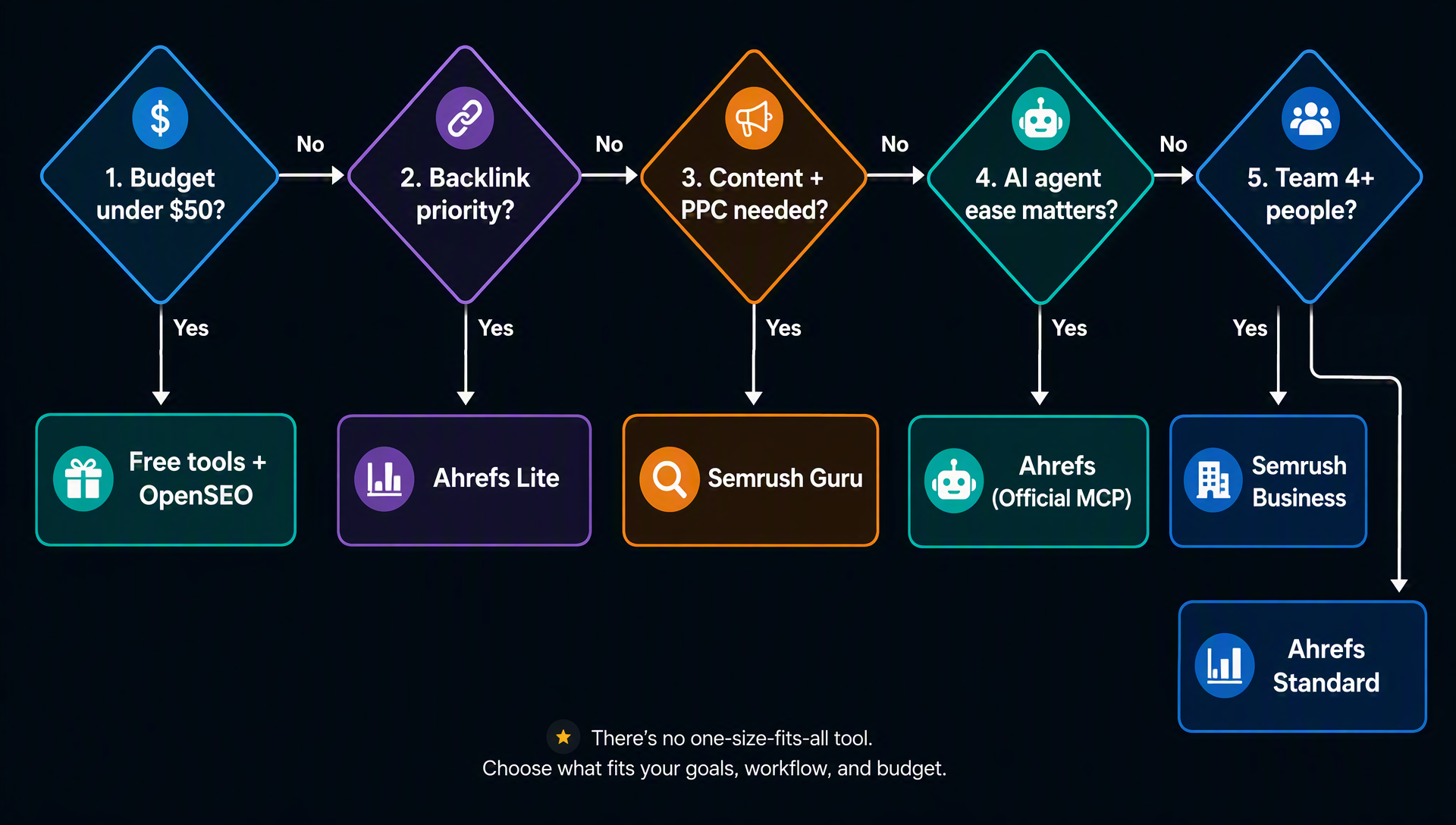
Five questions. Answer them honestly and follow the arrow.
Q1: Is your monthly budget under $50? → Yes: Use Ahrefs Webmaster Tools (free) + Semrush free tier + OpenSEO pay-as-you-go. Revisit this article when you have budget. → No: Go to Q2.
Q2: Is backlink research and link building your main priority? → Yes: Pick Ahrefs. Start with the Lite plan ($129/month). Upgrade when you need more projects. → No: Go to Q3.
Q3: Do you also need content writing tools, PPC research, or local SEO? → Yes: Pick Semrush. Start with Guru annual ($208/month) if you want content tools included. Start with Pro ($117/month annual) if you only need SEO basics and will add tools later. → No: Go to Q4.
Q4: Do you want to use AI agents (Codex, Claude Code) to run your SEO research? → Yes, and ease of setup matters: Pick Ahrefs (official MCP, works out of the box). → Yes, and I'm comfortable with community tools: Semrush works too with the community MCP server. → Not a priority: Either tool works. Go with the one that fits your budget.
Q5: Are you in a team of 4 or more people? → Yes: Semrush Business scales better on per-seat pricing for larger teams. → No: Ahrefs Standard is cheaper for 2-3 person teams.
Quick-Reference Decision Table
You are a... | Pick | Plan | Approx. Monthly Cost |
|---|---|---|---|
Solo blogger, budget-conscious | Ahrefs | Lite annual | ~$108 |
Solo marketer who writes content | Semrush | Guru annual | ~$208 |
Link-building specialist | Ahrefs | Standard annual | ~$208 |
Small agency (2-3 people) | Ahrefs | Standard (with seats) | ~$407 |
Growing agency (5+ people) | Semrush | Business annual | ~$417+ |
Local business owner | Semrush | Pro (with Local add-on) | ~$177+ |
Indie hacker / startup | OpenSEO | Pay-as-you-go | ~$5-20 |
AI-automation-first team | Ahrefs | Lite+ annual | ~$108+ |
FAQ
Which tool is easier to learn? Ahrefs. The interface is cleaner, there are fewer menus, and most people get comfortable within a week. Semrush packs 50-plus tools across multiple modules. Powerful, but there is more to click through.
Do I need both tools? Most beginners do not. Some agencies run both (Ahrefs for backlinks, Semrush for content and reporting), but that is a $250+/month commitment. Start with one, master it, and only add the second when you have a specific gap the first tool cannot fill.
Is Semrush still independent after the Adobe acquisition? Adobe acquired Semrush in early 2026. As of August 2026, Semrush operates as a subsidiary with its own brand, product roadmap, and pricing. The acquisition provides long-term financial stability, but pricing and product direction may shift over time under Adobe's ownership.
Can I really do SEO with just AI agents and no manual tool? Not yet. AI agents are excellent for data gathering, competitor research, and report formatting. But interpreting results, making strategic decisions, and creating genuinely helpful content still requires human judgment. Think of agents as power tools, not autopilot.
What if I outgrow my plan? Both tools let you upgrade anytime. Ahrefs credits unused API units to the next month. Semrush prorates upgrades. Start small — you can always move up.
Does either tool guarantee better rankings? No. No SEO tool can guarantee rankings. These tools provide data, analysis, and recommendations. Your results depend on what you do with that information, your market competition, and Google's (and AI search engines') ever-changing algorithms.
Author: Alice Monroe, AI SEO Tools Analyst Covering 150+ Tools at Auspia. Alice writes practical tool comparisons and AI-agent workflows to help growth teams choose and use the right SEO software.