Your competitor just got a 1-star review. That's your next high-converting page.
Most SaaS teams treat negative reviews of rival products as gossip — useful for morale, useless for growth. That's a expensive mistake. Every angry G2 comment, every Capterra rant about "hidden fees," and every Reddit thread titled "looking for an alternative to [Competitor]" is a search query with purchase intent hiding behind it.
Here's why that matters in 2026: comparison queries like "Competitor vs Your Brand" and "Competitor alternatives" sit at the very bottom of the funnel. Recent SaaS conversion data shows pages built around competitor comparison tables and first-party survey data averaged 47% higher conversion rates from organic traffic than standard product pages, and "vs" queries drove 3x more demo requests than top-of-funnel blog posts. Accounts that built dedicated comparison landing pages saw a 62% uplift in qualified leads.
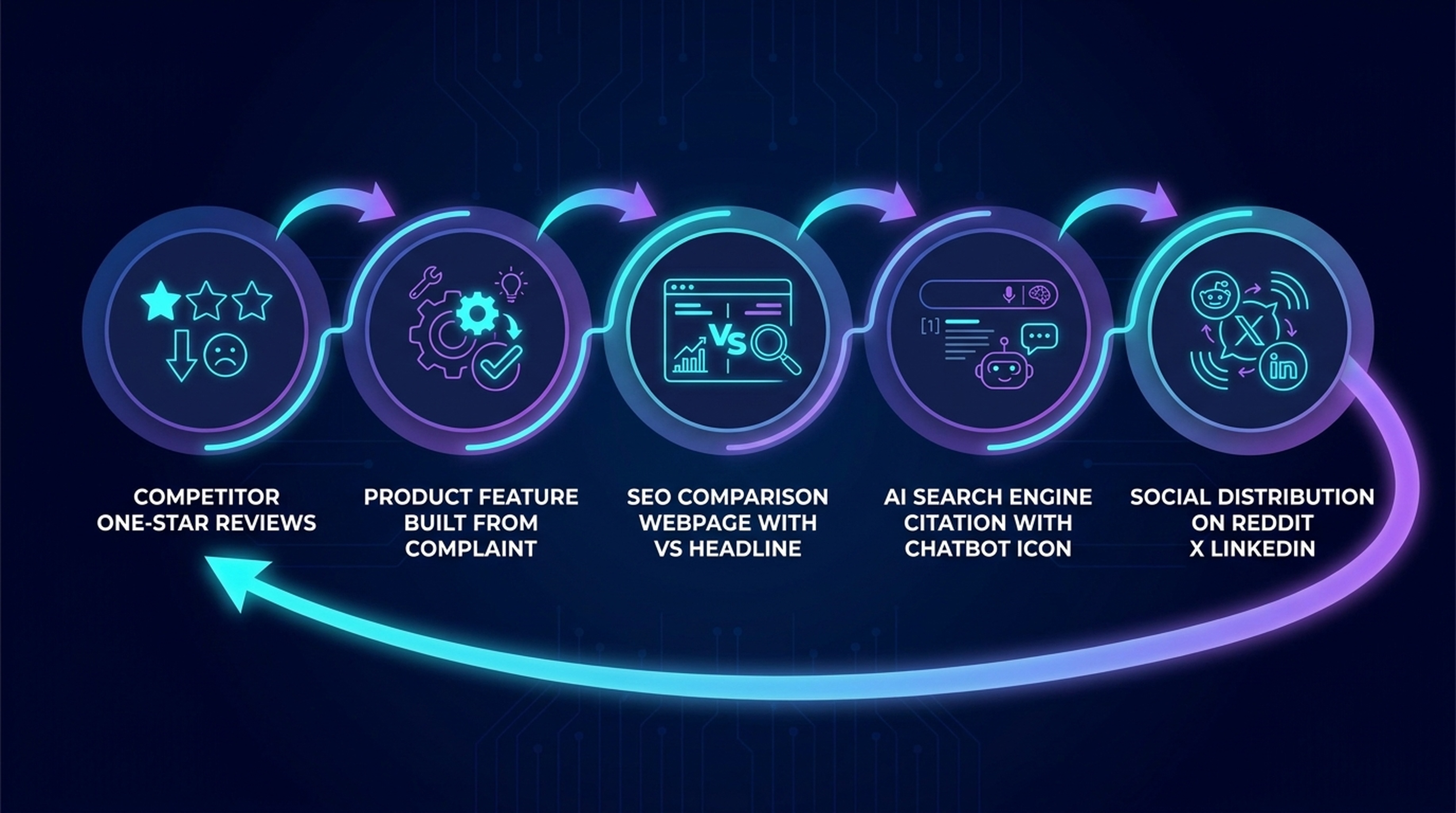
The growth hack is not "make a comparison page." It's the closed loop: mine competitor complaints → turn the recurring ones into product features → publish a comparison page that answers those exact complaints → optimize it so both Google and AI search engines cite it → distribute it where the complainers already hang out. This article is the full playbook.
Why comparison pages are the highest-ROI SEO bet in 2026
Three forces converged to make comparison pages more valuable than ever:
- Search intent is maxed out. Someone typing "Notion vs Coda" has already decided they're unhappy with one of them. You're not educating — you're closing.
- AI search rewrote discovery. Roughly 51% of B2B software buyers now start research with an AI chatbot, and 45% say review-site citations are the most trusted signal in an AI-generated answer. Comparison pages with clean structured data and review citations are exactly the artifacts LLMs lift into their answers.
- Competitor brand traffic is under-claimed. Most founders are scared to name competitors on their own site, which leaves the "vs" SERPs wide open for whoever is willing to write the honest, useful comparison.
The result: a single well-built comparison page can out-convert ten top-of-funnel posts, and it compounds because AI engines keep citing it.
The 5-step loop: from competitor 1-star reviews to a ranking comparison page
Step 1 — Mine competitor negative reviews (the right way)
Don't skim one review and call it research. Build a recurring-complaint dataset across four sources:
- G2, Capterra, and TrustRadius — filter each competitor's reviews to 1–2 stars, then sort by "most helpful." Export the top 20–30 per competitor.
- Reddit — search
site:reddit.com "competitor name" alternativeandcompetitor name + frustrated/switching/leaving. Reddit threads show up constantly in comparison SERPs. - App store reviews and Trustpilot — especially for mobile-first or consumer SaaS.
- Your own lost-deal notes — your sales team already logs why prospects picked the competitor, and the cracks that surfaced later.
Tag every complaint. After 50–80 entries, three to five themes will dominate — things like "slow onboarding," "opaque pricing," "no API," "support tickets go unanswered for days." Those themes are your page outline.
Step 2 — Convert recurring complaints into product features
This is the step most "comparison page" guides skip, and it's what separates a growth loop from a one-off landing page. The loop only works if your product actually fixes the complaint, because buyers will check.
For each top complaint theme, do one of three things:
- Ship the fix. If competitors' users hate the slow migration, build a one-click importer and make it the headline of your comparison page.
- Productize a workaround. If you can't rebuild the feature, document a fast path and call it out: "Migrates in under 10 minutes — here's how."
- Be honest where you can't. If you also lack the feature, don't pretend. Lead with the two themes where you genuinely win and footnote the rest.
The comparison page is the publishing layer of a real product decision. That's why it converts — the claims are true.
Step 3 — Build one comparison page per competitor (not a mega-grid)
Resist the urge to make a single "Us vs Everyone" table. Build one dedicated page per competitor. Reasons:
- Each "Competitor vs Your Brand" page targets a distinct high-intent keyword cluster and can rank independently.
- One-on-one pages let you address that competitor's specific complaints in depth instead of generic feature checklists.
- AI search engines extract cleaner answers from focused pages than from crowded grids.
Name the competitor. Yes, really. Brands worry about legal or reputational risk, but the data is clear: pages that name the competitor and acknowledge where the competitor wins convert better than pages that only punch. Credibility is the conversion lever, not aggression. Lead with two sentences on who the competitor is best for — then get into where they fall short, using the complaint themes from Step 1 as your section headers.
Step 4 — Optimize for Google AND AI search (the 2026 twist)
This is where 2026 diverges from the 2018 comparison-page playbook. You're no longer writing for one crawler — you're writing for Google's index, ChatGPT, Perplexity, Claude, and Bing Copilot simultaneously. The page has to be machine-liftable.
Mandatory technical elements:
- Schema.org `Product` and `ItemList` markup on the comparison table. Structured-data pages are far more likely to earn rich snippets and AI citations.
- A named-competitor FAQ block with
FAQPageschema. LLMs love Q&A pairs, and this quietly does the heavy lifting on conversion. - Review-site citations inline. Quote the actual G2/Reddit complaints with links. Remember: 45% of buyers trust review-site citations in AI answers — feed the models what they trust.
- One dominant search intent per page. If a page tries to serve "compare," "alternatives," and "switching" at once, split it into three variants. Mixed intent kills conversion.
- Skimmable structure. Comparison table up high, sticky CTA, mobile parity tested on three devices. Comparison tables that break on mobile lose the demo.
Step 5 — Distribute where the complainers already are
The page is worthless if the people who wrote the 1-star reviews never see it. Distribute in three places:
- Reddit — in relevant subreddits, without dropping a naked link. Write the comparison takeaways as a post and link the page as the "full breakdown." Reddit threads rank in comparison SERPs, so this double-dips.
- X / LinkedIn — frame it as a public teardown: "We read 200 reviews of [Competitor]. Here's the #1 thing their users hate — and how we built around it." Founder-led teardown posts materially outperform product-marketing copy in 2026.
- Direct outreach to the reviewers — where platform rules allow, reply to or message people who left the negative review with a genuinely helpful resource. This is the highest-converting traffic you'll ever get.
What a comparison page that actually converts looks like
A defensible anatomy, top to bottom:
- Headline naming the competitor and the core pain point (e.g., "Auspia vs [Competitor]: The Honest Comparison for Teams Tired of Slow Onboarding").
- 30-second verdict — who should pick which tool, stated in two sentences. Buyers who get a fast answer trust you.
- Side-by-side comparison table with
Product/ItemListschema, focused on the complaint themes — not a 40-row feature dump. - "Where [Competitor] wins" section — one or two honest paragraphs. This is the credibility tax; pay it gladly.
- Deep-dive sections — one per complaint theme, each with a real review quote, the root cause, and how your product handles it.
- "Switching from [Competitor]" section — migration time, data portability, switching incentive. This is where hesitant buyers convert.
- Named-competitor FAQ block with
FAQPageschema — 5–8 questions pulled from "People also ask" and Reddit. - Sticky CTA — free trial or demo, visible on mobile without zooming.
The mistakes that sink comparison pages
- Trashing the competitor. Disparaging pages convert worse and risk legal headaches. Be specific and factual, never emotional.
- Feature-checklist-only pages. A 60-row tick grid tells the buyer nothing about whether the tool fixes their problem. Story beats spreadsheet.
- Hiding the competitor's name. "Us vs the leading tool" pages capture zero brand-search traffic and look evasive.
- Mixed intent on one URL. Comparison, alternatives, and switching are three different buyers. Split them.
- No distribution plan. Publishing and praying leaves 90% of the value on the table.
- Measuring pageviews instead of pipeline. A comparison page with 300 visits and 18 demos beat a 30,000-visit listicle every time. Track conversion rate, qualified leads, and pipeline — not traffic.
How to know it's working (and how Auspia fits)
Stop tracking vanity metrics. The only KPIs that matter for comparison pages in 2026:
- Demo/trial conversion rate from comparison-page traffic vs. site average.
- Qualified leads sourced to comparison URLs.
- AI citation rate — are ChatGPT, Perplexity, and Google AI Overviews actually citing your page when buyers ask "Competitor vs Your Brand"? This is the new frontier and most teams aren't measuring it yet.
That last metric is exactly where a tool like Auspia's GEO Checker earns its keep: run your comparison-page URLs across the major AI engines, see which prompts cite you and which cite a competitor, then patch the gaps with better schema, sharper FAQ answers, and more review-site citations. If your comparison page isn't getting cited by AI search, it's invisible to half your buyers — no matter where it ranks on Google.
Your 7-point launch checklist
- [ ] Exported 50+ negative reviews per top competitor across G2/Capterra/TrustRadius/Reddit
- [ ] Identified 3–5 recurring complaint themes and confirmed your product fixes at least two
- [ ] Published one dedicated "Competitor vs Your Brand" page per competitor
- [ ] Added
Product/ItemList+FAQPageschema and inline review-site citations - [ ] Included an honest "where the competitor wins" section and a "switching from" section
- [ ] Distributed the teardown on Reddit, X, and LinkedIn with value-first framing
- [ ] Set up AI-citation tracking (GEO Checker) and pipeline-based measurement
Do all seven and you've built something most competitors haven't: a comparison-page engine that turns their worst reviews into your best-qualified traffic — and keeps getting cited long after you hit publish.
Author: The Auspia Growth Desk — Auspia's editorial team researching SEO, GEO, and AI-search growth tactics that compound. We test every playbook before we publish it.