The short version
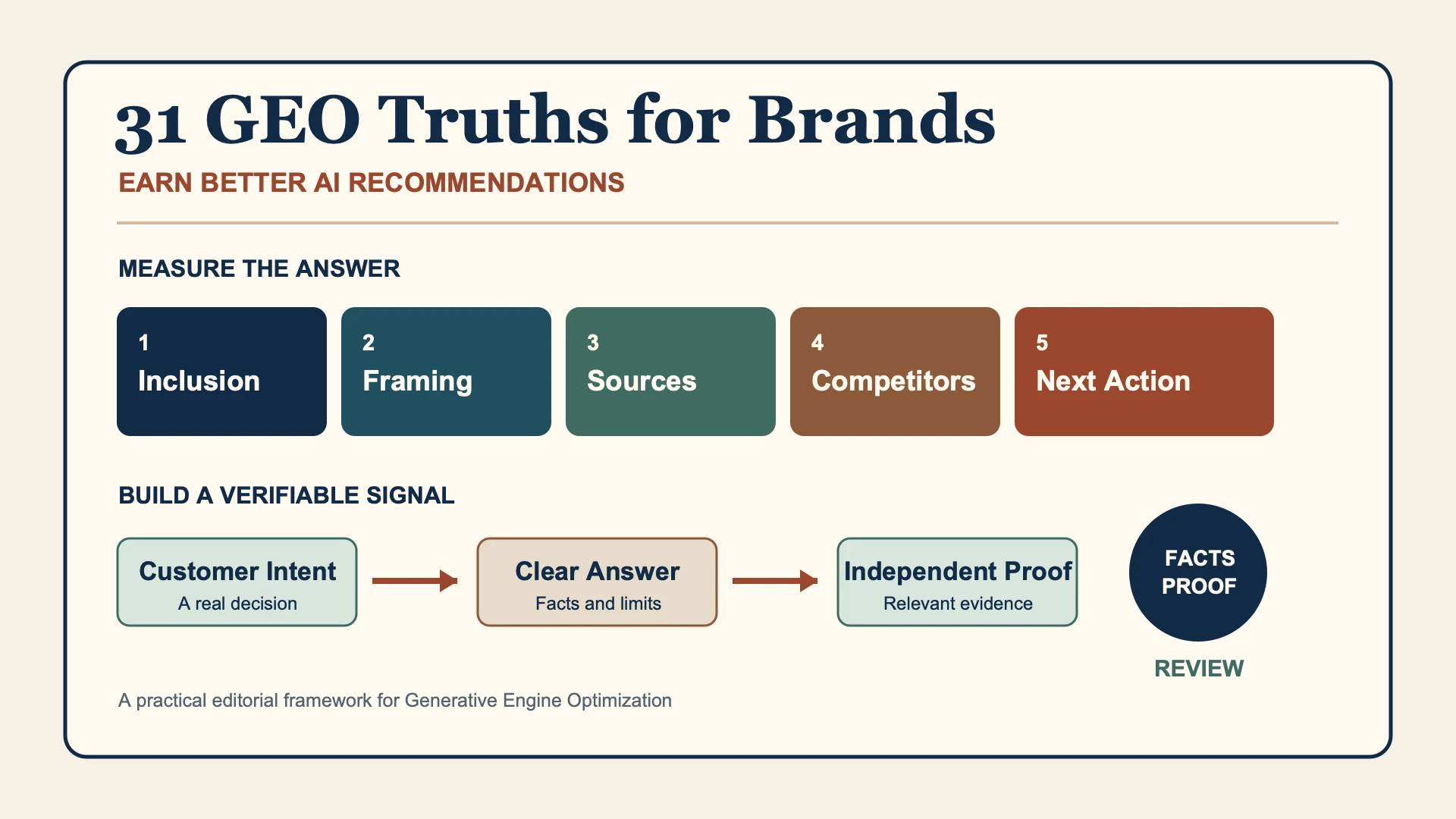
Generative engine optimization is not the work of making a brand name appear in more AI answers. It is the work of making the right answer easy for an AI system to understand, verify, and recommend when a customer has a real decision to make.
That distinction changes the program. A useful GEO practice measures more than mentions, starts with customer intent rather than a keyword list, fixes the brand-owned pages that carry the facts, and builds corroborating evidence beyond the company site. It also accepts an uncomfortable truth: no agency can honestly guarantee a permanent position in a generative answer.
Here are 31 working principles for teams building visibility across ChatGPT, Perplexity, Google AI features, Gemini, Copilot, and other answer surfaces. Their retrieval and ranking systems are not identical, and many details are not public. The operating discipline, however, travels well.
1. Measure the answer, not the mention
1. A brand mention is only the first signal
Being named in an answer tells you that you entered the conversation. It does not tell you whether the answer made you look credible, whether users saw you before alternatives, or whether the recommendation fit the question.
2. Track five dimensions of AI visibility
For each priority prompt, record brand inclusion, relative position when the interface gives one, sentiment or framing, cited or linked sources, and competing brands. A single total score hides the decision you need to make next.
Signal | The question it answers | What it can uncover |
|---|---|---|
Inclusion rate | Do we appear at all? | A coverage gap |
Answer prominence | Are we presented early or as an afterthought? | A competitor advantage |
Framing | What does the answer say about us? | Outdated or weak positioning |
Evidence sources | Which pages support the answer? | A fact, crawl, or source-quality issue |
Competitive set | Who is recommended instead? | The real comparison to investigate |
3. Keep the platform view separate
Do not average every result into a flattering global number. A prompt may produce a well-cited answer in Perplexity, a different comparison in Google, and a brief answer with no visible citations elsewhere. Treat each surface as a different research environment until your data says otherwise.
4. Prioritize with business value, not executive preference
Start with the questions that sit near a meaningful outcome: a qualified visit, product shortlist, consultation, or purchase. Then weigh current weakness, room to improve, and how well the answer surface connects to the next step. A prompt that matters often deserves more attention than a broad category question with high visibility but no commercial path.
5. Product and use-case questions are often closer to conversion
People rarely ask only whether a brand is good. They ask which project-management platform works for a 20-person design agency, which carry-on holds up on weekly travel, or which accounting tool handles a specific reporting need. Those questions contain a user, a situation, and a decision. They are where a useful product explanation earns its keep.
6. One blended GEO metric will make your team lazy
Report by platform, prompt cluster, audience scenario, and product or offer. If the report cannot tell you whether to improve a product specification, publish a comparison, correct an old claim, or seek independent coverage, it is reporting theatre.
2. Build for the questions beneath the questions
7. GEO is an intent problem before it becomes a content problem
Question wording changes constantly. The underlying job changes much more slowly. A traveler may ask about battery life, reliable airport calls, or a lightweight laptop for long trips; the deeper need is dependable work away from a desk. Build around that job, then map the forms in which people ask it.
8. Brand-owned pages are the factual backbone
Your website, product pages, help center, specifications, pricing information, and genuinely useful FAQs are the pages you can keep accurate. If they are vague, inconsistent, or difficult to crawl, no amount of external publishing will make the core facts dependable.
9. Put the answer where a reader can find it
Lead a page with the conclusion, the relevant constraints, and the intended user or use case. Follow with supporting detail. This is good for a hurried buyer and gives retrieval systems a self-contained passage to work with. It does not mean stuffing every paragraph with a question.
10. Give a page one main job
A page trying to prove that one product is durable, affordable, sustainable, ideal for travel, and best for large teams usually becomes vague. Split meaningful use cases into pages or sections with clear boundaries. Depth is easier to verify than a catalogue of loose claims.
11. Technical details need plain-language context
"Up to 18 hours" is a fact. "Suitable for a full day of light office work, subject to workload and settings" tells a buyer how to use that fact. Good GEO pages carry both the exact attribute and the decision context.
12. FAQ pages work when they answer questions your team actually hears
Mine sales calls, support tickets, product reviews, onboarding notes, and site search. If the same uncertainty keeps appearing, write a concise answer, confirm it with the responsible product or legal owner, and make it easy to find. Invented FAQs are easy to spot and rarely help anyone.
13. A content brief should name the scenario, not merely the phrase
Weak brief: "Use the keyword best CRM for startups ten times." Better brief: "Help an operations lead at an early-stage B2B company decide whether the product supports a small sales team, a short setup window, and limited admin time." The second brief gives a writer something worth answering.
14. Structure should clarify, never impersonate authority
Descriptive headings, tables, accessible images, and consistent product facts make a page easier to use. Schema should describe the visible page faithfully. It cannot turn a thin or unsupported claim into evidence.
15. Freshness is a content responsibility
Pricing, integrations, policy changes, product limits, and availability have dates attached to them. Set an owner and a review date for pages that make those claims. Old pages do not become harmless just because they stop receiving traffic reports.
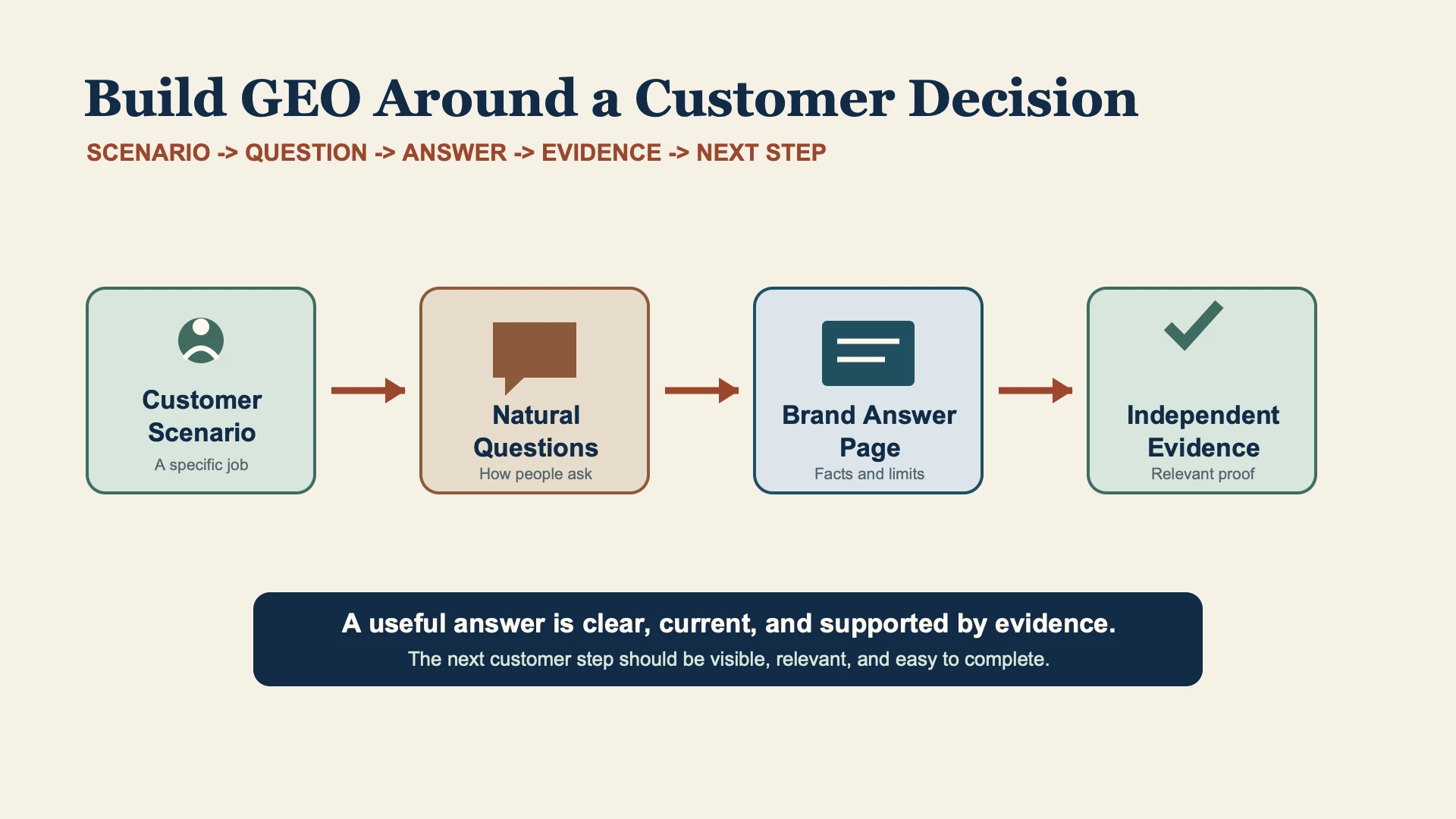
Plan GEO around the customer scenario, then connect questions to answer pages and evidence rather than publishing disconnected keyword articles.
3. Treat evidence as a system, not a press-release quota
16. AI systems have more than one possible information path
An answer may draw on model knowledge, a maintained index, retrieved web pages, connected data, or a combination of these. Public interfaces rarely expose the entire process. That is why an isolated result is not a diagnosis of the system, and why broad promises about any one platform deserve skepticism.
17. Independent corroboration carries more weight than repetition
Ten near-identical articles published on ten sites do not create ten independent facts. They create one claim repeated ten times. Seek sources that add their own relevant evidence: a credible review, a documented partner integration, a standards listing, a case story with verifiable scope, or a publication that assessed the category on its own terms.
18. Authority without relevance is still a poor fit
A respected publication may not answer the use case you care about. A detailed specialist source may be more useful for a narrow prompt. Judge a potential source by its audience, editorial standards, specific relevance, and whether it can make a claim that the brand site alone cannot substantiate.
19. Keep factual language aligned everywhere
If your pricing page says one thing, a sales deck says another, and an old partner directory says a third, the disagreement becomes part of the information environment. Create a source-of-truth list for product names, categories, claims, limits, and approved comparisons. Then update the pages with the greatest visibility first.
20. Crawlability is part of credibility
A page that fails to load, blocks useful content behind a script, redirects unpredictably, or sends contradictory canonical signals is difficult for both people and machines to rely on. The fix might be technical, editorial, or both. Check the live public page before diagnosing an AI visibility problem.
21. Do not confuse distribution with verification
Syndicating one company-written announcement can help discovery in the right context. It is not the same as cross-validation. An evidence plan needs different kinds of pages, produced for different audiences and grounded in consistent facts.
22. Earned coverage is strongest when it can disagree with you
The useful external source is not one that repeats a perfect headline. It is one that can explain who a product fits, what it does well, and where a buyer should be cautious. That kind of specificity reads like evidence because it is evidence.
23. Old information is an active GEO risk
Established brands usually have more historical material to reconcile: retired products, former policies, discontinued locations, and reviews that no longer reflect the offer. A cleanup plan should deal with prominent inaccuracies before the team starts manufacturing new pages.
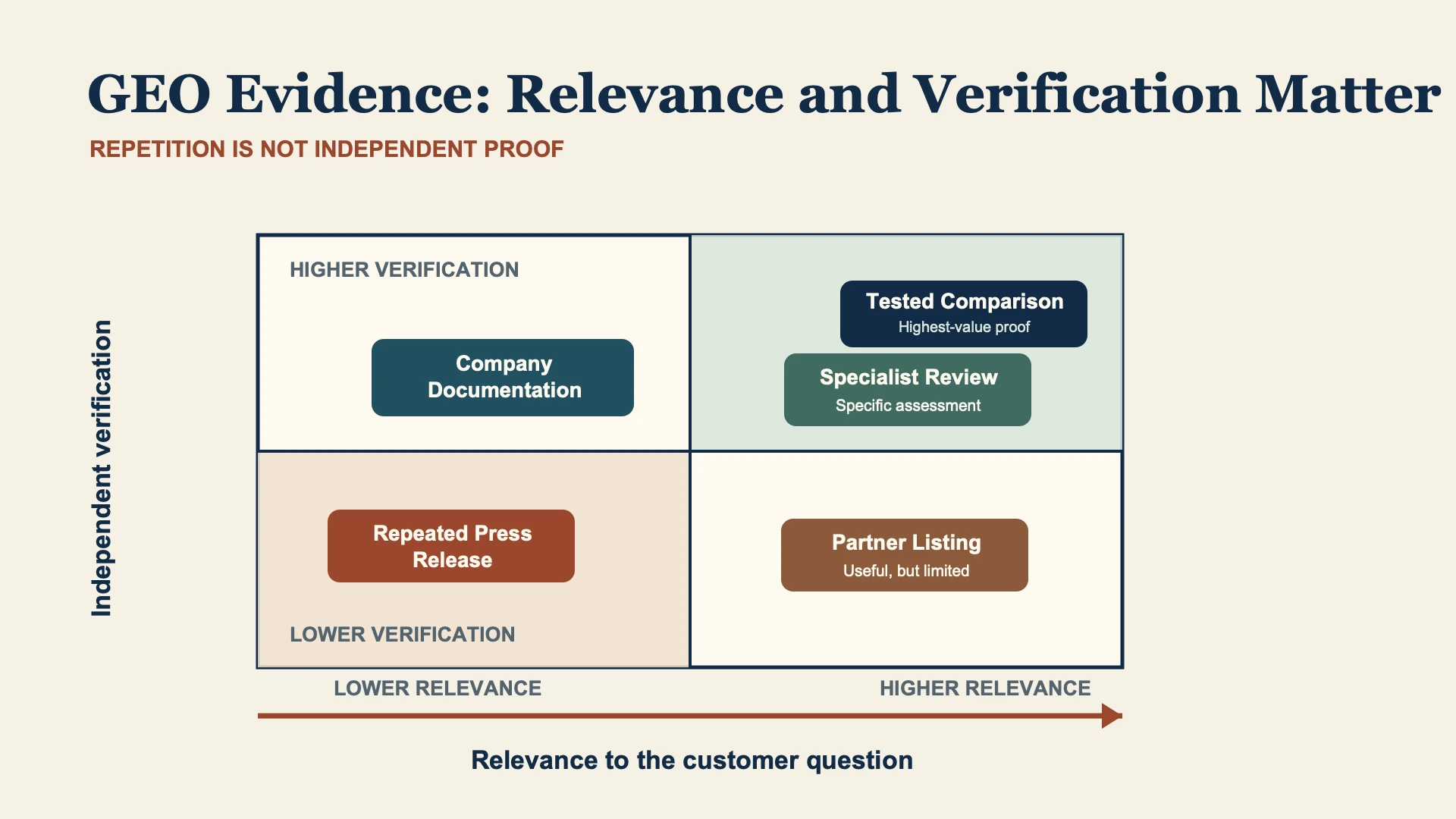
Independent proof and relevance to the customer's question carry more weight than a large volume of repeated brand claims.
4. Choose a GEO strategy that matches the buying journey
24. B2B and high-consideration categories need decision-stage coverage
Software, financial services, healthcare, legal services, and other high-stakes categories usually have a visible path: problem discovery, research, comparison, validation, and conversion. Each stage needs different proof. A first-touch explainer cannot carry the burden of a late-stage comparison page.
25. Broad consumer categories need scenario coverage
For footwear, skincare, home goods, and many retail products, questions often arrive through specific situations: sensitive skin on a beach holiday, a trail shoe for wet weather, a gift for a frequent traveler. The content model needs enough breadth to cover those situations without making claims the product cannot support.
26. Depth beats volume where the cost of a wrong answer is high
In specialized or regulated markets, publish fewer pages with clear sources, qualified authorship where appropriate, dates, limitations, and review processes. A page that cannot defend its claim is a liability, even if it sounds polished.
27. Breadth can be rational when intent is genuinely diverse
The opposite is also true. If a product has many legitimate uses, a narrow content plan leaves valuable questions unanswered. Build a scenario matrix first, then decide where a short answer, detailed guide, comparison, or product page is needed.
28. Spend where the prompt, audience, and channel overlap
Avoid a blanket "be everywhere" plan. Choose the channels and formats most likely to reach the people and questions that matter to the business. Then measure whether those assets actually improve the answers you observe. Distribution is a hypothesis, not a finish line.
29. Convert product copy into decision-ready language
"Advanced automation" says little. "Automatically assigns incoming requests by region and account owner, with an approval step before handoff" gives a buyer a usable fact. Specificity improves the page for humans first; it also leaves less room for an answer system to guess.
30. Give each asset a role in the journey
An overview page, pricing page, implementation guide, comparison, customer evidence, and support article should reinforce one another without becoming clones. Link them when the next page truly helps the reader make progress.
Journey moment | The question a user may ask | Useful asset | Proof required |
|---|---|---|---|
Problem discovery | "Why does this keep happening?" | Explainer or diagnostic guide | Clear definition and practical examples |
Option research | "What kinds of solutions exist?" | Category guide | Transparent criteria and trade-offs |
Comparison | "Which option fits my situation?" | Comparison or use-case page | Specific capabilities and constraints |
Validation | "Can I trust this claim?" | Documentation, customer evidence, or independent source | Verifiable facts and current details |
Action | "What do I do next?" | Product, pricing, or contact page | Clear steps, eligibility, and expectations |
5. Avoid the habits that make GEO look busy but accomplish little
31. GEO is a maintained operating system, not a one-time campaign
The work only compounds when a team closes the loop: diagnose visibility, choose one intent cluster, improve the answer and evidence, verify the live pages, observe the result, and record what changed. Stop maintaining it and outdated information, stronger competitors, and new customer questions take over the space.
That final principle explains most GEO failures. Teams buy a mention report, publish a burst of generic content, then expect a stable result from systems that keep changing. The better approach is less glamorous: own the facts, answer a real question, earn evidence, and review the answer environment on a schedule.
A practical 30-day starting point
- Pick one product, service, or high-value audience segment.
- Collect 20 to 40 customer questions from first-party research and search behavior.
- Group them by underlying scenario, then select a small number of priority clusters.
- Record a baseline across the AI surfaces that matter to your buyers, including answer wording and visible sources.
- Audit the brand-owned pages supporting those clusters for accuracy, clarity, crawlability, and missing evidence.
- Make the smallest useful set of page repairs, then pursue the external proof that cannot come from your own site.
- Review the same prompt set after the changes have had reasonable time to be discovered. Log movement, but also log what the answer got right or wrong.
Auspia's AI Search Visibility Checker can help turn this baseline into a repeatable review, especially when your team needs to compare prompt clusters and document the evidence behind each recommendation.
Frequently asked questions
Can a GEO provider guarantee that my brand will rank first in AI answers?
No. Answer systems change by prompt, time, user context, platform, and available information. A credible provider can define the measurement method, document the work, and show you what improved. It should not sell a permanent rank as a certainty.
Is GEO just SEO with a new name?
No, but the foundations overlap. Accurate, crawlable, well-structured pages remain useful. GEO adds the need to study how people phrase decisions to answer systems, how the answer frames a brand, and which visible sources support or contradict that framing.
Should we publish a large volume of AI-written content for GEO?
Only if every page solves a distinct, well-supported user need and has a review process. Volume without clear purpose, evidence, or differentiation creates more material to maintain and can blur your brand's factual record.
How often should a brand review its GEO performance?
Review important prompt clusters on a regular cadence that fits how quickly your products and category change. Update the underlying facts as soon as they change. A monthly review is a reasonable starting rhythm for many teams, with closer monitoring during launches, major news, or product changes.
Author: Adrian Cole, Analyst of 1,000+ AI Search Results at Auspia. Adrian writes about how brands appear across answer engines and what teams can verify before they optimize.