The short version
Auspia was built from a simple frustration: SEO mattered too much to ignore, but it was becoming too heavy for lean teams to run well.
For small teams, SEO rarely fails because people do not care. It fails because the work is scattered across too many jobs: keyword research, competitor analysis, content planning, writing, publishing, internal linking, monitoring, refreshing, and reporting. Each task is reasonable on its own. Together, they become a second operating system inside the company.
Auspia exists to remove that drag. Our goal is to turn SEO from a manual workload into an automated growth capability, so teams can keep building their product while a dedicated system keeps finding, creating, publishing, and improving organic growth assets in the background.
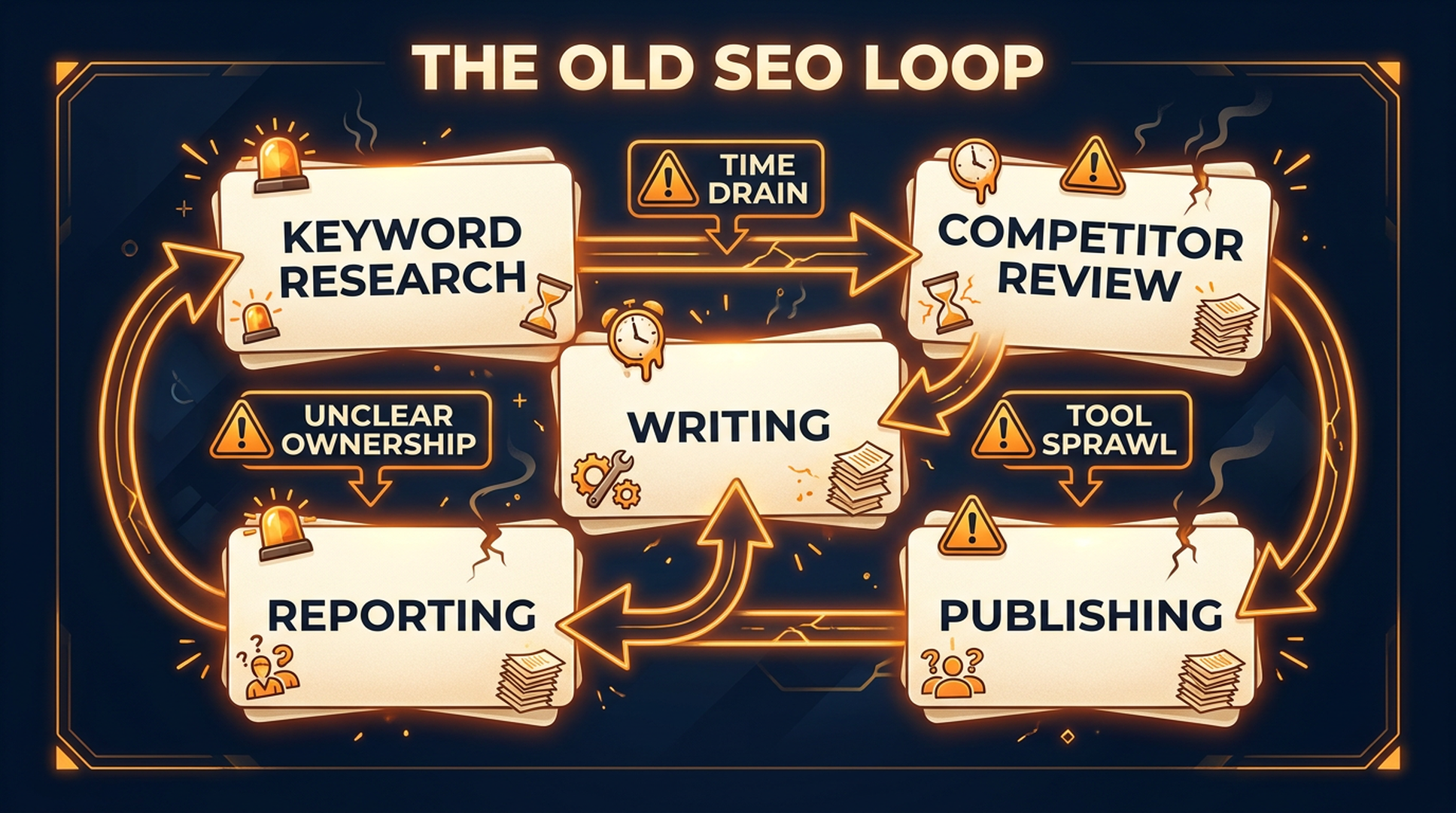
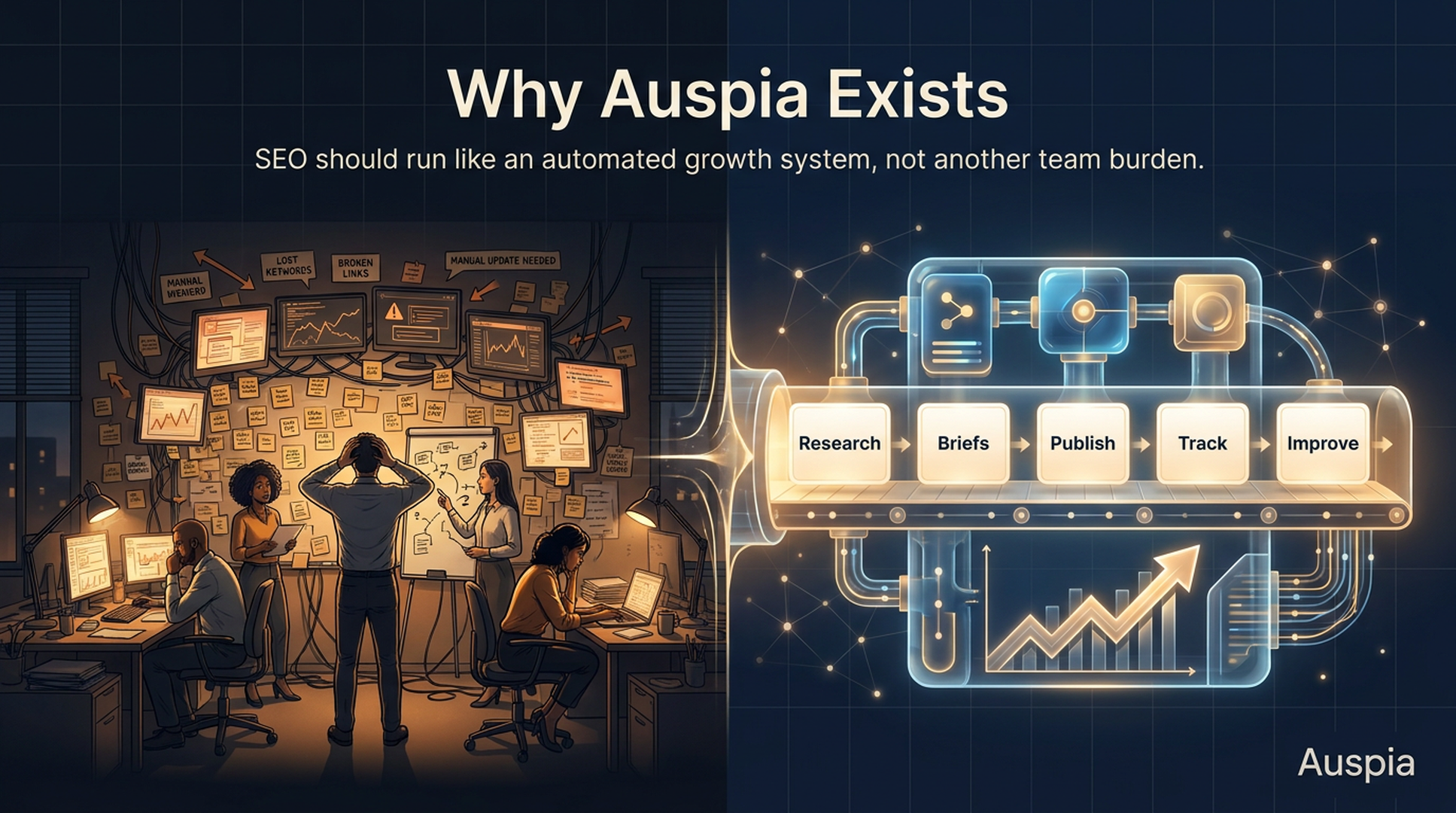
The old SEO loop asks a small team to behave like a full editorial, analytics, and technical growth department.
The problem was not SEO. The problem was the weight of running it.
A few years ago, the promise of SEO felt straightforward: publish useful pages, answer real search intent, earn trust, and create a compounding channel that did not depend entirely on paid acquisition.
The reality was less elegant.
A founder or growth lead could spend one evening mapping keywords, the next morning checking competitors, the afternoon rewriting briefs, and the following week wondering why nothing had been published yet. Then came the tracking. Then the content updates. Then the question nobody wanted to answer: who owns this every week?
The tools helped, but only up to a point. Many SEO tools give teams more data. They do not always reduce the amount of labor needed to turn that data into decisions, pages, experiments, and improvements. For a lean team, that distinction matters.
Data is useful. A dashboard is useful. But if every dashboard creates another task list, the team is still stuck.
That was the early frustration behind Auspia. The work was important, but the operating model was wrong for the teams that needed it most.
The moment that shaped the idea
Auspia began with a question that sounded almost too simple:
What if SEO could run every day without forcing the team to become SEO specialists?
The idea became clearer during an internal growth discussion in April 2026. The team was debating keyword priorities and organic traffic plans while urgent product work waited nearby. The tension was familiar to many founders: growth cannot be ignored, but neither can the product.
That tension led to the first version of Auspia. It was not a polished product. It was a set of internal automation scripts built to reduce repetitive SEO work. The scripts helped collect competitor keyword signals, turn opportunities into content drafts, and monitor the early performance of published pages.
It was rough. It was practical. Most importantly, it changed the team's behavior.
Instead of asking, "Who has time to do SEO this week?" the team could ask, "What should the system improve next?"
In an early internal test, the team saw organic traffic move meaningfully within about a month while spending far less manual time on the repetitive parts of SEO. That was enough to prove the bigger point: automation could make SEO more accessible without pretending strategy no longer mattered.
Why automation had to be the core
Auspia is not built around the idea that AI should replace judgment. It is built around a more practical belief: most SEO programs are slowed down by repeatable work that should not require constant human attention.
A strong organic growth system needs recurring execution:
SEO job | Why it slows teams down | What Auspia is designed to automate |
|---|---|---|
Opportunity discovery | Teams miss keywords, competitors, and new search patterns when research is irregular. | Daily opportunity scanning and prioritization. |
Content briefs | Briefs often take longer than the first draft. | Search-intent-aware outlines and content plans. |
Draft production | Publishing stalls when writing depends on spare time. | First drafts built from structured SEO inputs. |
Publishing workflow | Finished content gets stuck in handoffs. | Repeatable publishing and content operations. |
Measurement | Teams review results too late or too rarely. | Ongoing tracking, learning, and refresh signals. |
The point is not to remove humans from growth. The point is to stop wasting human attention on the parts of growth that machines can run reliably.
People should decide the market, positioning, voice, product truth, and the standard of quality. Auspia should handle the daily SEO machinery around those decisions.
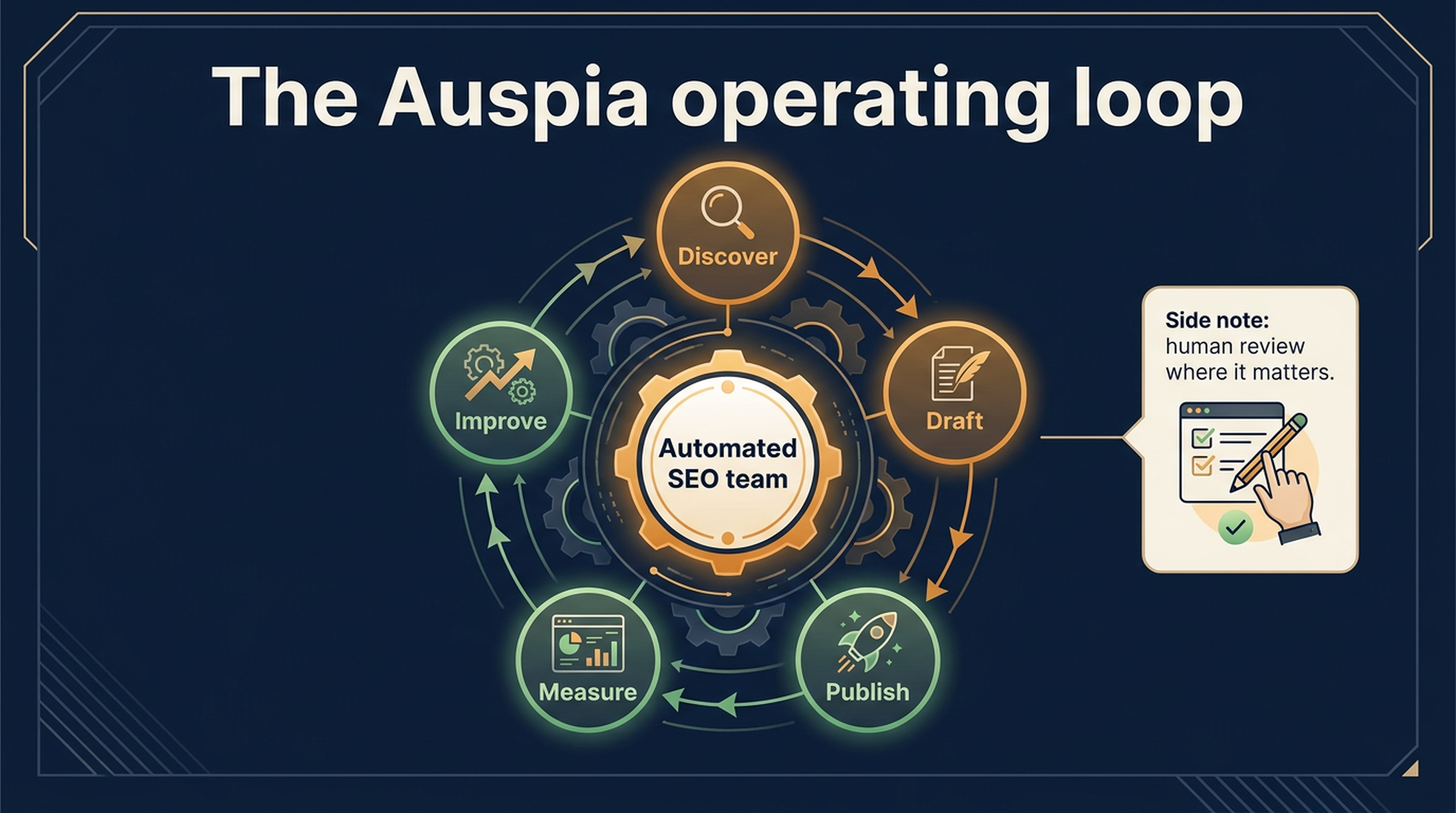
The Auspia loop turns SEO into a recurring system: discover opportunities, draft assets, publish, measure, and improve.
The product belief: SEO should be owned, not constantly operated
Most teams do not want another tool to check. They want a growth function that works.
That difference matters. A traditional SEO tool often says, "Here is the data. Now go do the work." Auspia is designed to move closer to the outcome: "Here is the opportunity, here is the content asset, here is what changed, and here is what should happen next."
This is why we describe Auspia as an automated SEO team rather than a standard SEO dashboard. The product is built to help teams run the full loop:
- Find organic growth opportunities before they disappear into a backlog.
- Create useful pages that match search intent and answer real questions.
- Publish consistently enough for SEO to compound.
- Track what changes after content goes live.
- Improve pages based on evidence instead of guesswork.
For teams that also care about GEO, AEO, and AI search visibility, this operating model matters even more. Search is no longer only a list of blue links. Buyers now discover brands through AI answers, summaries, citations, and recommendation-style surfaces. That makes consistent, structured, trustworthy content more important, not less.
Auspia's wider work across SEO, GEO, AEO, and AI growth tools comes from the same belief: good products should be easier to discover, even when the team behind them does not have a large marketing department.
What we are trying to make easier
The real mission is not "more content." The internet has enough empty content.
The mission is to make useful organic growth easier to run for teams that have something real to say, sell, or build. That means reducing the operational burden without lowering the bar for quality.
Auspia is built for teams that recognize these problems:
- SEO is important, but nobody owns it consistently.
- Content planning happens in bursts, then disappears for weeks.
- Competitor research produces notes, not shipped pages.
- Reporting explains what happened, but does not trigger the next action.
- The team wants compounding growth, but cannot afford a full SEO department.
Those are not rare edge cases. They are the normal reality for startups, product-led companies, agencies, and small growth teams.
Auspia's answer is a system that works every day. It does not get distracted. It does not wait for a quarterly planning meeting. It keeps turning search and AI visibility signals into actions.
The kind of future Auspia is building toward
We believe organic growth should become more fair.
Today, many good products stay invisible because their teams are better at building than at running the SEO game. Meanwhile, companies with larger marketing machines can occupy search results simply because they have more process, more budget, and more people to keep the engine moving.
Automation can narrow that gap.
If a small team can run a disciplined SEO system without hiring a full department, more useful products can be found. If content operations become easier, teams can spend more time improving what they sell and less time wrestling with spreadsheets, briefs, and reporting rituals.
That is the origin of Auspia. It started with a founder's irritation at how much time SEO consumed. It became a product because that irritation was not unique.
The next growth channel should not become the next team burden.
That is why Auspia exists.
FAQ
Is Auspia an SEO tool or an AI content tool?
Auspia is closer to an automated SEO operating system. It uses AI for content and workflow automation, but the larger goal is to run the full SEO loop: opportunity discovery, content production, publishing support, performance tracking, and improvement.
Why does Auspia focus so much on automation?
Because execution is where many SEO programs break. Teams often understand the strategy but lack the time and process to run it every week. Automation helps turn SEO from occasional effort into a consistent growth system.
Does automation mean lower-quality content?
It should not. Auspia's position is that automation should remove repetitive work while preserving human judgment around positioning, product truth, editorial standards, and final review.
Who is Auspia built for?
Auspia is built for founders, lean growth teams, agencies, and product-led companies that need organic growth but do not want to build a full SEO department before they can compete.
How does this connect to GEO and AI search?
AI search makes structured, useful, trustworthy content more important. Auspia helps teams create and improve assets that can support both traditional SEO and visibility across AI answer surfaces.
Author: Amelia Ross, AI Brand Positioning Strategist for 300+ Category Narratives at Auspia. Amelia writes about category language, brand differentiation, and how growth products explain their point of view clearly.