Direct answer
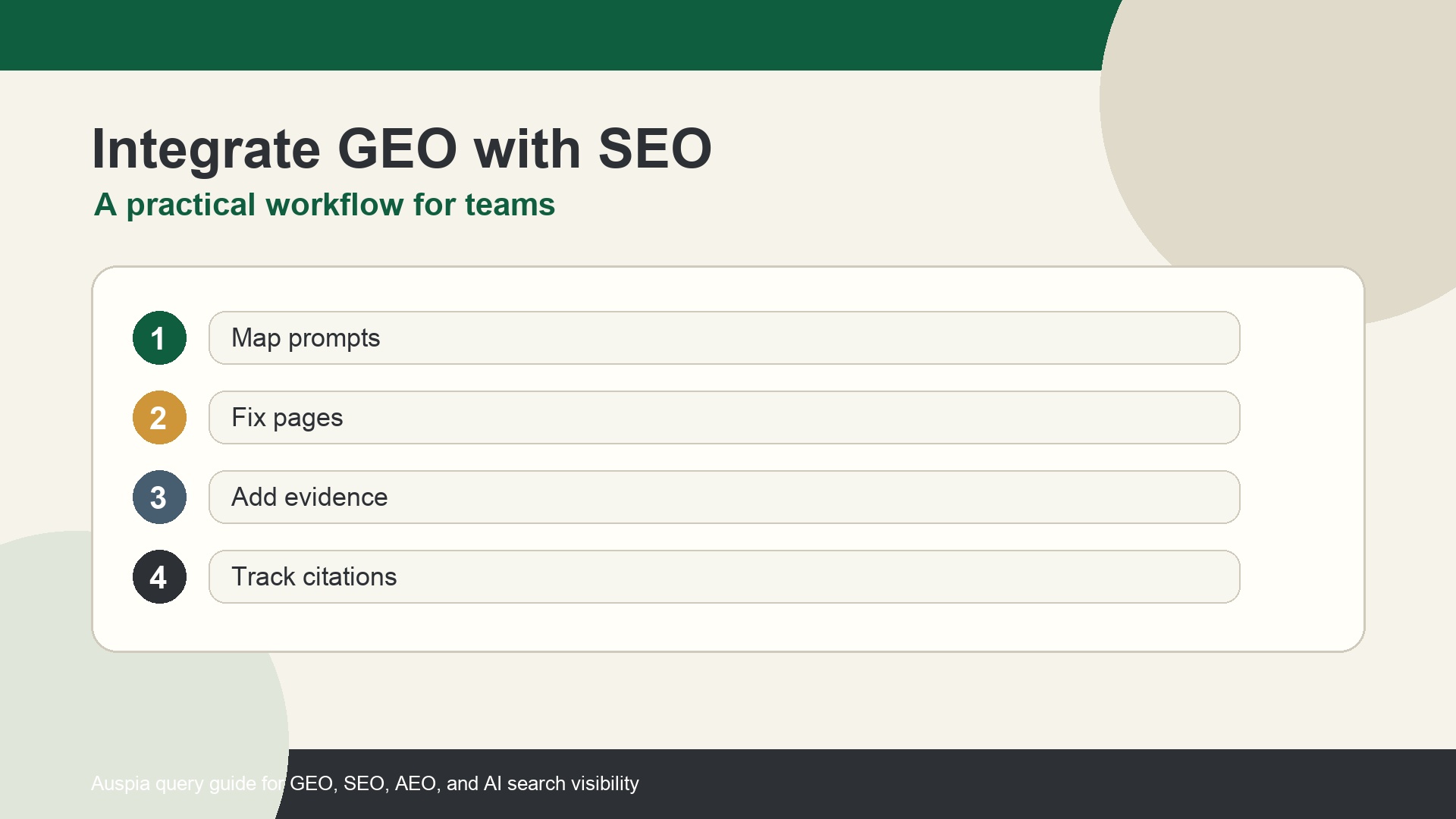
To integrate GEO with SEO, start with the pages that already matter for search and revenue. Keep the SEO foundation, then add prompt research, answer-ready structure, entity facts, citation-worthy evidence, and AI visibility measurement.
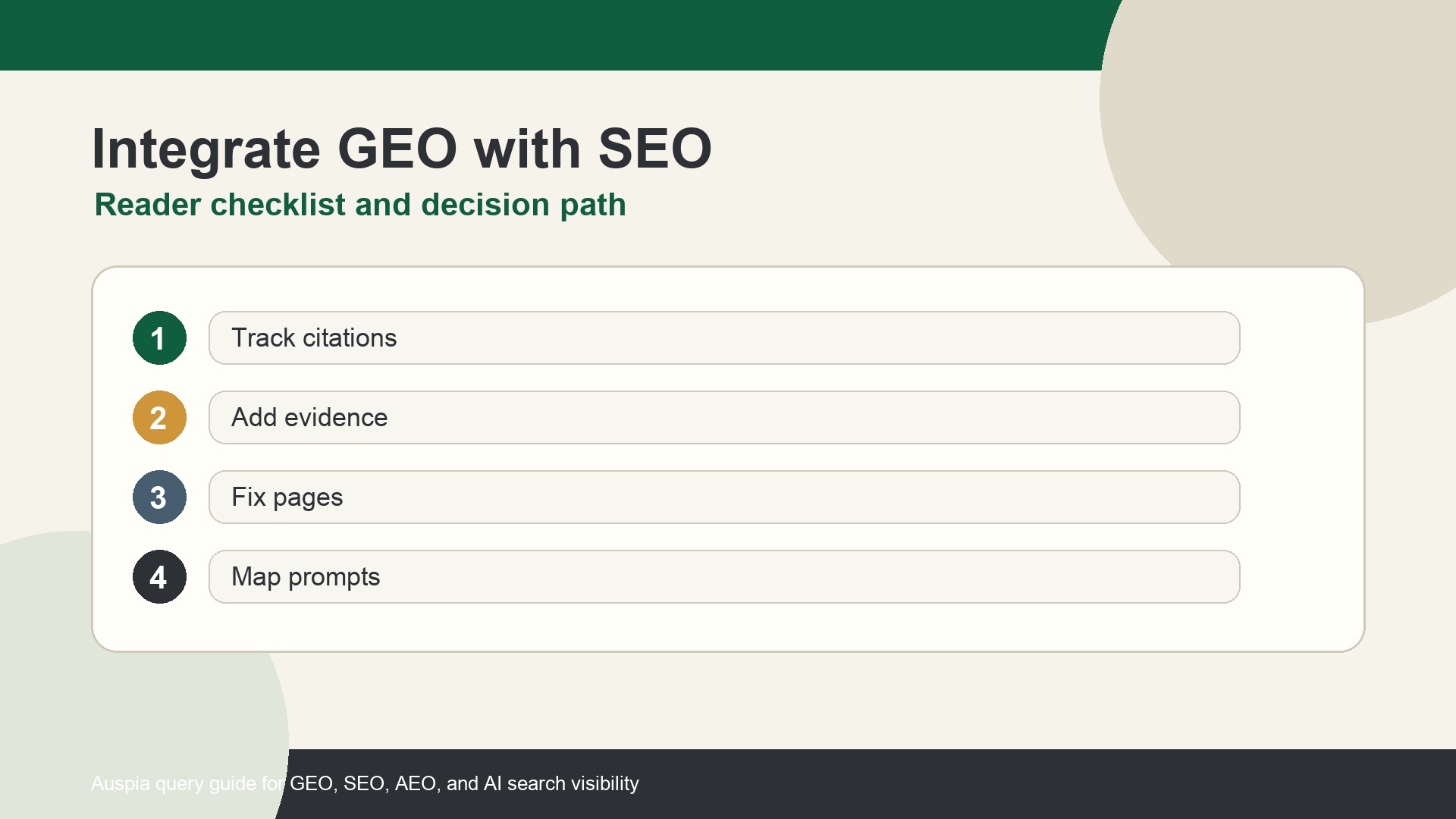
The workflow
Step | SEO task | GEO addition |
|---|---|---|
1 | Pick priority keywords | Add buyer prompts and AI-answer questions |
2 | Audit the page | Check if the page can be summarized and cited |
3 | Improve content | Add direct answers, tables, examples, constraints |
4 | Build authority | Add third-party evidence and consistent entity facts |
5 | Measure | Track rankings plus AI mentions and citations |
Step 1: build a query and prompt map
Do not start by asking "how many blog posts do we need?" Start by clustering intent.
For a GEO vs SEO topic, the clusters might be definition, comparison, AEO, tools, agency selection, local geo confusion, ecommerce, SaaS, and measurement. Each cluster deserves a specific page or section.
Then convert those clusters into prompts:
- What is GEO in SEO context?
- How is GEO different from traditional SEO?
- Which is more important for B2B SaaS, SEO or GEO?
- What tools help with GEO and SEO integration?
- Who offers GEO-ready SEO support?
Step 2: update the SEO page foundation
Before adding GEO tactics, fix the basics:
- indexable URL;
- descriptive title and meta description;
- clean heading hierarchy;
- internal links from relevant pages;
- schema where useful;
- fast, readable page experience;
- clear author and update information.
GEO is not a shortcut around weak SEO.
Step 3: make the page answer-ready
A GEO-ready page should give models clean material to work with. Add:
- a direct answer near the top;
- a comparison table;
- definitions in plain language;
- use-case examples;
- limitations and caveats;
- FAQ questions copied from real search behavior;
- citations or source notes for current claims.
This helps AEO too, which is why the SEO/AEO/GEO stack works well.
Step 4: strengthen entity and source signals
AI systems often need confidence that the brand is real, relevant, and accurately described. Make sure your website and external profiles agree on the basics: name, category, products, markets, use cases, integrations, pricing model, and contact paths.
Then add evidence. Evidence can be original research, benchmarks, case studies, documentation, third-party mentions, reviews, partner pages, or comparison pages. The point is not to spam the web. The point is to make important claims verifiable.
Step 5: measure both systems
Classic SEO metrics still matter: rankings, clicks, impressions, indexed pages, conversions, and revenue. GEO adds a different set:
- Does the brand appear for target prompts?
- Is it cited?
- Which source is cited?
- Is the description accurate?
- Which competitors appear more often?
- Did AI referral traffic or branded search change?
Run a monthly prompt test and keep the results in a dashboard. That is the simplest starting point.
30-day implementation plan
Week | Work | Output |
|---|---|---|
1 | Cluster search queries and buyer prompts | Query/prompt map |
2 | Audit 5 priority pages | SEO + GEO gap list |
3 | Rewrite sections and add evidence | Updated pages |
4 | Test AI answers and update internal links | Visibility baseline |
FAQ
Can I add GEO to existing SEO pages?
Yes. Existing pages are often the best starting point because they already have search history, links, and topical relevance.
How many prompts should I track?
Start with 20 to 50 prompts per product category. Include definitions, comparisons, "best tool" queries, alternatives, problems, and buyer objections.
How long does GEO take to show results?
Some AI answers change quickly after page updates. Broader brand inclusion may take longer because it depends on external sources, citations, and repeated retrieval patterns.
What is the best first tool?
Use a search performance tool for SEO and an AI visibility checker for GEO. Auspia's AI Search Visibility Checker is a practical starting point.
Author: Martin Hayes, GEO Playbook Builder for 200+ Execution Checklists at Auspia. Martin writes about search intent, AI search visibility, and practical organic growth systems for teams that need clearer decisions.