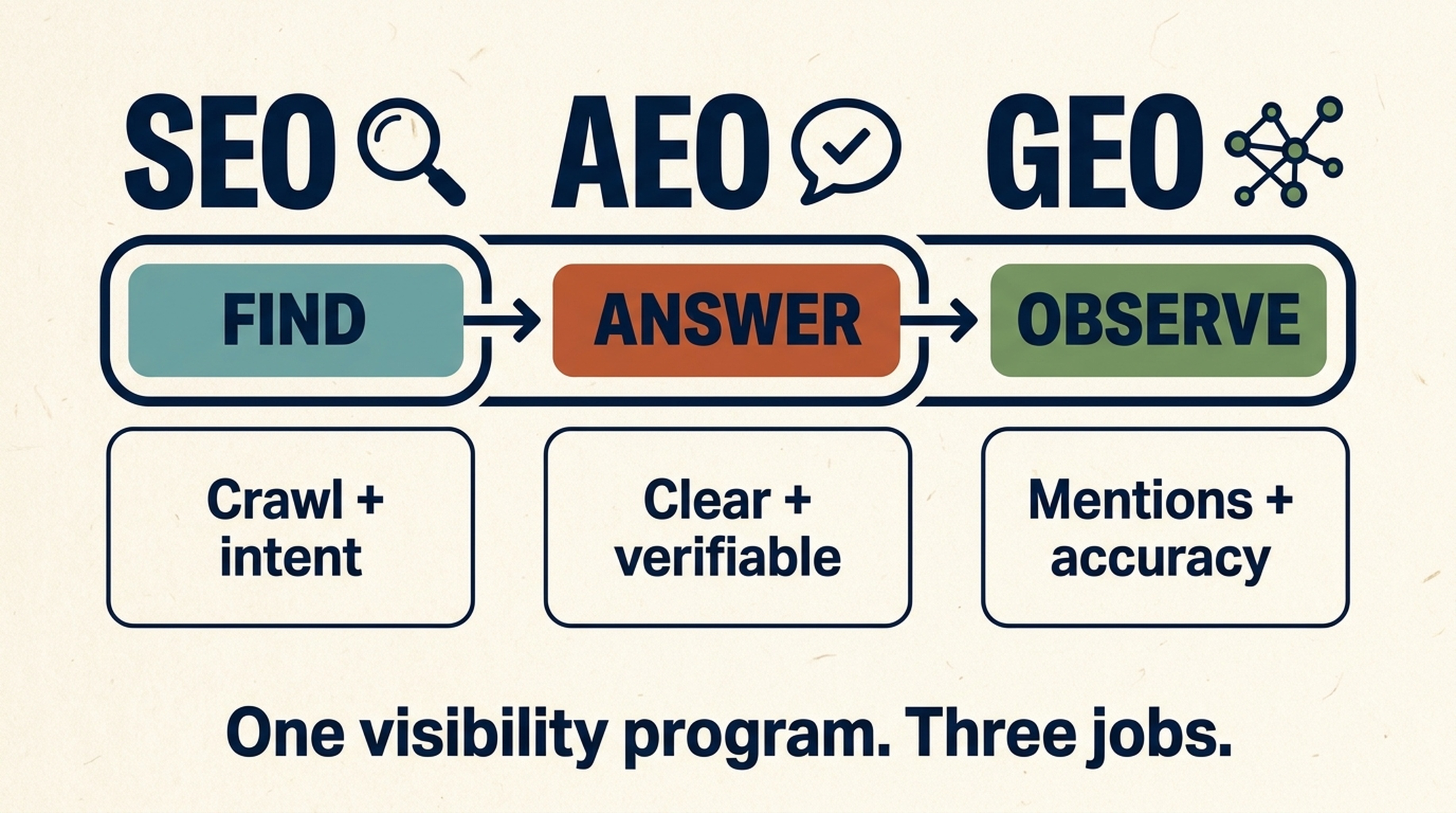
SEO makes useful pages discoverable, AEO makes the answer in those pages extractable, and GEO is the practical work of monitoring how your brand is described when AI engines answer on your behalf. In 2026 the useful way to treat these three acronyms is as three jobs inside one visibility program — with a shared foundation underneath them all: whether the web, and the AI systems reading it, can tell who you are and what you are known for. This guide separates the jobs, shows how they stack, and gives you a decision rule for which one to work on next.
Why this question won't go away in 2026
The comparison queries keep growing even though the topic is not new. In our own Search Console data, this query family — "aeo seo," "aeo vs seo," and the localized variants "aeo או geo" (Hebrew), "aeo seo คือ" (Thai), and "aeo vs seo vs geo różnice" (Polish) — accumulated 213 impressions at average positions between 33 and 90, with zero clicks. People are searching for the difference in markets we do not serve yet, and the pages answering them are not ranking.
That combination — measurable demand, weak rankings, and a topic that shifts every few weeks as AI surfaces change — is why this guide exists as a living document. It was first published in July 2026 and is updated as the evidence changes. The September 2026 update adds two things: the release of Gemini 3.8 Flash into Google's AI Mode, and the growing case that entity clarity is the common substrate under SEO, AEO, and GEO.
One visibility program, three jobs
SEO is the job of eligibility: can search engines find, render, and understand your pages, and do those pages match what people actually search? Its evidence is Google Search Console performance.
AEO (answer engine optimization) is the job of clarity: when a ranking page is read by an answer system or a human skimmer, can the conclusion be found in the first sentences? Its evidence is whether the answer to the page's core question is instantly extractable.
GEO (generative engine optimization) is the job of representation: when an AI engine answers a question your audience asks, does it describe your brand correctly, cite your pages, and rank you among the sources it trusts? Its evidence is dated observation of AI answers — a prompt log, not a rank tracker.
Google imposes no special file or markup for AI Overviews or AI Mode, and it has not added one in the September 2026 model releases. The three jobs run on the same crawl, index, and structured-data foundation as classic search — a position we documented in detail in our guide to what Google's official AI-feature guidance actually requires. What differs is what each job optimizes: access, clarity, or representation.
Side by side: what each discipline does
SEO | AEO | GEO | |
|---|---|---|---|
Primary job | Make pages discoverable | Make answers extractable | Make brand representation accurate |
The question it answers | Can engines reach and understand us? | Can readers and answer systems find the conclusion? | When AI answers for us, what does it say? |
Evidence of progress | GSC queries, clicks, rankings | Answer-first blocks, structured Q&A extraction | Dated prompt log with sources and brand description |
What it explicitly does not guarantee | Clicks or AI citations | Placement in any AI answer | That the AI answer converts |
The three overlap heavily in practice: an answer-first rewrite is both an AEO tactic and a GEO signal, and an entity fix (below) improves all three. The distinguishing question for each page is the one in the table — because the correct next job is diagnosed from the failure, not from the acronym.
The shared foundation underneath all three: entity clarity
The most useful framing to come out of 2026 is that SEO, AEO, and GEO all run on one substrate: entity clarity — whether search engines and LLMs can tell who you are, what you make, and what you are known for. As Search Engine Journal's August 2026 explainer puts it, search is shifting from lexical matching to semantic matching, and entities are the unit that semantic systems reason with. Google converts text into underlying entities when indexing pages and when parsing queries: "restaurants underneath the Eiffel Tower" is understood as the entities restaurant + Eiffel Tower + a location, not a keyword string.
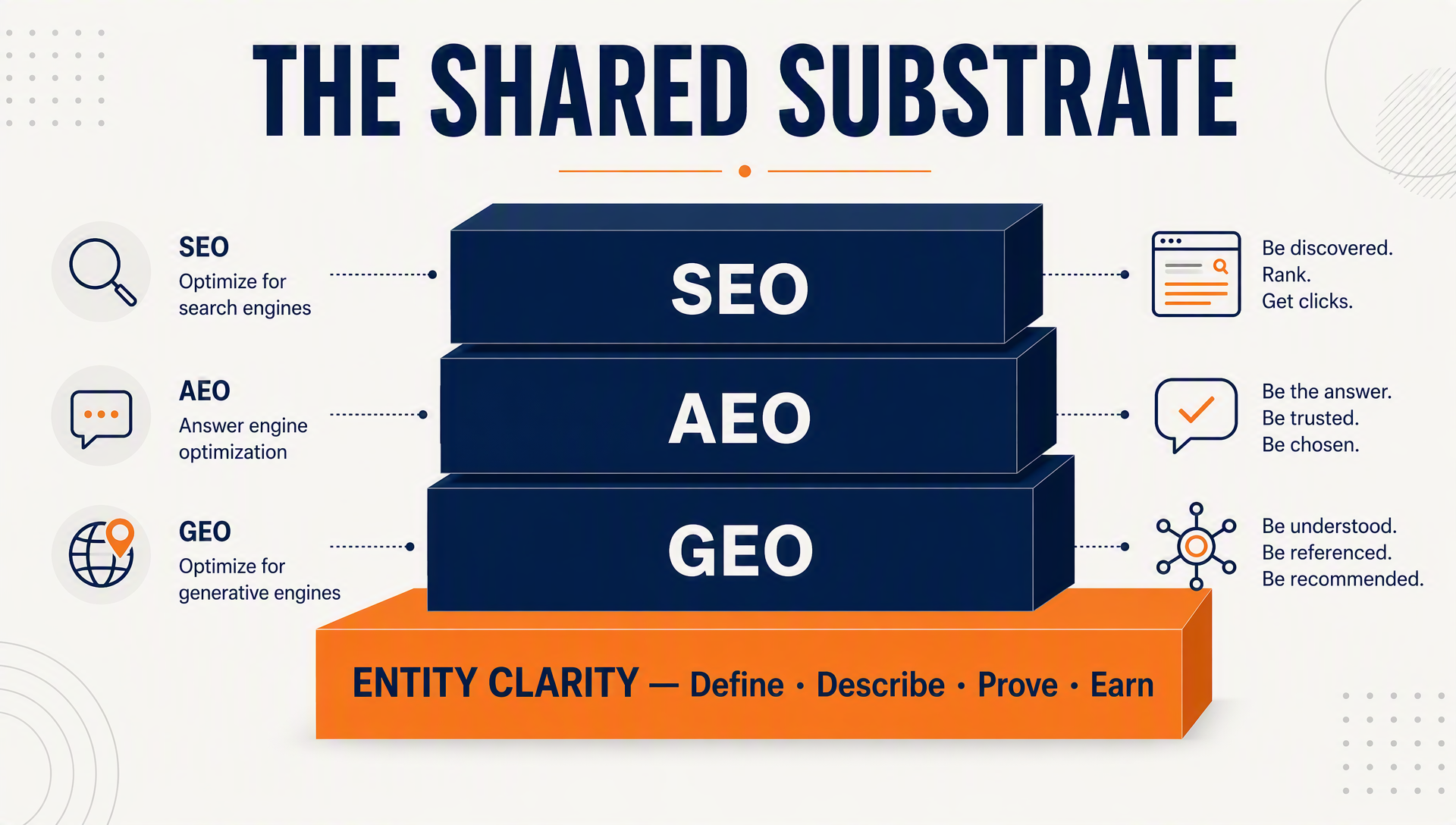
The practical framework, condensed from that same analysis, has four layers:
Define — entity hygiene. Inventory every property that represents your brand: website, about and contact pages, corporate site, people's profiles, social channels, Google Business Profile, marketplaces. Brand descriptions, NAP details, and leader bios must be consistent and accurate everywhere, or the entity drifts. A company that updates its address only on its own website while suppliers still list the old one can be treated as two businesses.
Describe — make entities and relationships explicit. Each page should clearly target its entity with consistent terminology, consistent anchor text, and the relationships spelled out: Organization, Article, and Person schema, sameAs links joining profiles, and internal links that act as an entity map. On large sites, internal linking is one of the highest-leverage fixes because it defines the semantic structure of the site — which entities you want to be known for.
Prove — establish verifiable credibility. Every person who represents the brand — writers, founders, executives, experts — needs one consistent, verifiable identity: author pages linked to real profiles, publication history, methodology, credentials. Schema is a trust builder, not a ranking switch: engines cross-verify what you declare against what the rest of the web says.
Earn — third-party corroboration. You do not fully define your own entity. Accurate mentions, directory listings, reviews, expert commentary, and consistent third-party descriptions corroborate who you are; bylines, interviews, and citations corroborate what you are known for. AI systems cross-reference your site, your Business Profile, review text, and third-party mentions to build their picture of you — and four surfaces must agree: the webpage, the schema, the platform of record, and third-party sources.
Why this is the substrate for all three jobs: SEO needs entity clarity so engines map your pages to the right queries. AEO needs it so answer systems extract facts attributed to the right entity instead of a generic one. GEO needs it because AI answers are built from entity descriptions — and if the description is ambiguous, the AI will describe you wrong no matter how many citations you earn. If GEO is about how AI represents you, then who you are, in a form AI can verify, is the input it cannot skip.
What changed in AI search since this guide first ran
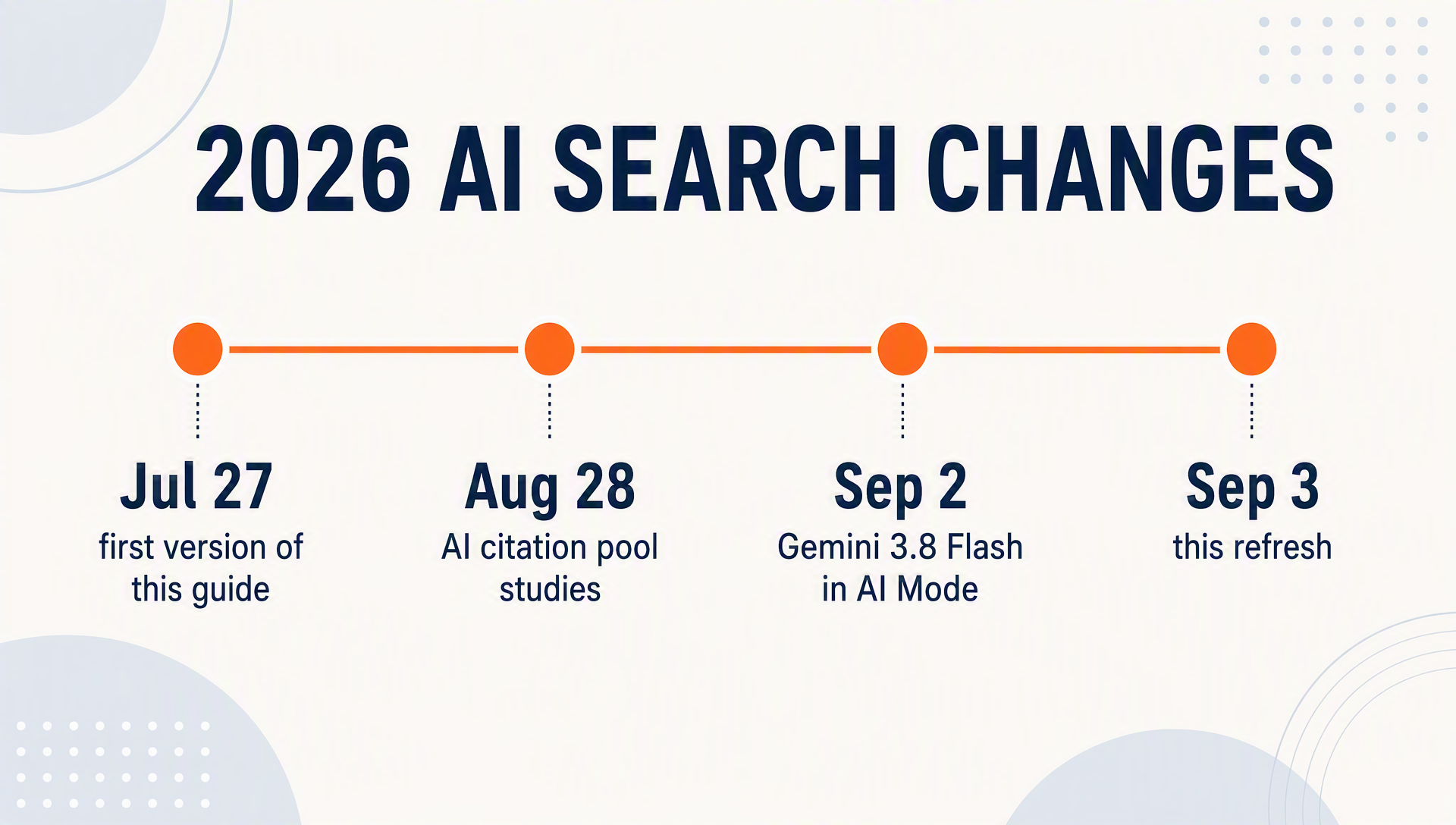
A dated changelog keeps this guide honest. Since the July 2026 version:
Date | Change | Consequence |
|---|---|---|
2026-08-28 | Industry studies documented how AI engines build citation pools (e.g., manufactured "best software" pages cited at scale by Perplexity) | Citation ≠ endorsement; add citation-quality checks to GEO measurement |
2026-09-02 | Google announced Gemini 3.8 Flash, with AI Mode in Google Search listed among consumer surfaces | A faster, cheaper default model now serves AI Mode answers; expect behavior shifts and track them with dated snapshots |
2026-09-02 | Google also noted 3.7 Flash "remains supported for efficiency-first workloads" | AI Mode behavior may vary by task complexity; test both ends of the range |
2026-09-03 | Google still lists no AI-only file or markup for AI features | No new SEO task was created by the model release; foundations still win |
None of these changes rewrote the decision map below. A model release does not change whether your page is accessible, whether your answer is extractable, or whether your entity is clear — it changes the surface where those qualities get tested. That is a reason to test more often, not to buy a new discipline.
Choose the next job by the problem, not the acronym
Start with SEO when access or demand is weak. Pages that are unindexed, poorly linked, mis-targeted, or getting no qualified traffic have an SEO problem regardless of how clean their answers are. No AEO block or GEO citation program fixes an unreachable page. Diagnose with Search Console: if your money pages are not appearing for queries that have demand, the next job is SEO.
Move to AEO when the answer is buried. A page ranking well but making visitors hunt for the conclusion has an AEO problem. The fix is usually cheap and mechanical: lead with a short answer, put plain definitions first, use comparison tables, and write headings that contain the question. Answer systems reward the same structure that impatient readers do.
Add GEO observation when AI answers influence a real decision. If buyers compare vendors through ChatGPT, Perplexity, Gemini, or Google AI Mode — that is, when an AI answer can stand between your content and your customer — start a dated prompt log, or run our AI search visibility review for a structured first capture. Record date, platform, the exact question, sources cited, and how your brand was described. Two weeks of log beats a month of opinions about whether "AI is taking your traffic."
One page can serve all three jobs
A single page can carry all three layers at once. Take a vendor comparison page for an SEO product:
Layer | Practical decision | Quality check |
|---|---|---|
SEO | Target the query the page can win, keep it crawlable | Page ranks and earns clicks for its primary query |
AEO | Put the recommendation in the first paragraph, not paragraph six | The answer survives extraction: read the first 100 words alone |
GEO | State who the page is for, who tested it, and how — the facts AI can verify | AI answers citing the page describe the brand and method correctly |
Entity (substrate) | Consistent brand naming, named testers with real profiles, | Four surfaces agree: page, schema, platform of record, third parties |
No layer guarantees placement. The layers raise the probability that a page is eligible, understood, and correctly represented — which is the entire game in 2026.
A single workflow instead of three audits
Run one five-step loop, not three separate reviews:
- Eligibility. Is the page reachable, indexed, and correctly targeted? (SEO)
- Clarity. Does the answer appear in the first sentences? (AEO)
- Verifiability. Can the claims be checked — named authors, dated evidence, real methodology? (entity + E-E-A-T)
- Consistency. Do the page, schema, profiles, and third-party mentions describe the same entity? (entity)
- Representation. What does the dated AI-answer log say about how your brand comes across? (GEO)
Measurement without double-counting
Keep evidence in separate fields instead of melting everything into one "AI visibility" score:
Question | Primary evidence | Caveat |
|---|---|---|
Did organic discovery improve? | Google Search Console queries, clicks, positions | Google's AI feature activity is reported inside the regular performance reports |
Did extraction improve? | Answer-first audit, structured Q&A tests | Not the same as ranking |
Did AI representation improve? | Dated prompt log: platform, sources, brand description | A mention is not a conversion; one prompt test is not a trend |
Did the business improve? | Referrals, conversions, pipeline | Attribution across AI surfaces is still imprecise |
Mistakes that make the program noisier
- Treating robots.txt directives as ranking levers (they are access controls, not signals).
- Duplicating "AI versions" of pages that split the entity instead of strengthening it.
- Counting every AI mention as a win without checking whether the description is correct — or whether the source is credible.
- Promising results from small prompt tests; a five-answer sample is an anecdote, not a trend.
A 30-day starting point
Pick five pages that carry commercial weight — your highest-intent product, service, and comparison pages. Then run four weeks in this order: week 1, fix access and clarity (SEO + AEO passes on the five pages); week 2, run the entity sweep — consistent naming, named authors, sameAs, four agreeing surfaces; week 3, start the dated AI-answer log for the questions those five pages answer; week 4, compare the log against traffic and conversion data and decide which page gets the next round.
You will not need a new budget line or a new tool stack. You will need the discipline to log what AI says before you try to change what AI says.
FAQ
Is GEO replacing SEO?
No. GEO is the observation and representation layer on top of the same foundation; the September 2026 model releases changed no ranking or citation policy. Pages that are unreachable or unclear still lose on every surface.
Is AEO just adding FAQ schema?
No. Schema helps, but AEO is primarily content structure — short answers first, definitions early, tables for comparisons. The answer must be extractable by a reader, not just declared in markup.
Is entity optimization the same as adding schema?
No. Schema is a label; entity clarity is the substance behind it. Engines cross-verify schema against the page, your platform of record, and third-party sources, so entity hygiene — consistent facts across properties, verifiable authors, corroborating mentions — matters more than the markup alone. Schema declares; consistency proves.
Is `llms.txt` a Google AI Mode requirement?
No. Google has not listed it as a requirement, and the September 2026 guidance added nothing to the AI-features documentation. It may help other tools, but it is not a Google lever.
Where should a small business start?
With the single commercially critical page that has the clearest gap: the page that should win a decision-driving query and does not. Run the eligibility check first, then clarity, then start the AI-answer log for that page's question. One page, one loop, one month — that is the smallest complete program.
Author: Maya Ellison, 12-Year GEO Strategy Researcher at Auspia. Maya writes about AI search visibility, brand entity clarity, and practical GEO operating systems for growth teams.