Executive summary
Agentic Engine Optimization, or AEO in the agentic sense, is the practice of making your documentation, product pages, API references, and support content easy for AI agents to find, parse, quote, and act on. In 2026 this is no longer a niche developer-docs problem. Coding agents, shopping agents, enterprise copilots, AI search tools, and workflow agents are now reading web pages on behalf of users.
The uncomfortable part is that most analytics stacks barely see this behavior. An agent may fetch one Markdown page, ignore your navigation, skip your JavaScript, and finish the task without triggering a scroll event, click event, demo CTA, or tutorial-completion metric. If the content is blocked, too long, visually dependent, or missing capability signals, the agent may quietly choose a competitor or invent an answer.
The practical answer is not to write for bots instead of people. It is to make your best human-facing content available in cleaner, more structured, lower-friction formats that agents can use without guessing.
Why AEO has become a 2026 traffic problem
For years, SEO teams optimized for two readers: the crawler and the human searcher. The crawler needed crawlability, canonical signals, structured data, and links. The human needed a useful page.
AI agents add a third reader.
This reader behaves differently. It does not browse like a person. It does not admire your layout. It rarely follows your carefully designed funnel. It wants the smallest reliable chunk of information that helps it complete a task.
That task could be:
- comparing tools for a buyer;
- implementing an API inside Cursor or Claude Code;
- summarizing vendor documentation for a procurement team;
- checking whether a site allows AI crawlers;
- answering a customer question inside an enterprise copilot;
- deciding whether your product has the capability a user asked for.
AEO matters because agents are becoming an invisible layer between users and websites. If your content is hard for agents to consume, humans may never see you in the answer path.
Auspia's view is simple: SEO still matters, but 2026 growth teams need to audit whether their websites are readable by answer engines and action engines, not only search engines. The starting point is a practical AI search visibility check, then a content and access-control audit.
How agents read differently from humans
A human developer opens a documentation hub, clicks the sidebar, reads headings, scrolls through examples, copies a snippet, and maybe uses a search box. A growth analytics tool can capture much of that journey.
An agent may do something much shorter:
- fetch a page or index file;
- strip the content into text;
- keep only the sections that fit the context window;
- infer capabilities from headings, examples, schemas, and links;
- produce the answer inside another interface.
That is why classic engagement metrics become misleading. A 400-millisecond session with no scroll depth may still represent a successful agent visit. A page with low visible engagement may be feeding a coding assistant, an AI answer, or an internal knowledge workflow.
The inverse is also true. A page can look healthy in human analytics while failing agents completely.
Human reader | AI agent reader | What this changes |
|---|---|---|
Uses navigation and visual hierarchy | Reads extracted text or Markdown | HTML chrome becomes noise |
Can tolerate long background sections | Has a context and cost budget | Token count becomes a content metric |
Clicks examples and CTAs | Fetches URLs and infers actions | Links need task descriptions |
Reads around ambiguity | Fills gaps with assumptions | Capability signals need to be explicit |
Triggers client-side analytics | Often appears only in server logs | Measurement has to move server-side |
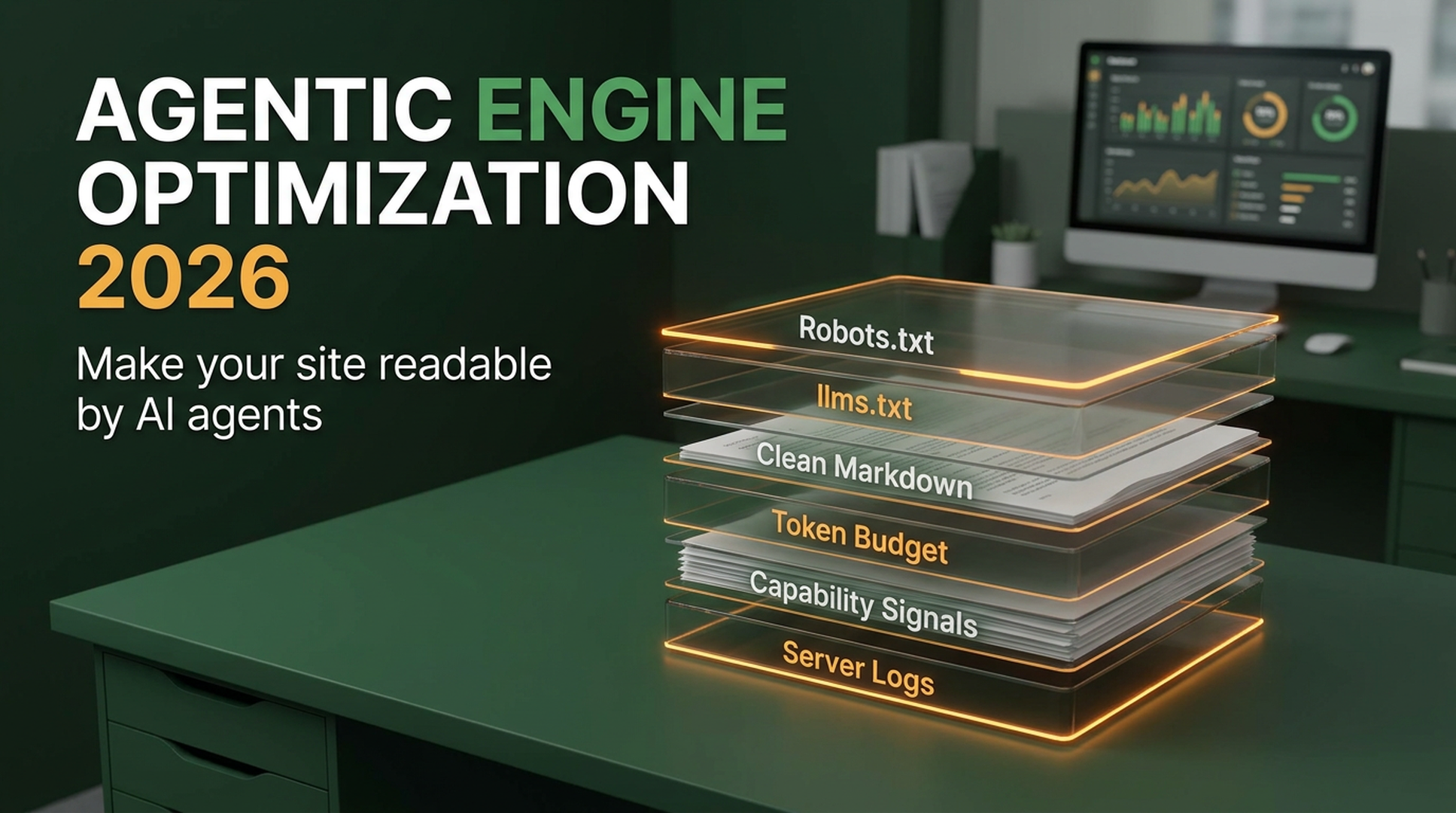
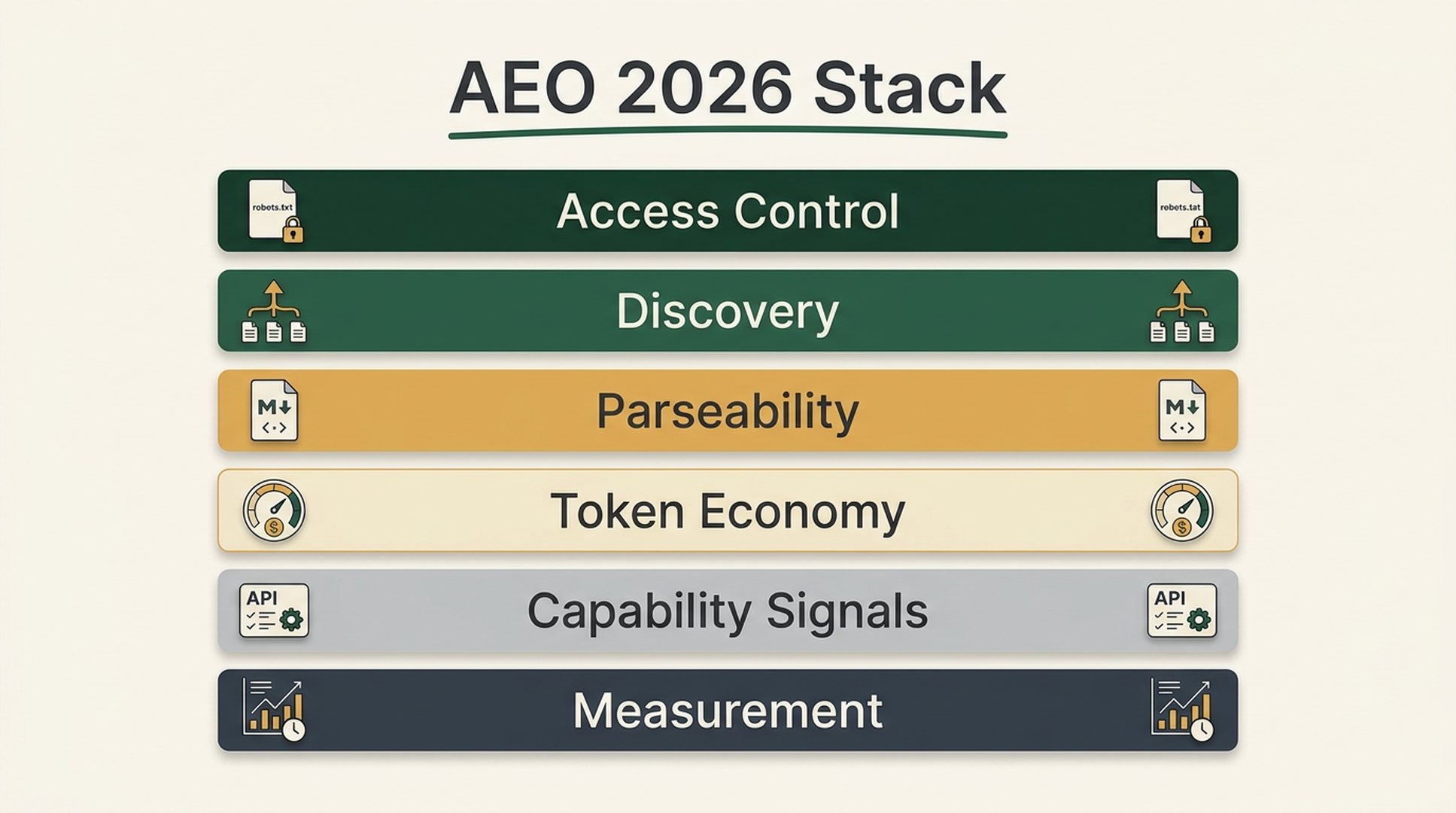
The AEO stack: six layers to audit
AEO is easier to manage when you stop treating it as one big content rewrite. It is a stack. Each layer answers a different question an agent has before it can use your site.
1. Access control: can agents reach the page?
Start with robots.txt. Many teams have crawler rules that were written for search engines, legacy scrapers, staging paths, or CDN defaults. Those rules may accidentally block the clients that AI systems use to retrieve content.
A 2026 audit should check:
- whether important documentation and comparison pages are blocked;
- whether AI crawler user agents are handled intentionally;
- whether API docs, changelogs, support docs, and pricing pages are accessible;
- whether security-sensitive or private areas are still protected.
This is not a recommendation to allow every bot. It is a recommendation to make a conscious access policy. Blind blocking and blind allowing are both lazy.
A useful first step is to test your file with a robots.txt AI crawler checker and document which agent classes you allow, restrict, or monitor.
2. Discovery: can agents find the right page fast?
Search engines have XML sitemaps. Agents increasingly need something more descriptive.
llms.txt is one emerging answer. It is a plain-text or Markdown index placed at the root of a site, usually at /llms.txt, that points agents to the most useful pages and explains what each page contains.
A weak entry says:
- API Reference: /docs/api
A better entry says:
- REST API authentication: /docs/api/auth
  Covers API keys, OAuth, token expiry, required headers, and common 401 errors. About 4,800 tokens.
That description saves an agent from fetching a dozen pages just to learn whether the content is relevant.
For product and growth sites, llms.txt should not only list developer docs. It can point to product explainers, tool pages, pricing logic, support policies, integration docs, and benchmark pages. Keep it short. If the index becomes a second website, agents will ignore or truncate it.
3. Parseability: can the content survive extraction?
Agents often see your page after the browser experience has been removed. That means the clean text version matters.
Good agent-readable pages have a few habits:
- the first 150-250 words state what the page is, who it helps, and what the reader can do next;
- headings form a logical outline without relying on visual cards;
- examples sit next to the explanation they support;
- tables define parameters, limits, and trade-offs;
- important facts are in text, not only inside images;
- the Markdown or text version excludes navigation, cookie banners, footer links, and repeated CTA blocks.
The fastest test is brutal: copy the page into plain Markdown and ask whether it still makes sense. If the page collapses without layout, icons, hover states, or embedded UI, it is not ready for agents.
4. Token economy: is the page small enough to use?
Token count is becoming a real content operations metric.
A long page is not automatically bad. Some API references need detail. The problem is an unchunked page that forces an agent to choose between overloading context, dropping sections, or using stale model memory.
Use practical thresholds:
Page type | Good target | If it exceeds the target |
|---|---|---|
Product overview | 1,500-4,000 tokens | Split use cases and proof into separate pages |
How-to guide | 3,000-8,000 tokens | Add task-level anchors and summaries |
API reference page | 5,000-15,000 tokens | Break by resource or endpoint group |
Long technical manual | 15,000+ tokens | Provide summaries, chunk maps, and downloadable Markdown |
The point is not to chase tiny pages. The point is to make length visible and navigable. Add token estimates to llms.txt, page metadata, or internal content dashboards. A content team cannot manage what it never measures.
5. Capability signals: can agents understand what you do?
Most websites describe themselves for human persuasion. Agents need operational clarity.
A product page may say it "helps teams automate growth." That sounds fine to a person, but it is weak input for an agent. The agent needs to know what actions, inputs, outputs, limits, integrations, and policies exist.
For technical products, a skill.md, AGENTS.md, MCP server description, OpenAPI file, or structured capability page can help. For non-technical products, the same idea still applies. Make capability statements explicit:
Vague claim | Agent-readable version |
|---|---|
"Automate reporting" | "Connect Google Search Console, crawl up to 10,000 URLs, and export weekly SEO issue reports as CSV or Markdown." |
"AI-powered optimization" | "Generate title, meta description, heading, and FAQ suggestions from a provided URL and target query." |
"Enterprise ready" | "Supports SSO, audit logs, role-based access, custom data retention, and workspace-level permissions." |
This is where AEO overlaps with conversion. Clear capability pages help agents, but they also help human buyers compare vendors without decoding vague marketing language.
6. Measurement: can you see agent demand?
Client-side analytics are not enough. AEO measurement starts in server logs.
Track three groups:
- referral traffic from AI interfaces such as ChatGPT, Perplexity, Claude, Gemini, Copilot, and other answer products;
- user-agent and runtime signatures that indicate automation, command-line fetches, headless browsers, or SDK clients;
- content endpoints requested by agents, especially Markdown,
llms.txt, OpenAPI files, docs, support pages, and comparison pages.
Do not overinterpret a single log line. User agents can be spoofed, and some AI systems fetch through generic infrastructure. Still, a directional baseline is useful. You want to know which pages agents request, which pages they fail to access, and which content formats they prefer.
A 30-day AEO plan for growth and documentation teams
AEO can turn into a standards debate if you let it. Avoid that. Start with the pages that already affect revenue, support, or developer adoption.
Days 1-3: access and discovery
Audit robots.txt, sitemap coverage, canonical URLs, and important blocked paths. Create a short list of pages agents should be allowed to read. Draft the first version of /llms.txt with 20-50 high-value URLs, each with a one-line task description.
Days 4-10: content extraction
Export your top pages to Markdown. Remove navigation noise. Put the answer in the first section. Add tables for limits, pricing logic, API parameters, comparison criteria, or workflow steps where prose is making agents guess.
Days 11-17: token and chunking
Estimate token counts for the pages in your agent index. Split pages that are too long. Add section summaries and anchor links. For API docs, separate authentication, errors, pagination, rate limits, and endpoint groups.
Days 18-24: capability pages
Write capability summaries for your main product, tools, integrations, and APIs. Include required inputs, outputs, constraints, and examples. If you have a code repository, add or improve AGENTS.md so coding agents know how to work in the project.
Days 25-30: measurement
Create a dashboard from server logs. Track AI referrals, agent-like fetches, status codes, requested content formats, and pages with high agent demand but weak structure. Use this dashboard to choose the next rewrite batch.
Common mistakes
The biggest mistake is treating AEO as a trick. Adding an llms.txt file to a weak site will not make agents trust bad content. Agents still need clear pages, consistent facts, and evidence.
Other mistakes are more operational:
- blocking AI crawlers accidentally, then wondering why the brand disappears from answers;
- publishing everything as JavaScript-heavy pages without clean text fallbacks;
- hiding key product facts inside images, carousels, modals, PDFs, or videos;
- writing long narrative intros before answering the actual question;
- describing benefits without inputs, outputs, constraints, or examples;
- measuring only client-side events and missing server-side agent fetches;
- assuming developer documentation is the only content agents read.
That last one matters. Agents now help with buying, research, support, workflows, and content planning. They read more than API docs.
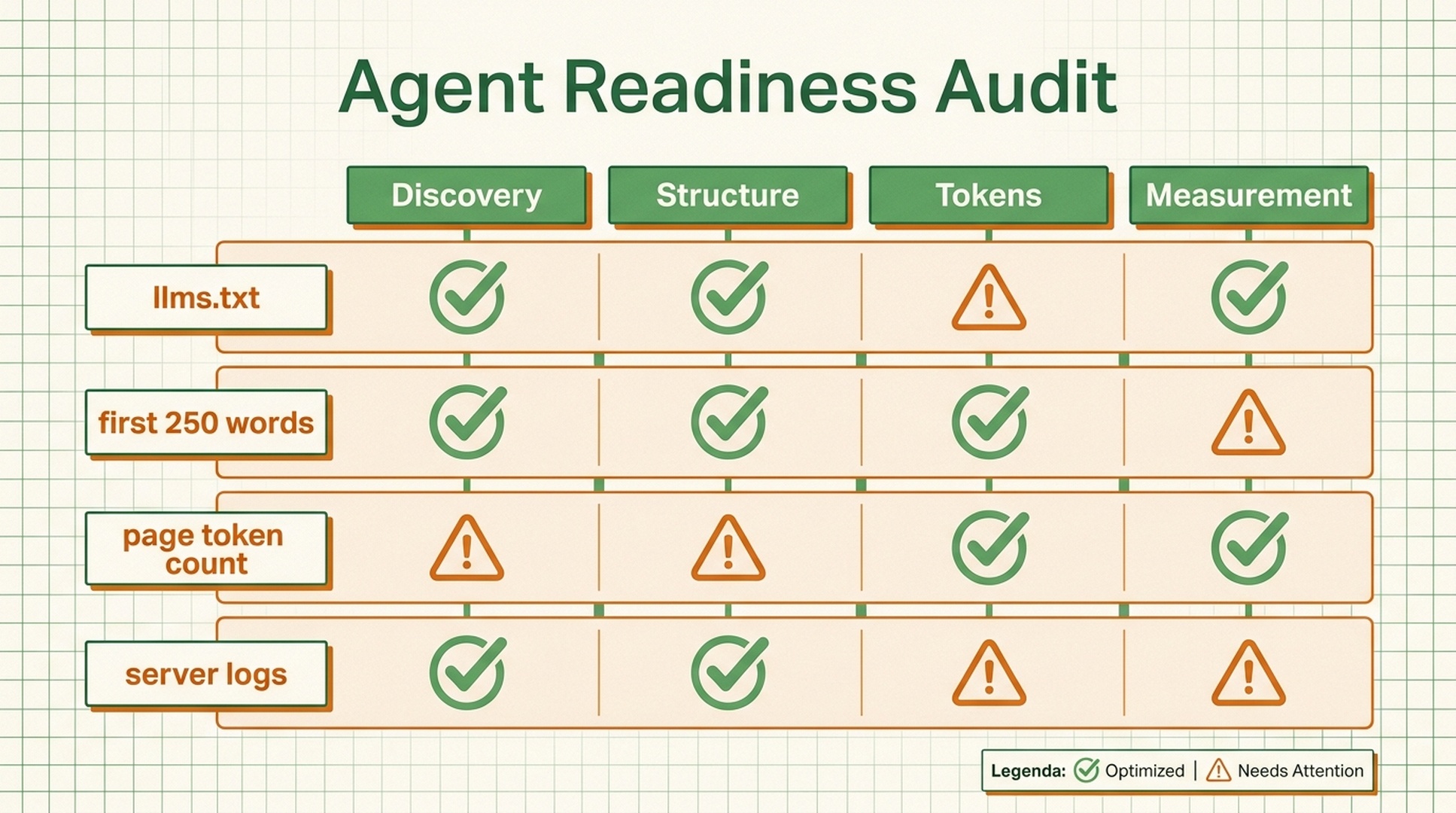
AEO audit checklist
Use this as a first-pass audit before you rewrite anything.
Area | Question | Pass signal |
|---|---|---|
Access | Can approved AI agents fetch important pages? |
|
Discovery | Is there an agent-oriented index? |
|
Structure | Does the page answer early? | The first 250 words state purpose, audience, and next action |
Format | Is a clean text version available? | Markdown or readable HTML excludes navigation noise |
Token economy | Are long pages measured and chunked? | Token estimates appear in docs or internal dashboards |
Capability | Are actions, inputs, outputs, and limits explicit? | Product and API capabilities are machine-readable |
Evidence | Can agents cite support for claims? | Claims link to docs, examples, tests, policies, or data |
Measurement | Can you see agent fetches? | Server logs segment AI referrals and agent-like clients |
Auspia takeaway
AEO is not replacing SEO. It is what happens when search, answer engines, and autonomous agents start sharing the same discovery path.
The practical 2026 move is to make your most important pages agent-readable without making them worse for people. That means cleaner structure, shorter routes to the answer, visible constraints, explicit capabilities, and server-side measurement.
If you do nothing else this week, do three things: test robots.txt, publish a small llms.txt, and rewrite one high-value page so the first 250 words can stand alone inside an AI answer or agent workflow.
FAQ
Is Agentic Engine Optimization the same as Answer Engine Optimization?
No. Answer Engine Optimization focuses on being cited or summarized in AI answers. Agentic Engine Optimization focuses on whether autonomous agents can retrieve, understand, and act on your content. They overlap, but agentic optimization cares more about task completion, capability signals, permissions, and machine-readable formats.
Do all websites need llms.txt in 2026?
Not every small site needs a complex file, but any site with documentation, tools, product comparisons, integrations, support content, or API references should consider it. A short, accurate index is better than a long generated one.
Should we allow every AI crawler?
No. Decide which content should be accessible, which user agents you trust, and which paths must stay private. AEO is about intentional access, not open access to everything.
How do we know whether agents are already visiting our site?
Start with server logs. Look for AI referral sources, command-line or SDK user agents, repeated fetches of docs and Markdown files, requests to robots.txt, llms.txt, OpenAPI files, and unusual sessions that never trigger client-side analytics.
What is the fastest AEO improvement?
Rewrite the first section of your most important documentation or product page. Put the direct answer, use cases, constraints, and next action near the top. Then expose that same content in clean Markdown or readable HTML.