Short answer
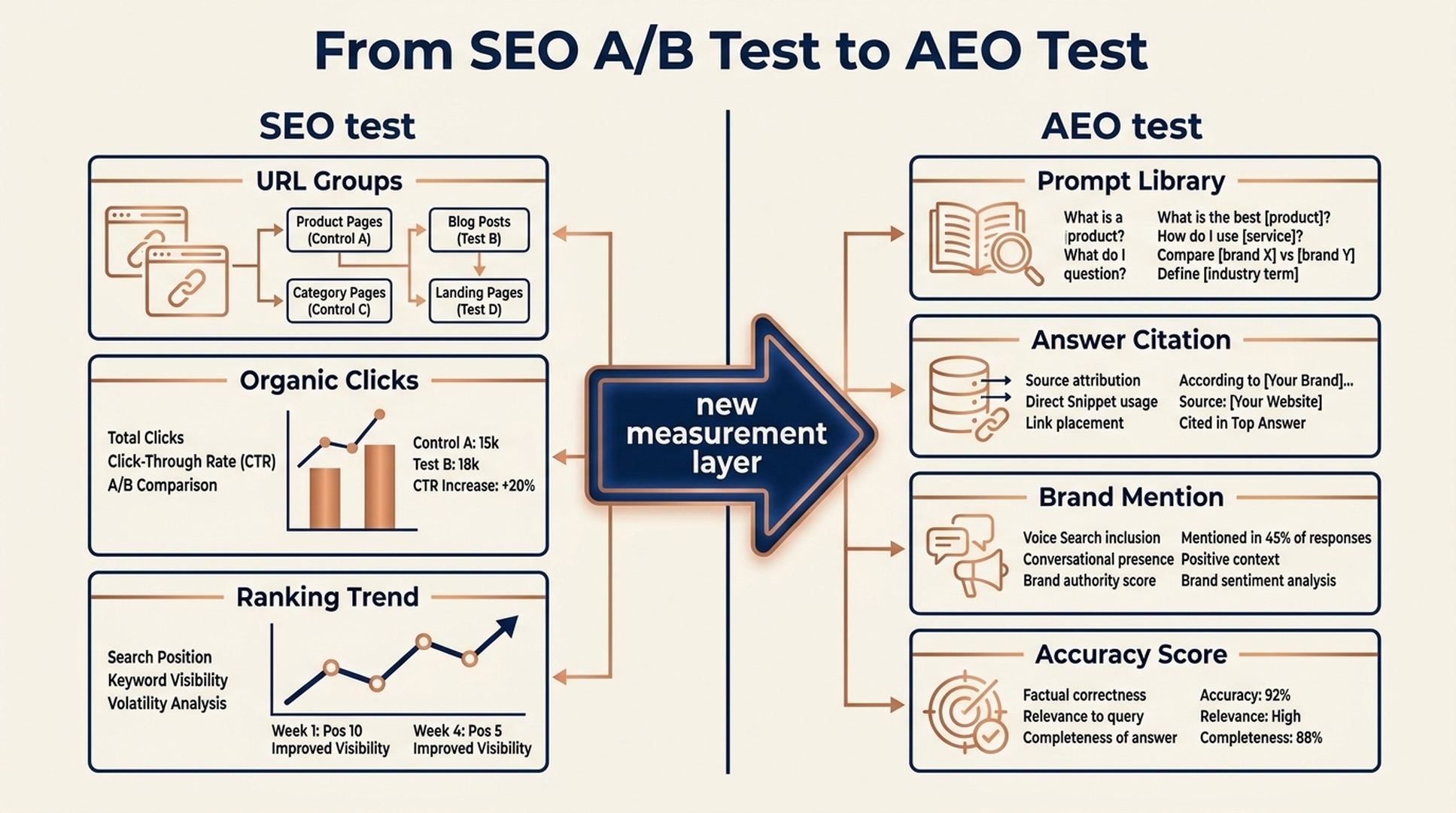
AEO testing is not SEO testing with a new label. Traditional SEO experiments can isolate page changes against organic sessions and rankings. AEO experiments have to measure whether answer engines can find, trust, summarize, and cite your content across prompts where the user may never click.
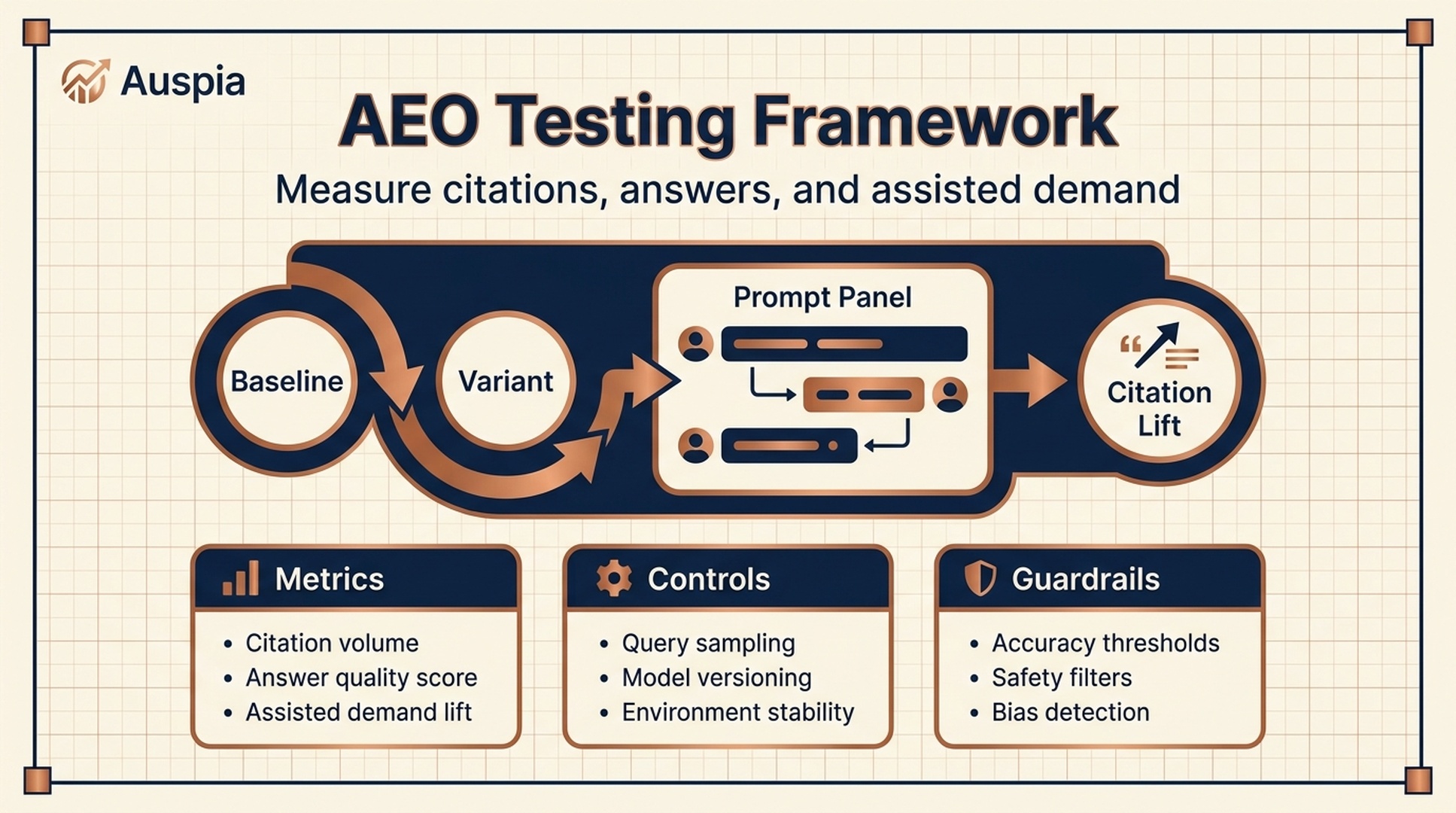
The practical upgrade is a four-layer test: keep URL-level controls where possible, add a fixed prompt panel, track answer outcomes such as citation rate and mention accuracy, and connect those outcomes to assisted demand signals. The result will be less tidy than a classic SEO split test, but it is far better than shipping FAQ blocks and hoping ChatGPT, Perplexity, Gemini, Copilot, or Google AI answers notice.
A helpful starting point is the SEO testing logic described in Kaitlin R. McMichael's Medium article, "Upgrading your SEO testing framework for AEO", which argues that answer engines need their own testing metrics because zero-click visibility often happens before traffic appears. Auspia's view is similar, with one extra constraint: AEO tests should separate answer visibility from answer quality. Being mentioned is not enough if the answer is wrong, outdated, or attributed to a competitor.
Caption: AEO testing keeps the discipline of SEO experiments but adds prompt panels, citations, answer accuracy, and assisted-demand metrics.
What AEO frameworks usually include
When people talk about an AEO framework, they usually mean one of several overlapping systems. They are not identical, and that is why AEO testing gets messy.
Framework type | What it optimizes | Typical assets | Testable metric |
|---|---|---|---|
Answer extractability | Whether a page gives a direct, quotable answer | short definitions, comparison tables, FAQs, how-to steps | answer inclusion, snippet reuse, answer completeness |
Entity authority | Whether the brand, product, author, and topic are easy to identify | about pages, author pages, organization schema, consistent brand facts | correct entity mention, fewer hallucinated facts |
Citation readiness | Whether answer engines can treat the page as a source | original data, updated explanations, clear sourcing, crawlable pages | citation rate, source position, citation diversity |
Conversational intent coverage | Whether the site covers natural-language questions, not just head keywords | prompt clusters, buyer questions, objection pages | prompt coverage, answer share, follow-up query inclusion |
Technical accessibility | Whether crawlers and AI retrieval systems can access the content | indexable HTML, structured data, robots policy, internal links | crawl status, rendered content availability, schema validity |
Trust and freshness | Whether the answer looks safe to reuse now | dates, review notes, evidence, policy pages, support docs | freshness mention, outdated-answer reduction, source preference |
None of these frameworks replaces SEO. They add a measurement layer for answer surfaces where visibility may not show up as a visit.
Two public guidance points matter here. Google says its AI features are part of Search and that its existing Search essentials still apply to eligibility and visibility in AI experiences. Bing's webmaster guidelines also continue to emphasize crawlability, quality, relevance, and avoiding manipulative behavior. In other words, AEO still depends on boring fundamentals. The test design changes because the output is now an answer, not just a ranked blue link.
Why classic SEO tests break when the output is an answer
Classic SEO A/B testing works best when you can group similar URLs, change one element, and wait for organic traffic or rankings to diverge. That logic is still useful for title templates, internal links, structured data, copy blocks, and page modules.
Answer engines add three complications.
First, the unit of measurement is no longer only the URL. An AI answer may pull from your page, a competitor's page, a review site, a social post, a documentation page, or a knowledge panel. A page-level change may improve the answer even if the page gets no direct visit.
Second, the query is no longer stable. A user might ask "best CRM for small agencies," "HubSpot alternatives for a five-person agency," or "which CRM is easiest to migrate from spreadsheets?" Those prompts overlap, but they produce different answer contexts.
Third, the result is qualitative. A ranking position can move from 6 to 3. An answer can cite you but misstate your pricing, mention a retired feature, or recommend you for the wrong buyer. AEO testing needs numbers, but it also needs a human-readable quality gate.
That is why an AEO framework should not ask only, "Did traffic increase?" It should ask: "Did the answer engine become more likely to use the right page, say the right thing, and send higher-intent demand later?"
The Auspia AEO testing model
Use this model when you want to test whether a content, schema, or entity update improves answer-engine visibility. It borrows the discipline of SEO experimentation but accepts that AEO data is noisier.
1. Define the answer behavior, not just the page change
A weak hypothesis sounds like this: "Adding FAQ schema will improve AEO."
A stronger hypothesis sounds like this: "Adding a concise comparison table, updated pricing facts, and FAQ schema to 40 product-comparison pages will increase correct brand citations for evaluation prompts by at least 15% over 45 days, without reducing organic conversions."
The second version is testable because it names the asset, the prompt type, the expected answer behavior, the time window, and the guardrail.
2. Build a prompt panel before editing pages
A prompt panel is the AEO equivalent of a keyword set, but it should sound closer to how buyers ask questions.
Include five prompt groups:
Prompt group | Example | Why it matters |
|---|---|---|
Definition | "What is answer engine optimization?" | tests extractable explanations |
Comparison | "AEO vs SEO for B2B SaaS" | tests category clarity |
Recommendation | "Which tools help measure AI search visibility?" | tests brand inclusion and competitor context |
Problem diagnosis | "Why is my brand not appearing in AI answers?" | tests helpful troubleshooting content |
Buyer objection | "Is AEO worth testing if traffic is zero-click?" | tests conversion-adjacent answers |
Keep the prompt set stable during the test. If you keep adding prompts midway through, you are no longer testing a change. You are moving the measuring stick.
3. Choose the test asset and control group
Good AEO test assets include comparison pages, glossary pages, product documentation, FAQ hubs, review-response pages, and pages with original data. Avoid testing a single page unless it already receives enough impressions, citations, or prompt mentions to observe change.
For a cleaner test, split similar pages into variant and control groups. Example: 30 comparison pages get an updated answer block and source table; 30 similar pages stay unchanged for the first test window. If the pages are too different, use a before-and-after design, but label it weaker evidence.
4. Measure four outcome layers
AEO visibility is not one metric. Treat it as a stack.
Outcome layer | Metric | How to read it |
|---|---|---|
Retrieval | crawler access, indexed status, content rendered | if this fails, the rest of the test is noise |
Answer presence | brand mention rate, page citation rate, source position | shows whether answer systems are using you |
Answer quality | accuracy score, message match, outdated-fact rate | shows whether visibility is safe |
Business signal | branded search lift, AI referral clicks, demo assists, sales notes | shows whether visibility is connected to demand |
Traffic still matters. It is just a late signal for many answer experiences.
5. Run the test long enough to avoid a false read
For many sites, 30 days is the minimum useful window. For lower-volume prompt panels or pages that are crawled less often, 45 to 60 days is safer. Do not call a result after a week unless the change is huge and repeated across several answer engines.
Also record platform context. Google AI Overviews, Perplexity, ChatGPT browsing, Gemini, Copilot, and Claude do not refresh or source answers in the same way. If one platform moves and another does not, that is not a failed test. It may tell you which retrieval system recognized the change first.
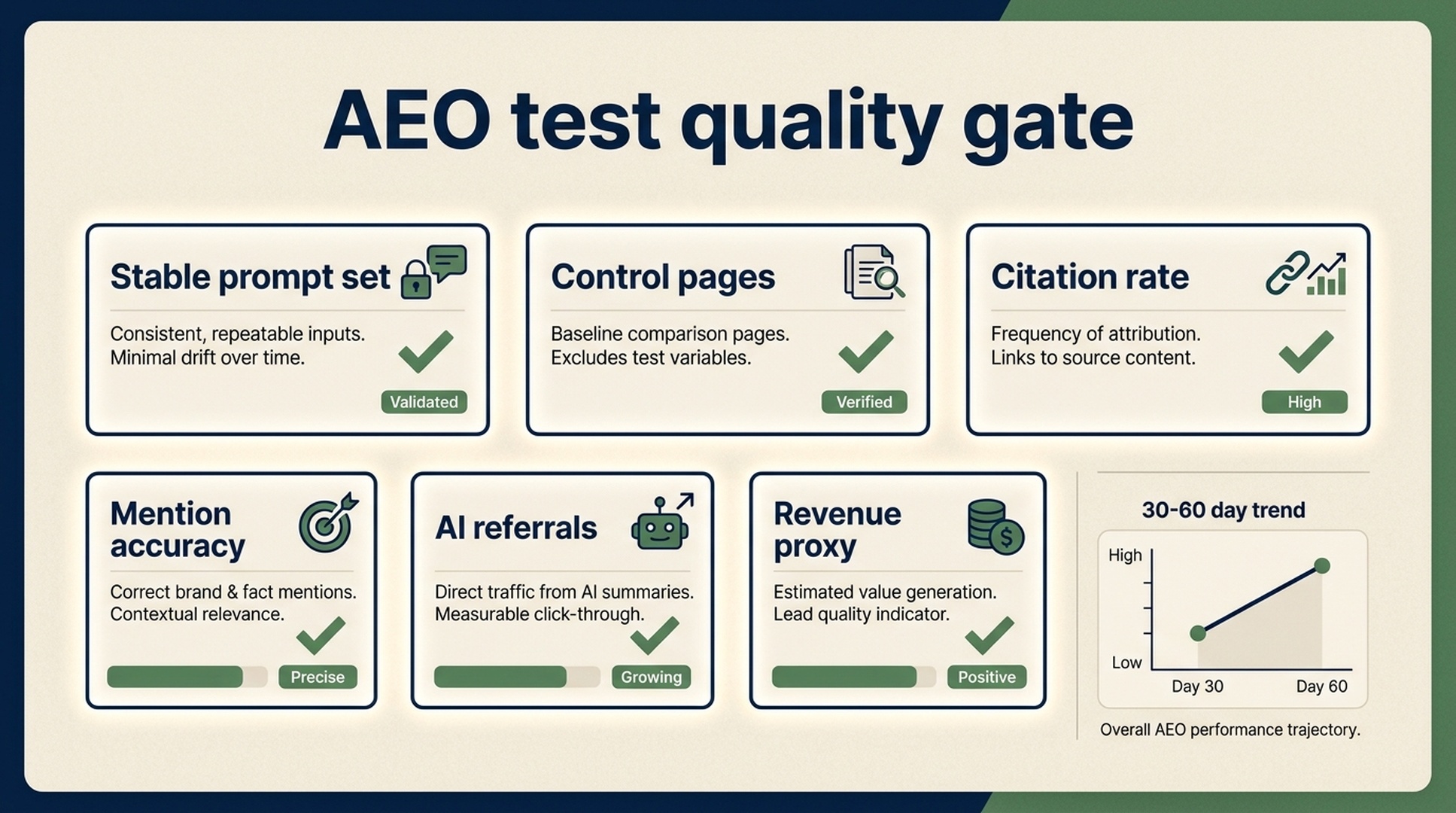
Caption: A practical AEO quality gate tracks prompt stability, controls, citations, mention accuracy, AI referrals, and a revenue proxy.
Metrics worth testing, and metrics to treat carefully
The temptation is to build a big dashboard and call it an AEO operating system. Resist that. Start with metrics that can survive a skeptical review.
Metric | Use it? | Notes |
|---|---|---|
Citation rate | Yes | Count how often your domain or page is cited for the fixed prompt panel. |
Correct brand mention rate | Yes | Separate "mentioned" from "mentioned accurately." |
Source position | Yes, with caution | Useful in Perplexity-like outputs; less consistent across chat products. |
Answer sentiment | Sometimes | Helpful for reputation topics, weak for technical how-to topics. |
AI referral traffic | Yes, but incomplete | UTM and referrer data can be patchy; treat as a downstream signal. |
Organic clicks | Yes | Still useful, especially if Google AI features affect click behavior. |
Share of answer | Yes, if defined | Decide whether you count citation, mention, recommendation, or all three. |
One-off screenshots | No as proof | Screenshots are good evidence for a case note, not a statistical result. |
If the team can only track three metrics, use citation rate, mention accuracy, and assisted demand. That combination prevents the classic mistake: celebrating visibility that never turns into trust or pipeline.
AEO test designs you can use
There are several workable AEO testing frameworks. Choose based on the evidence you can collect, not on the neatness of the slide.
URL split test
Use this when you have many similar pages, such as comparison pages, location pages, help articles, or glossary entries.
- Variant pages get the AEO change.
- Control pages remain unchanged.
- Both groups are checked against the same prompt panel.
- You compare citation and answer-quality lift between groups.
This is closest to classic SEO testing. It is also the hardest to run well because many sites do not have enough similar pages.
Before-and-after prompt test
Use this when the site is smaller.
- Capture baseline answers for a fixed prompt set.
- Ship the page or entity update.
- Recheck the same prompts on a set cadence.
- Compare against a competitor or category benchmark.
This design is easier, but it is vulnerable to market noise. If a competitor publishes a major report during your window, your result may move for reasons unrelated to your change.
Entity-level test
Use this when the problem is inconsistent brand facts, not weak page copy.
- Update about pages, organization schema, author pages, product facts, and trusted external profiles.
- Track whether answer engines describe the company correctly.
- Watch for fewer hallucinated categories, old names, retired products, or wrong geographies.
This is useful for brands that are visible but misunderstood.
Citation acquisition test
Use this when answer engines ignore your site but cite third-party sources.
- Publish original data or a better reference page.
- Earn or update relevant third-party mentions.
- Track which sources answer engines cite over time.
- Separate owned-page citations from third-party citations that mention your brand.
This test admits something many AEO articles avoid: sometimes the page you want cited is not the only source that matters.
SERP-to-answer test
Use this when Google AI Overviews or featured answer features are the main surface.
- Track classic organic rankings, AI answer inclusion, and click behavior together.
- Check whether the page supports both the answer block and the blue-link result.
- Watch for cases where answer visibility rises while clicks fall.
This is not a failure by itself. It may mean the page is doing upper-funnel work that needs a different conversion path.
A simple 45-day AEO experiment plan
Here is a version a small growth team can run without buying a heavy testing platform.
Day | Work | Output |
|---|---|---|
1-3 | Pick one topic cluster and 30-100 prompts | prompt panel and baseline sheet |
4-7 | Choose variant/control pages or a before-and-after set | test map |
8-14 | Capture baseline answers across 2-4 answer engines | citation and accuracy baseline |
15-21 | Ship the AEO change | updated pages, schema, internal links, entity facts |
22-44 | Recheck prompts weekly | trend log with notes |
45 | Decide keep, rollback, or expand | test readout |
The readout should include screenshots, but do not let screenshots replace the table. A single attractive AI answer can hide a weak average result.
Common mistakes when teams test for AEO
The first mistake is testing too many changes at once. If you rewrite the page, change schema, add internal links, update your about page, and run a PR campaign in the same week, you may improve visibility. You will not know which change mattered.
The second mistake is ignoring wrong answers. A brand mention with a bad description is not a win. For AEO, accuracy is a growth metric because wrong answers can suppress qualified demand.
The third mistake is treating answer engines as one channel. They are not. A page may perform well in Perplexity because it cites sources heavily, yet move slowly in ChatGPT if the answer depends on browsing context or third-party mentions.
The fourth mistake is optimizing only owned pages. Answer systems often synthesize across review sites, documentation, social discussions, news, comparison pages, and structured databases. A useful AEO framework includes owned content and credible external corroboration.
The fifth mistake is overreading short-term volatility. Answer outputs change. Re-run the prompt set, keep timestamps, and look for repeated movement.
Auspia view: the better test question
AEO testing should not ask, "Can we trick an answer engine into citing us?" That framing leads to brittle tactics and bad content.
The better question is: "Can we make the right answer easier to retrieve, easier to verify, and safer to cite?"
That is where the testing framework becomes useful. It turns AEO from a vague content trend into a set of observable behaviors: the engine finds the page, uses the page, describes the brand correctly, cites the source, and sends some form of qualified demand later.
If your current SEO testing system already has hypotheses, control groups, rollout windows, and business guardrails, keep it. Add a prompt layer. Add answer-quality scoring. Add citation tracking. Then run smaller tests until the signal is boring enough to trust.
For teams starting from scratch, Auspia's AI Search Visibility Checker can help frame the first prompt set before you build a larger AEO test plan.
FAQ
What is AEO testing?
AEO testing measures whether changes to content, structured data, entity information, or external evidence improve how answer engines mention, summarize, cite, or recommend a brand. It looks beyond rankings and clicks because many answer experiences are zero-click.
How is AEO testing different from SEO A/B testing?
SEO A/B testing usually compares organic traffic or ranking changes across URL groups. AEO testing adds prompt panels, citation tracking, brand mention accuracy, answer quality, and assisted-demand signals because the user may get the answer without clicking.
Which AEO metric should a team start with?
Start with citation rate and mention accuracy for a fixed prompt panel. Add AI referral traffic, branded search movement, demo assists, or sales notes once the baseline is stable.
Can FAQ schema improve AEO visibility?
It can help when the page already contains useful, clear answers. FAQ schema alone is weak if the answer is thin, outdated, blocked from crawlers, or unsupported by trusted sources.
How long should an AEO test run?
Run most AEO tests for at least 30 days. Use 45 to 60 days when prompts have low volume, pages are crawled slowly, or answer outputs are volatile.
Do AEO tests need statistical significance?
Use statistical discipline when you have enough pages, prompts, and observations. For smaller sites, use directional evidence, repeated prompt checks, control pages where possible, and clear confidence labels. Do not pretend a handful of screenshots is a statistically valid result.
Author: Nora Whitfield, AEO Specialist for 800+ Answer Patterns at Auspia. Nora writes about answer engine optimization, extractable content, FAQ design, and practical testing systems for growth teams.