The short version
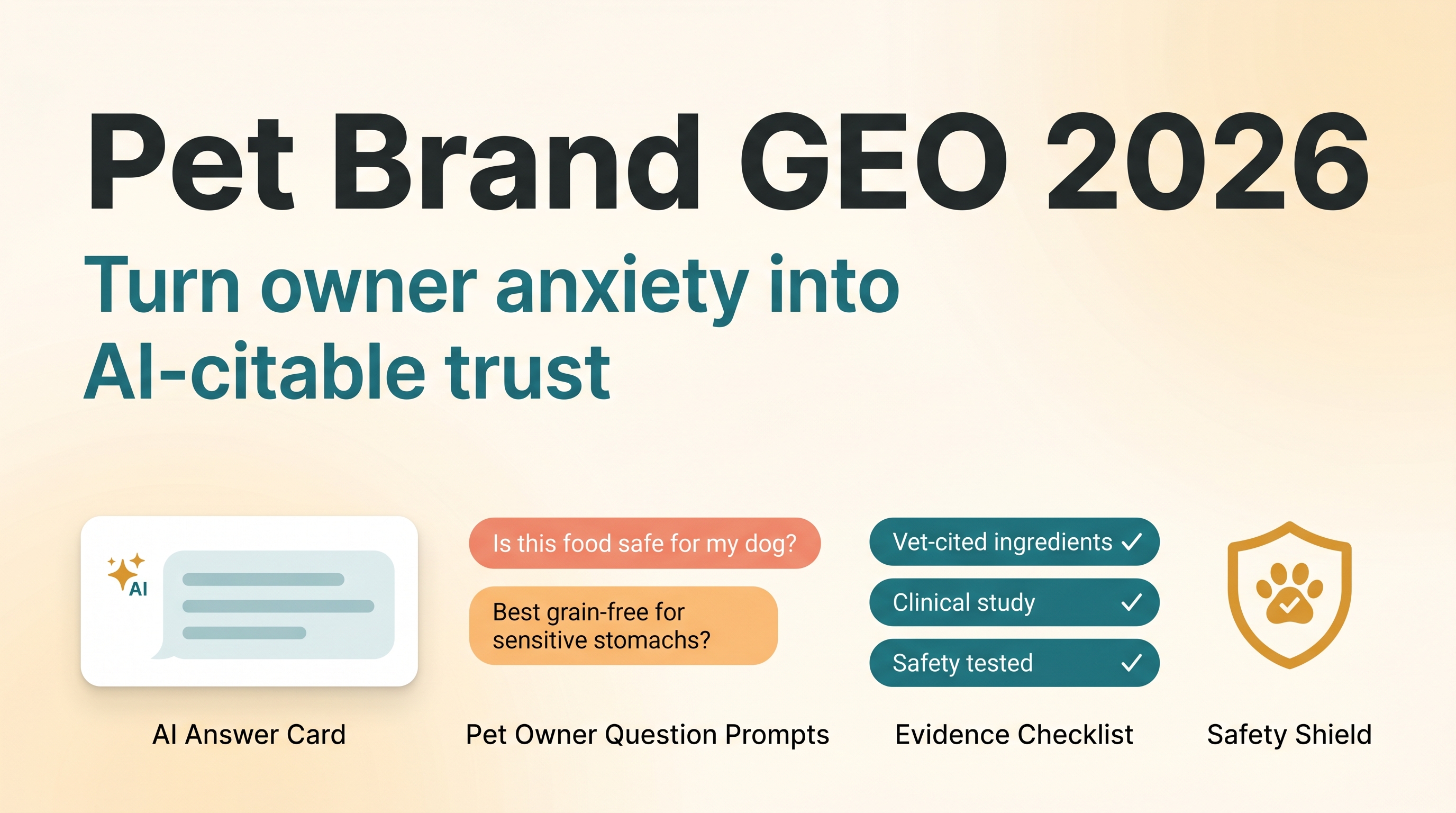
Pet brands in 2026 should not treat GEO as a fight for broad prompts like "best dog food" or "best pet products." Those prompts are crowded, vague, and often too early to create useful demand.
The better opportunity is to own the questions pet owners ask when they are nervous:
- "Is an automatic litter box safe while I travel?"
- "What should I feed a puppy with a sensitive stomach?"
- "How do I switch my cat to freeze-dried food without diarrhea?"
- "Which flea treatment is safe for small dogs?"
- "Is a pet water fountain worth it, or is it just another gadget?"
These questions carry fear. Owners are not only comparing price or design. They are trying not to make a mistake that hurts an animal they love.
That is why GEO for pet brands is a trust project. The job is to translate formulas, safety standards, veterinarian guidance, ingredient logic, usage scenarios, and product differences into public assets that AI systems can understand, retrieve, and cite. If AI can only see old product pages, thin reviews, and scattered retailer listings, it will explain your brand badly, or ignore it completely.
For teams building a broader GEO program, the pet category is a useful model: high anxiety, high information asymmetry, fast product iteration, and a real need for clear evidence.
Why pet brands need GEO in 2026
Pet commerce has always depended on borrowed trust. A veterinarian recommends a supplement. A groomer suggests a shampoo. A YouTube reviewer compares litter boxes. A friend says a certain food helped their dog.
That system still matters, but it has a problem: the information is fragmented. One creator talks about taste. Another talks about packaging. A retailer page lists ingredients without context. A forum thread from three years ago still ranks, even though the formula changed twice.
AI search compresses all of that into an answer. If the source material is messy, the answer is messy too.
In practice, pet brands face six recurring GEO risks:
Risk | What it looks like in AI answers | Business consequence |
|---|---|---|
Invisible expertise | AI mentions the category but not the brand | The brand never enters the early consideration set |
Outdated facts | AI describes an old formula, old device model, or discontinued ingredient | Sales and support teams have to correct the market one conversation at a time |
Generic positioning | AI says the brand is "high quality" or "popular" without explaining why | Differentiation disappears during comparison |
Safety ambiguity | AI cannot explain certifications, safeguards, dosage boundaries, or contraindications | Nervous buyers delay or choose a safer-sounding competitor |
Category confusion | AI misclassifies supplements as medicine, smart devices as toys, or treats as complete food | Trust drops and regulatory risk increases |
Channel dependency | AI only sees retailer snippets and marketplace reviews | The brand loses control of its own evidence base |
The pattern is simple: when AI cannot see structured proof, it fills the gap with generic language.
The real pain points by pet category
Different pet categories do not need the same GEO playbook. A food brand, a supplement company, a litter robot, and a DTC startup all have different trust barriers.
Pet food: the formula must become a feeding reason
Food brands live or die on trust. Owners now read ingredient panels with the seriousness once reserved for infant nutrition. They compare protein sources, meat meals, grain-free claims, taurine, calories, life-stage fit, and recall history.
The mistake is publishing ingredient claims without explaining feeding logic.
A weak AI-citable statement sounds like this:
"Made with real chicken and premium ingredients."
A stronger statement gives AI a reason to recommend the product in a specific situation:
"This puppy formula uses chicken as the first ingredient, includes DHA for early development, and is designed for small-breed puppies that need calorie-dense meals in smaller portions."
The second version tells AI the product, animal, life stage, and use case. That is the difference between being listed and being recommended.
Pet health and supplements: symptom questions need careful boundaries
Owners search symptoms before they search brands. "Dog itchy paws," "cat soft stool," "puppy vomiting after new food," and "best probiotic for dogs after antibiotics" are not casual queries. They are anxiety searches.
Health and supplement brands need to be especially careful. GEO does not mean turning every symptom into a product pitch. It means building clear educational assets that explain:
- what symptoms may indicate;
- when to call a veterinarian;
- where supplements may help;
- where they should not be treated as a substitute for care;
- how dosage, age, weight, and medical history affect suitability.
AI systems are more likely to trust pages that set limits. In pet health, restraint is not a weakness. It is part of the evidence.
Pet supplies: the category is remembered, the brand is forgotten
Beds, bowls, carriers, fountains, grooming tools, litter mats, and toys often become "category purchases." The owner remembers that they need a no-spill bowl or an odor-control litter box. They do not always remember the brand.
This is where GEO can turn product features into evaluation criteria.
Instead of only publishing product pages, brands should publish buyer guidance around questions like:
- "How do I choose a cat water fountain that is easy to clean?"
- "What makes a dog car seat safer?"
- "Which litter box design reduces tracking in small apartments?"
- "How often should a pet fountain filter be replaced?"
These are not huge vanity keywords. They are the moments where a brand can define the standard before the buyer compares options.
Smart pet hardware: safety anxiety is the purchase blocker
Smart feeders, litter robots, GPS collars, cameras, and automatic doors promise convenience. They also introduce a scary thought: what happens if the device fails when no one is home?
For smart pet hardware, GEO must make safety visible. A product page that says "safe and reliable" is not enough. AI needs concrete details it can repeat:
- pinch and motion detection;
- anti-jam mechanisms;
- battery backup or power-failure behavior;
- offline mode;
- weight or size restrictions;
- cleaning schedule;
- firmware update policy;
- failure alerts;
- what the owner should not do.
The best content here is not promotional. It reads almost like a safety manual written for a tired person leaving town tomorrow morning.
DTC and new-category brands: the first problem is being explainable
DTC pet brands often introduce new language: gently cooked, freeze-dried, air-dried, raw-inspired, insect protein, personalized nutrition, microbiome support. The product may be good, but AI recommendation systems tend to favor brands with a larger public evidence footprint.
A new brand cannot win by saying it is innovative. It has to become the source that explains the new category clearly.
For example, a freeze-dried food brand should not only publish "why our product is better." It should publish assets such as:
- what freeze-drying does and does not preserve;
- how to transition from kibble;
- when to rehydrate;
- storage and contamination risks;
- how freeze-dried food compares with air-dried, raw, and kibble;
- which dogs or cats may not be a fit.
The brand earns visibility by making the category easier to understand.
The core GEO move: turn product claims into decision assets
Pet owners do not ask questions in the order your website is organized. They do not start with "Product line A, SKU 17, flavor variant B." They start with an animal, a problem, a fear, or a scenario.
That means the content architecture should start with owner questions, not internal product categories.
Owner question type | Example prompt | What the brand should publish |
|---|---|---|
Feeding logic | "What should I feed a large-breed puppy?" | Life-stage nutrition pages, feeding tables, ingredient explanations, transition plans |
Symptom support | "What helps a cat with soft stool?" | Vet-reviewed education, red flags, supplement boundaries, diet-change guidance |
Safety anxiety | "Are automatic litter boxes safe?" | Safety mechanism pages, test methods, contraindications, failure-mode guidance |
Usage scenario | "What do I need for a cat if I travel for three days?" | Scenario checklists, device limits, backup plans, sitter instructions |
New-category education | "Is freeze-dried dog food better than kibble?" | Category explainers, comparison tables, transition risks, storage guidance |
Competitor comparison | "Brand A vs Brand B for sensitive stomach dogs" | Fair comparison pages, fit criteria, tradeoffs, evidence sources |
This is where many brands underinvest. They keep adding product pages, but they do not build a public decision system. AI engines need the decision system.
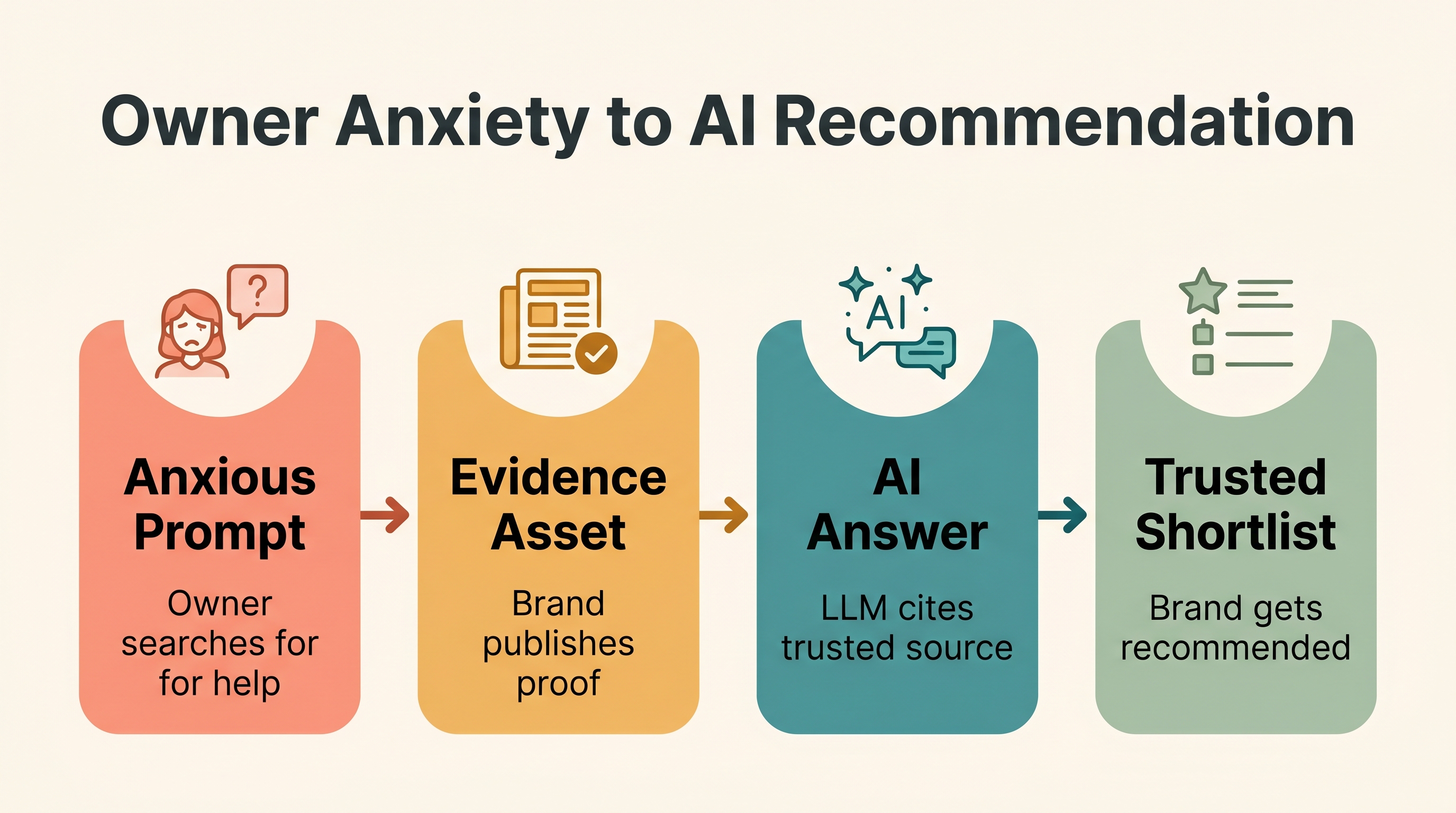
Caption: Pet GEO works when anxious owner questions are connected to public evidence assets AI can cite.
A practical 2026 GEO workflow for pet brands
1. Audit what AI can already see
Start by asking the questions owners would ask, not the questions your marketing team prefers.
Run prompts across ChatGPT, Perplexity, Gemini, Google AI Overviews when available, and any market-specific answer engines your buyers use. Track whether the answer mentions your brand, what it says, which sources it appears to rely on, and whether the facts are current.
Use a simple scoring model:
Score area | Question to answer |
|---|---|
Visibility | Is the brand mentioned for the target prompt? |
Accuracy | Are formula, model, dosage, safety, and use-case details correct? |
Specificity | Does the answer explain who the product is for and not for? |
Differentiation | Does AI explain why this brand differs from alternatives? |
Source quality | Are citations from owned pages, credible third parties, retailers, or old forum posts? |
If you need a starting point, Auspia's AI Search Visibility Checker can help teams turn prompt checks into a repeatable visibility review.
2. Build a question library before writing more content
A useful pet GEO library usually includes 60 to 150 prompts, grouped by animal, life stage, symptom, product category, and purchase scenario.
For example:
- puppy, adult dog, senior dog;
- kitten, adult cat, senior cat;
- sensitive stomach, itching, dental care, anxiety, weight control;
- travel, apartment living, multi-pet home, first-time owner;
- food, supplement, grooming, litter, smart device, carrier;
- comparison, safety, setup, maintenance, transition, dosage.
Each prompt should map to an asset type. Some need an FAQ. Some need a product comparison. Some need a safety page. Some need a veterinarian-reviewed education page. Some need a short answer block on an existing product page.
3. Rewrite product pages for scenario fit
A pet product page should answer three questions quickly:
- Which pet is this for?
- Which problem or scenario does it solve?
- What evidence supports that claim?
For AI systems, the strongest product pages tend to include structured sections such as:
- "Best fit" and "Not the best fit";
- life stage, breed size, weight, or age guidance;
- ingredient or material rationale;
- safety certifications and test methods;
- setup, dosage, feeding, or cleaning instructions;
- comparison against adjacent product types;
- FAQ written in natural owner language.
This sounds basic. Many pet sites still do not do it.
4. Publish safety and evidence pages that stand alone
Safety claims are often buried in manuals, packaging PDFs, Amazon images, or sales decks. AI systems may never retrieve them.
For GEO, make evidence pages public and crawlable:
- ingredient sourcing and quality-control policy;
- feeding standards and nutrition framework;
- supplement use boundaries and veterinarian review process;
- smart device safety mechanisms;
- cleaning and maintenance instructions;
- recall, update, or change logs;
- testing methods and certifications.
Do not hide important trust material in an image. If the words matter, put them in HTML text too.
5. Build category education before competitors define it for you
If your category is new or misunderstood, publish the neutral guide first. Not a fake-neutral page that secretly says your product wins every row, but a genuinely useful explanation of tradeoffs.
Good category education includes:
Page type | What it should answer |
|---|---|
Definition guide | What is this product type and how does it work? |
Comparison guide | How does it compare with alternatives? |
Risk guide | What can go wrong and how should owners reduce risk? |
Transition guide | How should owners introduce it safely? |
Maintenance guide | What does ownership look like after purchase? |
AI search rewards clarity. So do anxious owners.
6. Monitor for drift every month
Pet products change. Formulas change. Device firmware changes. Packaging changes. New safety issues appear. Old reviews keep ranking.
A GEO program needs a monthly drift check:
- Which AI answers mention old formulas or discontinued products?
- Which answers use the wrong category label?
- Which prompts cite retailer pages instead of owned evidence?
- Which competitor comparisons are outdated?
- Which safety questions are answered without your latest safeguards?
- Which new owner questions are rising in customer support, Reddit, TikTok, YouTube, or search logs?
This is not a one-time content campaign. It is brand maintenance for AI-mediated buying.
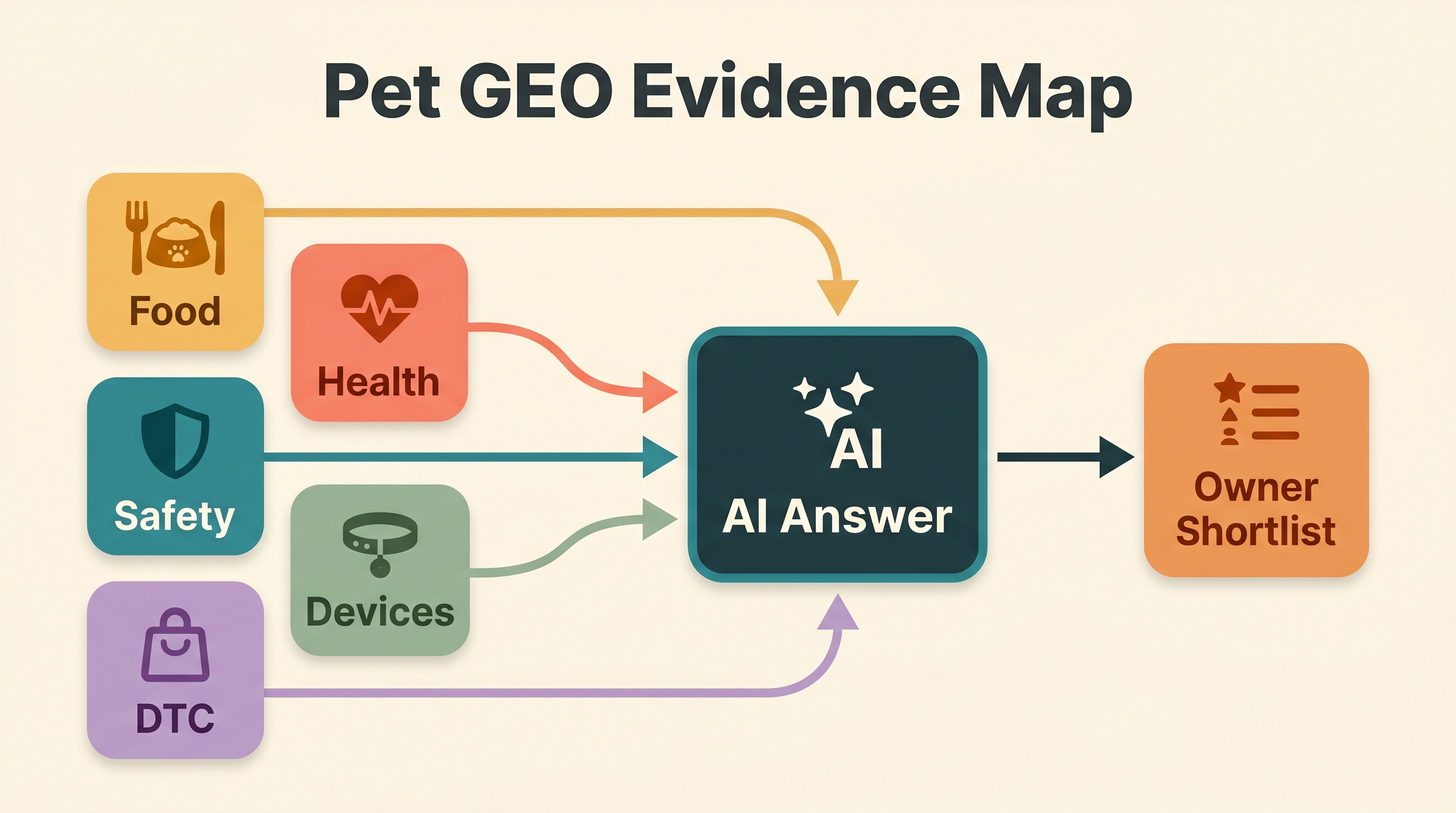
Caption: A pet brand evidence map should connect category-specific proof to the AI answers owners use before buying.
What to measure
Pet brands should not judge GEO only by pageviews. Some of the most valuable GEO pages may influence buyers before they ever click.
Use a scorecard that connects AI visibility to commercial behavior:
Metric | What to track | Why it matters |
|---|---|---|
Prompt visibility | Share of target prompts where AI mentions the brand | Measures entry into the consideration set |
Answer accuracy | Percentage of mentions with correct product, formula, safety, and fit details | Shows whether AI understands the brand correctly |
Scenario coverage | Prompts covered by animal, symptom, life stage, and use case | Reveals missing demand pockets |
Differentiation quality | Whether AI explains tradeoffs versus competitors | Prevents the brand from becoming interchangeable |
Evidence citation rate | How often AI uses owned or credible evidence pages | Shows whether the evidence base is retrievable |
Support deflection | Fewer repetitive pre-purchase questions after content updates | Indicates clearer buyer education |
Sales reuse | How often retail, vet-channel, or DTC teams use GEO assets | Turns content into a frontline trust tool |
The best GEO dashboards combine prompt testing, analytics, CRM notes, support tickets, and sales feedback. A prompt report alone is not enough.
The B2C and B2B split most pet brands miss
Pet GEO is not only for consumers. Many brands also sell through veterinarians, groomers, retailers, distributors, shelters, breeders, or franchise operators.
Those buyers ask different questions:
Consumer prompts | Channel and business prompts |
|---|---|
"Best food for a senior dog with sensitive digestion" | "Pet food distributor for premium sensitive stomach formulas" |
"Are automatic litter boxes safe for large cats?" | "Reliable smart litter box brand for pet stores" |
"Dog probiotic after antibiotics" | "Vet-channel probiotic brand with dosage documentation" |
"Cat water fountain easy to clean" | "Wholesale pet fountain brand with replacement filter supply" |
A complete GEO program should include both. Consumer prompts shape demand. Channel prompts shape distribution.
Common mistakes
The biggest mistake is trying to make AI "say nice things" about the brand. That mindset creates fluffy content and weak evidence.
Other mistakes are more operational:
Mistake | Better approach |
|---|---|
Chasing broad category prompts first | Start with anxious, specific decision prompts |
Publishing ingredient lists without context | Explain formula logic by animal, life stage, and scenario |
Treating safety as a slogan | Publish mechanisms, limits, certifications, and failure guidance |
Letting retailers define the brand | Build owned evidence pages AI can retrieve |
Ignoring contraindications | State who the product is not for and when to consult a vet |
Skipping updates after product changes | Run monthly AI-answer drift checks |
Using one content template for all categories | Separate playbooks for food, supplements, supplies, hardware, and DTC categories |
FAQ
What is GEO for pet brands?
GEO for pet brands is the practice of making a brand's product expertise, safety evidence, usage guidance, and category knowledge easy for AI answer systems to understand, retrieve, and cite. The goal is not only traffic. It is accurate recommendation in owner decision moments.
Is pet GEO different from pet SEO?
Yes, although they overlap. Pet SEO focuses on ranking pages in search results. Pet GEO focuses on how AI systems summarize the category, select brands, explain fit, and cite evidence. Strong SEO foundations still matter because AI systems often retrieve from crawlable web content.
Which pet brands benefit most from GEO?
Food, supplement, smart hardware, grooming, litter, DTC nutrition, and new-category brands all benefit, but for different reasons. Food needs formula trust. Supplements need careful symptom education. Hardware needs safety clarity. DTC brands need category explanation and credibility.
Should pet brands create AI-only content?
No. The content should help owners first. If a page is clear for a worried owner, it is usually clearer for AI too. Avoid pages written only to manipulate answer systems.
How often should pet brands check AI answers?
Monthly is a practical cadence for active brands. Check more often after formula changes, product launches, safety incidents, recalls, firmware updates, or major retail expansion.
Final takeaway
Pet GEO in 2026 is not a shortcut for ranking. It is a way to make expertise visible at the exact moment an owner feels unsure.
The brands that win will not be the ones that publish the most generic pet-care articles. They will be the brands that can explain, in public and with evidence, which animal they help, which scenario they fit, what the risks are, and why the product is safe enough to trust.
That is the real recommendation engine: not hype, but clarity under anxiety.
Author: Lydia Hart, Brand Entity Strategist for 200+ Entity Audits at Auspia. Lydia writes about brand facts, entity consistency, category language, and knowledge graph readiness for AI search.