Quick answer
If a local clinic is starting GEO in 2026, the first move is not to publish 30 generic education articles. Build a patient question map first.
That map should list the questions people ask before they book: what service fits my situation, who will see me, what does the first visit include, how much could it cost, what can and cannot be promised, and when do I need an in-person assessment. Then check whether your public pages answer those questions clearly enough for a patient, a search engine, and an AI answer system to repeat them without guessing.
This sounds basic. It is also where most local clinics fail.
GEO, or generative engine optimization, is the work of making your public information easier for systems like ChatGPT, Perplexity, Gemini, Google AI Overviews, and other answer surfaces to understand, verify, and cite. For clinics, the goal is not to make AI say something flashy. The goal is simpler and safer: when someone asks an AI assistant which provider to consider, the answer should describe your clinic accurately, with the right services, limits, location, process, and proof.
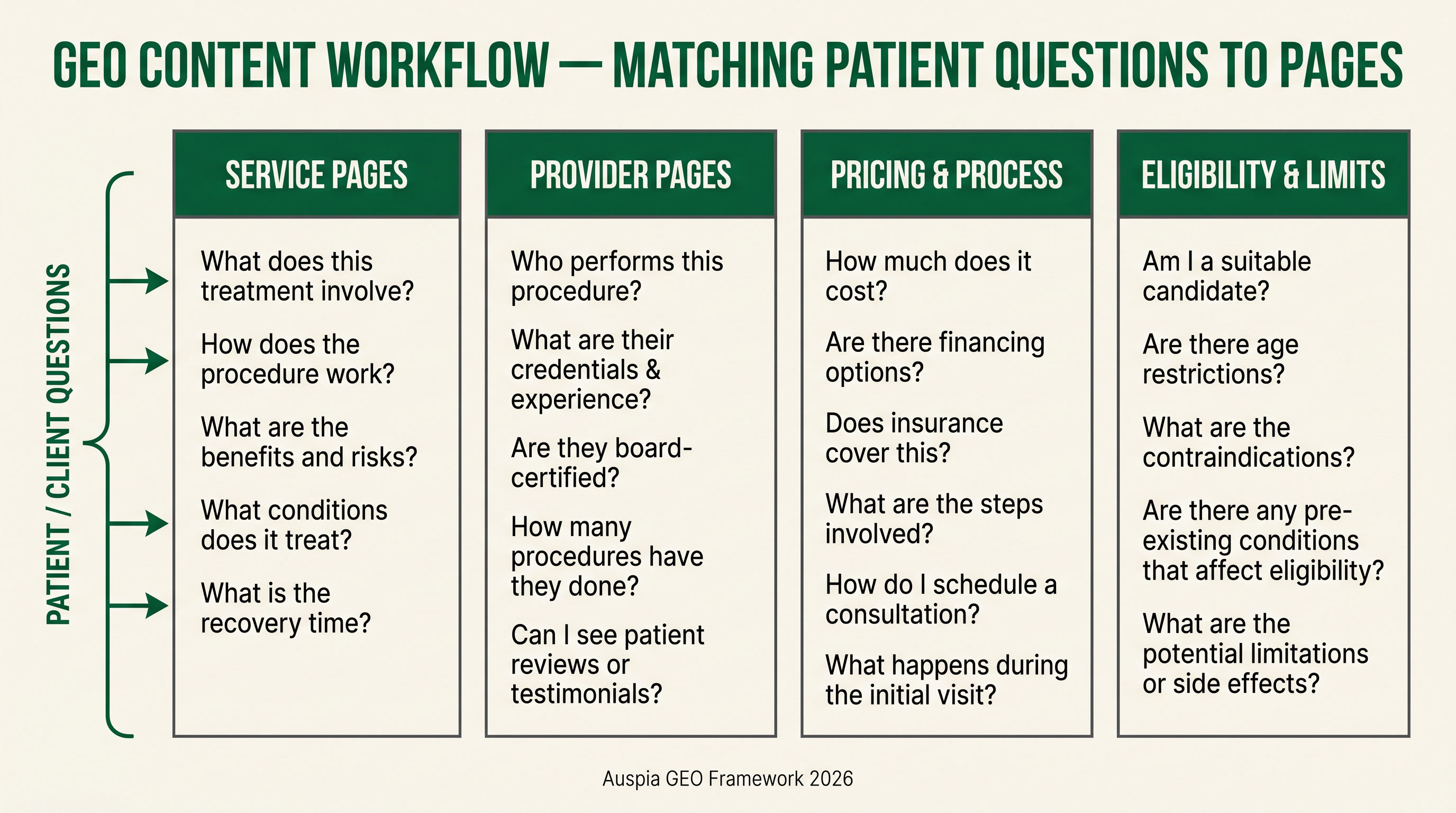
Caption: The first GEO asset for a clinic is a question map, not a content calendar.
Why this matters more in 2026
AI search is no longer a side channel. Gartner predicted in February 2024 that traditional search engine volume would drop by 25% by 2026 as people shift to AI chatbots and virtual agents. Pew Research Center reported in July 2025 that Google users were less likely to click traditional result links when an AI summary appeared. Pew's June 2026 work also shows AI summaries and chatbots have moved into mainstream use. Those findings point in the same direction: more decisions are being shaped before a visitor reaches your website.
For local clinics, that changes the front door.
A prospective patient may ask:
- "Which dermatology clinic near me treats acne scarring and explains pricing clearly?"
- "Can I book a same-week eye exam if I have blurry vision?"
- "What should I expect at a first physical therapy appointment?"
- "Is this dental implant price realistic, and what extra checks are needed?"
- "Which pediatric clinic has weekend availability and vaccine information?"
The clinic may still care about Google rankings. It should. But the discovery path is getting messier. A person can move from AI answer to map pack to review platform to clinic website to insurance directory in one session. If your public facts are thin, inconsistent, or overpromotional, AI systems have little useful material to work with.
This is why the first GEO project should be painfully practical. Before writing more content, find out whether your current public material can answer real patient questions.
What most clinics do first, and why it is the wrong order
A clinic team usually starts with service categories:
- urgent care
- dermatology
- dental implants
- pediatric visits
- physical therapy
- eye exams
- cosmetic procedures
- preventive checkups
Then someone turns those categories into blog ideas. "What is teeth whitening?" "What is acne treatment?" "What is physical therapy?" "What is LASIK?" The list looks productive because it fills a calendar.
But patients rarely ask in clean category labels.
They ask in decision language:
Generic topic | Real pre-booking question |
|---|---|
Dental filling | "Can a filling be done the same day, or will I need another appointment?" |
Dermatology | "Do I need a referral, and what happens during the first acne visit?" |
Physical therapy | "How many sessions might I need before I know if it is helping?" |
Pediatric care | "Can I book on weekends, and which vaccines are available at this location?" |
Eye care | "Do you treat dry eye, or do you only do standard vision exams?" |
Cosmetic treatment | "What results are realistic, and what risks should I know before booking?" |
A blog calendar built from service names misses the messy part of the decision. A question map starts with that messy part.
Build the patient question map
Create a spreadsheet with four columns:
Patient question | Public page that answers it | Answer quality | Fix needed |
|---|---|---|---|
"Do you offer same-day appointments?" | Appointment page | Partial | Add service-specific availability rules |
"Who will treat me?" | Provider profile | Weak | Add specialties, patient types, and credentials you can verify |
"What happens at the first visit?" | Missing | Gap | Create a first-visit process section |
"How much does it cost?" | Pricing page | Partial | Add ranges, variables, insurance notes, and consultation limits |
"Am I a good candidate?" | Service page | Weak | Add eligibility and "must be assessed in person" language |
Do not turn this into a branding exercise. The point is to see where the clinic's public information breaks down.
A useful first map includes at least five question groups.
1. Service-fit questions
These are the questions that decide whether the clinic belongs in the consideration set.
Examples:
- "Do you treat this condition or only diagnose it?"
- "Is this service available for children, adults, or both?"
- "Can the first visit include treatment, or only assessment?"
- "What equipment, tests, or records are needed before treatment?"
- "When should I go to urgent care or emergency care instead?"
The GEO fix is usually a better service page, not another blog post. Add scope, use cases, exclusions, and next steps. If the service depends on assessment, say that plainly.
2. Provider questions
Patients want to know who they are trusting. AI answer systems also need provider-level facts to distinguish one clinic from another.
A thin provider profile says:
"Dr. Lee provides compassionate care for the whole family."
A stronger profile says:
"Dr. Lee sees adult patients for dry eye, contact lens discomfort, and routine vision exams. New patients can book a 30-minute exam. Complex retinal symptoms are referred to a specialist."
That second version gives AI systems usable facts. It also helps patients decide faster.
For each provider page, check whether it answers:
- Which services does this provider actually handle?
- Which patient groups do they see?
- Which cases are referred out?
- What languages, locations, or appointment types are available?
- Which credentials or training can be stated accurately?
Avoid inflated claims. "Best," "leading," and "world-class" are weak unless you can support them with real, current evidence.
3. Price, insurance, and process questions
Local healthcare decisions often stall because pricing and process are vague. Clinics sometimes avoid public details because every case is different. That is understandable. It is also not a reason to say nothing.
A clinic can publish useful boundaries without pretending every patient is the same.
Good public information might include:
- what the first visit includes
- whether imaging, labs, or scans are separate
- which insurance plans are accepted, if applicable
- what must be confirmed before a quote is final
- when a deposit, referral, or pre-authorization is required
- what patients should bring to the appointment
This is not only helpful for conversion. It also reduces the chance that an AI answer invents a clean price or process because your site gave it no structure.
4. Eligibility and safety-limit questions
Clinics operate in sensitive categories. A GEO program that pushes too hard can create risk.
Do not write pages that imply guaranteed outcomes, universal suitability, or easy fixes. Instead, make limits visible:
- "This treatment may not be suitable for patients with..."
- "An in-person exam is required before..."
- "Results vary based on..."
- "Seek urgent care if..."
- "We do not diagnose through website forms or AI chat."
This is especially important for dental, dermatology, aesthetics, fertility, mental health, pediatric, vision, and physical therapy content. GEO for clinics should make the clinic easier to understand, not more aggressive.
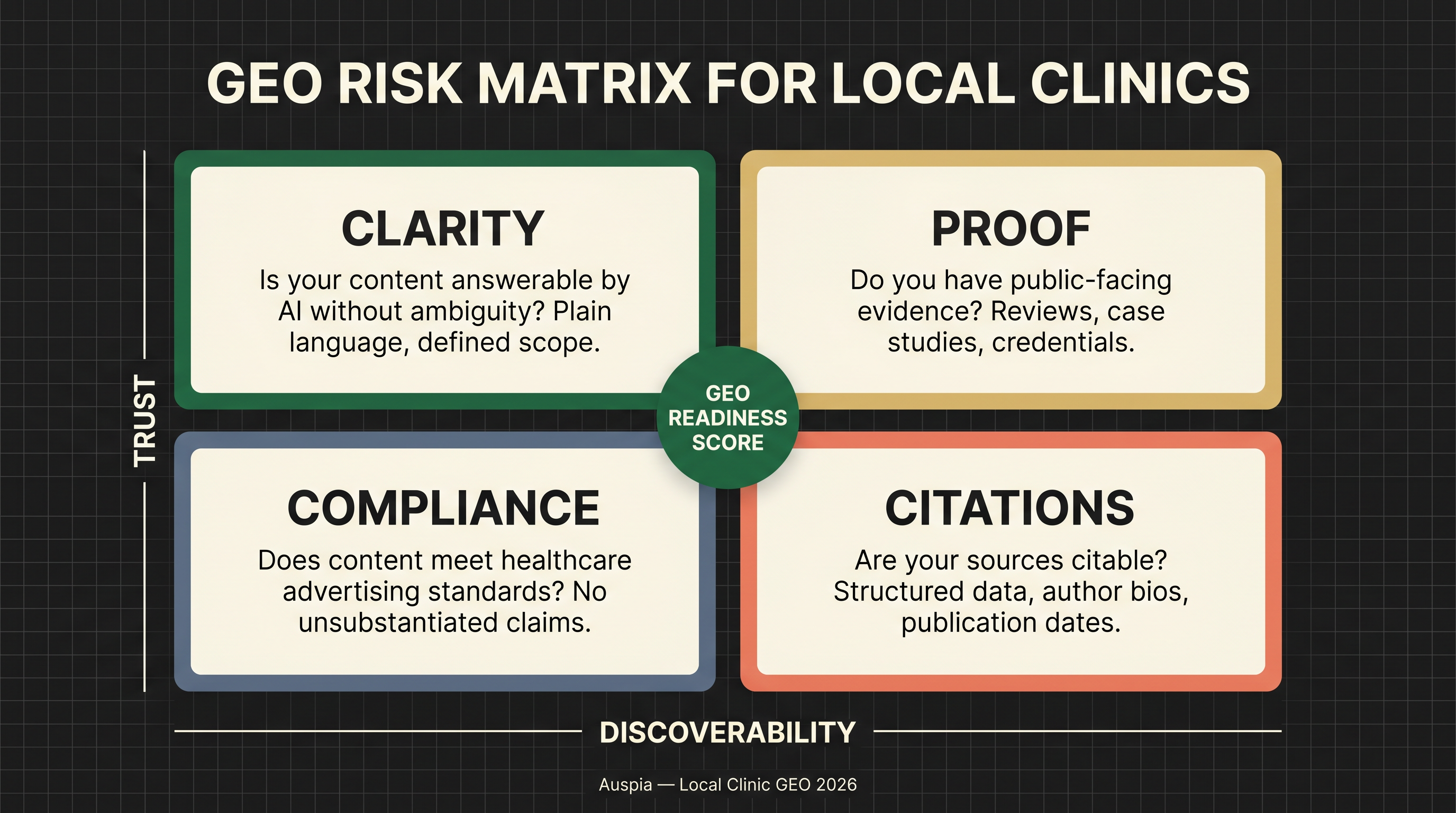
Caption: Clinic GEO readiness depends on clarity and proof as much as content volume.
5. Proof and reputation questions
AI answer systems often lean on third-party evidence when they compare local providers. Your own website matters, but it is not the whole evidence layer.
Map whether your public proof is visible and consistent across:
- Google Business Profile
- healthcare directories or insurance directories
- review platforms relevant to your market
- professional association profiles
- local news or community mentions, if real
- structured provider pages on your own site
- schema markup for organization, local business, physician, dentist, medical clinic, or service pages where appropriate
The rule is simple: the same facts should appear everywhere. Clinic name, address, phone, services, provider names, opening hours, and appointment links should not fight each other across platforms.
The first GEO audit: a 90-minute workflow
You can run a useful first audit without a large project plan.
Step 1: Collect 30 real questions
Pull questions from call logs, appointment emails, live chat, search queries, reviews, sales notes, front desk conversations, and Google Business Profile Q&A. If you do not have clean data, ask the front desk for the questions they answer every week.
Keep the wording close to how people actually ask.
Step 2: Group the questions
Use five buckets:
Bucket | What it tests |
|---|---|
Service fit | Can the patient tell whether the clinic handles this need? |
Provider fit | Can the patient tell who will help them? |
Price and process | Can the patient understand the first step and likely variables? |
Eligibility and limits | Can the patient understand what cannot be promised? |
Proof and trust | Can the patient verify the clinic outside the clinic's own claims? |
Step 3: Search like a patient
For each question, search in Google and ask at least two AI answer systems. Use prompts like:
- "Which clinic near [city] offers [service], and what should I know before booking?"
- "Compare [clinic name] with other local providers for [service]."
- "What does [clinic name] say about first appointments, pricing, and provider qualifications?"
- "Is [clinic name] a good fit for [specific patient situation]?"
Record whether the answer mentions your clinic, whether it gets the facts right, and whether it cites or references a source you control or trust.
If you want a faster baseline, use Auspia's AI Search Visibility Checker to test how your brand appears across answer-style queries, then manually inspect the most important prompts.
Step 4: Score each answer
Use a simple 0 to 2 score.
Score | Meaning |
|---|---|
0 | Public information does not answer the question |
1 | Public information partially answers it, but AI or patients must infer details |
2 | Public information answers it clearly with a page, profile, or verified listing |
Do not overcomplicate this. The score is there to choose the next fixes.
Step 5: Fix pages before publishing more articles
The first fixes usually fall into four page types:
Gap | Better asset |
|---|---|
Service scope is vague | Rewrite service pages with fit, process, limits, and next steps |
Provider info is thin | Expand provider pages with verifiable specialties and patient types |
Pricing is unclear | Add price variables, insurance notes, and consultation requirements |
AI gets facts wrong | Clean up directory listings, schema, GBP, and high-trust third-party profiles |
A content calendar can come later. First, make the clinic's core facts retrievable.
What not to do
Clinic GEO can go wrong quickly when teams chase mentions without thinking about trust.
Avoid these moves:
- publishing generic AI-written medical articles that say nothing about your actual clinic
- claiming outcomes you cannot promise
- inventing awards, rankings, case results, or provider authority
- hiding price variables behind vague "contact us" language when you can explain the range
- stuffing pages with city and service keywords until they read like spam
- copying competitor pages and changing the clinic name
- asking AI tools questions once, seeing one good answer, and calling the project done
The strongest clinic GEO work is boring in the right way. It makes public facts clearer, makes claims safer, and gives AI systems fewer chances to fill gaps with guesses.
A practical 2026 clinic GEO checklist
Use this checklist before you publish another batch of blog posts.
Check | Done? |
|---|---|
We have 30 real patient questions from calls, forms, reviews, search data, or staff input | |
Each priority service page explains who it is for, what happens first, and what cannot be promised | |
Provider pages state verifiable specialties, patient types, locations, and appointment options | |
Pricing or insurance pages explain variables, ranges, and what requires assessment | |
Google Business Profile and major directories match the website's core facts | |
We have tested priority prompts in at least two AI answer systems | |
We know which answers are wrong, missing, or unsupported | |
We have a fix list for pages, listings, schema, and third-party proof | |
Compliance or clinical review is part of the publishing workflow |
Auspia take
The source article that inspired this piece made a useful point for dental clinics: the first GEO asset is a table of real patient questions against public clinic information. That logic travels well beyond dentistry.
For any local clinic or service provider, 2026 GEO starts with answerability. Can a patient ask a specific question and find a specific, safe, verifiable answer in your public materials? Can an AI system repeat that answer without inventing details? Can the clinic prove the same facts outside its own website?
If the answer is no, do not start with more top-of-funnel education. Start by fixing the facts closest to the booking decision.
That is less glamorous than a big GEO campaign. It is also more likely to work.
FAQ
What is GEO for local clinics?
GEO for local clinics is the work of making clinic information clear, consistent, and verifiable so AI answer systems can describe the clinic accurately when people ask service, provider, price, process, and suitability questions.
Is GEO the same as local SEO?
No. Local SEO focuses on visibility in search results, maps, listings, and local pages. GEO overlaps with local SEO, but it also tests how AI answer systems summarize, compare, and cite your clinic across prompts.
Should a clinic publish blog posts for GEO?
Yes, but not first. Fix service pages, provider pages, pricing/process information, listings, and compliance-sensitive claims before scaling educational content.
How many prompts should a clinic test?
Start with 20 to 30 prompts based on real patient questions. Include service-fit, provider-fit, price, process, eligibility, and comparison questions. Track whether answers are accurate, sourced, and useful.
Can clinics use AI-generated medical content?
They can use AI to draft, organize, and review content, but clinical or compliance review is still needed. Do not publish medical claims, outcomes, eligibility guidance, or pricing promises without human review.
Author: Victor Lane, GEO Audit Specialist with 300+ Readiness Reviews at Auspia. Victor writes about practical GEO audits, scorecards, and implementation checks for teams that need cleaner AI visibility without risky claims.