


The short version
In 2026, health and wellness brands should treat GEO as a compliance project before they treat it as a traffic project. AI answer engines are more cautious with health-related content than with ordinary product content. If a page promises outcomes, hides the source of a claim, or floods the web with thin articles, the brand may earn less AI visibility, not more.
The safer play is simple: remove risky health claims, build a source trail that a model can verify, and answer real buyer questions in plain language. That does not make the work slower. It makes the work usable.
Why health GEO is different in 2026
A fitness app, supplement brand, wellness clinic, telehealth provider, or healthy food company does not compete for AI visibility under the same rules as a project management tool. Health content sits close to what Google calls "Your Money or Your Life" territory: content that can affect a person's health, safety, financial stability, or welfare. AI systems also tend to be conservative here because a bad answer can create real harm.
That changes the job of GEO.
For ordinary categories, GEO often starts with semantic coverage: cover the topic, answer the prompt, include facts, and make the page easy to cite. For health and wellness, the first gate is risk. Can the content be trusted? Are the claims specific and supported? Is the brand presenting educational information, or is it quietly making medical promises?
The original mistake many teams make is chasing AI mentions before they have earned eligibility. They publish dozens of articles, add more keywords, and assume volume will create visibility. In health categories, volume can backfire. A large footprint of weak or aggressive claims gives AI systems more reasons to avoid the brand.
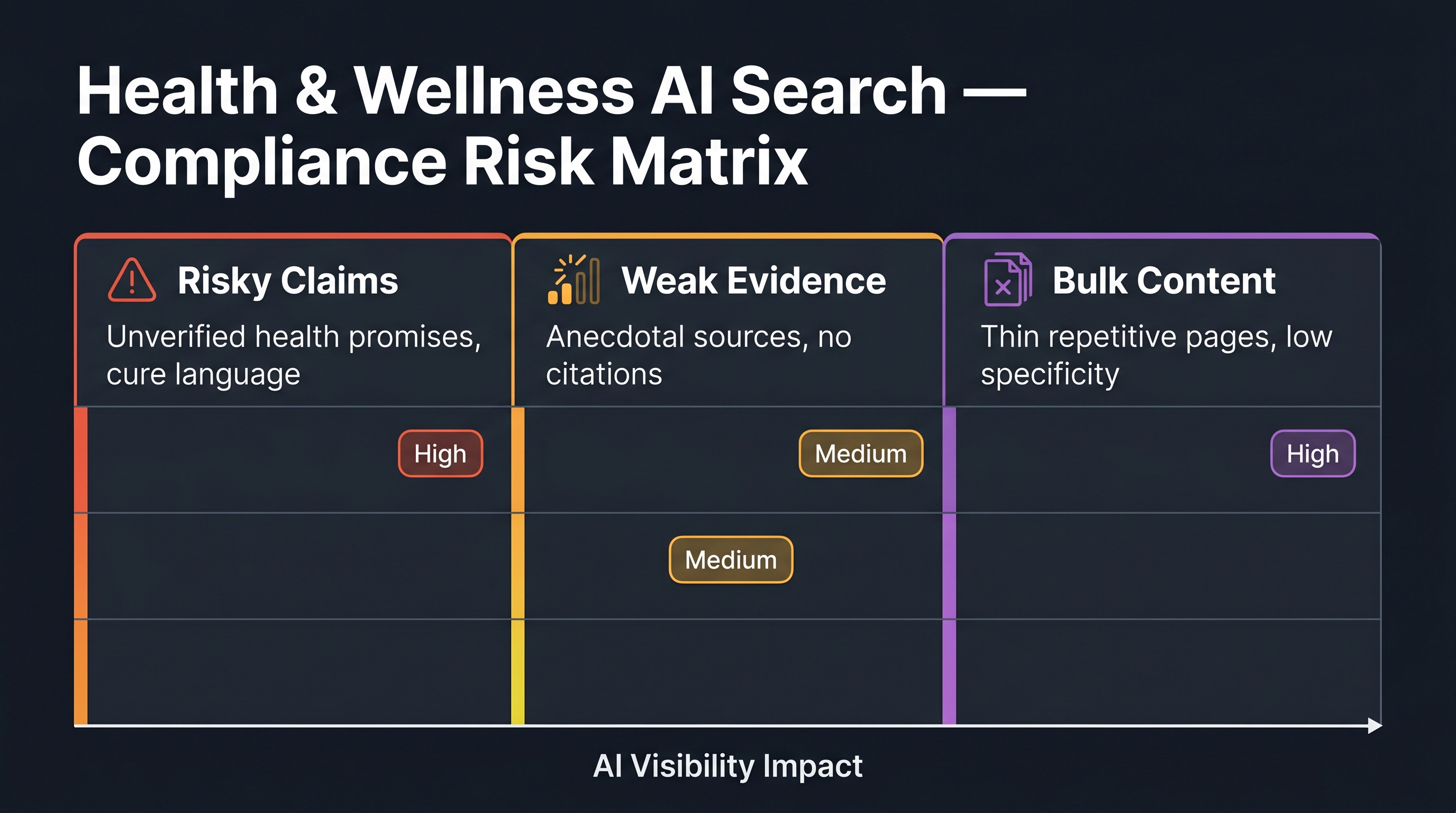
Three high-risk GEO mistakes health brands keep making
1. Turning wellness copy into medical claims
The fastest way to lose trust is to make claims the business cannot support. Phrases such as "cures," "guaranteed results," "clinically proven" without evidence, disease-treatment language for non-drug products, and precise outcome timelines can create regulatory and AI trust problems.
In the United States, the FTC's Health Products Compliance Guidance says health-related advertising claims need competent and reliable scientific evidence. The FDA also distinguishes between allowed structure/function claims for dietary supplements and disease claims, which are treated very differently. The details vary by product category and jurisdiction, so legal review matters.
For GEO, the practical rule is this: if a cautious reviewer would ask, "Can you prove that?" an AI system may hesitate too.
Safer copy does not mean bland copy. It means being precise:
Risky phrasing | Safer direction |
|---|---|
"Cures chronic fatigue" | "Supports daily energy as part of a healthy routine" |
"100% effective in 7 days" | "Customer-reported experience varies; explain what was measured" |
"Prevents disease" | "Provides educational information and links to qualified sources" |
"Doctor recommended" with no detail | "Reviewed by [role] on [date], with review scope stated" |
This is not legal advice. It is an editorial control that keeps GEO work from drifting into claims the brand cannot defend.
2. Publishing from weak sources AI systems do not want to cite
Health AI visibility depends heavily on source quality. A page on an official brand site is useful, but it is not enough by itself when the topic involves ingredients, safety, contraindications, testing, or outcomes.
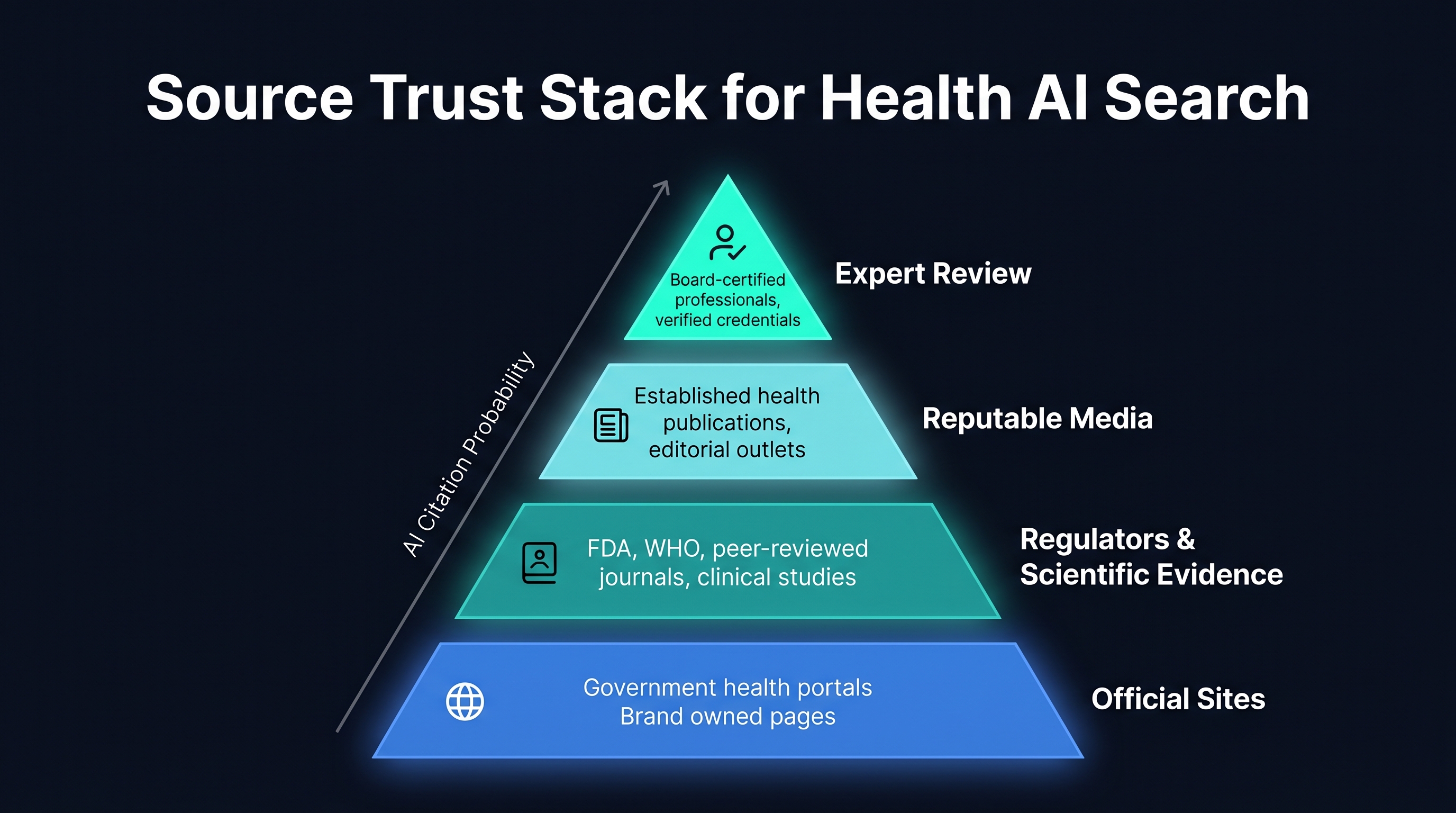
AI answer systems look for corroboration. They prefer content that is consistent across official pages, reputable publications, research sources, regulatory databases, standards bodies, and expert-reviewed materials. A pile of syndicated blog posts on low-quality sites rarely helps. It may even look like manufactured reputation.
A good health GEO source stack usually includes:
- Clear official pages: product facts, ingredient pages, safety notes, manufacturing details, contact information, and review dates.
- Evidence pages: cited studies, methodology notes, limitations, and plain-English summaries of what the evidence does and does not show.
- Third-party context: reputable media coverage, professional association references, public datasets, or standards where relevant.
- Human accountability: named reviewers, credentials where appropriate, and visible update history.
This is where many brands underinvest. They write for users, but forget to write for verification.
3. Using bulk AI content as if more pages means more trust
Bulk content is tempting because AI search still rewards clear answers. The problem is that health content has a higher bar. A hundred lightly edited articles about "best supplements for stress" or "how to improve sleep fast" may create topical noise, not topical authority.
The pattern is easy to spot:
- Repeated paragraphs with different keywords.
- Generic disclaimers added after aggressive claims.
- No source trail behind ingredient or outcome statements.
- FAQ sections that answer search prompts but ignore risk, eligibility, age, medication interactions, or when to consult a professional.
- No visible owner for medical or scientific review.
For health GEO in 2026, fewer pages with better evidence usually beat more pages with shallow coverage. AI systems need clean retrieval candidates. They do not need another thousand words of recycled wellness advice.
A 3-step health GEO compliance workflow for 2026
Step 1: Build a claim map before writing anything
Start by inventorying every claim the brand makes across the website, landing pages, blog posts, paid ads, PDFs, marketplaces, and social bios. Put each claim into one of four buckets:
Claim type | What to check | GEO action |
|---|---|---|
Product fact | Is it objectively true and current? | Keep, but add source and date |
Structure/function | Is it allowed for the product category? | Review language and required disclaimers |
Performance outcome | Is the evidence strong enough? | Add study, sample, limitation, or remove |
Disease claim | Does it imply diagnosis, cure, treatment, or prevention? | Route to legal/regulatory review |
This prevents the usual content problem: the writer starts with a prompt, the reviewer catches problems late, and the team rewrites everything after design and publishing are already done.
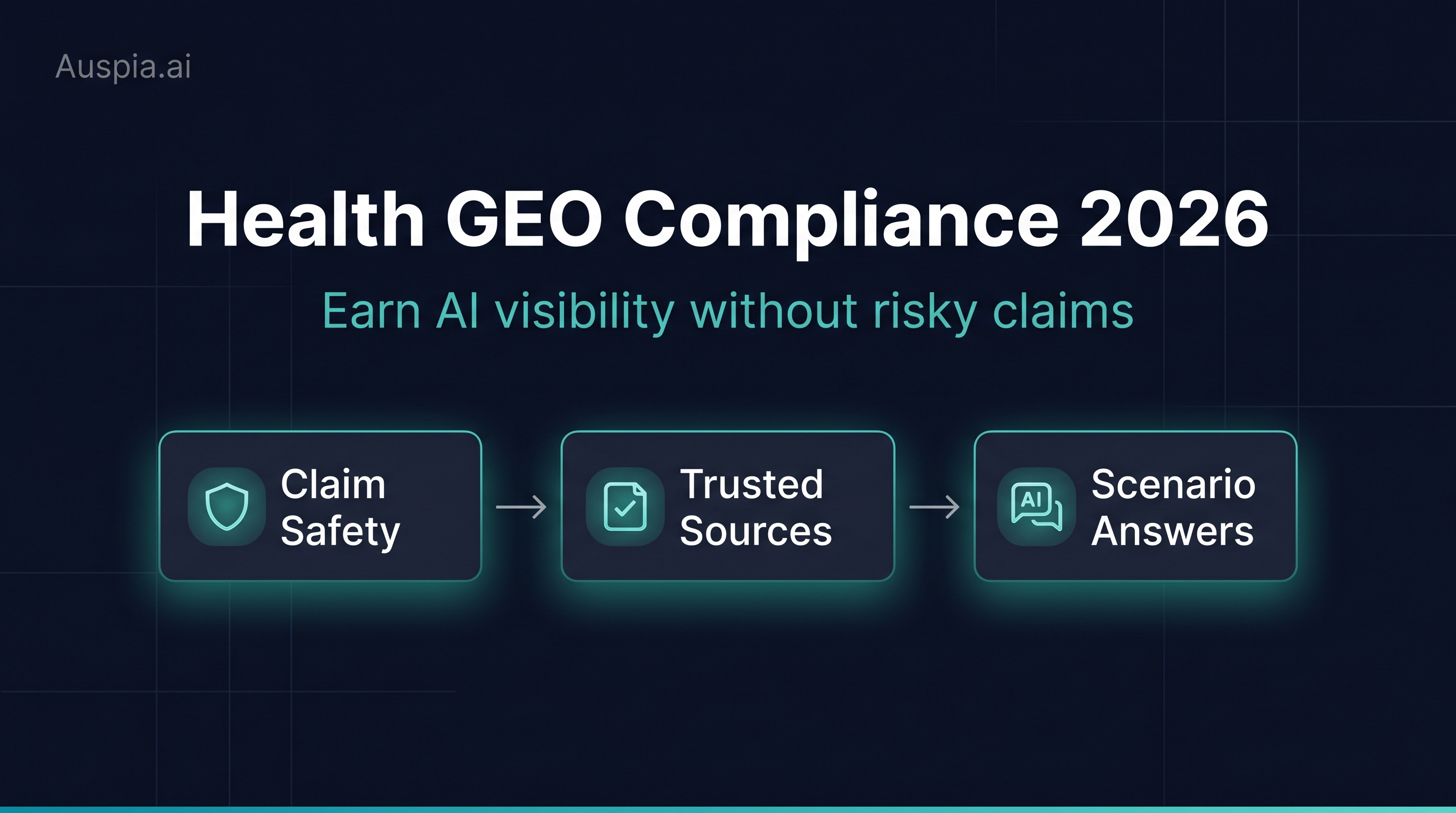
Auspia's preferred workflow is claim-first. Content comes second.
Step 2: Create an AI-readable evidence layer
Do not bury evidence inside PDFs or vague footnotes. Build pages and sections that make source quality obvious.
Useful evidence assets include:
- A product facts page with ingredients, formulation notes, intended use, limitations, and last-reviewed date.
- An evidence summary page that explains which studies support which claims.
- A safety and FAQ page that covers who the product may not be for, without making the page scary or defensive.
- A reviewer note that says what was reviewed: copy accuracy, ingredient claims, scientific references, or regulatory language.
- Schema where appropriate, especially Organization, Product, FAQPage, Article, and author/reviewer fields when they are truthful and maintained.
This helps users. It also gives AI systems stable facts to retrieve. If your brand facts change across your homepage, Amazon listing, press release, and blog, models may choose a safer competitor with cleaner data.
You can use Auspia's AI Search Visibility Checker to spot whether your brand is being mentioned in answer surfaces, then compare those outputs against your approved claim map.
Step 3: Answer real health buyer questions without overreaching
The best health GEO content is not keyword stuffing. It is scenario coverage.
Good prompts to map include:
- "Is [brand] safe?"
- "Who should not use [product type]?"
- "What is the difference between [ingredient A] and [ingredient B]?"
- "What should I ask my doctor before using [category]?"
- "How do I compare [product type] if I care about sleep, stress, energy, skin, digestion, or recovery?"
- "What claims are wellness brands not allowed to make?"
Each answer should be direct, sourced, and careful. A useful format is:
- Direct answer in two or three sentences.
- Who this applies to.
- Evidence or source behind the answer.
- Limitations and when to seek professional advice.
- Related product or educational page, only when relevant.
That structure works well for readers and AI answer extraction because it separates facts, scope, and next action.
A practical compliance checklist before publishing
Before a health or wellness page goes live, ask these questions:
- Does the page avoid disease-treatment language unless the product and review process allow it?
- Can every measurable claim be traced to a source?
- Are absolute promises removed or qualified?
- Is the page clear about who reviewed it and when?
- Are citations close to the claims they support?
- Does the page answer the user's question without pushing a product too early?
- Are old posts, partner pages, marketplace listings, and press releases consistent with the new wording?
- Would the answer still be safe if an AI system summarized it without the surrounding sales context?
The last question matters. AI systems often compress. If the safe context is only in a disclaimer at the bottom, the model may not carry it into the answer.
What most teams miss
The common advice is "make your content more authoritative." That is too vague to be useful.
For health GEO, authority is operational. It comes from the way the team handles claims, sources, review, and updates. A brand that cannot show how a claim was approved will struggle to look trustworthy, even if the copy sounds polished.
The second miss is treating compliance as a final approval step. In 2026, compliance has to shape the content architecture. It decides what pages exist, what evidence is needed, how FAQs are phrased, and which prompts the brand should avoid.
The third miss is assuming AI visibility is always positive. A bad AI mention can be worse than no mention if it amplifies an unsupported claim or attributes risky language to the brand. Measurement should track mention quality, claim accuracy, citation source, and risk level, not just share of answer.
Auspia takeaway
Health and wellness GEO is not about being louder. It is about becoming easier to verify.
If you want a simple operating model for 2026, use this sequence:
- Clean the claims.
- Strengthen the source trail.
- Publish scenario answers.
- Monitor AI answers for accuracy and risk.
- Refresh pages when products, evidence, or regulations change.
That is less glamorous than flooding the web with AI articles. It is also much harder for competitors to copy.
FAQ
Is GEO safe for health and wellness brands?
Yes, if the program starts with claim review, source quality, and careful content scope. It becomes risky when teams chase AI mentions with unsupported health promises or mass-produced articles.
Should health brands use AI-generated content?
They can, but AI drafts need human review. For health topics, review should cover factual accuracy, claims, evidence, regulatory language, and whether the page could be misunderstood when summarized by an AI answer engine.
What is the best first GEO project for a health brand?
Start with a brand facts and claims audit. Then update official product, safety, FAQ, and evidence pages before expanding into broader educational content.
Do citations matter more than keywords for health GEO?
Both matter, but citations and source trust often decide whether health content is eligible for AI answers. Keywords help a model find the topic. Evidence helps it trust the answer.
How often should health GEO content be reviewed?
Review core product, safety, and claims pages whenever evidence, ingredients, regulations, or positioning changes. For active categories, a quarterly review cadence is a reasonable starting point.
Author: Lydia Hart, Brand Entity Strategist for 200+ Entity Audits at Auspia. Lydia writes about brand facts, entity consistency, and trust signals that help AI systems understand companies more accurately.


