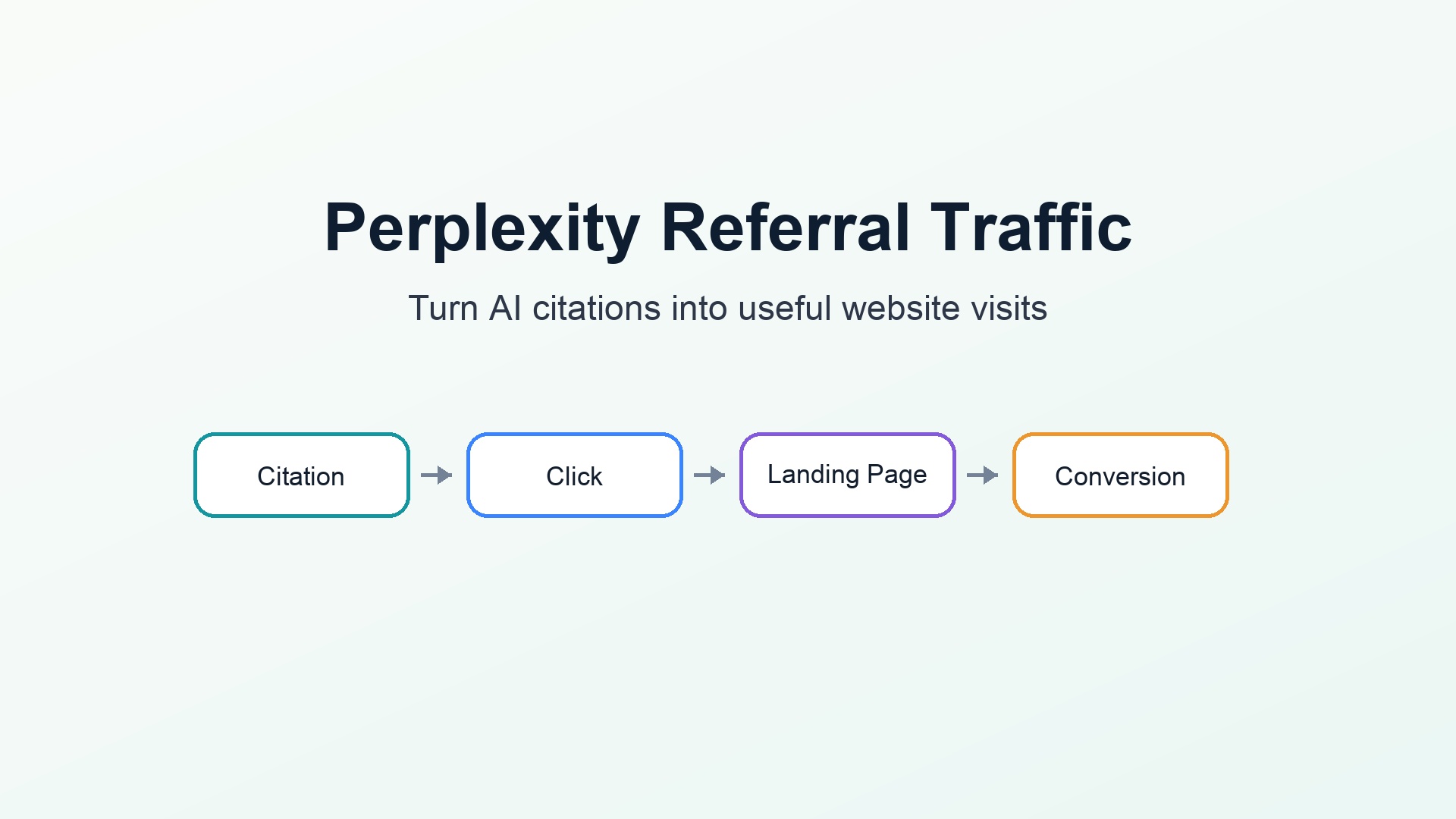
A citation is not the finish line
Getting cited by Perplexity is useful, but it is not the business outcome. The outcome is qualified attention that turns into a visit, a tool run, a signup, a demo request, or a later branded search.
That requires a different question:
If someone clicks this Perplexity citation, what should happen next?
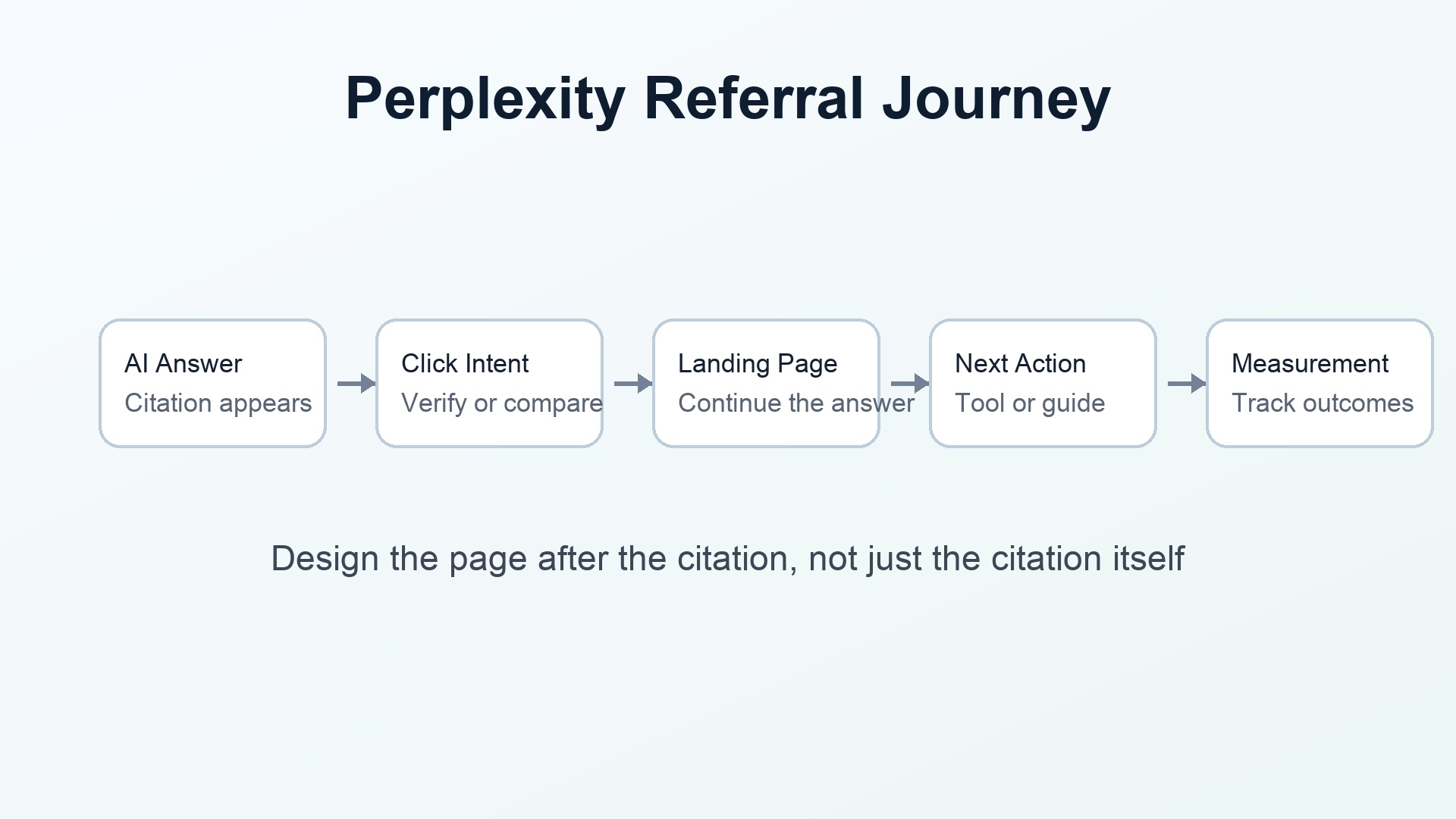
Many teams stop at visibility. They track whether Perplexity mentions the brand or cites a URL, then leave the cited page unchanged. That wastes the moment. Perplexity visitors usually arrive with context. They have already read an AI answer, compared options, or verified a claim. The landing page should continue that journey, not restart it with generic marketing copy.
A useful Perplexity referral strategy connects four pieces:
Piece | What to design |
|---|---|
Citation intent | Why the user clicked the source |
Landing page fit | Whether the page answers the next question |
Conversion path | The tool, checklist, guide, or demo that matches the intent |
Measurement | How you track referrals, engagement, and later assisted behavior |
Why Perplexity referral traffic behaves differently
A Google visitor often clicks because the title and snippet look promising. A Perplexity visitor may click after reading a summarized answer and wanting proof, detail, or a next action.
That difference matters.
Visitor source | Likely behavior |
|---|---|
Google organic | Scans page to see if it matches the query. |
Perplexity citation | Clicks to verify a claim, inspect a source, compare details, or use a recommended tool. |
Branded search | Checks credibility after seeing the brand elsewhere. |
Direct visit | May be returning after previous research. |
Perplexity traffic may be smaller than Google traffic. It can still be high intent when the prompt is tied to evaluation, technical implementation, or vendor selection.
The landing page needs to respect that intent.
Map citation intent before changing CTAs
Start by mapping why the page might be cited.
Citation intent | User is probably thinking | Best landing page response |
|---|---|---|
Verify a definition | "Is this explanation accurate?" | Show the direct answer, sources, and related terms. |
Compare options | "Which vendor or method fits my case?" | Show criteria, comparison table, and decision guidance. |
Solve a technical issue | "How do I implement this?" | Show steps, examples, tool, and troubleshooting. |
Check a claim | "Can I trust this data or recommendation?" | Show evidence, methodology, dates, and source links. |
Continue evaluation | "Should I try this product?" | Show use cases, proof, pricing path, and low-friction CTA. |
Do not use the same CTA for every cited page. A technical prompt needs a checker or implementation guide. A comparison prompt needs criteria and next-step evaluation. A measurement prompt needs a dashboard template or visibility tool.
Build cited pages for continuation
A cited page should feel like the next page in the user's research, not a cold landing page.
Add these elements:
Page element | Why it helps Perplexity visitors |
|---|---|
Direct answer recap | Confirms the claim they clicked to verify. |
Source/evidence section | Shows why the page was worth citing. |
Jump links | Lets the visitor skip to implementation, comparison, or tool sections. |
Contextual CTA | Matches the prompt that likely produced the citation. |
Related guide | Keeps educational visitors moving through the cluster. |
Tool or checklist | Gives researchers something useful before a sales ask. |
Product path | Helps high-intent visitors move toward signup or demo. |
For example, a page cited for "how to check AI crawler access" should not only explain crawler theory. It should offer a crawler checker, robots.txt examples, WAF notes, and a next guide for fixing blocked pages.
CTA mapping for Perplexity traffic
Use this matrix to choose the next step.
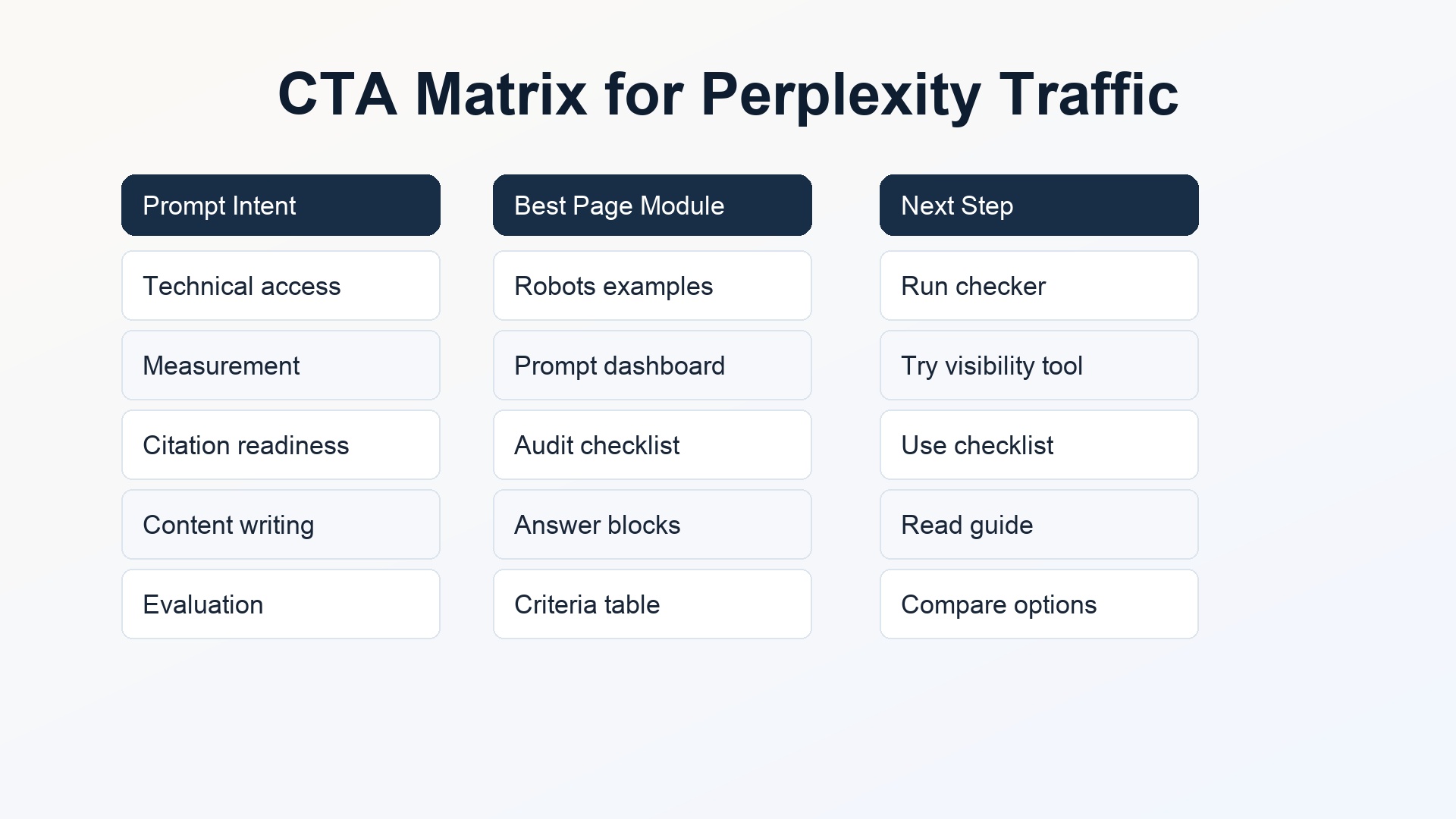
Prompt intent | Page module | CTA |
|---|---|---|
Technical access | Robots.txt examples, WAF checks, log review | Run the Robots.txt AI Crawler Checker |
AI visibility measurement | Prompt library, mention tracking, citation dashboard | Try the AI Search Visibility Checker |
Citation readiness | Audit checklist, source structure, evidence map | Use the Perplexity SEO Audit Checklist |
Content writing | Answer block, fact table, before/after rewrite | Read the Perplexity-ready content guide |
Brand entity | Brand fact sheet, profile cleanup, schema notes | Build a brand entity cleanup list |
Vendor evaluation | Comparison criteria, use cases, proof points | Compare tools or request an audit |
A CTA can be useful without being aggressive. Perplexity users are often in research mode. Give them a practical next step before asking for a meeting.
Measure the whole referral path
Perplexity referral traffic can be hard to attribute perfectly. That does not mean you should ignore it.
Track three layers:
Layer | Metrics |
|---|---|
AI answer visibility | Brand mention, cited URL, citation position, claim accuracy, competitor presence |
Referral session | Source, landing page, engagement time, scroll, next page path, tool click |
Assisted outcome | Branded search lift, return visits, signup, demo, assisted conversion notes |
Analytics tools may show Perplexity referrals directly. They may also miss part of the journey if users search your brand later or return from a different device. Treat the report as a mix of direct evidence and careful interpretation.
Do not say "Perplexity caused all branded search growth." Say "Perplexity visibility increased in these prompt groups during the same period that branded search and direct visits rose." That is more honest and more useful.
Landing page fixes by traffic pattern
Use behavior data to decide what to fix.
Pattern | What it may mean | Fix |
|---|---|---|
Perplexity referrals bounce quickly | The page does not match the citation intent. | Move the direct answer higher and add jump links. |
Visitors read but do not click | The content is useful but the next step is weak. | Add a contextual tool, checklist, or related guide. |
Tool clicks happen but no signup | The tool path may need clearer output or follow-up. | Add result explanation, email capture, or next diagnostic. |
Blog pages get traffic but product pages do not | Internal path is too soft. | Add relevant product modules and comparison links. |
Branded search rises but referrals stay flat | Users may be discovering you without clicking citations. | Track prompt mentions and branded journeys together. |
Competitors get cited for buyer prompts | Your evidence or comparison pages are weak. | Build comparison criteria, proof assets, and third-party profiles. |
The fix should match the pattern. Do not add a demo CTA to every page and call it optimization.
Design a Perplexity-to-site journey
Here is a simple journey for an AI search visibility tool:
Step | Example |
|---|---|
Prompt | "How can I check whether my brand appears in AI search answers?" |
Perplexity answer | Mentions prompt tracking, brand mentions, citations, and visibility tools. |
Citation click | User lands on an Auspia guide or tool page. |
Page confirmation | The first section explains AI search visibility measurement clearly. |
Useful action | User runs an AI Search Visibility Checker or downloads a prompt template. |
Product path | Tool result suggests a deeper audit, demo, or related guide. |
Measurement | Track source, landing page, tool run, next page, return visit, and conversion. |
That journey is stronger than "AI answer -> blog post -> generic footer CTA."
Before optimizing the referral path, make sure the source page can earn the citation. Start with How to get cited by Perplexity, then use How to measure Perplexity SEO to track the result.
Internal links that support Perplexity traffic
The cluster should help visitors keep moving.
Use one or two relevant links per page:
If the visitor needs... | Link to... |
|---|---|
Big-picture framework | Perplexity SEO hub |
Citation repair | How to get cited by Perplexity |
Technical access | PerplexityBot SEO guide |
Content structure | Perplexity-ready content guide |
Measurement | Measure Perplexity SEO |
Audit template | Perplexity SEO audit checklist |
Entity cleanup | Brand entity signals guide |
Do not overload every page with every link. Match the link to the next likely question.
14-day referral optimization sprint
Use this sprint after a page starts getting Perplexity mentions or citations.
Day range | Work | Output |
|---|---|---|
Days 1-2 | Identify cited pages and prompt groups | Citation and intent map |
Days 3-4 | Review landing page fit | Mismatch notes and missing sections |
Days 5-7 | Add contextual CTAs and internal links | Updated page modules |
Days 8-9 | Improve evidence and source sections | Better verification path |
Days 10-11 | Set analytics events | Tool clicks, CTA clicks, scroll, next page path |
Days 12-14 | Recheck prompts and behavior | Referral report and next fixes |
This sprint works best after the measurement system is already in place. If you have not built a prompt library yet, start with measurement first.
FAQ
What is Perplexity referral traffic?
Perplexity referral traffic is website traffic that arrives after a user clicks a source or citation from Perplexity. It may come from cited pages, answer sources, or follow-up research journeys influenced by Perplexity.
Is Perplexity traffic usually high intent?
It can be high intent when prompts involve comparison, technical implementation, vendor evaluation, or claim verification. It may be lower intent for broad educational prompts. Measure by prompt group and landing page, not only by total sessions.
How do I increase clicks from Perplexity citations?
Improve source relevance, page titles, direct answer sections, evidence quality, and page usefulness. Then make the cited page worth visiting with examples, tools, templates, data, or implementation steps.
What should a Perplexity visitor see first?
They should quickly see the answer or evidence they clicked to verify. Start with a clear answer, source context, and jump links to the next useful section.
How do I track Perplexity conversions?
Track referrals, landing pages, tool usage, CTA clicks, signup or demo events, assisted conversions, return visits, and branded search movement. Keep direct evidence separate from interpretation.
Should every cited page have a product CTA?
No. Match the CTA to the intent. Some visitors need a checklist, technical guide, or tool before they are ready for a demo.
Sources
- Perplexity Help Center: How does Perplexity work?
- Perplexity Docs: Perplexity crawlers
- Perplexity Docs: API overview
Auspia takeaway
Perplexity citations are a starting point, not the finish line.
The real work is designing what happens after the citation click: confirm the answer, show useful evidence, offer a next step, and measure whether the visitor moves deeper into the journey.
A brand can win visibility and still waste the traffic. Do not stop at being cited. Build the path after the citation.
Author: Leah Foster, Conversion SEO Strategist for 400+ Landing Pages at Auspia. Leah writes about landing pages, conversion paths, content-to-demo journeys, and turning AI search visibility into useful website visits.