


The short answer
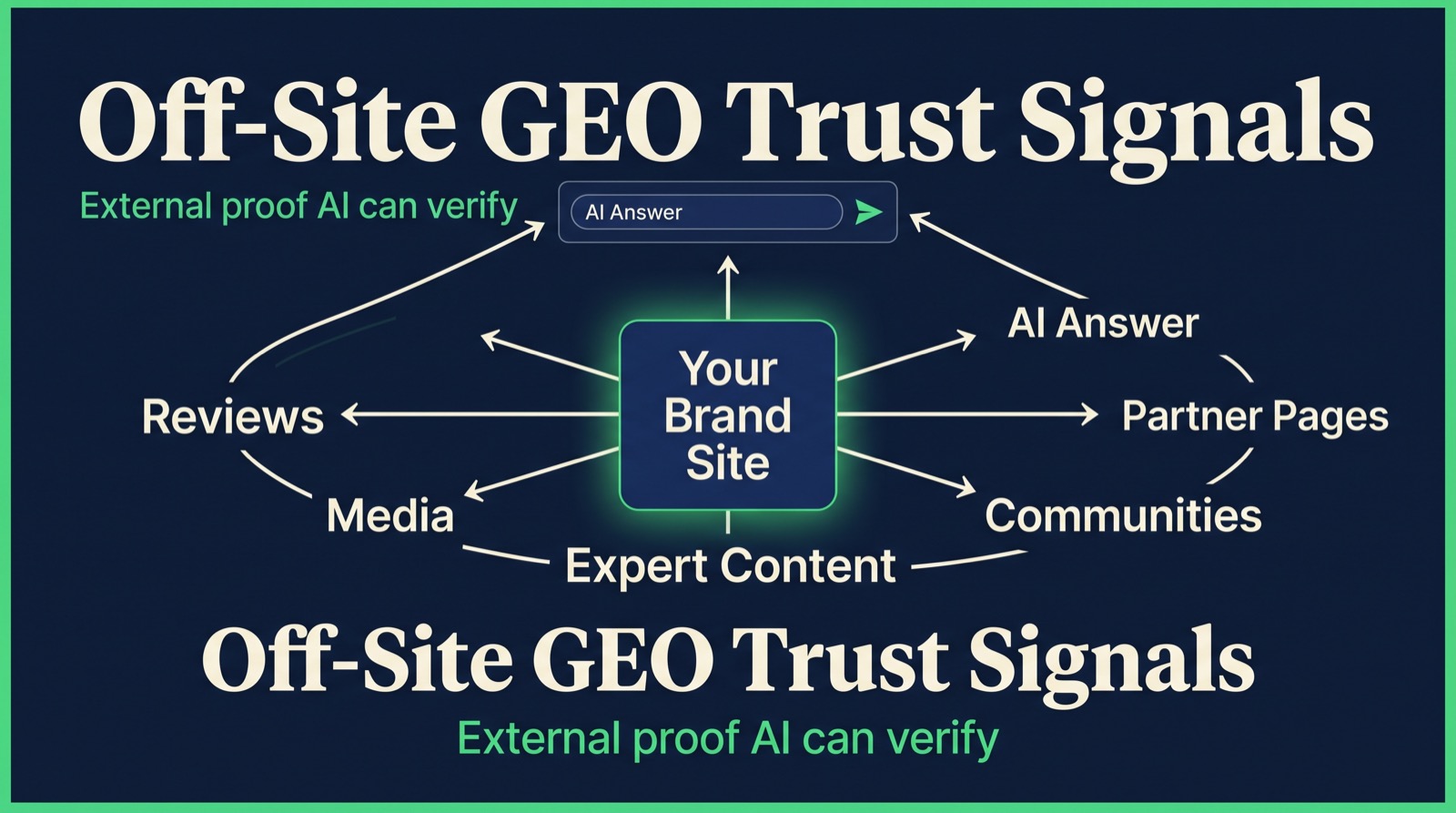
Off-site GEO optimization means building credible external proof around your brand so AI answer systems do not have to rely only on your website. Your site can explain who you are. Off-site signals help confirm that other trusted sources, communities, customers, reviewers, partners, and databases describe you in a consistent way.
The practical goal is simple: when an AI system checks the web for a product, service, company, or category answer, it should find the same facts about you across more than one believable place.
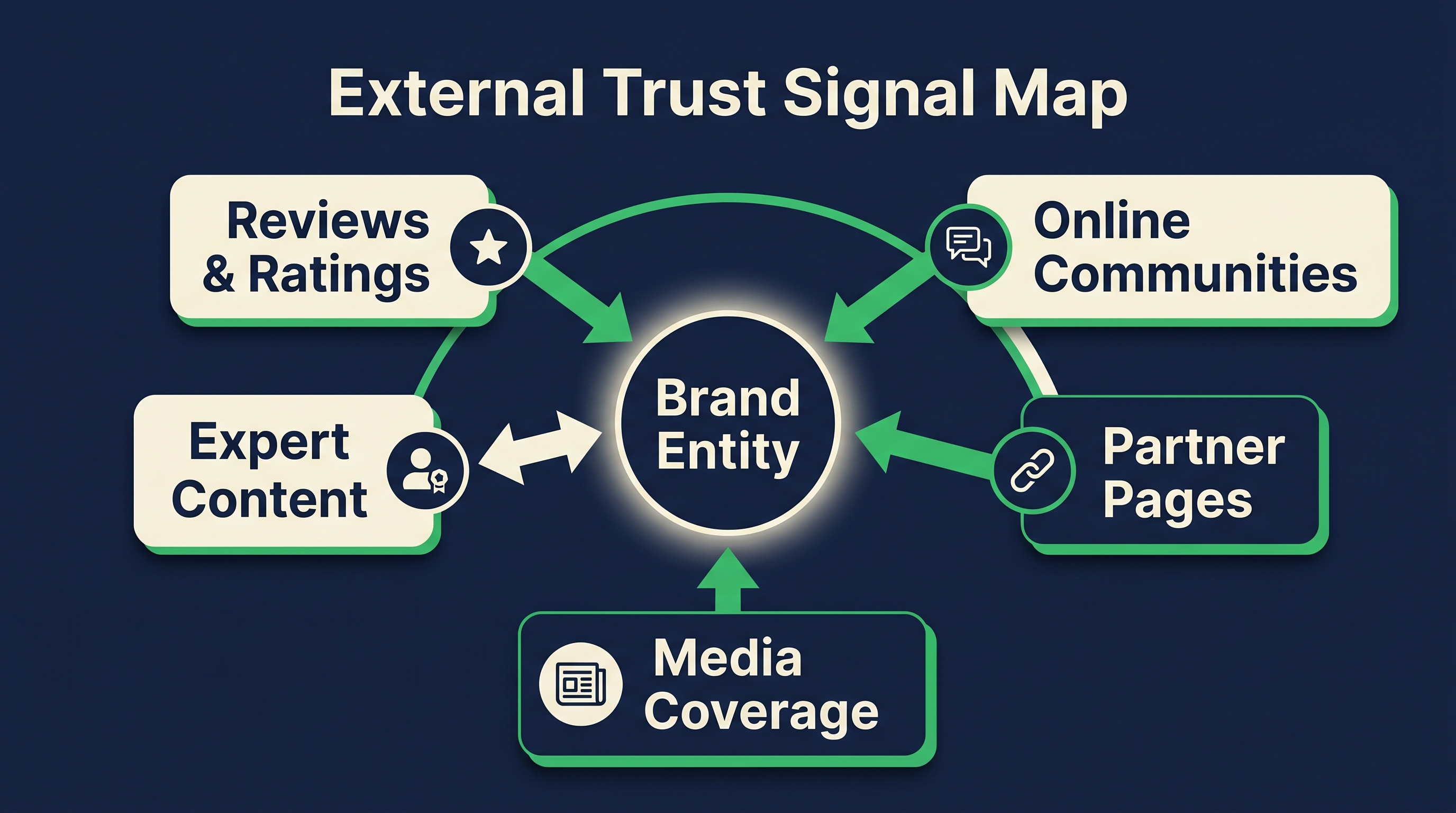
That does not mean spraying press releases across low-quality sites. It means earning and organizing proof where buyers and retrieval systems already look: industry publications, review platforms, partner pages, comparison articles, podcasts, public datasets, communities, Q&A pages, and expert-led resources.
Why off-site GEO matters
A useful website is still the base layer of GEO. If your homepage, service pages, product pages, About page, and FAQ pages cannot explain what you do, off-site work will only amplify confusion.
But in competitive markets, your website alone often is not enough. AI systems are designed to synthesize answers from multiple sources. They may see your own claims as useful, but they will look for corroboration before recommending or citing you in decision-heavy prompts such as:
- "Which tools help B2B teams track AI search visibility?"
- "What are the best alternatives to [competitor] for a mid-market SaaS team?"
- "Which agency is credible for GEO strategy in the United States?"
- "Is [brand] known for enterprise SEO, GEO, or content automation?"
For a human buyer, external proof reduces risk. For an AI system, it reduces ambiguity. Both are trying to answer the same question: "Can I trust this source enough to mention it?"
Auspia's view: off-site GEO is not reputation theater. It is evidence architecture. The job is to make your brand easier to verify from outside your own domain.
On-site GEO vs off-site GEO
Most teams start GEO by rewriting pages. That is usually correct. The mistake is stopping there.
Layer | What it proves | Typical assets | Risk if missing |
|---|---|---|---|
On-site GEO | The brand can explain itself clearly | Homepage, product pages, service pages, FAQ, docs, schema, comparison pages | AI may misunderstand your category, audience, or differentiator |
Off-site GEO | The market can confirm the brand's claims | Reviews, partner pages, media mentions, expert articles, community discussions, directories, podcasts | AI may see your claims as unsupported or less trustworthy than competitors |
Measurement | The signals are working in real answer surfaces | Prompt checks, citation tracking, share-of-answer reports, referral quality | Teams keep publishing without knowing what moved visibility |
A strong GEO program needs all three. On-site pages create the primary statement. Off-site signals create corroboration. Measurement tells you where the answer system still misunderstands you.
What counts as an external trust signal?
A trust signal is not just a backlink. For GEO, the quality of the context matters as much as the link itself.
Good off-site signals usually have five traits:
- They appear in a context that buyers or practitioners actually trust.
- They describe your brand, product, category, use case, or differentiation in plain language.
- They are consistent with what your own website says.
- They include enough detail for an AI system to extract a useful fact.
- They are findable: crawlable, indexed, or accessible through platforms that AI systems commonly use or cite.
Here are the most useful categories.
Signal type | Best for | What to improve |
|---|---|---|
Review platforms | SaaS, tools, agencies, service businesses | Category labels, customer segments, use cases, review freshness |
Industry media | B2B services, software, professional firms | Expert quotes, product context, market positioning |
Community discussions | Developer tools, SaaS, consumer products, niche categories | Honest use cases, comparisons, limitations, real language |
Partner and integration pages | Platforms, marketplaces, service ecosystems | Entity relationship clarity and solution fit |
Comparison and alternatives pages | High-intent buyer prompts | Differentiators, boundaries, who should choose what |
Podcasts, webinars, and transcripts | Founder-led or expert-led brands | Named expertise, repeatable category language, quotable explanations |
Public profiles and databases | Local, B2B, technical, regulated, or entity-heavy brands | NAP consistency, brand facts, product taxonomy, credentials where relevant |
The stronger signal is rarely the one with the highest domain metric. It is the one that explains your brand accurately in a place the buyer would trust.
Build the off-site GEO system in 7 steps
Step 1: freeze your canonical brand facts
Before you ask anyone else to describe you, decide what description you want repeated.
Create a one-page brand fact sheet with:
- official brand name and common short name
- category and subcategory
- primary audience
- core product or service description
- strongest use cases
- locations or markets served
- competitors and alternatives, where useful
- proof points you can defend
- claims you do not want others to make
This sounds basic. It is not. Many GEO problems start because the website says one thing, founders say another thing on podcasts, directories place the company in the wrong category, and old guest posts use outdated positioning.
AI systems are bad at resolving messy brand identities. Give them less mess.
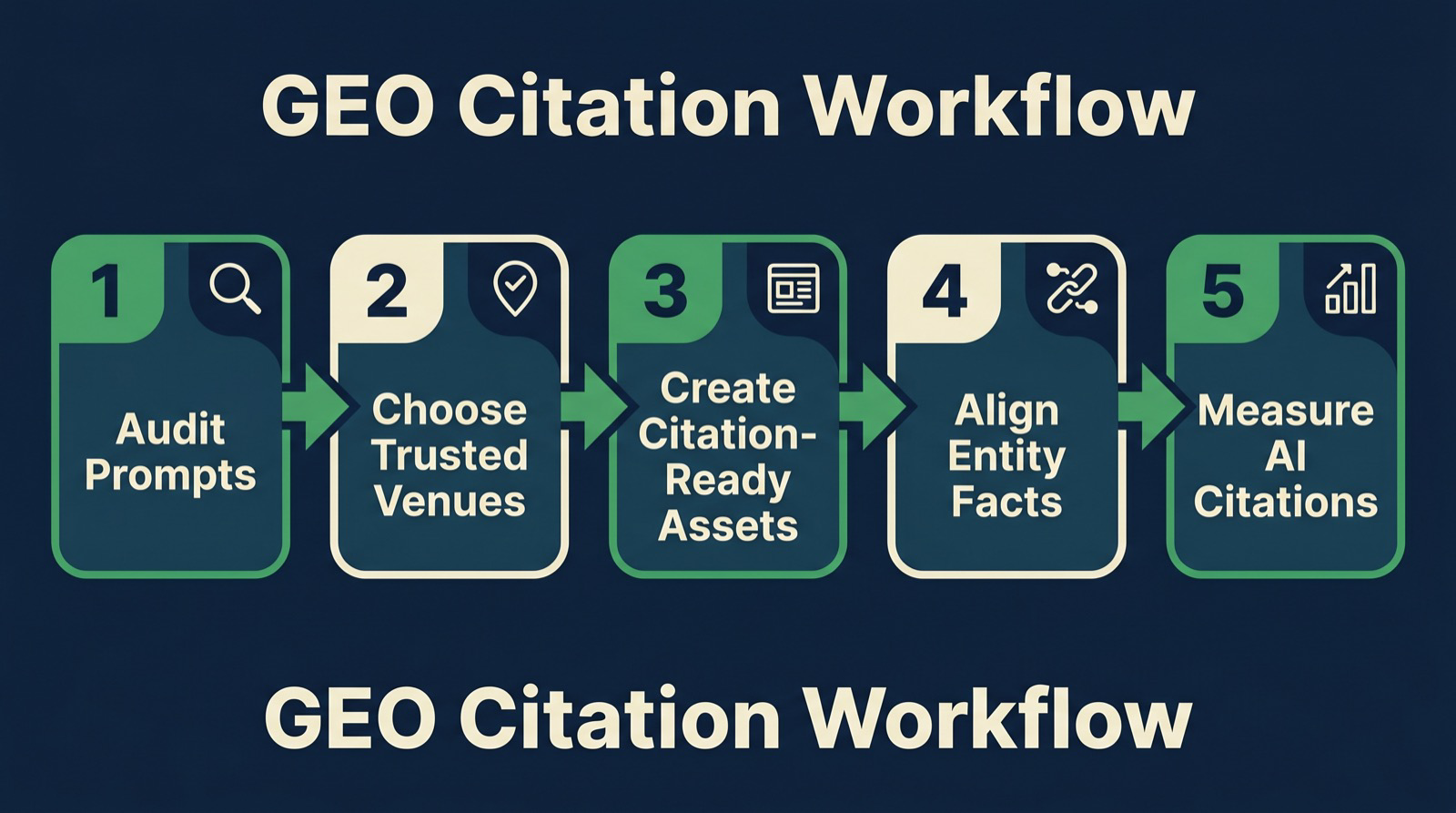
Step 2: audit the external answer surface
Run the prompts your buyers would use in ChatGPT, Perplexity, Gemini, Google AI Overviews, and traditional search. Track four things:
- whether your brand appears
- how the system describes you
- which competitors appear instead
- which external sources seem to support the answer
Do not only test branded prompts. Test category, comparison, problem, and buying prompts.
For example:
- "best GEO tools for SaaS companies"
- "Auspia alternatives for AI search visibility tracking"
- "how to audit AI citations for a B2B website"
- "which tools check whether a site is ready for AI crawlers"
If your brand appears but the description is wrong, prioritize entity consistency. If competitors appear with third-party citations and you do not, prioritize external proof. If no one is cited clearly, build the clearest answer asset in your category and then distribute evidence around it.
Auspia's AI Search Visibility Checker can help teams turn this from an occasional manual check into a repeatable visibility review.
Step 3: choose trust venues by buyer behavior, not vanity metrics
A common off-site mistake is chasing any site that will publish a mention. That creates noise.
Start with the places your buyers already use to reduce risk:
- SaaS buyers: G2, Capterra, Product Hunt, integration marketplaces, comparison blogs, analyst-style roundups
- developer audiences: GitHub, technical docs, Stack Overflow-style Q&A, dev communities, changelog sites, independent tutorials
- local service businesses: Google Business Profile, local directories, association pages, local news, niche review sites
- ecommerce brands: YouTube reviews, Reddit, marketplace reviews, creator comparisons, buying guides
- professional services: partner directories, guest expert articles, podcast transcripts, conference pages, case-study collaborations
Reddit, for example, can be useful when the discussion is authentic and specific. It is not useful when teams drop promotional posts into unrelated threads. Community signals work because they contain buyer language, objections, and comparisons. If you remove the honesty, you remove the value.
Step 4: create citation-ready external assets
A citation-ready asset is easy to quote, summarize, and verify. It usually has a clear title, a direct answer, named entities, specific examples, and a stable URL.
Good candidates include:
- expert guest articles that answer a real buyer question
- partner pages that explain the relationship and use case
- public case studies with realistic constraints and outcomes
- integration listings with clear product categories
- comparison pages written with fair limitations
- podcast pages with transcripts and summary bullets
- original benchmarks or surveys that others can reference
Avoid vague thought leadership. "The future of AI search is changing" gives an AI system almost nothing to cite. "We reviewed 500 AI answers across 40 B2B software prompts and found that third-party review pages appeared in 31% of cited sources" is much more useful, if you have the data to support it.
Step 5: make external descriptions consistent
Consistency is not sameness. You do not need every mention to use identical wording. You do need the same facts to survive across channels.
Check these fields across external profiles and articles:
- brand name spelling
- product category
- target audience
- website URL
- headquarters or service area, if relevant
- founder or team names, if public and useful
- product features
- use cases
- pricing claims
- compliance or security claims
Outdated directory profiles are a quiet GEO problem. So are old guest posts, abandoned marketplace descriptions, and partner pages that describe your product with last year's positioning.
When those pages stay online, AI systems may treat them as current evidence. Clean them up or ask for updates.
Step 6: connect off-site proof back to owned pages
External proof works better when it supports a clear owned destination.
If a third-party article says your tool helps with AI citation tracking, your site should have a page that explains AI citation tracking clearly. If a review says your product is strong for B2B content teams, your product page should say who it is for and what workflow it supports. If a podcast introduces your founder as an expert in GEO audits, your site should have a GEO audit resource that confirms the methodology.
This is where internal linking still matters. Link your owned resources naturally from your own pages, and when appropriate, ask partners or publications to link to the most relevant page rather than always linking to the homepage.
For GEO-specific foundations, Auspia's GEO resources are a good place to build from before expanding off-site.
Step 7: measure mention quality, not just mention count
Off-site GEO should be measured like a signal system, not a PR activity.
Track these metrics monthly:
Metric | What it tells you |
|---|---|
Brand mention rate in AI answers | Whether the brand is entering relevant answer sets |
Description accuracy | Whether AI understands the category, audience, and offer |
Citation frequency | Whether external or owned pages are being used as sources |
Citation quality | Whether cited pages are accurate, current, and useful |
Competitor co-mentions | Which brands AI groups you with |
Referral quality | Whether AI/search visitors behave like real prospects |
External profile consistency | Whether third-party descriptions still match the canonical fact sheet |
The best early win is often not "more mentions." It is a more accurate description. If AI systems stop calling you the wrong type of company, later citation gains become easier to interpret.
A 30-day off-site GEO plan
Use this if you need a practical starting point.
Week | Focus | Output |
|---|---|---|
Week 1 | External visibility audit | Prompt list, competitor mentions, wrong descriptions, source map |
Week 2 | Entity cleanup | Updated brand fact sheet, corrected profiles, priority partner pages |
Week 3 | Proof asset creation | 2-3 citation-ready guest posts, partner listings, review requests, or comparison assets |
Week 4 | Measurement loop | Repeat prompt checks, document description changes, prioritize next venues |
Keep the scope small. Ten good external signals that repeat the right facts beat 100 thin mentions that create confusion.
Common mistakes
Treating off-site GEO as link building with a new name
Links still matter, but GEO asks a broader question: can an AI system understand and verify why your brand belongs in the answer? A bare backlink in a generic article rarely does that.
Publishing external content before fixing the website
If your own site is unclear, off-site work spreads unclear information faster. Fix your primary pages first.
Using inconsistent category language
A brand cannot be "AI SEO software," "content automation agency," "GEO platform," and "marketing workflow tool" everywhere without explaining the relationship. Choose the category hierarchy and repeat it.
Over-controlling community conversations
Communities do not work like ads. Useful off-site GEO often includes criticism, tradeoffs, and alternatives. That texture is part of why community content can be credible.
Measuring only backlinks or domain authority
A high-authority mention that misclassifies your product can hurt understanding. A niche page with the right audience and accurate detail may be more useful for AI retrieval.
Off-site GEO checklist
Use this before you invest in more external content.
- Your website has a clear homepage, product/service page, About page, FAQ, and decision-stage content.
- You have a canonical brand fact sheet that the team uses when writing bios, profiles, and partner descriptions.
- You know which prompts matter for awareness, comparison, and buying decisions.
- You have mapped which competitors appear in AI answers and which sources support them.
- Your key external profiles use the same category, description, website URL, and audience language.
- You have at least a few third-party pages that explain what you do in specific, citation-ready language.
- You monitor whether AI systems describe you more accurately over time.
FAQ
Is off-site GEO the same as digital PR?
No. Digital PR can support off-site GEO, but the goals are different. PR often focuses on exposure. Off-site GEO focuses on verifiable external evidence that helps AI systems understand and trust a brand in specific answer contexts.
Do backlinks still matter for GEO?
Yes, but they are not the whole story. A link inside a detailed, relevant, trusted page is more useful than a link in a vague article. For GEO, the surrounding explanation, entity clarity, and source quality matter a lot.
Should a new brand start with off-site GEO?
Usually not. Start with on-site clarity first: homepage, product or service pages, About page, FAQ, and a few decision-stage articles. Once your owned pages are clear, use off-site work to add proof.
Which off-site platforms matter most?
It depends on your market. SaaS companies often need review sites, integration marketplaces, comparison pages, and practitioner communities. Local businesses need local profiles, review platforms, association pages, and regional mentions. B2B service firms usually need expert content, partner references, case studies, and niche industry media.
How long does off-site GEO take to show results?
Expect to measure early signals over weeks, not days. Look first for better description accuracy and more relevant co-mentions. Citation frequency and qualified referral traffic usually take longer.
Can Auspia help measure off-site GEO visibility?
Auspia can help teams audit AI search visibility, track prompt-level mentions, and identify where external trust signals are weak. Start with a small prompt set and expand once you know which buyer questions matter.
Author: Isabel Grant, Researcher of 2,000+ AI Citation Patterns at Auspia. Isabel writes about citation earning, source quality, and how brands become easier for AI answer systems to verify.


