Recommendation at a glance
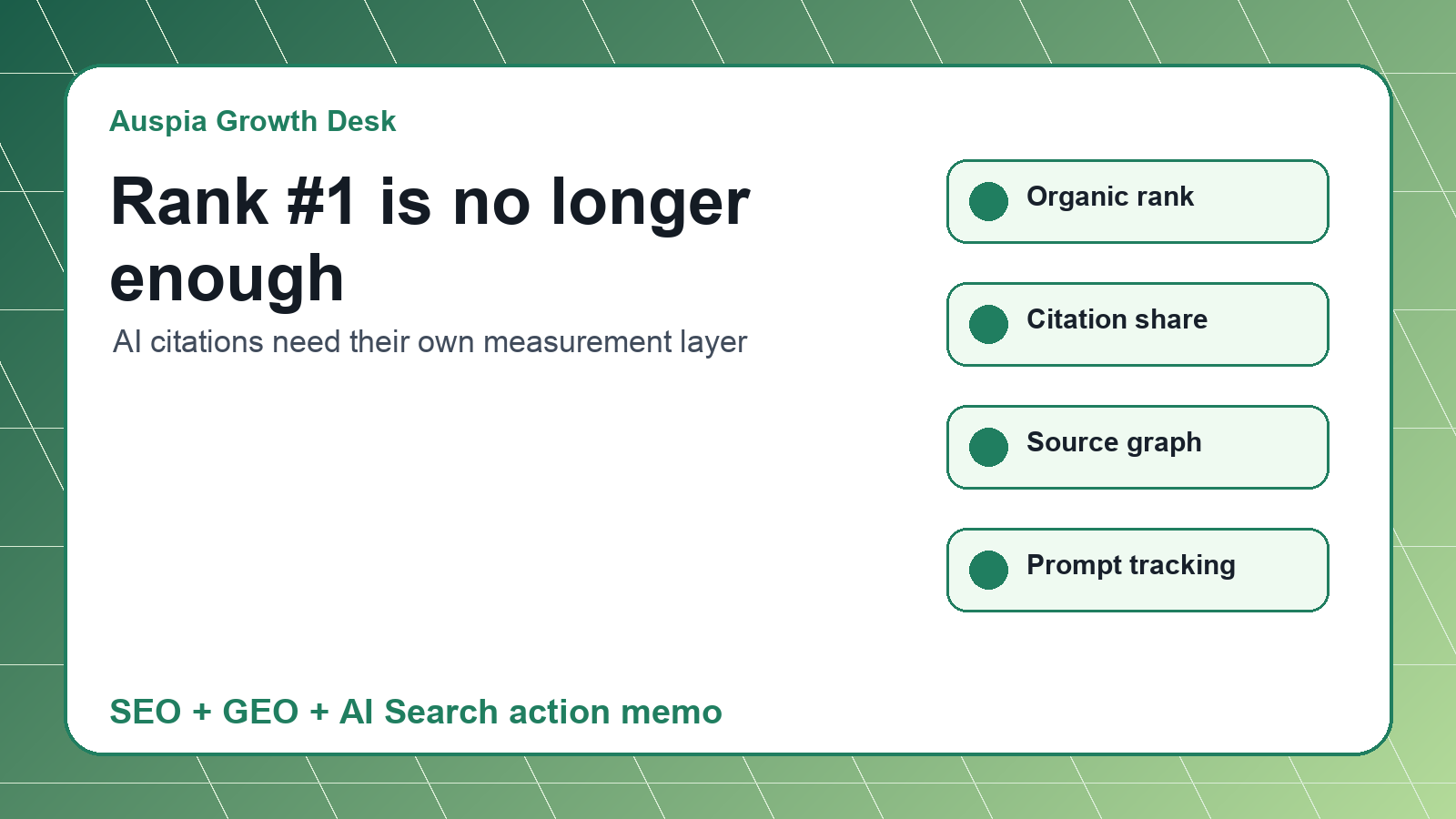
Do not replace SEO reporting with AI citation reporting. Add a new layer.
Neil Patel's recent AI citation research argues that ranking in Google no longer guarantees being cited by AI systems. His data summary says many AI citations now come from sources outside Google's top results, including a large share outside Google's top 10 or outside Google-derived sources entirely.
That does not mean rankings are dead. It means rank is no longer a complete visibility metric.
What the evidence says
Neil Patel's published summary says AI citation likelihood and Google rank are increasingly decoupled. The page reports that a large share of AI citations come from pages ranking below position 20 or from non-Google sources, and that the share drawn from top-10 Google results fell sharply from the prior benchmark.
The exact numbers will vary by vertical, prompt set, and AI platform. The direction is what matters for operators: AI systems do not simply copy the first page of Google.
They may use web search, partner indexes, browsing tools, known sources, community pages, documentation, marketplaces, news, forums, and their own retrieval layers. A brand can rank well and still be invisible in an AI answer.
The metric stack now has four layers
A modern visibility report should separate four questions.
Question | Metric | Tooling pattern | Owner |
|---|---|---|---|
Can Google find and rank us? | Rank, impressions, clicks | Search Console and rank tracking | SEO |
Do users still click? | CTR, landing page sessions, conversions | Search Console, analytics, CRM | Growth |
Do AI systems mention us? | Brand mention rate, share of answer | Prompt tracking | GEO |
Do AI systems cite us? | Citation rate and cited URL quality | AI citation audit | SEO/GEO |
The mistake is treating one layer as the truth. A page can rank but lose clicks to AI Overviews. A page can be cited by Perplexity but receive little traditional traffic. A brand can be mentioned without a link. Each signal answers a different business question.
Why ranking first may not be enough
AI systems prefer pages that help them answer confidently. That can include pages with strong structure, clear facts, third-party support, fresh data, and low ambiguity. A page ranking first because it matches a keyword may still be a weak citation candidate if it lacks proof.
Common citation blockers include:
- The article has a broad claim but no source note.
- The page uses vague brand language instead of concrete facts.
- The answer is buried below a long introduction.
- The site has poor entity consistency across its About page, author page, schema, and social profiles.
- Better third-party sources explain the topic with clearer evidence.
This is why the answer is not "do GEO instead of SEO." The answer is to make SEO assets citation-ready.
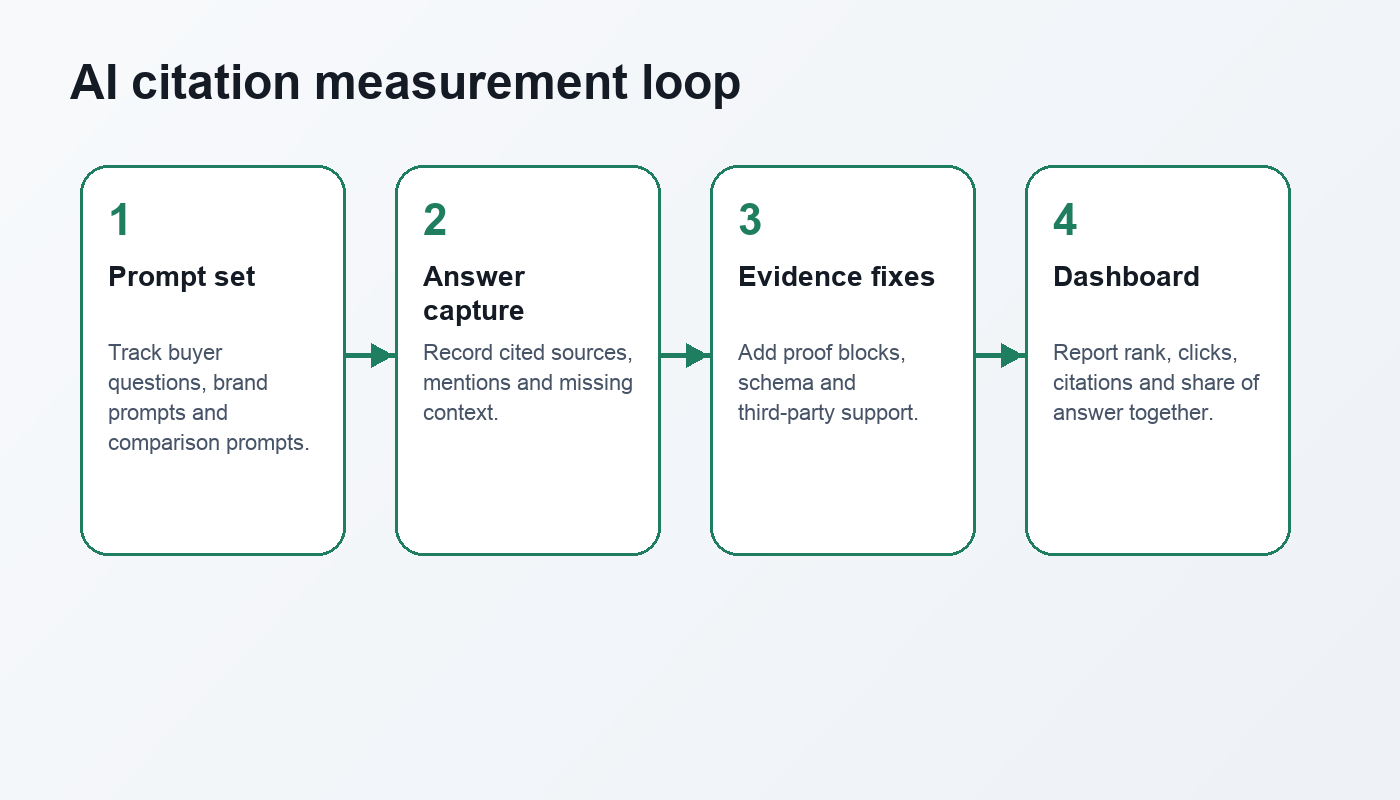
A four-week repair plan
Week 1: build a prompt set. Include buyer questions, category questions, comparison prompts, alternative prompts, and branded prompts. Keep the list small enough to run weekly.
Week 2: capture answers. Record whether your brand appears, whether your pages are cited, which competitors appear, and which third-party sources are used.
Week 3: repair pages. Add direct answers, comparison tables, source notes, author context, screenshots, current dates, and internal links. Remove vague sections that do not help answer extraction.
Week 4: build the dashboard. Report rankings, clicks, AI mentions, citations, and conversion signals together. Do not let the AI citation dashboard become a vanity chart.
The Auspia view
Google first page visibility is still useful. It is no longer sufficient.
Small teams should treat citation share like a new search layer. Start with the prompts that matter commercially, not random prompts that are fun to test. Then improve the pages, profiles, and third-party evidence that AI systems can use when forming answers.
If you need a starting point, run an AI Search Visibility Checker for your brand and category prompts, then compare the findings against your highest-value SEO pages.
FAQ
Does a top Google ranking still matter for AI search?
Yes. Ranking can still help discovery, trust, and traffic. It just does not guarantee citation inside AI answers.
What is an AI citation?
An AI citation is a source link or referenced page used by an AI answer system to support its response. Different platforms display and choose citations differently.
Should every page be optimized for AI citations?
No. Prioritize pages that answer commercial questions, define your category, compare alternatives, explain products, or support high-intent buyer research.
How often should teams measure AI citations?
Weekly is enough for most small teams. Daily tracking creates noise unless you are monitoring a major launch, reputation issue, or high-volume category.
Sources
- Neil Patel, Google Rankings Don't Guarantee AI Citations: https://neilpatel.com/marketing-stats/google-rankings-vs-ai-citations/
- Neil Patel X discussion: https://x.com/neilpatel/status/2073527316773236974
Author: Ethan Marlowe, GEO Measurement Lead Across 500+ Prompts at Auspia. Ethan writes about prompt tracking, citation reporting, and AI visibility dashboards.