Short answer
To get cited by Perplexity, your content has to pass two tests.
First, Perplexity needs to be able to access and understand the page. That means no accidental crawler blocking, no important facts trapped behind scripts or logins, and no thin pages that say a lot without proving much.
Second, the page has to be useful as a source inside an AI answer. Perplexity tends to cite pages that can support a claim, answer a specific question, and give the model something concrete to quote or verify. A generic landing page is weak. A clear guide, benchmark, comparison, dataset, documentation page, original research note, or well-structured FAQ has a much better chance.
There is no guaranteed "submit this page and get cited" button. Treat Perplexity visibility as a source-quality problem: make your pages discoverable, make your claims verifiable, then test the prompts where buyers, researchers, or journalists would expect your brand to appear.
How Perplexity citations work in practice
Perplexity is an AI answer engine with web search behavior. A user asks a question. The system retrieves web sources, builds an answer, and attaches citations so the reader can inspect where claims came from.
That citation layer changes the SEO job in one important way: being ranked in Google is helpful, but it is not the whole job. Your page also needs to be usable by an answer engine.
A citation-ready page usually has these traits:
Source trait | Why it matters for Perplexity | Weak version | Stronger version |
|---|---|---|---|
Crawlable | Retrieval systems need access to the page | Blocked by robots.txt or hidden behind login | Public page with clear HTML content |
Specific | AI answers need source support for a narrow claim | "We help teams grow with AI" | "Our 2026 benchmark compared 120 SaaS pricing pages across 8 answer engines" |
Evidence-backed | Citations need to justify claims | Opinion with no data or examples | Data, methodology, screenshots, examples, or named references |
Extractable | The system must understand the answer quickly | Long page with vague sections | Descriptive headings, answer blocks, tables, FAQs |
Fresh enough | Current topics need current sources | Old article with no update context | Updated page with dates, version notes, or current examples |
The useful mental model: Perplexity does not cite "brands" in the abstract. It cites URLs. Your job is to create URLs that deserve to be used as evidence.
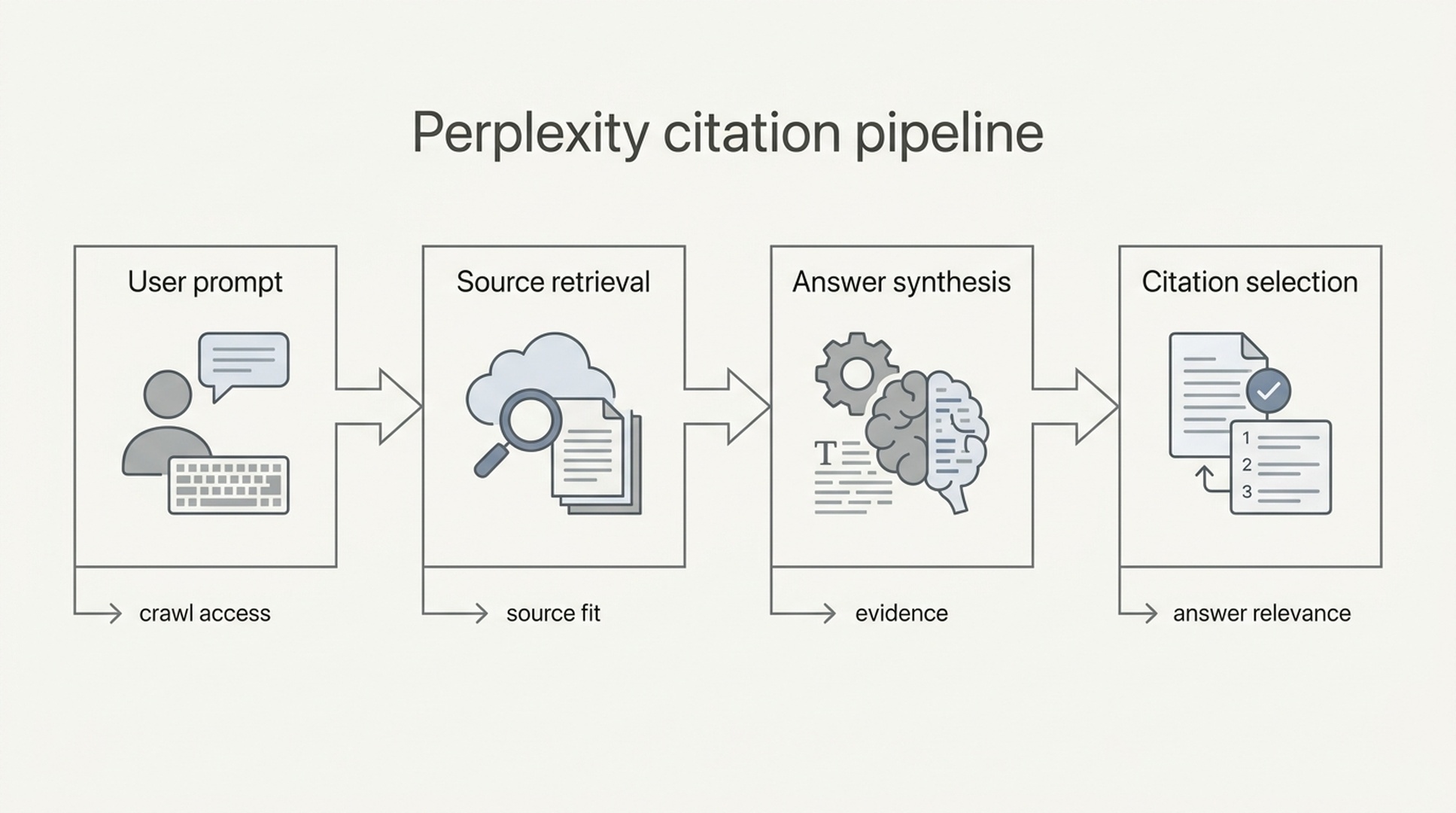
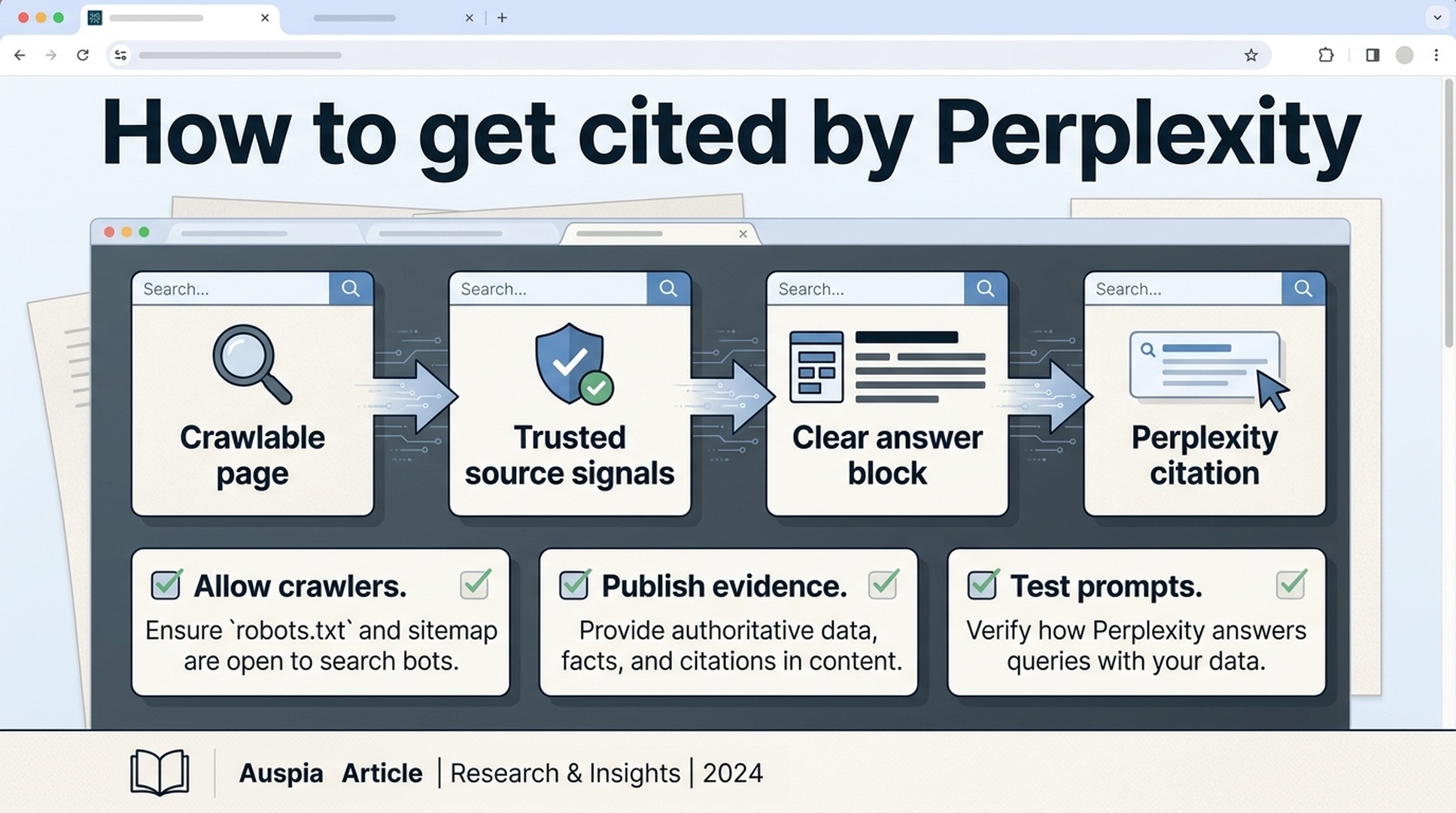
Perplexity citation pipeline: access, source fit, evidence, and answer relevance all matter before a URL becomes a visible citation.
First, make sure Perplexity can crawl you
Before rewriting content, check the boring technical layer. It is boring because it works.
Perplexity documents several crawlers, including PerplexityBot for search index crawling and Perplexity-User for user-triggered fetches. The exact crawler behavior can change, so confirm against Perplexity's own crawler documentation before making policy decisions. Still, the operating principle is stable: if you block the crawler, hide the content, or serve a broken page, citation odds drop.
Run these checks:
- Review
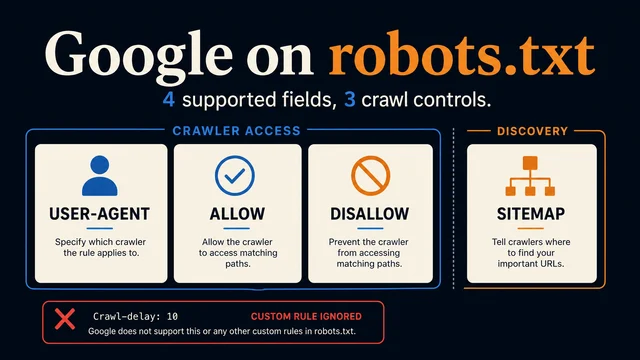
robots.txt- Confirm you are not blocking Perplexity-related user agents.
- Check whether broad rules like
User-agent: * Disallow: /blog/accidentally block useful content. - If your legal or security team blocks AI crawlers by policy, document that tradeoff. You cannot block access and expect citations at the same time.
- Test important URLs without JavaScript dependency
- Open the page with a text browser or fetch the raw HTML.
- Make sure the core answer, facts, headings, and links are present without requiring a complex client-side render.
- If the page is mostly empty until JavaScript loads, improve server-rendered content.
- Avoid gated source pages
- Perplexity may cite public summaries, docs, articles, and reports more easily than gated PDFs or pages requiring a form.
- If you need lead capture, publish a public evidence page and gate the deeper asset separately.
- Keep canonical and metadata clean
- Use one canonical URL for the article.
- Avoid duplicate versions with conflicting titles.
- Make the title, meta description, headings, and schema describe the same topic.
For Auspia readers, this is where a quick AI crawler audit helps. If you already maintain rules for Googlebot, Bingbot, and other search crawlers, add Perplexity access to the same review habit rather than treating it as a one-off GEO hack. You can start with the Robots.txt AI Crawler Checker.
Build pages that can be cited, not just pages that can rank
A normal SEO article can rank because it is comprehensive. A Perplexity-citable article needs a sharper job: it must support an answer.
That means each important page should make one or more claims that are easy to retrieve, trust, and cite.
Good citation targets include:
- Original research: surveys, benchmarks, usage data, experiments, market maps.
- Documentation: product docs, API references, changelogs, pricing explanations, feature pages.
- Comparison pages: clear criteria, limitations, methodology, and alternatives.
- How-to guides: step-by-step process with examples and caveats.
- Glossary pages: definitions with context, examples, and related terms.
- Case studies: real constraints, actions, and outcomes, with no inflated claims.
Weak citation targets include:
- Thin landing pages with generic benefits.
- Articles that summarize other articles without adding evidence.
- Pages that make big claims without methodology.
- AI-written pages with no author, date, examples, or primary source value.
- Pages where the answer is buried under intros, sales copy, and repeated keyword variations.
Here is the simplest rewrite rule:
If a sentence asks the reader to trust you, add proof near it.
For example:
Weak: "Perplexity optimization helps B2B brands increase AI search visibility."
Stronger: "In our weekly prompt tracking, Perplexity visibility usually changes at the URL level first: documentation pages, comparison pages, and original research pages get cited before broad product pages."
The second version is still a claim, but it gives the reader a concrete observation and tells the model what kind of page behavior to associate with the topic.
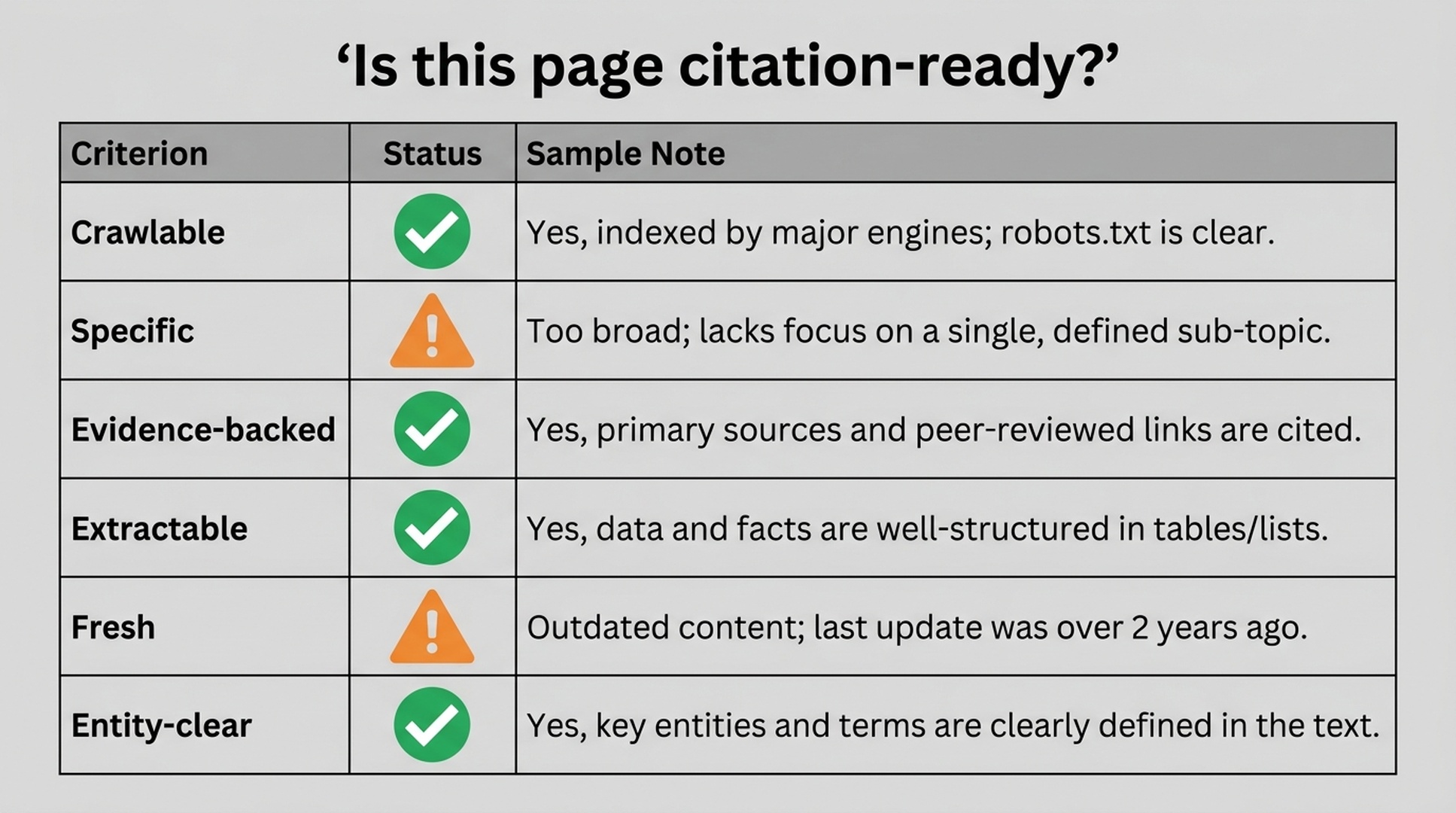
Use a source fitness scorecard before asking why a page is not showing up in AI citations.
Use an answer block near the top
Perplexity often answers direct questions. Your page should do the same.
Add a short answer block within the first screen of the article. Keep it plain. Avoid a long throat-clearing intro.
Example structure:
## Short answer

To get cited by Perplexity, publish crawlable pages that answer a specific question with evidence. The strongest candidates are original research, documentation, comparison pages, and guides with clear definitions, examples, dates, and source links. You cannot guarantee a citation, but you can improve eligibility by removing crawler blocks, strengthening source quality, and testing the prompts where your audience expects an answer.
This helps in two ways. Human readers get the answer fast. AI systems get a clean extractable passage that states the relationship between the query and the page.
Do the same inside deeper sections. If a section answers "Does schema help Perplexity?" start with the answer, then explain.
Add evidence Perplexity can use
Perplexity citations are often attached to factual claims. So give the system better facts.
A strong evidence layer may include:
Evidence type | Best use case | Example |
|---|---|---|
Methodology | Research and benchmarks | "We tested 200 prompts across 5 answer engines between June 3 and June 12, 2026." |
Tables | Comparisons and decision queries | Feature-by-feature comparison with criteria |
Named examples | How-to and strategy posts | "A payroll software vendor might create pages for contractor tax forms, payroll cutoff dates, and state compliance." |
Screenshots | Tool workflows and UI changes | Annotated logged-out screenshot of a public result page |
Update notes | Fast-changing topics | "Updated July 2026 to reflect current crawler documentation." |
Source links | Claims about platforms or policies | Links to official Perplexity docs, publisher pages, or product announcements |
Do not fake data. Do not invent benchmarks. If you only have qualitative observations, say that.
Perplexity citation work is partly editorial discipline. A page that says "we studied this" should show what was studied. A page that says "this tool is better" should show the criteria. A page that says "the platform changed" should link to the platform source.
Create pages around prompts, not only keywords
Traditional SEO starts with keywords. GEO work also needs prompt mapping.
A keyword might be:
- "best CRM for small business"
A Perplexity-style prompt might be:
- "What are the best CRMs for a 20-person B2B services team that needs email sync and simple pipeline reporting?"
- "Compare HubSpot, Pipedrive, and Zoho for a founder-led sales team."
- "Which CRM is easiest to migrate to from spreadsheets?"
Those prompts imply different citation needs. A generic "best CRM" page may not be enough. The answer engine needs sources for pricing, feature fit, migration complexity, team size, integrations, support, and tradeoffs.
Build a prompt map:
Prompt cluster | Page to create or improve | Citation angle |
|---|---|---|
Definition prompts | Glossary or explainer page | Clear definition and examples |
Comparison prompts | Alternative or comparison page | Criteria, pros, cons, pricing notes |
How-to prompts | Workflow guide | Steps, screenshots, checklist |
Trust prompts | Research, benchmark, case study | Data, method, outcomes |
Product-fit prompts | Use-case landing page | Constraints, audience, decision rules |
The best prompt maps are not huge. Start with 20 to 50 questions your buyers or researchers would actually ask Perplexity. Then test which sources appear and what those sources have that yours lacks.
Strengthen entity signals around your brand
Perplexity needs to understand who you are, what category you belong to, and why your page is relevant to the question.
Entity clarity matters most when the query includes a category, product type, or comparison.
Check these brand basics:
- Your About page states what the company does in one direct sentence.
- Product pages use consistent category language.
- Author pages or bylines are credible and not fake expert theater.
- Organization schema, article schema, breadcrumbs, and canonical tags are clean.
- Your brand is mentioned consistently across docs, social profiles, directories, review sites, and partner pages.
- Important pages link to each other using descriptive anchor text.
For a GEO article, "descriptive" means boring in a good way. Use anchor text like "AI search visibility checker" instead of "learn more." Use "Perplexity citation tracking" instead of "our solution."
The point is not to stuff entity keywords everywhere. The point is to remove ambiguity.
Earn off-site corroboration
Perplexity can cite your own website, but third-party corroboration helps. If the only place that says your brand matters is your own site, you have a weak source graph.
Useful corroboration sources include:
- Independent reviews and comparison pages.
- Partner directories.
- Podcast or webinar pages with transcripts.
- Research citations.
- GitHub repositories or docs, if relevant.
- Analyst roundups.
- News mentions.
- Community discussions with real users.
- Public customer stories.
You do not need all of these. You need enough external confirmation for the kind of claim you want to appear in.
For example, if you want Perplexity to cite your brand for "AI search visibility tools," your own product page is useful, but it is stronger when paired with third-party mentions, docs, examples, and comparison pages that describe the same category.
This is where PR, SEO, and partnerships finally overlap in a practical way. Not "brand awareness" as a vague goal. Source graph building.
A 30-day Perplexity citation sprint
Use this when you want a practical starting plan.
Week | Work | Output |
|---|---|---|
Week 1 | Audit crawl access and existing citation footprint | Robots.txt notes, list of currently cited URLs, prompt baseline |
Week 2 | Upgrade 3 to 5 source pages | Answer blocks, evidence tables, clearer headings, source links |
Week 3 | Publish one original evidence asset | Benchmark, comparison matrix, methodology post, or research note |
Week 4 | Test prompts and improve internal/external signals | Citation report, prompt gaps, next-page backlog |
Week 1: Find your current footprint
Test 20 to 50 prompts. Include:
- Brand prompts: "What is [brand]?"
- Category prompts: "best tools for [category]"
- Comparison prompts: "[brand] vs [competitor]"
- Problem prompts: "how to solve [problem]"
- Buyer prompts: "which [tool type] should a [specific audience] use?"
Track:
- Whether your brand appears.
- Whether your URL is cited.
- Which competitor URLs are cited.
- What page types get cited.
- Which claims the answer includes.
- Whether the answer is accurate.
Week 2: Improve existing pages
Pick pages already close to citation eligibility. Do not start with your homepage.
Prioritize:
- Docs pages with missing context.
- Comparison pages with weak criteria.
- Blog posts that already rank but lack evidence.
- Product pages with strong use cases but poor extractability.
- Research pages that need a clearer summary.
Add answer blocks, tables, examples, update notes, and source links. Remove vague intro copy.
Week 3: Publish one evidence asset
One good evidence page can do more than ten generic blog posts.
Possible assets:
- "2026 benchmark of [category] tools"
- "State of [workflow] report"
- "Comparison matrix for [product category]"
- "Dataset of [industry] pricing pages"
- "Methodology: how we evaluate [topic]"
- "Public checklist for [technical audit]"
Make the asset public, indexable, and easy to cite.
Week 4: Retest and build the backlog
Run the same prompt set again. Do not panic if citations do not change immediately. AI search systems do not update every source at the same speed.
Look for movement:
- New brand mentions.
- More accurate descriptions.
- Competitor citations replaced by neutral sources.
- Your pages appearing for long-tail prompts.
- Better summaries of your category or product.
Then decide whether the next sprint needs technical fixes, stronger content, or more third-party corroboration.
What not to do
Some GEO advice makes this harder than it needs to be.
Avoid these mistakes:
Mistake | Why it fails |
|---|---|
Publishing dozens of generic "Perplexity SEO" posts | Thin pages do not become strong sources just because they mention the platform |
Blocking AI crawlers while expecting AI citations | Access policy and visibility goals conflict |
Stuffing "Perplexity" into every title | The cited source must answer the user's question, not just name the answer engine |
Using fake statistics | AI systems and human readers both punish unreliable claims over time |
Hiding the real answer behind a form | Gated pages are poor citation targets |
Treating citation as a one-time win | Prompts, sources, and answers change, so measurement has to repeat |
The biggest mistake is chasing the citation instead of improving the source. A citation is an outcome. Source quality is the work.
How to measure Perplexity citation progress
Do not measure only traffic. Perplexity referral traffic can be small, inconsistent, or hard to attribute. Citation visibility often matters before traffic shows up.
Use a simple tracking sheet:
Metric | What it tells you |
|---|---|
Citation rate | Percentage of tracked prompts where your URL is cited |
Brand mention rate | Percentage of prompts where your brand appears, cited or not |
Answer accuracy | Whether Perplexity describes your brand, product, or data correctly |
Cited URL mix | Which pages Perplexity uses as sources |
Competitor citation share | Which competitors or publishers dominate the answer |
Source type gap | Whether Perplexity prefers docs, research, reviews, or news for the query |
Change over time | Whether updates improve visibility across repeated tests |
A practical cadence: test every two weeks for active campaigns and monthly for evergreen category prompts.
If you test daily, you may overreact to noise. If you test once, you will miss the pattern.
FAQ
Can you submit a site to Perplexity for citations?
Not in the same way you submit a sitemap to a search engine and wait for indexing. The practical path is to make the page crawlable, source-worthy, and relevant to prompts where Perplexity retrieves web sources. Perplexity also has publisher-related programs, but those do not replace basic source quality.
Does robots.txt affect Perplexity citations?
Yes, crawler access can affect whether Perplexity can retrieve or index your content. Check Perplexity's current crawler documentation before changing rules, then confirm your important pages are not accidentally blocked.
Does schema markup help with Perplexity?
Schema can help clarify entities, article structure, breadcrumbs, authorship, products, FAQs, and organization details. It is not a citation guarantee. Use schema to reduce ambiguity, not to compensate for weak content.
What type of content gets cited most often?
The safest answer is: content that supports a specific claim. In practice, that often means original research, documentation, comparison pages, technical guides, data pages, and articles with clear answer blocks and evidence.
How long does it take to get cited by Perplexity?
There is no fixed timeline. Changes depend on crawl access, source competition, query demand, content quality, and how often Perplexity refreshes the relevant results. Measure with a recurring prompt set rather than expecting an immediate result.
Should I optimize for Perplexity separately from Google?
Separate the measurement, not the fundamentals. Crawlability, strong titles, clear structure, topical authority, evidence, and trustworthy external mentions help both. Perplexity adds a stronger need for answer-ready passages, prompt testing, and citation tracking.
Source notes
Research used for this draft:
- Perplexity crawler documentation for crawler names and access considerations: https://docs.perplexity.ai/docs/resources/perplexity-crawlers
- Perplexity public product and publisher context: https://www.perplexity.ai
- Current public discussion and research around AI search citation behavior, retrieval quality, and source selection patterns. Treat platform behavior as changeable and verify crawler rules before publishing.
Author: Isabel Grant, Researcher of 2,000+ AI Citation Patterns at Auspia. Isabel writes about citation earning, source quality, and practical ways to make web content easier for AI answer engines to trust.