Quick answer
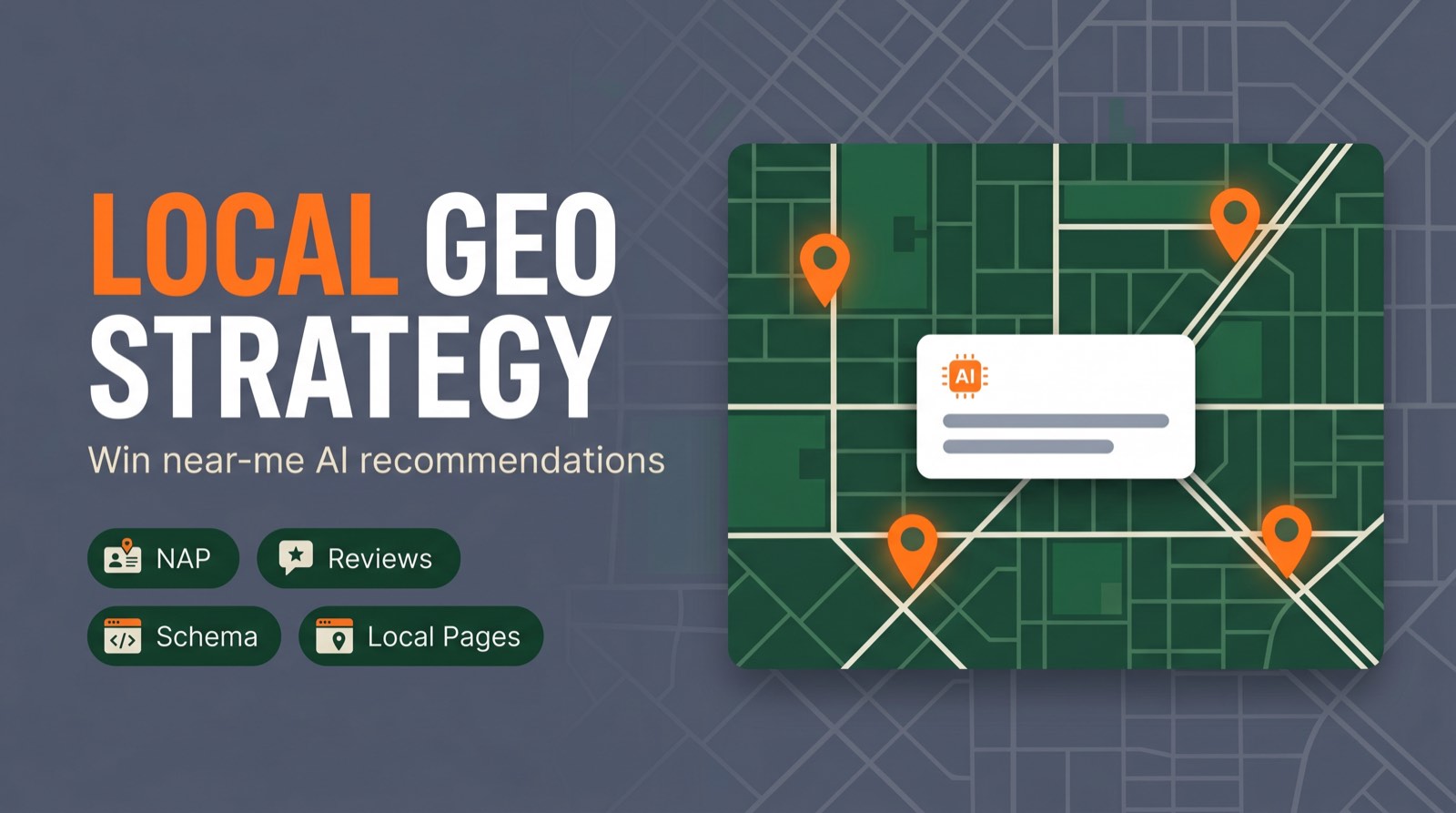
Local GEO is the work of making your business easy for AI systems to identify, trust, and recommend when someone asks a location-heavy question such as "best pediatric dentist near me," "where can I repair a MacBook in Brooklyn," or "top B2B video agencies in Austin."
The short version: AI does not recommend the closest business by magic. It usually needs a clear local entity, consistent facts, strong neighborhood/service evidence, recent reputation signals, and pages that answer the exact local intent. If those signals are messy, the model may recommend a better-documented competitor, give outdated details, or skip your business entirely.
For local teams, the practical goal is not to "hack" AI answers. It is to make the business the least ambiguous answer in its area.
Why "near me" GEO is different from normal GEO
Classic GEO often focuses on category questions: "best CRM for agencies," "how to choose an SEO tool," "alternatives to X." Local GEO adds one more filter that changes the whole game: geography.
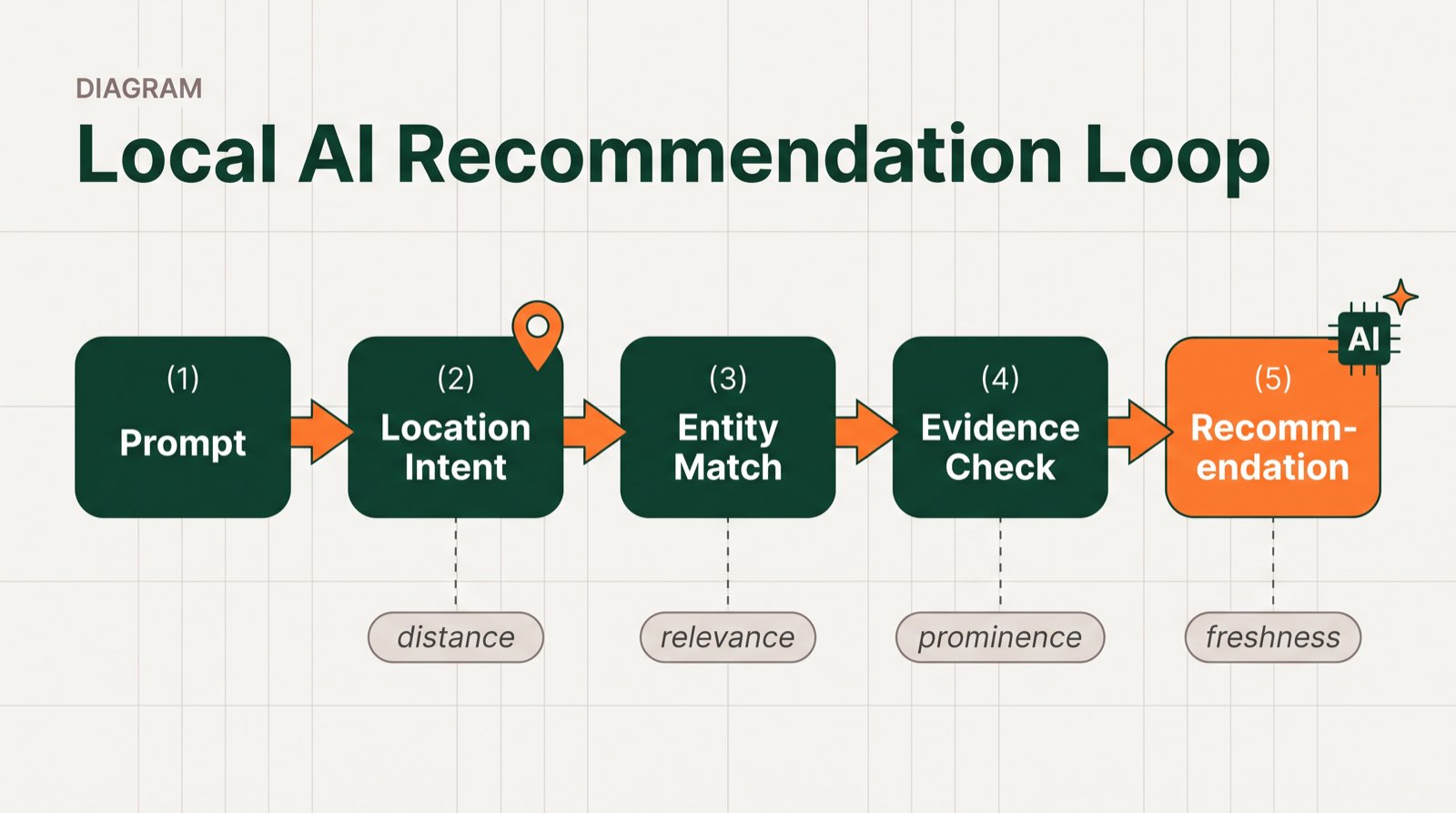
When a user asks "near me" or "in my city," an AI answer has to resolve several things at once:
Question the AI must answer | What your business needs to prove |
|---|---|
Where is this business? | Address, service area, map presence, local citations |
What does it actually do? | Clear service taxonomy, descriptions, category pages |
Is it relevant to this neighborhood or city? | Local landing pages, examples, local wording, nearby landmarks |
Is it trustworthy enough to recommend? | Reviews, third-party mentions, fresh content, accurate business profiles |
Can the user act on it now? | Hours, phone, booking links, directions, pricing cues |
Google's own local ranking guidance has long described local results through relevance, distance, and prominence. That framework is still useful for AI-era local visibility because answer systems also need to decide whether a business matches the user's need, is geographically suitable, and has enough evidence to deserve a recommendation.
The newer wrinkle is that AI systems may synthesize answers from multiple sources instead of showing one fixed ranked list. That means your website, Google Business Profile, local directories, review pages, schema markup, social profiles, and third-party articles all become part of the evidence field.
Start with local entity facts, not content volume
Many local businesses jump straight to blog posts. That usually misses the first problem: the entity is unclear.
Before writing another article, check whether the web can answer these questions consistently:
- What is the exact business name?
- What category should the business be grouped under?
- Which address, phone number, and opening hours are current?
- Does the business serve customers at a physical location, at the customer's location, online, or across a service area?
- Which cities, neighborhoods, counties, or districts are legitimately served?
- Which services are primary, and which are secondary?
- What makes the business different from nearby competitors?
This is where the CSDN source page gets one important thing right: AI visibility problems often begin with missing, inconsistent, or poorly structured business knowledge. The article frames this as standardizing brand information, product/service information, store information, high-frequency Q&A, and knowledge graph signals. The useful takeaway is simple: if the machine cannot reconcile your facts, it will not confidently recommend you.
For Auspia clients, we usually turn this into a local entity brief before touching page copy. One page. No fluff. Name, category, locations, service area, services, proof points, customer use cases, exclusions, and links to authoritative profiles.
Build pages around real local intent
A weak local page says: "We provide professional services in Dallas. Contact us today."
A strong local GEO page answers the user's actual local question:
- "Do you serve my area?"
- "Can you handle my specific problem?"
- "How fast can I get help?"
- "What proof do you have nearby?"
- "What should I do next?"
Use this structure for important city, neighborhood, or service-area pages:
Page block | What to include |
|---|---|
Local answer summary | One short paragraph that states the service, area, and best-fit customer |
Service coverage | Cities, neighborhoods, ZIP/postal areas, travel radius, remote/in-person availability |
Use cases | Specific local scenarios, not generic benefits |
Proof | Reviews, local projects, photos, before/after examples, certifications, partner mentions |
Practical details | Hours, booking method, parking, delivery, emergency availability, languages |
FAQ | Questions with local modifiers: cost, timing, area limits, permits, walk-ins |
Schema | LocalBusiness, Service, FAQPage, opening hours, geo/address fields where appropriate |
Do not make hundreds of doorway pages with thin swapped city names. AI systems are good at spotting pages that say nothing. More importantly, users are good at ignoring them.
Make NAP consistency boringly perfect
NAP means name, address, and phone number. It sounds old-school because it is. It still matters.
For local AI recommendations, NAP consistency reduces ambiguity. If one directory lists "Auspia Growth Lab," another says "Auspia AI Marketing," and your site uses a different phone number, the system has to decide whether those are the same entity. Sometimes it will. Sometimes it will not.
Audit these sources:
- Website footer and contact page
- Google Business Profile
- Apple Business Connect
- Bing Places
- Yelp, TripAdvisor, Trustpilot, G2, Capterra, Avvo, Healthgrades, Houzz, or industry-specific directories
- Local chamber, association, or marketplace listings
- Social profiles
- Press mentions and partner pages
For multi-location brands, create one canonical location record per branch. Each branch should have its own URL, address, phone number if applicable, hours, photos, service list, and review destination. Chain-wide copy can stay consistent, but local proof should not be cloned.
Use structured data to remove guesswork
Structured data will not force an AI system to recommend you. It can, however, make your facts easier to extract.
For local businesses, start with the basics:
LocalBusinessor the most specific subtype that fitsname,address,telephone,url,openingHoursSpecificationgeocoordinates when you have a public locationareaServedfor service-area businessessameAslinks to authoritative profilesServiceschema for core offeringsFAQPageschema only when the FAQ is visible and genuinely useful
Google Search Central's LocalBusiness structured data documentation is still the best baseline for what local entity fields should look like on a website. Use it as a floor, not a complete GEO strategy.
A simple test: if you paste your page into a structured data validator, can a reviewer understand who you are, where you operate, and what you offer without reading the whole page? If not, the markup is not doing enough work.
Reputation signals need local context
Reviews help local visibility, but generic review volume is not the whole story. AI answers often need to explain why a business fits the request. A review that says "great service" is nice. A review that says "they fixed our HVAC issue in East Austin within two hours" carries more local and service context.
You cannot script customer reviews, and you should not. But you can ask better prompts after a real service interaction:
- What problem did we help solve?
- Which service did you use?
- Which location or area did we serve?
- What made the experience useful?
- Would you recommend us for a specific situation?
Also build reputation outside review platforms. Local sponsorships, neighborhood guides, event pages, association profiles, podcasts, local news, and partner directories can all reinforce that your business exists in a specific place and category.
Track prompts, not just rankings
Local GEO measurement should start with the questions customers actually ask. Build a prompt set that covers the main patterns:
Prompt pattern | Example |
|---|---|
Near me | "best emergency plumber near me" |
City modifier | "best emergency plumber in Phoenix" |
Neighborhood modifier | "water heater repair in Arcadia Phoenix" |
Use-case modifier | "same-day plumber for apartment leak in Phoenix" |
Comparison | "who is better for residential plumbing in Phoenix, A or B?" |
Trust filter | "licensed plumber in Phoenix with good reviews" |
Constraint | "plumber open Sunday near Scottsdale" |
Run these prompts on the AI surfaces your customers use: Google AI features, ChatGPT browsing/search experiences, Perplexity, Gemini, Bing Copilot, and any vertical discovery platform that matters in your market. Record whether your business appears, what facts are cited, which competitors appear, and whether the answer includes wrong or outdated details.
The CSDN source emphasizes AI visibility diagnosis, competitor recommendation comparison, hallucination checks, and ongoing monitoring. That is the right operating pattern. The risk is turning it into a vanity report. The useful metric is not "AI mentioned us once." It is whether high-intent local prompts produce accurate, useful, conversion-ready recommendations over time.
Fix AI hallucinations with better evidence
Local hallucinations usually fall into a few buckets:
- Wrong hours
- Old addresses
- Merged locations
- Incorrect service areas
- Products or services you do not offer
- Confusion with a similarly named business
- Outdated pricing or availability
- Negative information that is old, unresolved, or missing context
The fix is rarely one magic form submission. Build stronger evidence where models and search systems can find it:
- Correct your own site first.
- Update Google Business Profile, Bing Places, Apple Business Connect, and major directories.
- Add a visible FAQ that states what you do and do not offer.
- Use sameAs links and consistent naming across profiles.
- Publish a location or service-area page that resolves the ambiguity.
- If the issue comes from a third-party page, request a correction or publish fresher evidence that can outweigh it.
- Re-test the exact prompts that produced the bad answer.
This takes patience. AI systems may not update instantly, and different platforms refresh at different speeds. Treat hallucination repair as evidence maintenance, not reputation magic.
A 30-day local GEO workflow
Here is the version a small team can actually run.
Week | Work | Output |
|---|---|---|
1 | Audit local prompts, competitors, profiles, NAP, and hallucinations | Local AI visibility baseline |
2 | Standardize entity facts, GBP/Bing/Apple profiles, key directories, and location records | Clean business knowledge layer |
3 | Rewrite priority service and location pages with local proof, FAQs, and schema | AI-readable local pages |
4 | Add review prompts, local proof assets, prompt tracking, and monthly reporting | Local GEO operating loop |
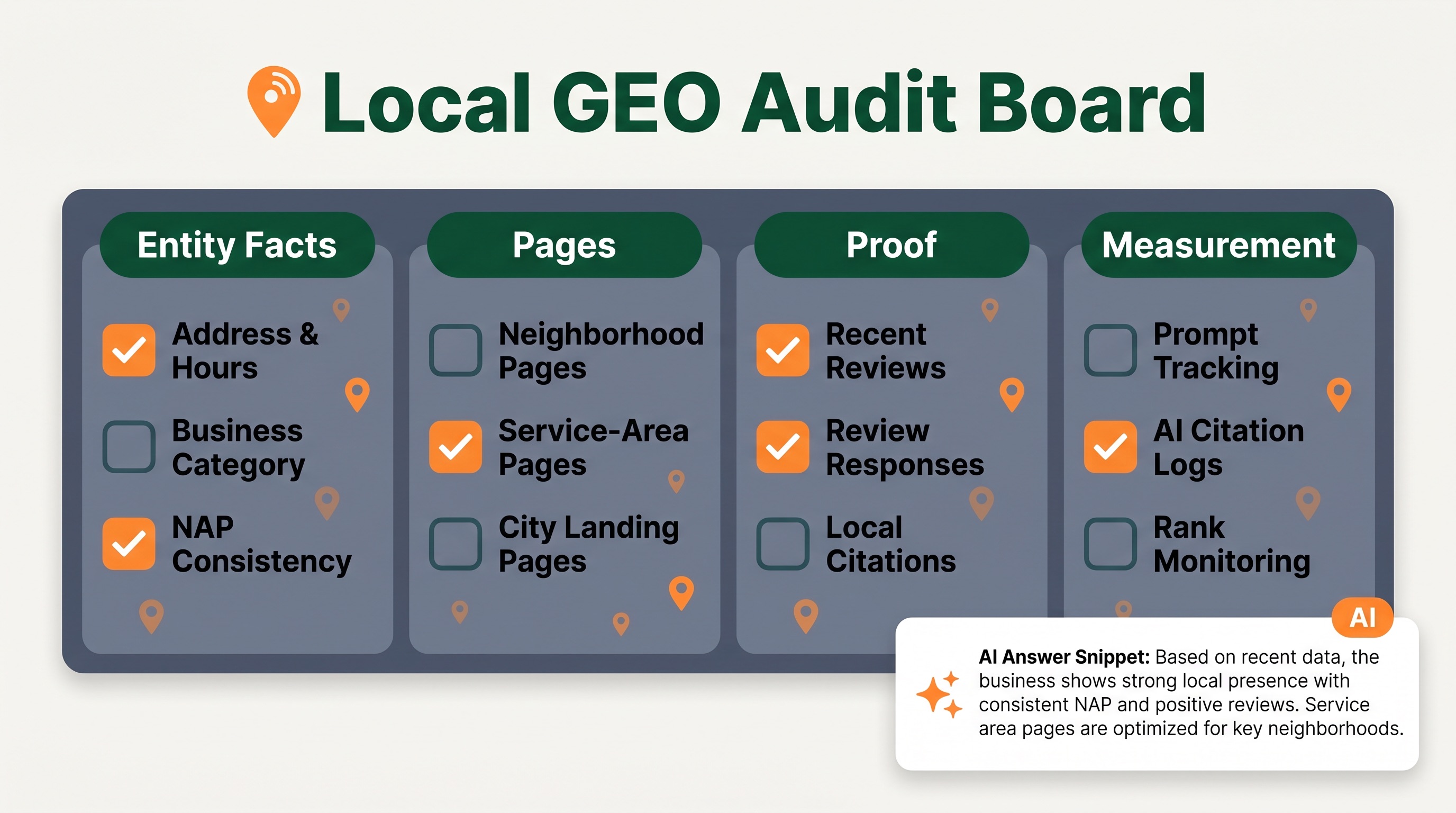
If you only have time for three actions, do these:
- Create one authoritative location/service-area page that answers the local buying question clearly.
- Fix every inconsistent business fact across your highest-trust profiles.
- Track 20-50 local AI prompts monthly and repair the errors that appear most often.
Common mistakes
The most common local GEO mistake is treating it like a city-name content farm. That worked poorly in SEO and works even worse when AI systems summarize quality and evidence.
Other mistakes to avoid:
- Publishing location pages for areas you do not really serve.
- Using identical copy across every branch page.
- Hiding address, phone, hours, and booking details behind JavaScript or images.
- Adding schema that does not match visible page content.
- Asking for reviews without giving customers a useful way to describe the service and location.
- Measuring only whether the brand is mentioned, not whether the answer is accurate or persuasive.
- Ignoring competitor recommendations until a sales team notices lost demand.
Auspia take
Local GEO is not separate from local SEO. It sits on top of it.
Search engines, maps, directories, review platforms, and AI answer systems all need the same thing: a business entity they can understand, evidence they can trust, and content that matches the user's local need. The difference in 2026 is that AI can compress those signals into one recommendation. If your facts are messy, you may never make the shortlist.
Auspia's practical recommendation is to build a local AI evidence layer: consistent entity facts, strong local pages, structured data, review context, third-party proof, and prompt-level monitoring. That is less glamorous than chasing a secret AI ranking trick. It is also more durable.
If you want to check your current baseline, start with Auspia's AI Search Visibility Checker and then map the gaps into a local GEO audit.
FAQ
What is local GEO?
Local GEO is the process of improving how AI answer systems understand and recommend a business for location-specific questions, including "near me," city, neighborhood, and service-area searches.
Is local GEO the same as local SEO?
No, but they overlap heavily. Local SEO improves visibility in search and map results. Local GEO focuses on whether AI systems can identify, trust, and recommend your business in generated answers. Strong local SEO usually provides the foundation for strong local GEO.
Do reviews affect AI recommendations?
They can. Reviews provide reputation, service, and location evidence. The most useful reviews mention the service, situation, location, and outcome naturally. Review quality and context matter more than raw count alone.
How many local pages should a business create?
Create pages only for real locations, service areas, or local use cases where you can provide specific proof. Ten useful local pages beat 500 thin city-name pages.
How often should local GEO prompts be checked?
Monthly is enough for most businesses. High-competition categories, multi-location brands, urgent services, and seasonal businesses may need weekly checks for priority prompts.
Author: Miles Donovan, Local AI Search Analyst Across 500+ Service Queries at Auspia. Miles writes about local visibility, service-area pages, and how businesses can earn clearer recommendations in AI search.