Executive summary
A good GEO content SOP does one simple thing: it moves the hard decisions to the front of the workflow. Before a writer drafts, the team should know the main question, search intent, evidence gaps, answer structure, review standard, and post-publish learning loop.
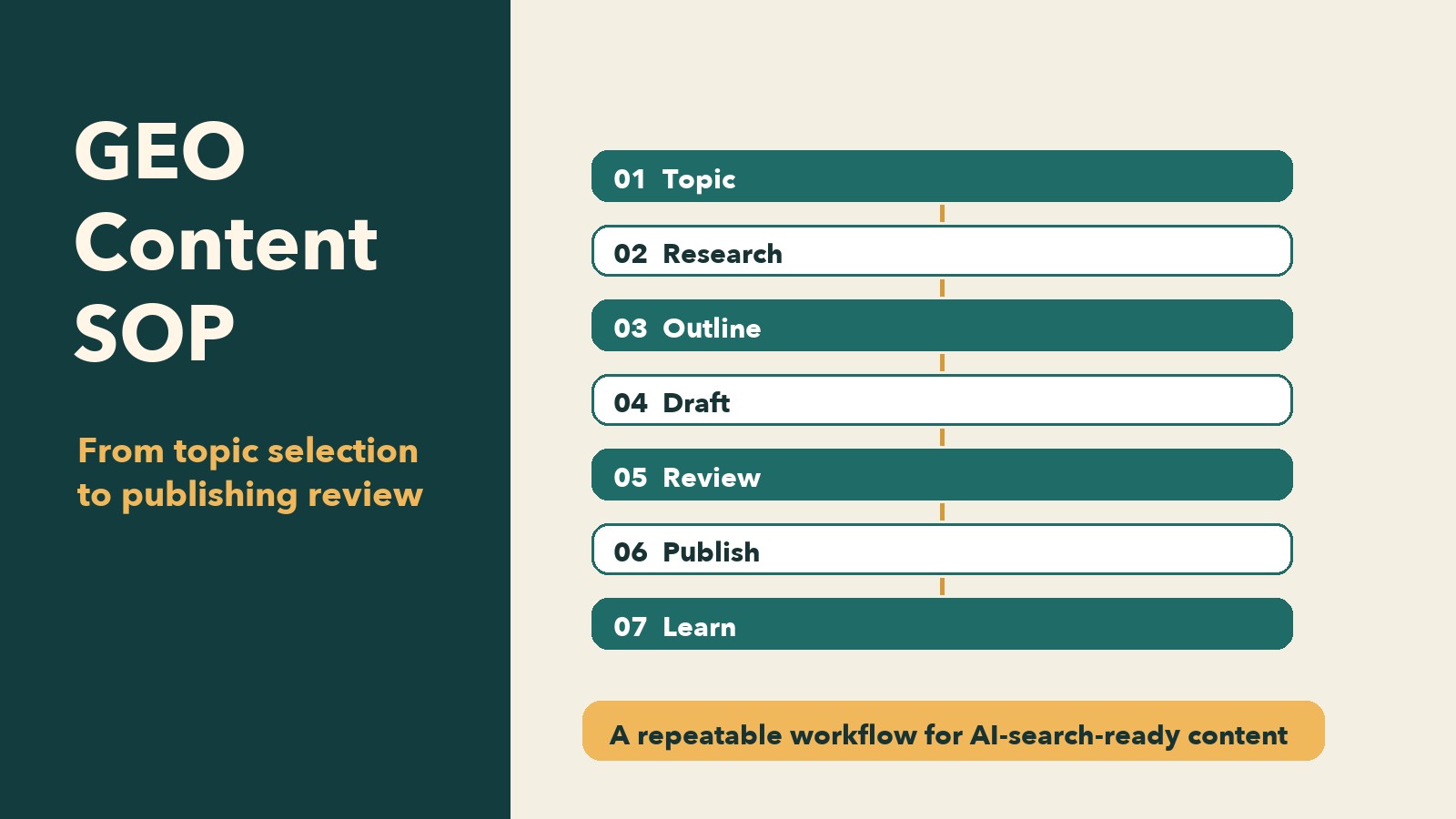
The workflow below turns GEO content from a one-off writing task into a repeatable operating system: choose the topic, research the answer, design the outline, draft extractable sections, review for substance, publish with clean entity signals, and review performance by question, not only by traffic.
This article is inspired by a Chinese SOP breakdown from SEOZZR and adapted for global B2B teams that need English, AI-search-ready content operations. It also follows the same basic direction as Google's public guidance on helpful, reliable, people-first content: write for real users, show experience and evidence, and make the page easy to understand.
Why GEO content needs an SOP
Most teams do not fail at GEO because the writer cannot write. They fail because every article starts from scratch.
One week the brief says "write about GEO strategy." The next week it says "cover AI citations." The writer gets a keyword, a target length, and a deadline. Then the draft has to solve everything at once: define the angle, judge the audience, compare competing pages, decide what evidence matters, build the structure, write the copy, and make the article useful.
That is too much to put inside the drafting stage.
GEO, or generative engine optimization, changes the content standard in a practical way. A page still has to help a human reader. It also has to make its answer, entities, evidence, and boundaries easy for AI answer systems to interpret. That does not mean writing for bots. It means writing clearer answers.
A stable SOP gives the team a shared way to ask:
- What question is this page actually answering?
- What proof or experience supports the answer?
- Which sections should stand alone if quoted, summarized, or reused?
- What should the reader do after the answer?
- What will we review after the page is live?
Without that workflow, teams publish a lot of content but learn very little from each page.
GEO writing is not just normal blog writing with new terms
Traditional blog writing often starts with a broad topic and expands until the article feels complete. GEO content starts with a sharper unit: a question that deserves a clear answer.
That small shift changes the whole workflow.
Normal content habit | GEO content requirement |
|---|---|
Cover the topic broadly | Answer the main question first |
Optimize around one keyword | Map the keyword to intent, follow-up prompts, and source needs |
Make the article pleasant to read | Make key sections clear even when read separately |
Review grammar and flow | Review answer clarity, evidence, extractability, and entity accuracy |
Measure traffic only | Measure prompts, citations, impressions, conversions, and update needs |
The goal is not to make every paragraph sound like an encyclopedia entry. The goal is to remove ambiguity where it hurts: definitions, comparisons, steps, claims, brand facts, and recommendations.
If a paragraph says "GEO improves visibility across AI platforms," the reader still has to guess how. If it says "GEO improves AI-search visibility by making brand facts, expert explanations, comparison points, and source-backed answers easier to retrieve and cite," the sentence gives both the concept and the mechanism.
That is the difference an SOP should force.
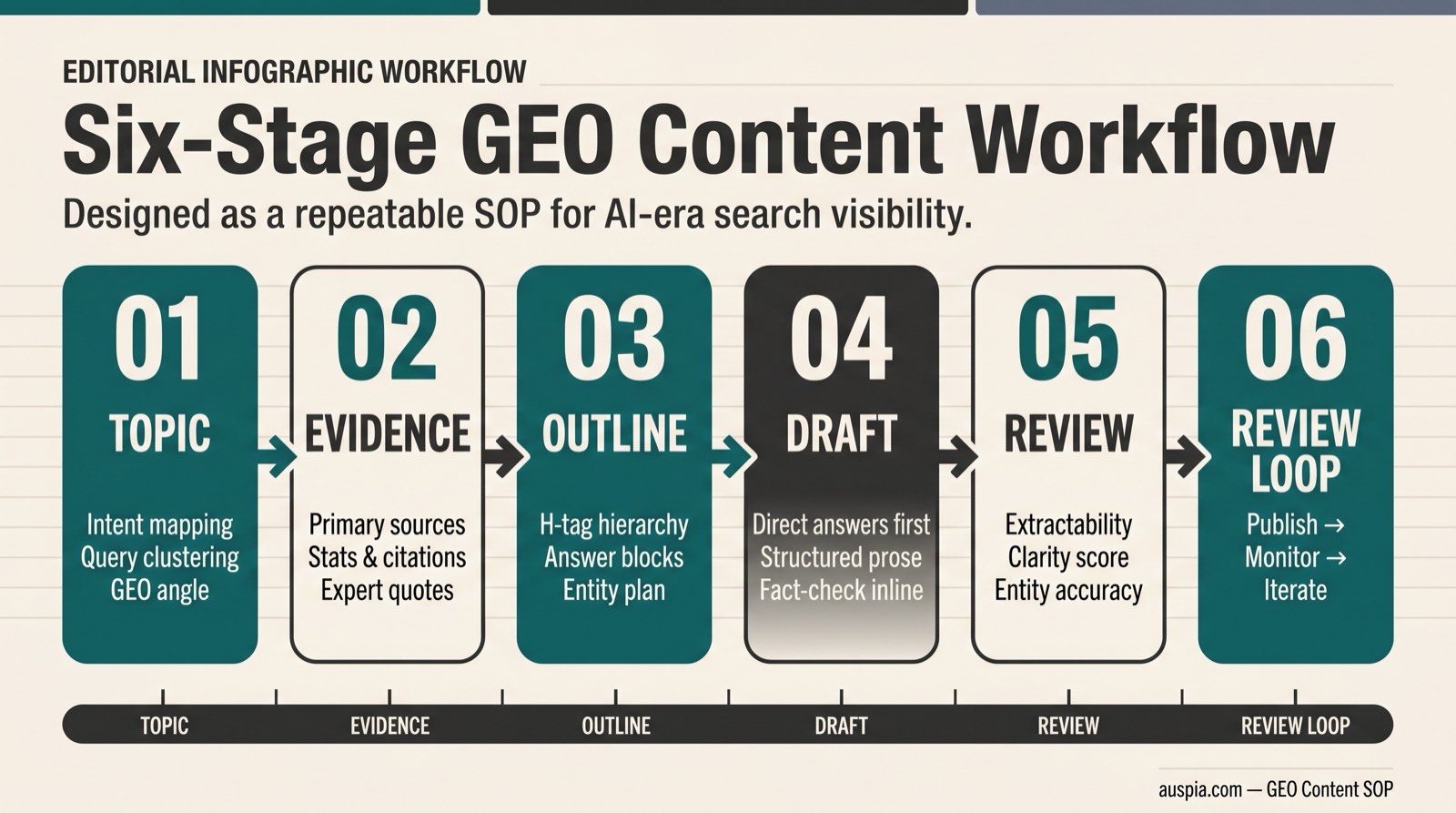
Caption: A practical GEO content workflow should solve direction, evidence, and review before the article reaches the publish button.
Step 1: choose a question, not only a keyword
The first document in the workflow is the topic brief. It should be short, but it cannot be vague.
For GEO content, a keyword is only a starting point. The brief should turn that keyword into a question, a reader situation, and a business reason to answer it.
A useful topic brief includes:
Field | What to write |
|---|---|
Target query | The main search phrase or prompt family |
Main question | The question the page must answer in the first section |
Reader | Who is asking and what they already know |
Intent | Learn, compare, diagnose, execute, buy, or justify |
Content gap | What competing pages miss or explain poorly |
Auspia angle | The practical point of view this article will add |
Exclusions | What the article will not cover |
Next action | Audit, template, tool, demo, internal link, or checklist |
The exclusions line matters more than teams expect. It keeps the article from swelling into a weak all-purpose guide.
For example, an article on "GEO content SOP" should not try to become a full technical SEO guide, an AI policy essay, and a content calendar template at the same time. It should explain the operating workflow for creating stronger GEO content. Technical SEO can appear where it affects publishing quality, but it should not take over the piece.
Auspia tip: before drafting, run the topic through a few buyer-style prompts in tools such as ChatGPT, Perplexity, Gemini, and Google AI features. Record the questions that repeat. Those repeated prompts often reveal the real article structure better than a keyword list does.
Step 2: research until you can make a judgment
Research is not a folder full of links. Research is the point where the team decides what the article can honestly say.
A GEO research pass should answer five questions:
- What does the reader need to decide or do?
- What do the current top pages already explain well?
- Where are the weak spots, missing examples, or vague claims?
- Which facts need sources, dates, examples, or constraints?
- Which sections should become tables, checklists, diagrams, or step lists?
This is where many teams waste time. They read ten pages, paste notes into a doc, and still cannot say what the article should add. The better approach is to classify the evidence.
Use this simple evidence board:
Evidence type | Examples | How it affects the article |
|---|---|---|
Source guidance | Google Search Central docs, platform help pages, official docs | Sets boundaries and prevents bad advice |
SERP patterns | Top-ranking pages, AI Overview wording, People Also Ask questions | Shows what users and engines already expect |
Practitioner insight | Case notes, field observations, workflow examples | Adds texture and avoids generic advice |
Brand evidence | Product pages, docs, screenshots, tool outputs, original data | Supports your own recommendation |
Missing proof | Claims without support, stale data, broad statements | Becomes a revision note or exclusion |
For this article, the source page from SEOZZR is useful because it identifies a real operational problem: teams often blame the draft when the issue started earlier in topic selection, research, outline, or review. We are not copying its structure line by line. We are using that operational insight and rebuilding the workflow for Auspia's English GEO audience.
Step 3: build the outline before drafting
The outline is not a table of contents. It is the article's argument map.
A weak outline lists topics:
- Introduction
- What is GEO content
- How to write it
- Checklist
- Conclusion
A stronger outline assigns a job to each section:
- Executive summary: answer the title in under 150 words
- Problem: show why ad hoc writing fails
- Distinction: explain how GEO content differs from normal blog content
- Workflow: give the six-stage SOP
- Review system: define what editors should check
- Measurement: explain what to learn after publishing
- FAQ: answer the real objections
Before drafting, check every H2 against one question: if this section disappeared, would the article lose a necessary answer? If not, cut it or merge it.
For GEO content, the outline should also flag extractable assets:
- A direct answer paragraph
- A comparison table
- A step-by-step workflow
- A checklist
- A short definition
- A FAQ answer
- A source list or evidence note
These assets make the page easier for people to scan and easier for AI systems to parse. They also make later content refreshes faster because the team can update a table or checklist without rewriting the whole article.
Step 4: draft for answer clarity first
The first draft should prove that the article works. It does not need to be polished on the first pass.
Ask the writer to focus on four things:
- The first section answers the main question without a long warm-up.
- Each H2 moves the argument forward.
- Claims are either supported, clearly framed as judgment, or removed.
- Important sections can be understood without reading the whole article.
This last point is where GEO writing becomes stricter than ordinary content writing. A definition, comparison, or checklist should not require three previous paragraphs to make sense.
Here is a practical drafting rule: after finishing a section, copy the strongest paragraph into a separate note. If that paragraph cannot stand on its own, rewrite the section until it can.
This does not mean every paragraph should be blunt or repetitive. The article still needs rhythm and a human voice. But the main answers should not hide behind setup language.
Step 5: review content before language
A polished article can still be a bad GEO article.
Many editorial reviews start with grammar, tone, and formatting. Those checks are useful, but they come second. The first review should test whether the content deserves to be published.
Use this review table before editing sentences:
Review area | Pass condition | If it fails |
|---|---|---|
Main answer | The article answers the title near the top | Rewrite the opening before touching style |
Search intent | The content matches the reader's likely task | Reframe the angle or change the title |
Evidence | Claims have sources, examples, or clear limits | Add proof, narrow the claim, or remove it |
Extractability | Definitions, steps, and comparisons are easy to quote | Split mixed paragraphs and add tables |
Entity clarity | Brand names, product names, dates, and roles are consistent | Fix entity facts before publishing |
Differentiation | The article adds something beyond common SERP summaries | Add examples, workflow detail, or a stronger POV |
Next action | The reader knows what to do next | Add a checklist, tool link, or internal path |
Only after this content review should an editor clean up style. Otherwise the team spends time making vague sections sound better instead of making them useful.
Auspia recommends a two-pass review: one editor reviews substance, another reviews readability. In smaller teams, the same person can do both, but not in the same pass.
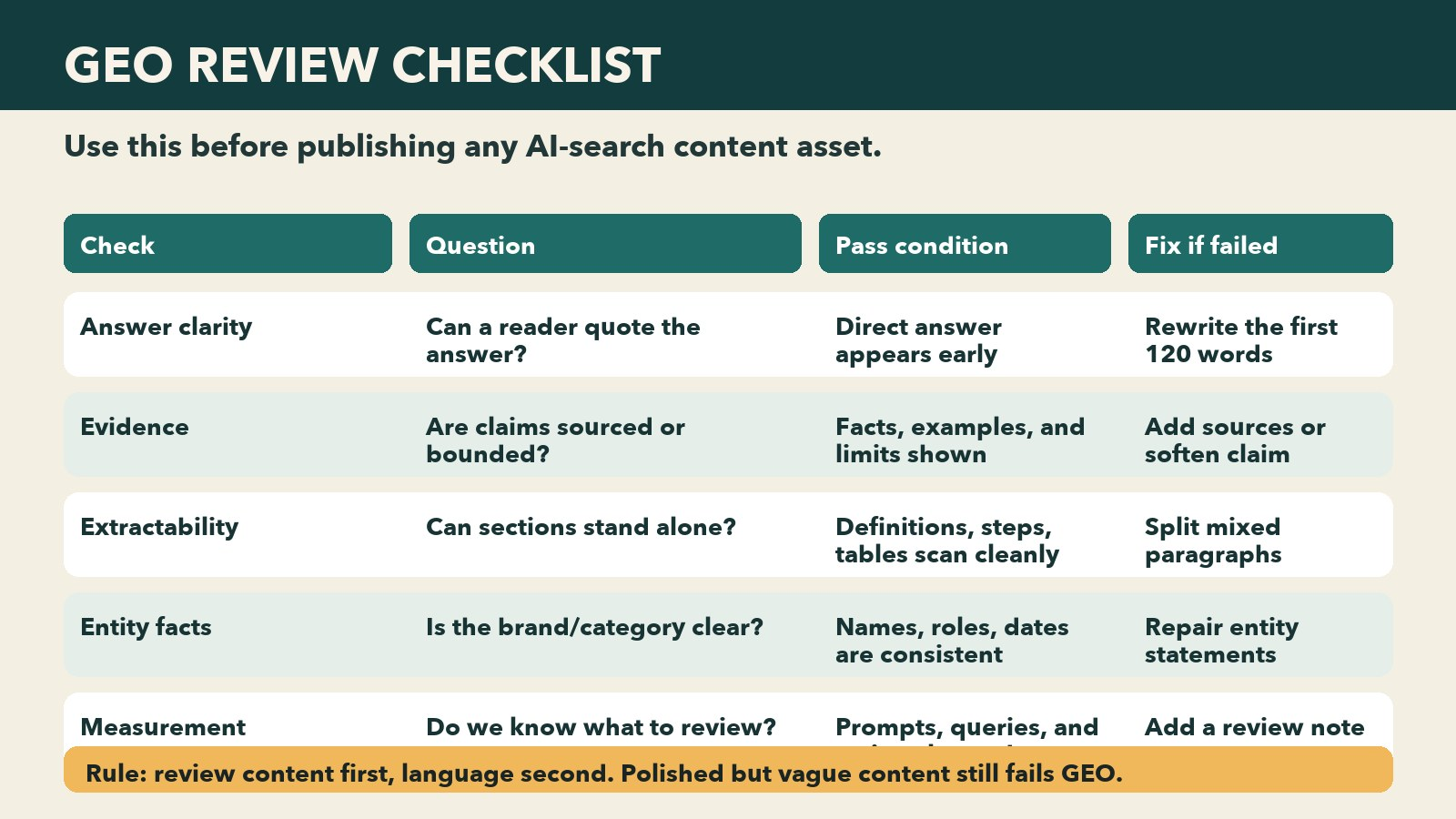
Caption: Review the content layer before polishing language. A clean sentence cannot rescue a weak answer.
Step 6: publish with clean signals
Publishing is still part of the SOP. A good article can lose value if the page gives unclear signals.
Before publishing, check:
- The title and meta description match the actual answer.
- The slug is short and stable.
- The author, date, and update notes are visible where the site supports them.
- Internal links are helpful, not stuffed.
- Images have descriptive alt text.
- Tables render properly on mobile.
- Schema, canonicals, and indexability are not broken.
- The page has a logical next action.
For a GEO article, the next action should connect to the reader's job. If they are diagnosing visibility, link to an audit or checker. If they are building a workflow, link to templates or tools.
For example, after reading this SOP, a team may want to test whether its pages are already visible in AI answers. That is where an AI Search Visibility Checker or a GEO Score Checker fits naturally. One or two internal links are enough.
Step 7: review by question, not just by traffic
The review loop is where GEO content improves.
Do not stop at sessions, impressions, and rankings. Those metrics matter, but they do not explain which part of the content helped or failed.
For GEO content, review the page through questions:
Review question | What it tells you |
|---|---|
Which queries or prompts bring users to the page? | Whether the topic brief matched real demand |
Which sections earn engagement or citations? | Which answer assets are working |
Do AI answer tools mention the brand, page, or idea? | Whether the page is retrievable and citeable |
Are readers converting after the answer? | Whether the next action matches intent |
Which comments or sales questions repeat? | What the next refresh should add |
Set a review window before publishing. For a new evergreen article, a 30-day and 90-day check usually works. For a fast-moving AI search topic, review sooner.
The point is not to declare the article a winner or loser. The point is to trace the result back to the workflow. If the page attracts the wrong readers, revisit the topic brief. If it gets impressions but no engagement, revisit the outline and opening answer. If readers engage but do not convert, revisit the next action.
That is how the SOP becomes a learning system instead of a production checklist.
A reusable GEO content SOP template
Use this as a lightweight operating template for each article.
Stage | Owner | Required output |
|---|---|---|
Topic selection | Strategist or editor | Topic brief with main question, intent, audience, gap, angle, exclusions |
Research | Researcher, strategist, or writer | Evidence board, SERP notes, source list, missing proof notes |
Outline | Editor or senior writer | H2 map, section jobs, extractable assets, internal link plan |
Draft | Writer | First draft focused on answer clarity and section-level usefulness |
Content review | Editor or strategist | Substance fixes, claim checks, differentiation notes |
Language review | Editor | Readability, tone, grammar, formatting, image alt text |
Publish | CMS owner or editor | Metadata, category, tags, image fields, schema, internal links |
Review loop | Growth owner | 30-day and 90-day learning notes by query, prompt, section, and conversion |
Small teams can combine roles. The important part is that the outputs stay visible. If the topic brief or evidence board is missing, the article should not move to drafting.
Common mistakes
The most common mistake is starting with a title that sounds useful but hides three different articles inside it. Fix that by writing the main question and exclusions before the outline.
The second mistake is treating competitor research as a rewrite exercise. The goal is not to average the top five pages. The goal is to find what is already clear, what is missing, and what your team can explain better.
The third mistake is reviewing only for polish. GEO content needs a content review that checks answer quality, evidence, entity clarity, and extractability.
The fourth mistake is publishing without a learning loop. If nobody reviews which questions, sections, or prompts worked, the next article starts from zero again.
FAQ
What is a GEO content SOP?
A GEO content SOP is a repeatable workflow for planning, researching, writing, reviewing, publishing, and improving content that can perform in both search engines and AI answer systems. It focuses on clear answers, reliable evidence, entity consistency, and post-publish learning.
How is GEO content different from SEO content?
SEO content often focuses on ranking for queries and satisfying search intent. GEO content keeps those goals but adds another layer: the content should be easy for AI systems to retrieve, interpret, summarize, and cite. In practice, that means clearer answer blocks, stronger evidence, better structured sections, and cleaner entity signals.
Should every article follow the same SOP?
The workflow should stay consistent, but the depth can change. A strategic guide may need a full research board and two review passes. A short update may only need a compact brief, source check, and fast editorial review. The mistake is not adjusting the depth; the mistake is skipping the thinking entirely.
What should teams measure after publishing GEO content?
Track normal SEO metrics such as impressions, rankings, clicks, and conversions. Add GEO-specific checks such as prompt visibility, citation presence, brand mention quality, AI answer accuracy, section engagement, and the questions that sales or support teams keep hearing after the page goes live.
Can AI tools help with this workflow?
Yes, but they should not replace editorial judgment. AI can cluster questions, summarize competing pages, turn notes into outline options, and draft first-pass tables. A human editor still needs to decide the angle, check evidence, remove weak claims, and make sure the article has a useful point of view.
Sources and further reading
- SEOZZR: GEO content SOP: from topic selection and research to publishing review
- Google Search Central: Creating helpful, reliable, people-first content
- Google Search Central: AI features and your website
Author: Clara Bennett, 10-Year Content Strategy Practitioner at Auspia. Clara writes about editorial systems, topic maps, repeatable content operations, and SEO/GEO production workflows.