Direct answer
SEO is more important when your site lacks rankings, technical health, or search traffic. GEO becomes more important when buyers use AI answers to compare options, shortlist vendors, or ask category questions where your brand should appear.
Most businesses should not choose one. They should sequence the work.
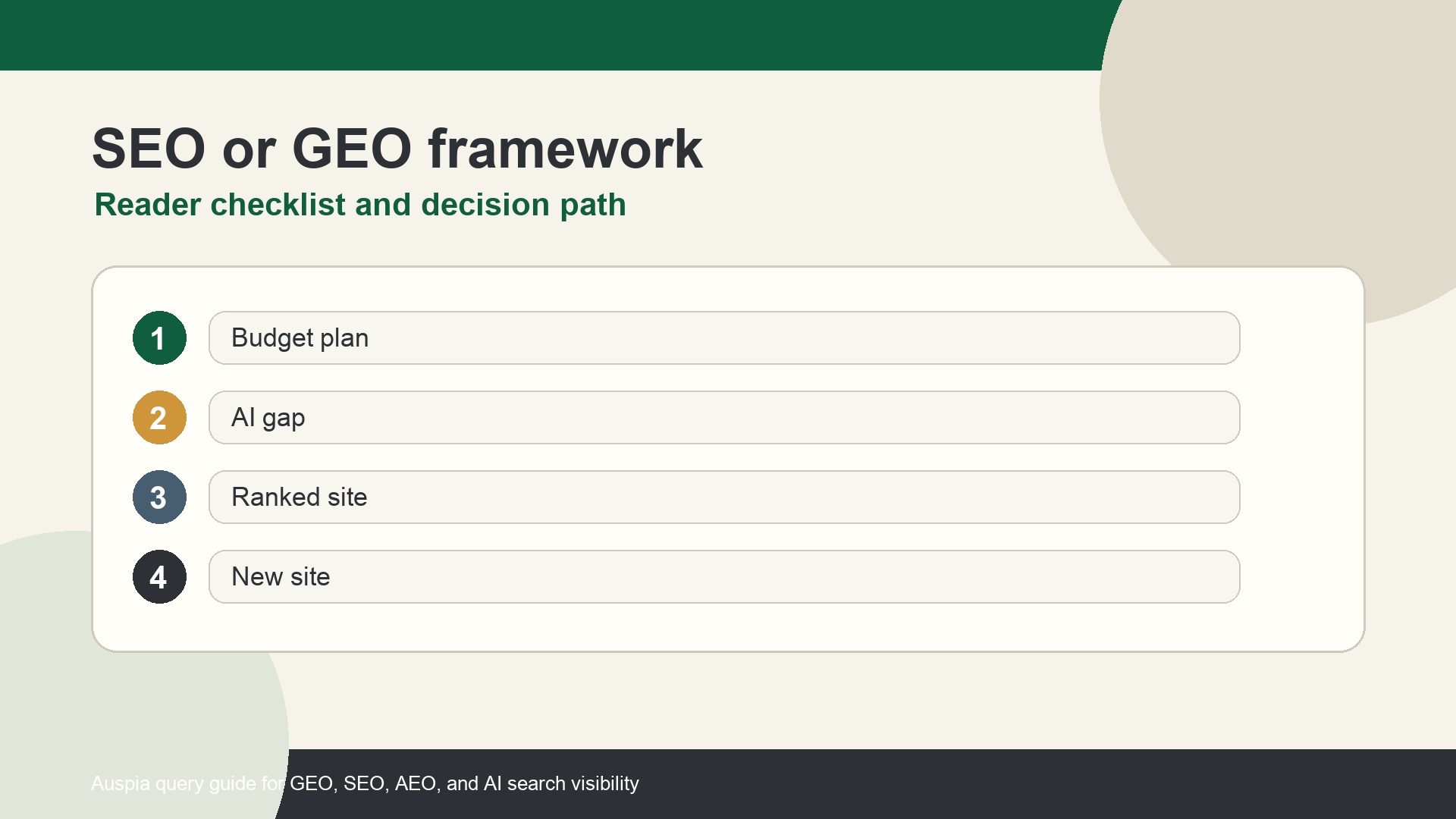
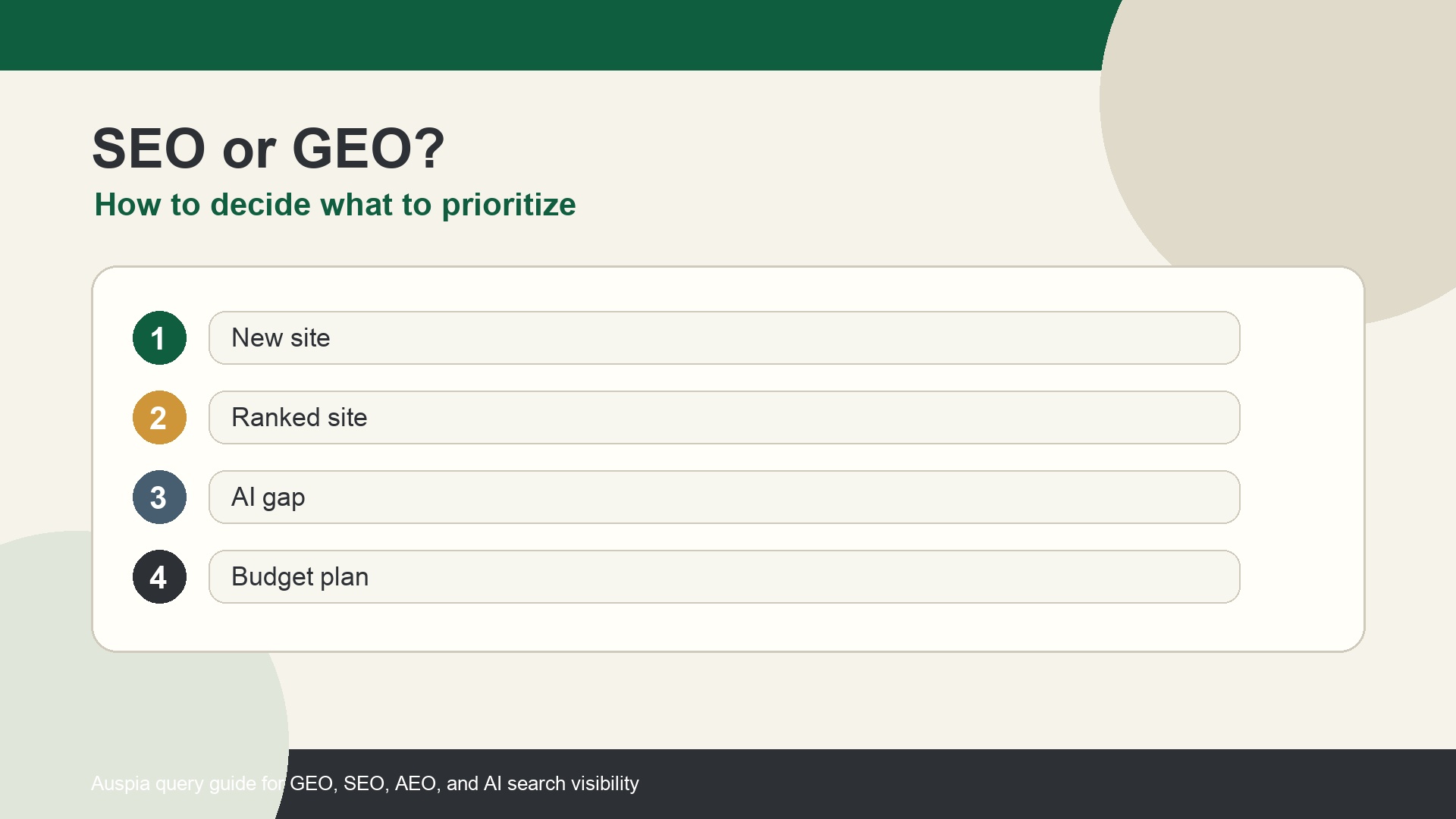
Use this decision table
Business situation | Prioritize | Why |
|---|---|---|
New website, low authority | SEO | You need crawlability, content coverage, and links first. |
Local service business | Local SEO first, GEO second | Maps, reviews, and local pages drive demand, but AI recommendations are growing. |
B2B SaaS with existing rankings | SEO + GEO | Buyers ask AI tools for comparisons and shortlists. |
Ecommerce brand | SEO first for category/product demand, GEO for buying guides | Product discovery still depends on search, but AI shopping research matters. |
Agency or consultant | GEO earlier | Buyers ask AI systems who understands AI Overviews, AEO, and GEO. |
Brand with wrong AI descriptions | GEO now | Accuracy issues can damage consideration even if rankings look fine. |
When SEO gives better results
SEO is usually better for measurable traffic in the short term. You can track impressions, clicks, rankings, conversions, and revenue. If the site has obvious technical issues or thin content, GEO work will not compensate.
SEO is also better for demand that still has strong click behavior: product pages, local services, transactional searches, documentation, support content, and category pages.
When GEO gives better results
GEO becomes valuable when the buyer journey starts in an answer system. This is common for comparison, strategy, and vendor-selection questions.
Examples:
- "Which SEO agency understands AI Overviews and GEO?"
- "What tools bridge traditional SEO and GEO?"
- "What should a SaaS company do about GEO vs SEO?"
- "Which platforms are cited for AI search visibility?"
If your brand is absent from those answers, you may never make the shortlist.
A budget split by maturity
Organic maturity | SEO budget | GEO budget | Notes |
|---|---|---|---|
Foundation | 80% | 20% | Fix technical SEO, core pages, and content gaps. |
Growth | 60% | 40% | Add prompt tracking and citation work to priority clusters. |
Established | 50% | 50% | Run SEO and GEO as one organic visibility program. |
AI-influenced category | 40% | 60% | If buyers heavily use AI answers, invest more in GEO evidence and measurement. |
These are planning ranges, not rules. The right split depends on the buyer journey.
What executives should ask
Do not ask "Is SEO dead?" It is the wrong question.
Ask:
- Which queries still drive clicks and pipeline?
- Which AI prompts influence our buyers?
- Are we mentioned and cited for those prompts?
- Are AI systems describing us accurately?
- Which competitors appear when we do not?
- Which pages should support both ranking and AI citation?
That conversation leads to a better roadmap.
FAQ
Is GEO better than SEO?
Not universally. GEO is better for AI answer visibility. SEO is better for traditional search visibility and measurable traffic. Strong programs use both.
Should small businesses invest in GEO?
Yes, but after SEO basics. A small business should first fix local pages, reviews, crawlability, and service descriptions. Then test AI prompts that buyers might use.
Which one is easier to measure?
SEO is easier to measure because search consoles and analytics platforms are mature. GEO measurement is improving, but teams often need prompt tracking, citation logs, and manual review.
Can GEO drive revenue?
Yes, but attribution is less direct. A buyer may discover a brand in an AI answer, search the brand later, then convert through a direct or organic channel.
Author: Celia Morgan, Executive AI Search Briefing Writer for 300+ Strategy Memos at Auspia. Celia writes about search intent, AI search visibility, and practical organic growth systems for teams that need clearer decisions.