The Short Answer
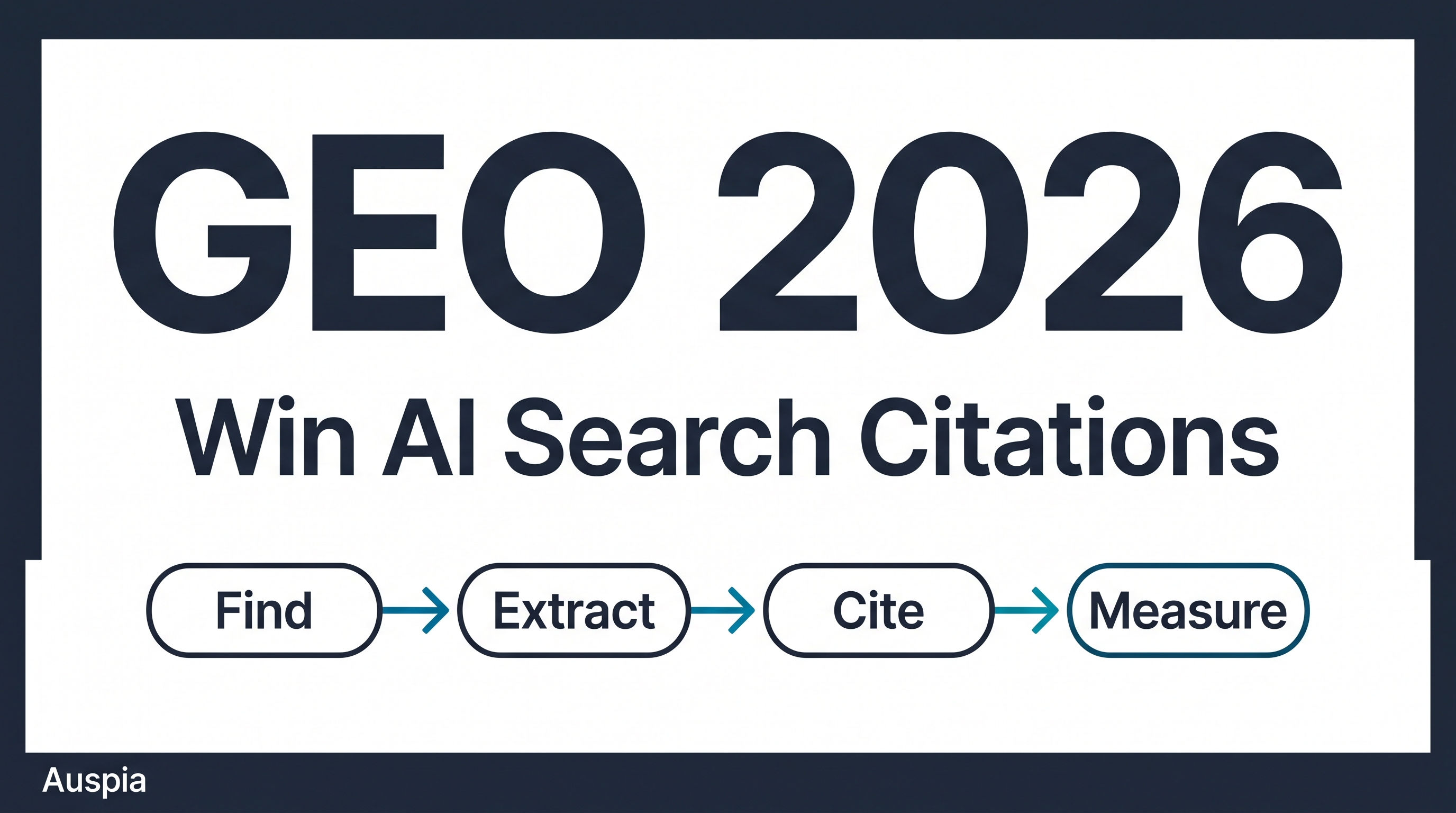
GEO captures AI search traffic by making your brand easier for answer engines to find, understand, quote, and trust. In 2026, that means fixing crawler access, publishing clean machine-readable pages, writing answer-first content, earning third-party validation, and measuring citation share across ChatGPT, Perplexity, Google AI Overviews, Gemini, Claude, and Copilot.
The shift is simple: traditional SEO wins when a user clicks a blue link. GEO wins earlier, when an AI system decides which sources deserve to shape the answer. If your content is useful but hard to crawl, vague in its wording, hidden behind JavaScript, or unsupported by outside evidence, it can rank in Google and still lose the AI answer.
This article is a practical 2026 playbook for growth teams that already understand SEO and now need a clear path into GEO: what to fix first, how to rewrite pages, how platform behavior differs, and how to monitor whether AI engines are actually citing you.
Why GEO Matters More in 2026
Users are increasingly asking AI systems the questions they used to type into search engines. Instead of opening ten tabs, they ask for a comparison, a recommendation, a definition, a vendor shortlist, or a step-by-step plan. The answer often includes cited sources, but the user may never visit the rest of the search results.
That changes the traffic game in three ways:
Old SEO behavior | AI search behavior | GEO implication |
|---|---|---|
User scans search results | AI synthesizes an answer first | Your page must be usable as source material |
Ranking position drives clicks | Citation and mention drive visibility | Track citation rate, not only rankings |
Keywords anchor the page | Entities, passages, and evidence anchor the answer | Write self-contained, factual, structured sections |
Authority comes mostly from links | Authority also comes from consensus sources | Build third-party proof around the brand |
The important point: GEO does not replace SEO. It sits on top of it. If a page cannot be indexed, loaded, parsed, or trusted by search systems, AI visibility usually suffers too. But SEO alone is no longer enough, because AI engines extract passages, compare sources, and summarize the answer before the user chooses whether to click.
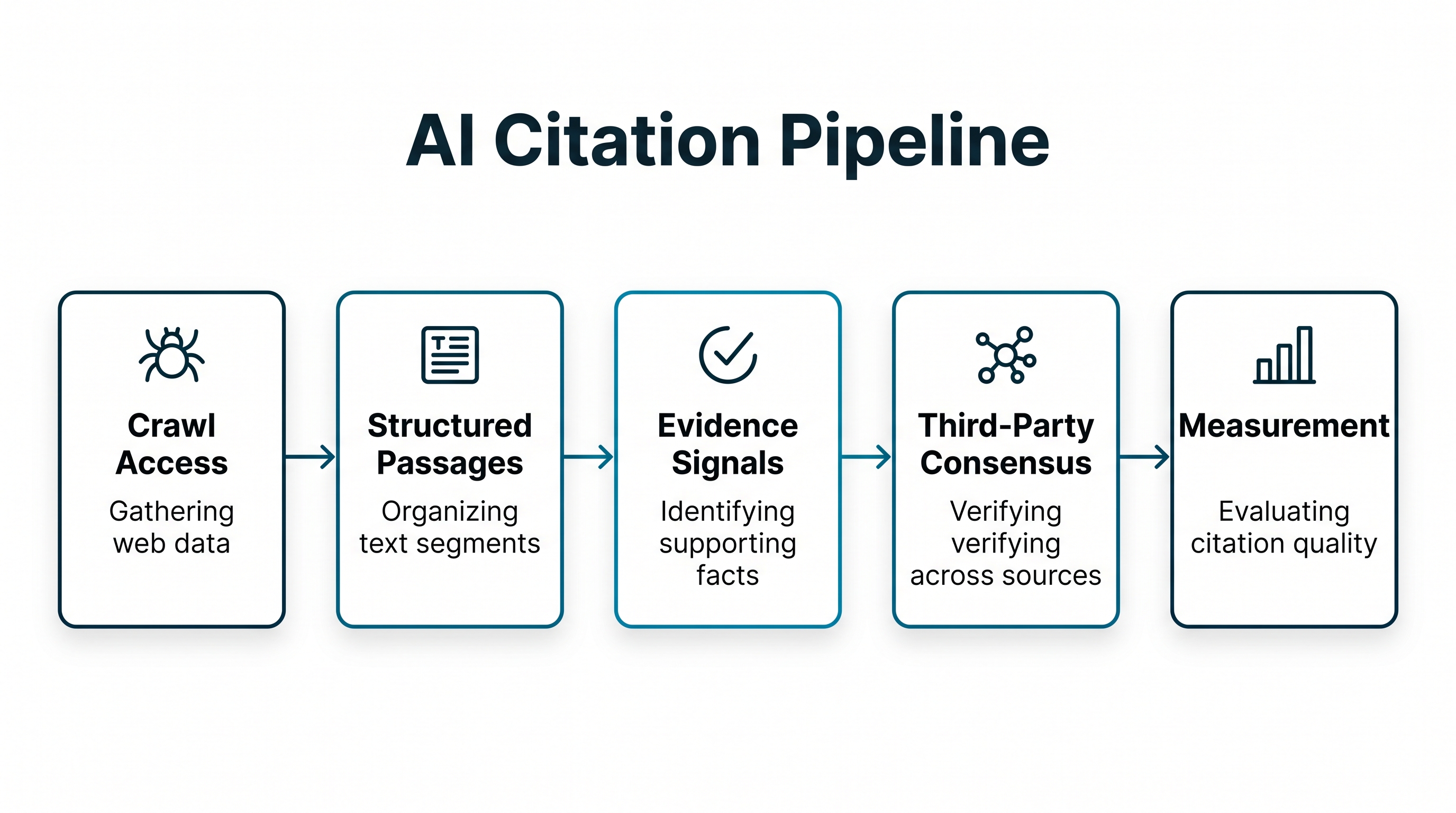
AI citation pipeline: AI search visibility depends on crawl access, extractable passages, evidence, third-party consensus, and measurement.
How AI Engines Decide Which Sources to Cite
Most AI answer systems follow a similar retrieval pattern:
- The user asks a question.
- The system rewrites or expands that question into several searches.
- It retrieves documents, passages, databases, community discussions, or structured sources.
- It ranks the most relevant and trustworthy snippets.
- It synthesizes an answer and may attach citations.
You can influence four parts of that process:
GEO lever | What it means | What to improve |
|---|---|---|
Be discoverable | The engine can crawl and index the page | robots.txt, sitemap, Bing/Google indexing, server-side rendering |
Be extractable | The engine can lift a useful passage | answer-first headings, short paragraphs, tables, schema |
Be quotable | The passage can stand alone without context | precise definitions, dates, numbers, named entities |
Be trustworthy | The source feels safe to cite | author info, references, third-party mentions, freshness |
A page can fail at any one of these layers. Many companies publish strong content but block AI-relevant crawlers. Others allow crawling but bury the answer under a long introduction. Others write useful guides but never earn outside references, so AI systems see them as one unsupported claim among many.
Step 1: Fix the Technical GEO Foundation
Start with technical access because it is the cheapest bottleneck to remove. A beautiful article cannot earn citations if AI systems cannot fetch the core content.
Which AI Crawlers Should You Review?
Review your robots.txt, CDN rules, WAF settings, and server logs for the crawlers that matter to your AI visibility goals. Common examples include:
GPTBot,OAI-SearchBot, andChatGPT-Userfor OpenAI-related discovery and user-triggered browsing behavior.PerplexityBotand Perplexity user agents for Perplexity crawling and answer sourcing.GooglebotandGoogle-Extendedfor Google Search, Gemini-related use cases, and AI Overview visibility policies.Bingbotfor Bing, Copilot, and ChatGPT search paths that rely on Bing-indexed content.- Claude-related user agents where live retrieval or user-requested access is relevant.
Do not treat all bots the same. Some publishers choose to block training crawlers while allowing search or user-triggered retrieval. That is a business decision, but make it deliberately. Accidental blocking is one of the easiest ways to disappear from AI answers.
Should You Add llms.txt in 2026?
Yes, but treat llms.txt as a helpful navigation layer, not a magic ranking switch. The file gives AI systems and agents a concise map of your most important pages. Place it at the site root and keep it short, current, and written in Markdown.
A simple structure looks like this:
# Brand Name
> One sentence explaining who the company helps and what it does.

## Core Products
- [Product Page](https://example.com/product): What the product does and who it is for.
- [Pricing](https://example.com/pricing): Plans, use cases, and buying information.

## Best Reference Pages
- [Main Guide](https://example.com/guide): Definitive explanation of the category.
- [FAQ](https://example.com/faq): Common buyer questions and direct answers.

## Docs and Data
- [API Docs](https://example.com/docs): Technical documentation.
- [Research Report](https://example.com/report): Public benchmark or methodology.
If you have developer documentation, consider an llms-full.txt or Markdown documentation export as well. Models often handle clean Markdown better than fragmented, script-heavy pages.
Which Schema Types Help GEO?
Use JSON-LD to clarify entities and page purpose. Prioritize:
Schema type | Best use case | GEO value |
|---|---|---|
| Brand, logo, sameAs profiles, contact points | Helps entity clarity |
| Blog posts, reports, guides | Exposes author, date, headline, image |
| Real question-answer sections | Helps extract direct answers |
| Step-by-step workflows | Helps systems understand process content |
| SaaS/product pages | Clarifies features, category, offer, reviews where valid |
Schema will not rescue thin content, but it reduces ambiguity. In AI search, ambiguity is expensive.
Why Rendering Still Matters
Critical content should be visible in the initial HTML. Many AI and search crawlers can process JavaScript to some degree, but complex client-side rendering still creates risk. If your pricing, product description, comparison table, or FAQ only appears after heavy JavaScript execution, make a server-rendered or static version available.
A practical target: make the main content readable without interaction, without login, and without waiting on nonessential scripts.
Step 2: Rewrite Content for AI Extraction
GEO writing is not about sounding robotic. It is about making each important passage useful even when pulled out of context.
Put the Answer Before the Story
Start important pages with a short answer block. It should name the topic, define the entity, state the main claim, and explain who should care.
Bad opening:
The world of digital discovery is changing faster than ever, and brands need to adapt to a new era of innovation.
Better opening:
Generative engine optimization is the process of making web content easier for AI answer engines to retrieve, summarize, and cite. It matters for B2B brands because buyers now ask ChatGPT, Perplexity, Gemini, and Google AI Overviews for vendor recommendations before they visit a website.
The second version gives an AI system a usable passage. It names the concept, explains the mechanism, and connects it to a buyer use case.
Use Questions as Headings
AI systems often decompose prompts into sub-questions. Your headings should match those questions.
Use headings like:
- What is GEO?
- How does GEO differ from SEO?
- Which pages should be optimized first?
- How do AI engines choose citations?
- What should a SaaS team measure weekly?
Avoid vague headings like:
- The New Era
- Our Approach
- Why It Matters
- Final Thoughts
Question-led headings help both human readers and answer engines understand the page structure.
Make Paragraphs Self-Contained
Every key paragraph should survive copy-paste. Avoid phrases like "as mentioned above," "this approach," or "these tools" unless the noun is clear in the same paragraph.
A strong GEO paragraph usually has four traits:
- It is 40-80 words.
- It names the entity or topic directly.
- It contains one main idea.
- It includes a concrete detail: a date, source type, platform, number, example, or constraint.
Add Evidence Without Faking Authority
AI engines are more comfortable citing pages that show where claims come from. Use named sources, public documentation, original data, customer examples, or clear methodology notes. If a number is from your own analysis, say how you collected it. If a claim is a market observation, label it as such.
Do not invent citations, fake expert quotes, or imply that a third-party result belongs to your company. GEO rewards clarity, not theatrical authority.
Step 3: Match the Platform, Not Just the Keyword
Each AI surface retrieves and cites sources differently. A generic "AI SEO" checklist misses these differences.
Platform | What usually matters | Practical GEO move |
|---|---|---|
ChatGPT with search | Bing visibility, clear answer structure, reputable consensus sources | Check Bing indexation, write answer-shaped summaries, strengthen brand facts |
Perplexity | Fresh pages, source transparency, community or publication references | Add FAQ sections, publish timely explainers, make public PDFs or reports crawlable |
Google AI Overviews | Google index quality, entity understanding, passage relevance, topical coverage | Build topic clusters, strengthen schema, update pages with clear dates |
Gemini | Google ecosystem signals and entity clarity | Align Organization schema, About page, product pages, and Knowledge Graph signals |
Claude | High factual density and clear long-form context | Publish precise guides, docs, and Markdown-friendly reference material |
Copilot | Bing indexation plus Microsoft ecosystem signals | Submit important URLs to Bing Webmaster Tools and keep technical pages indexable |
Grok | Public X discussion and social context | Build credible public conversation; avoid turning every post into an ad |
The lesson is not to create seven separate content programs. The lesson is to make one strong source layer and then check whether each platform can retrieve it.
Step 4: Build the Third-Party Consensus Layer
Your own website is the source you control. Third-party sources are the proof layer AI systems use to compare claims.
In 2026, GEO teams should map where their category conversations happen:
- Review platforms such as G2, Capterra, Trustpilot, Product Hunt, or marketplace listings.
- Developer and technical communities such as GitHub, Stack Overflow, Hacker News, and docs ecosystems.
- Professional networks such as LinkedIn, partner pages, analyst articles, podcasts, and conference pages.
- Community discussions such as Reddit, niche forums, Slack communities, and Discord servers where public pages are indexable.
- Reference-style assets such as Wikipedia, Wikidata, industry glossaries, public benchmark reports, and comparison pages.
This does not mean spamming every community with links. It means making sure the market can describe your brand accurately without relying only on your own homepage.
A useful test: ask, "If an AI engine ignored our website for one query, would the open web still explain who we are, what we do, and when we are a good fit?" If the answer is no, your consensus layer is thin.
Step 5: Measure GEO With Prompts, Citations, and Descriptions
Rank tracking is not enough. AI systems can mention your brand without linking to you, cite a competitor while describing your category, or quote an outdated page. You need a weekly prompt-based measurement loop.
Start with 30-80 prompts across five groups:
Prompt group | Example prompt | What to record |
|---|---|---|
Brand definition | "What is [brand], and who is it best for? Include sources." | Is the description accurate? |
Category discovery | "Best tools for [use case] in 2026. Cite sources." | Are you mentioned or excluded? |
Competitor comparison | "[Brand] vs [competitor]: when should I choose each?" | Are claims fair and current? |
Problem-solution | "How should a B2B SaaS team solve [problem]?" | Which sources shape the answer? |
Buying criteria | "What should I check before buying [category] software?" | Which features and proof points appear? |
For each run, record:
- Whether your brand appears.
- Whether your URL is cited.
- Which page is cited.
- Whether the answer is accurate.
- Which competitors appear.
- Which third-party sources are used.
- Whether the same prompt changed week over week.
Then pair prompt tracking with analytics. Watch referral traffic from AI domains, UTM patterns where available, assisted conversions from AI-search visitors, and branded search changes after AI mentions increase.
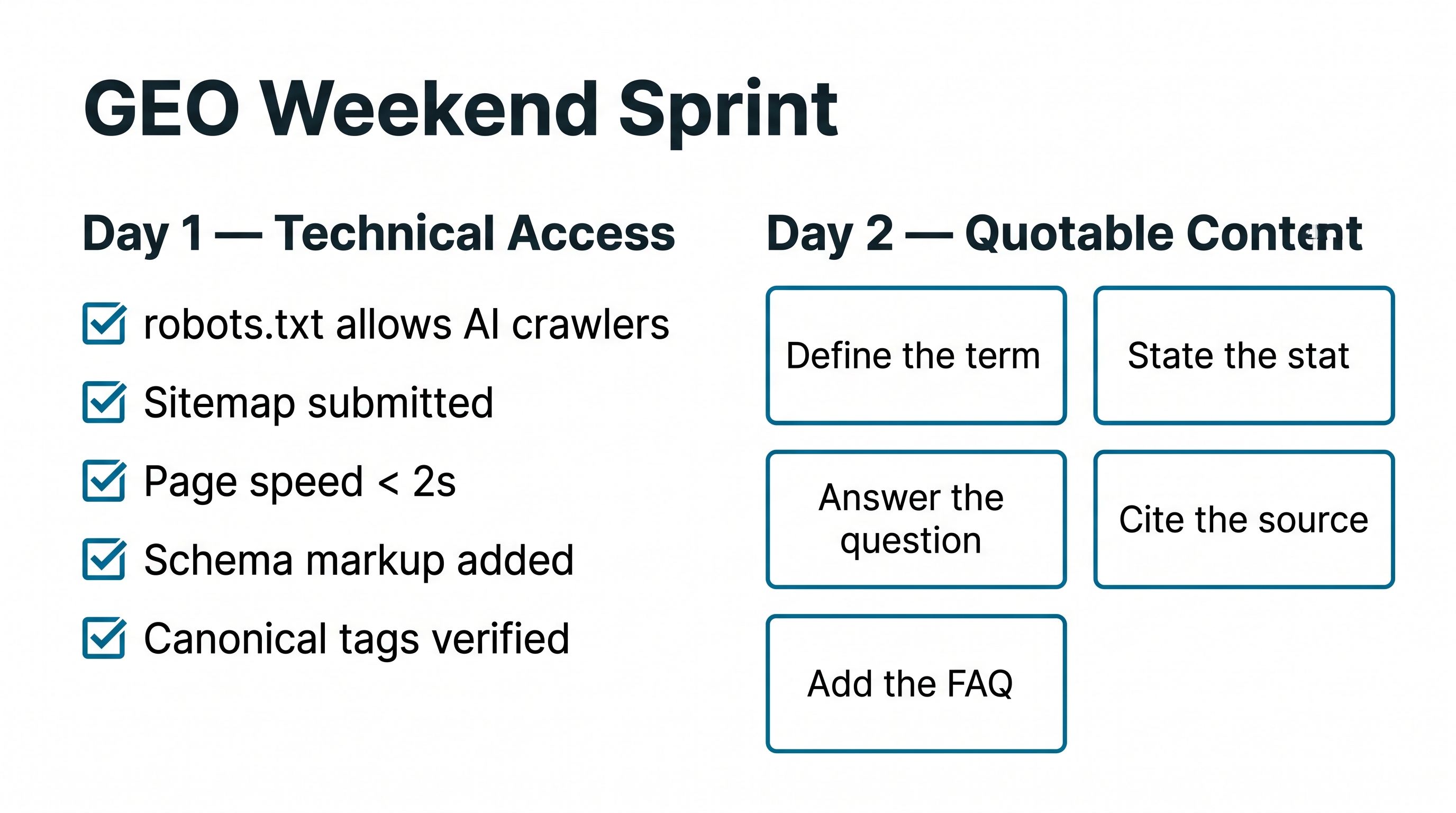
Two-day GEO sprint: fix technical access first, then make the highest-value pages quotable.
What Should You Do First If You Only Have One Weekend?
If you have two days, do not try to rebuild your whole content program. Fix the bottlenecks that affect the most important pages.
Day 1: Make the Site AI-Accessible
- Review
robots.txtand crawler rules. - Confirm key pages are indexed in Google and Bing.
- Publish or refresh
llms.txt. - Add Organization, Article, FAQPage, and HowTo schema where relevant.
- Make core page content available in the initial HTML.
- Remove blockers such as login walls, intrusive overlays, or broken canonical tags on strategic pages.
Day 2: Make the Top Pages AI-Quotable
Choose 3-5 pages that already matter for traffic or revenue. For each one:
- Add a 50-100 word answer block near the top.
- Rewrite vague H2s into real user questions.
- Break long sections into self-contained paragraphs.
- Add one comparison table, checklist, or FAQ block.
- Add dates, named entities, and source references where they genuinely help.
- Link to one deeper guide, tool, or report that supports the claim.
After the weekend, set a weekly measurement cadence. GEO compounds when you keep improving the pages that AI systems already almost cite.
A Practical GEO Checklist for 2026
Use this checklist before you call a page "AI-search ready."
Check | Pass condition |
|---|---|
Crawl access | Important AI/search crawlers are intentionally allowed or blocked by policy, not accident |
Indexation | Strategic pages are discoverable in Google and Bing |
Rendering | Core text appears in initial HTML |
Structure | The page has answer-first sections, question headings, and short paragraphs |
Evidence | Claims include sources, dates, examples, or methodology notes |
Entity clarity | Brand, product, author, and category are consistently named |
Schema | Valid JSON-LD is present where relevant |
Freshness | The page has a visible updated date when freshness matters |
Third-party proof | External sources describe or validate the brand/category |
Measurement | Prompts, citations, descriptions, and referral traffic are tracked weekly |
Where Auspia Fits
GEO can feel abstract until you test a real site. The fastest next step is to audit whether your pages are crawlable, structured, and citation-ready before you spend weeks rewriting content.
Auspia's free GEO Score Checker gives you a quick read on the basics: AI-search visibility signals, content structure, technical readiness, and practical fixes. Use it on your homepage, top product page, and one high-intent article. If the scores differ sharply, start with the page closest to revenue.
FAQ
What is GEO in 2026?
GEO, or generative engine optimization, is the practice of making content easier for AI answer engines to retrieve, understand, summarize, and cite. In 2026, GEO includes technical crawl access, structured content, schema, entity clarity, third-party validation, and prompt-based measurement.
Is GEO different from SEO?
GEO builds on SEO but optimizes for a different outcome. SEO often focuses on rankings and clicks from search results. GEO focuses on whether AI answer systems mention, describe, and cite your brand or content when users ask questions.
Does llms.txt guarantee AI citations?
No. llms.txt does not guarantee citations or rankings. It is a machine-readable guide that helps AI systems and agents discover your important pages. It works best when paired with indexable pages, strong content, schema, and external proof.
Which pages should I optimize for GEO first?
Start with pages tied to revenue and authority: homepage, product pages, comparison pages, high-intent guides, pricing or plan pages, documentation, and original research. These pages are most likely to shape AI answers about your category, brand, and buying criteria.
How do I measure AI search visibility?
Measure AI search visibility by running a fixed prompt set across platforms, recording brand mentions, URL citations, cited pages, description accuracy, competitor presence, and weekly changes. Pair that with referral traffic from AI domains and assisted conversion data.
Author: Bennett Hayes, Applied GEO Analyst Across 400+ Implementation Reviews at Auspia. Bennett writes about practical GEO execution, audits, and implementation notes for teams turning AI-search visibility into a repeatable workflow.