Executive summary
In 2026, appliance shoppers do not move in a straight line from Google to a product page anymore. They ask AI systems questions such as "Which washer is better for a small apartment?", "Is a heat-pump dryer worth it?", or "What does ENERGY STAR certified actually save?" The brands that show up inside those answers will not be the brands with the loudest slogan. They will be the brands with the clearest specs, the most useful buying guidance, and the most consistent proof across their own site, retailer pages, reviews, manuals, videos, and third-party references.
This article uses home laundry appliances as the working example because the category has the same pattern many durable-goods brands now face: high price, long comparison cycles, technical questions, service concerns, and a lot of distrust around vague claims. The playbook applies to HVAC, kitchen appliances, smart home devices, mattresses, water filters, fitness equipment, and other considered purchases.
The short version: GEO in 2026 is not "AI keyword stuffing." It is the work of becoming a better source for the questions buyers already ask.
Why appliance brands need a 2026 GEO plan
Home appliance growth is harder than it looked a few years ago. Replacement demand still exists, but most shoppers compare more carefully. Retail media costs are not cheap. Marketplace pages are crowded. Product pages often say the same things: powerful, quiet, efficient, smart.
Meanwhile, buyers have become more research-heavy. Before they spend $800, $1,500, or $3,000 on an appliance, they want practical answers:
- What size do I need for a household of four?
- Is the premium model actually quieter?
- Will it fit through my doorway?
- Does the installation require a special outlet, vent, drain, or clearance?
- Which features matter, and which ones are marketing?
- What do real owners complain about after six months?
AI search surfaces, chat assistants, retail AI guides, and Google AI Overviews are becoming part of that research path. A buyer may never type your exact brand name at the start. They may start with a use case: "best washer dryer for a condo with no vent." If your brand has no clear answer assets for that use case, the AI system has little reason to mention you.
That is the opening for GEO.
The market pattern: comparison has moved from brands to questions
Large appliance brands still have advantages: distribution, recognition, service networks, and review volume. Smaller brands and challengers cannot usually outspend them across every channel.
But AI-led discovery creates more specific entry points. Instead of fighting only for broad terms like "best washing machine," a brand can compete around narrower decision moments:
Buyer situation | Search or AI prompt | What the brand should own |
|---|---|---|
Small apartment | "best compact washer dryer for apartments" | Fit, noise, venting, capacity, installation photos |
Family laundry | "washer capacity for family of four" | Load-size guide, drum capacity examples, cycle recommendations |
Energy savings | "heat pump dryer vs vented dryer electricity cost" | Transparent assumptions, calculator, comparison table |
Allergy concerns | "washer settings for pet hair and allergies" | Fabric care guidance, rinse-cycle explanation, filter maintenance |
Installation fear | "what to check before washer dryer delivery" | Doorway checklist, outlet requirements, drainage diagrams |
Here is where a challenger brand can enter the conversation. AI systems tend to reward sources that answer the exact question with enough detail to be useful. A brand does not need to be famous for every prompt. It needs to be the clearest source for the prompts that match its product strengths.
Why home laundry is a natural GEO category
Laundry appliances are boring until someone needs to buy one. Then the details matter a lot.
Capacity is confusing. Cubic feet, kilograms, family size, bedding size, and real load behavior do not translate neatly. A 4.5 cu. ft. washer sounds simple until the buyer asks whether it can handle a king comforter.
Energy claims are easy to overstate. Heat-pump dryers, high-efficiency washers, cold-water cycles, and ENERGY STAR labels all need explanation. Buyers want the cost difference, but the answer depends on local electricity prices, load frequency, fabric type, and drying habits.
Installation questions can block conversion. A buyer may love the product but hesitate because they are unsure about venting, stacking kits, drain hoses, doorway width, delivery stairs, or smart-home setup.
Reviews are full of hidden objections. Noise, vibration, odor, app reliability, long cycle times, and service availability often matter more than the official feature list.
These are exactly the topics where AI systems look for answerable, source-backed content. A product page that only says "large capacity, quiet operation, advanced cleaning" is weak material. A cluster of guides, tables, diagrams, FAQs, spec pages, owner manuals, and support articles is much stronger.
What GEO means for appliance brands
Generative Engine Optimization is the practice of making your brand, product data, and evidence easier for AI answer systems to find, understand, compare, and cite.
For appliance brands, that usually means five things:
- Your product facts are consistent everywhere.
- Your category education is better than the retailer's thin product copy.
- Your proof is specific: certifications, test conditions, manuals, warranty terms, service coverage, and owner feedback.
- Your pages answer real buyer questions in extractable formats.
- Your brand is mentioned by sources outside your own site when the claim needs third-party support.
GEO is connected to SEO, but it is not identical. SEO often starts with ranking pages. GEO starts with answer inclusion: can an AI system confidently use your information when explaining a choice?
A practical test is simple. Ask an AI system: "Which washer dryer is best for a small apartment with no exterior vent?" Then ask: "What sources would you use to decide?" If your brand has no page that answers that question directly, you are asking the model to infer too much.
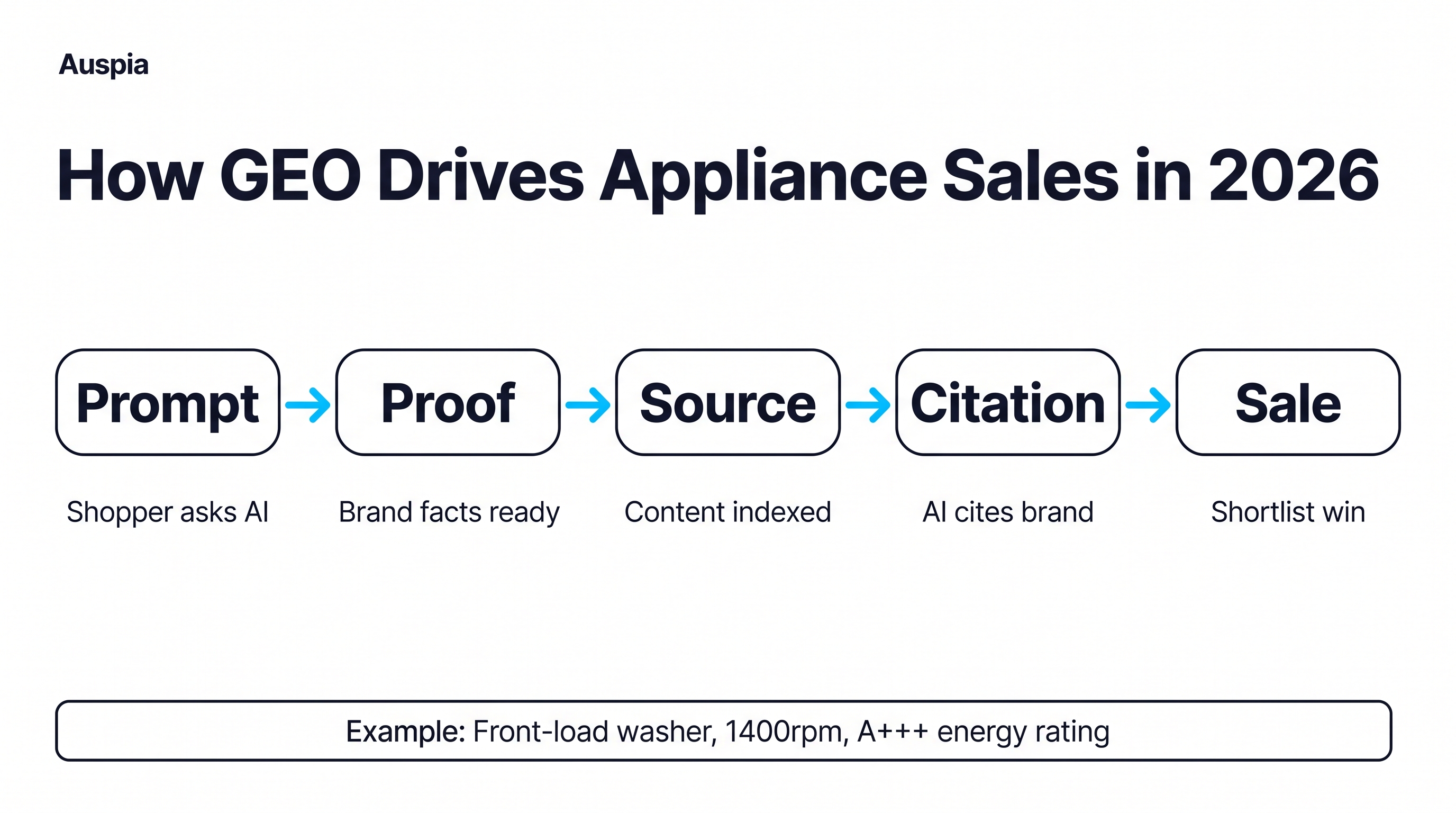
Caption: A 2026 appliance GEO workflow connects buyer prompts to proof assets, citable sources, AI answer inclusion, and eventual product consideration.
Step 1: map audience segments and AI prompts
Start with buyer situations, not keywords. Appliance buyers think in constraints.
For a laundry brand, the main segments might look like this:
- Condo and apartment residents who need compact size, low noise, and simple installation.
- Families who care about capacity, speed, stain performance, and durability.
- Energy-conscious buyers comparing heat-pump dryers, high-efficiency washers, and cold-water cycles.
- Pet owners and allergy-sensitive households that need better rinse, filter, and fabric-care guidance.
- Landlords or property managers who care about reliability, warranty, and service calls.
Turn each segment into prompts:
- "What washer dryer fits in a 24-inch laundry closet?"
- "Is a 2.4 cu. ft. washer enough for two people?"
- "Heat pump dryer pros and cons for apartments"
- "Washer vibration on second floor: what to check"
- "Laundry appliance checklist before delivery"
Then build a prompt library. Track which prompts are commercial, which are educational, which are post-purchase support questions, and which are risk questions. This becomes the content map.
Auspia users can also run recurring checks with an AI Search Visibility Checker to see whether brand mentions, citations, and answer framing change over time.
Step 2: make product facts consistent across the web
AI systems get confused when the same model has different numbers on different pages. Humans do too.
For each product, create a single source of truth for:
Data type | Examples | Why it matters for AI answers |
|---|---|---|
Identity | Brand name, model name, model number, UPC or SKU | Prevents entity confusion and wrong model grouping |
Dimensions | Width, depth, height, clearance, door swing | Supports fit and installation answers |
Capacity | Drum volume, load examples, household suitability | Supports comparison and buying guidance |
Energy | Certification, annual kWh, test standard, assumptions | Prevents vague savings claims |
Noise and vibration | Decibel range, test setup, floor guidance | Helps answer apartment and upstairs-installation prompts |
Installation | Venting, outlet, drain, stacking, kit requirements | Removes purchase blockers |
Warranty and service | Coverage period, exclusions, service areas | Builds trust and reduces support uncertainty |
Push the same facts to your own site, retailer feeds, marketplace listings, manuals, schema markup, help center pages, and PR/product launch materials. If a retailer page lists an old depth measurement, fix it. If a manual uses a different model name than the product page, fix that too.
This work is unglamorous. It is also one of the highest-leverage GEO tasks. AI systems cannot recommend what they cannot disambiguate.
Step 3: build a category education layer
Most appliance websites underinvest in education. They publish product pages, then expect retailers, review sites, and Reddit threads to explain the category for them.
That is risky. If third-party sources explain the category better than you do, AI systems will lean on them.
For laundry appliances, the education layer should include:
- A washer capacity guide with real household examples.
- A heat-pump dryer vs vented dryer comparison with energy assumptions.
- A compact laundry installation guide for apartments and closets.
- A noise and vibration troubleshooting guide.
- A cycle guide that explains quick wash, sanitize, delicate, bedding, and eco settings.
- A maintenance guide for filters, door seals, detergent use, and odor prevention.
Each guide should answer the question first, then explain the caveats. Avoid burying the useful answer under brand storytelling.
For example, a capacity guide might open with:
"For one or two adults, a compact washer around 2.3 to 2.8 cu. ft. usually handles weekly laundry, towels, and light bedding. Families washing bulky bedding often need a larger drum. Check the actual load examples, not just the capacity number."
That sentence is more useful to an AI answer than a paragraph about innovation.
Step 4: turn proof into answer assets
Appliance buyers are skeptical for good reasons. They have seen too many exaggerated claims: ultra quiet, most efficient, professional-grade, maintenance-free.
GEO-friendly proof is more boring and more useful.
Use evidence such as:
- ENERGY STAR listings and the specific model identifiers that match them.
- Test conditions for noise, energy, drying time, and cleaning performance.
- Installation diagrams with measurements and clearance notes.
- Warranty PDFs that explain what is covered and what is not.
- Service-area pages with realistic response expectations.
- Owner review summaries that include positive and negative themes.
- Support articles that acknowledge common issues instead of hiding them.
Do not say "quietest washer" unless you can support the claim and know the legal limits in your market. Say "tested at X dB under Y conditions" if you have that data. If you do not, explain the practical factors that affect noise: floor type, leveling, load balance, spin speed, and installation.
AI systems are more likely to use information that has conditions attached. So are careful buyers.
Step 5: adapt content for different AI surfaces
A 2026 GEO plan should not assume one platform behavior. ChatGPT, Perplexity, Gemini, Google AI Overviews, retailer AI assistants, and category-specific recommendation engines all handle sources differently.
A better approach is to create durable source assets and adapt the format by surface:
Surface | Content that tends to help | Practical move |
|---|---|---|
Google AI Overviews | Clear answer pages, comparison tables, schema, trusted references | Publish concise guides with FAQ and structured data |
ChatGPT-style assistants | Well-structured explainers and consistent entity facts | Keep product facts stable and easy to retrieve |
Perplexity-style search | Citable articles, docs, reviews, third-party mentions | Build pages that answer specific prompts and earn references |
Retail AI shopping guides | Feed quality, product attributes, review themes | Clean product data feeds and retailer content |
YouTube and visual search | Installation videos, comparison visuals, troubleshooting clips | Add descriptive titles, captions, transcripts, and alt text |
This is not about copying the same post everywhere. It is about making the same truth available in the format each system can use.
Step 6: use multimodal content because appliances are physical products
Text alone cannot solve every appliance question. Buyers need to see size, clearance, controls, hose placement, stacking hardware, filter access, and installation steps.
Create visual assets that AI and humans can understand:
- Dimension diagrams with width, depth, height, and clearance.
- Installation checklists shown as one-page graphics.
- Short videos showing leveling, filter cleaning, stacking kit setup, and ventless installation.
- Product photos with descriptive filenames and alt text.
- Comparison charts that show the tradeoff between compact, standard, and large-capacity models.
A useful filename is not IMG_4821.jpg. Use something like compact-washer-24-inch-clearance-diagram.jpg. Alt text should describe the information: "Diagram showing 24-inch compact washer clearance requirements for a laundry closet."
For AI visibility, multimedia needs text around it. Add captions, transcripts, and nearby explanations so the image is not isolated from the answer.
Step 7: measure visibility, not just traffic
GEO measurement is still messy. That does not mean teams should wait.
Create a weekly or biweekly prompt set. Use 30 to 100 prompts across buying, comparison, installation, and troubleshooting intent. Record:
- Whether your brand appears.
- Which competitors appear.
- Whether the answer cites or references your pages.
- Which page or source was used.
- How the brand is described.
- Whether the description is accurate.
- Whether the answer recommends a next step that helps conversion.
Then map misses to actions. If AI answers mention competitors for "ventless dryer for apartments" because they have stronger installation guides, write the guide. If answers describe your product incorrectly, audit product feeds and schema. If your brand appears but is framed as expensive or hard to install, build proof that addresses that objection.
Measurement is less about a perfect score and more about a repeatable loop: prompt, observe, fix, publish, recheck.
Compliance lines appliance brands should not cross
GEO does not make advertising law disappear. In fact, AI answer visibility can make risky claims spread faster.
For appliance brands, be careful with:
- Energy savings claims without test conditions or assumptions.
- "Best," "most efficient," "quietest," or "number one" claims without substantiation.
- Health-related claims around allergen removal, bacteria reduction, mold, or sanitization.
- Installation pricing that excludes unavoidable fees.
- Warranty promises that hide exclusions.
- Competitor comparisons that cherry-pick data.
A good rule: if a claim would make your legal or compliance team nervous on a product page, do not try to sneak it into a GEO page, FAQ, social post, or video transcript.
Transparent limits often work better anyway. "Drying time varies by load size, fabric type, and room conditions" sounds less flashy, but it builds trust.
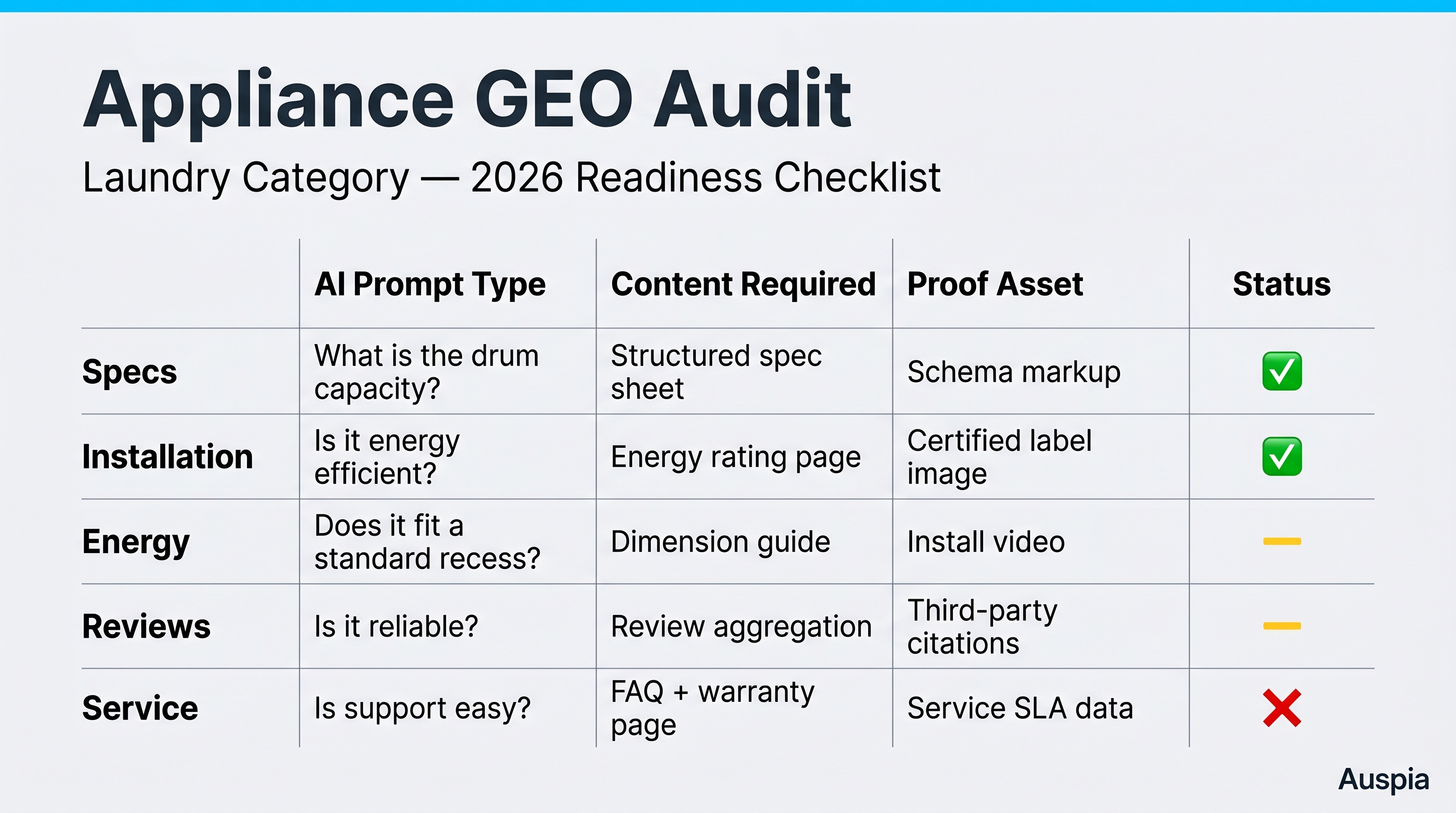
Caption: A practical audit matrix helps appliance teams find missing facts and weak proof before AI systems form the answer without them.
A 30-day rollout plan
If the team is small, do not start with 80 articles. Start with the assets that remove buying friction.
Week | Main task | Output |
|---|---|---|
1 | Prompt and data audit | 50 buyer prompts, competitor answer notes, product fact sheet |
2 | Entity and spec cleanup | Updated product pages, retailer feed fixes, schema improvements |
3 | First education cluster | Capacity guide, installation checklist, energy comparison page |
4 | Proof and measurement loop | Review-theme summary, FAQ updates, first visibility report |
By the end of 30 days, you should know which prompts you can win, which claims need proof, and which product facts are still confusing AI systems.
After that, expand by use case: apartments, families, pet owners, energy savers, landlords, premium remodels, and support-heavy topics.
Common mistakes
Mistake one is treating GEO as a content-volume game. Publishing 100 thin AI-written pages will not fix unclear product facts or weak proof.
Mistake two is copying retailer copy into blog posts. Retailer copy is usually too shallow for AI answers and too repetitive for humans.
Mistake three is hiding negative review themes. If owners complain about vibration, long dry times, or app setup, answer those concerns directly. AI systems may find the complaints elsewhere anyway. Better that your brand explains the cause, prevention steps, and support path.
Mistake four is measuring only branded prompts. Of course your brand may appear when the prompt includes your brand name. The real test is whether you appear for category and use-case prompts before the buyer has chosen a shortlist.
Mistake five is using unsupported superlatives. In 2026, the safer and stronger move is to publish test conditions, comparison assumptions, and practical buyer guidance.
FAQ
What is GEO for appliance brands?
GEO for appliance brands means making product facts, buyer guides, proof, reviews, and support content easier for AI answer systems to find, understand, compare, and cite. It helps a brand appear in AI-generated buying guidance for use-case questions, not only branded searches.
Is GEO different from SEO?
Yes, but they overlap. SEO focuses on search visibility and rankings. GEO focuses on whether AI answer systems can include your brand or product in synthesized answers. Strong technical SEO, structured data, clear content, and third-party references all support GEO.
Which appliance pages should brands create first?
Start with pages that answer high-friction buying questions: sizing, installation, energy use, noise, warranty, maintenance, and model comparisons. For laundry appliances, a capacity guide and installation checklist are usually good first assets.
How often should a team check AI visibility?
For active categories, check a fixed prompt set weekly or every two weeks. Track brand mentions, citations, competitor mentions, answer accuracy, and the sources used. Monthly checks may be enough for slower categories.
Can small appliance brands win GEO visibility?
Yes, especially around narrow use cases. A smaller brand can beat larger competitors for prompts where it has clearer specs, better guides, better proof, or more useful installation content. Broad "best appliance" prompts are harder; specific buyer situations are more realistic.
Final takeaway
The next appliance buyer may not begin with a brand. They may begin with a problem: a narrow laundry closet, a high electricity bill, a noisy second-floor washer, a new baby, a rental unit, a pile of pet hair.
If your content answers that problem better than anyone else, AI systems have a reason to bring you into the shortlist.
That is the work of GEO in 2026: become the clearest source before the buyer has decided who deserves attention.
Author: Isabel Grant, Researcher of 2,000+ AI Citation Patterns at Auspia. Isabel writes about citation earning, source quality, and how brands become reliable inputs for AI search systems.