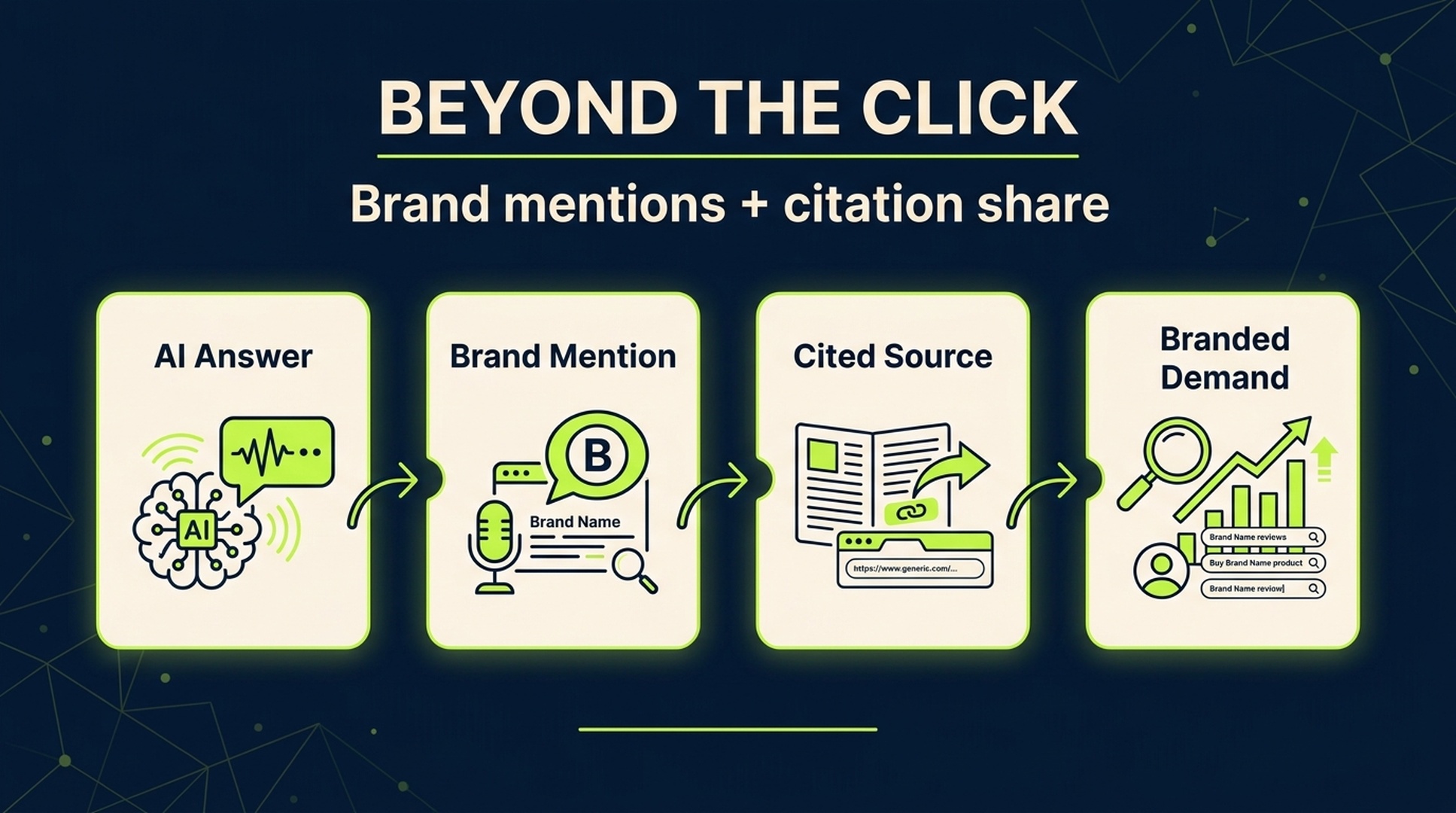
AI search has changed a simple assumption behind organic reporting: that visibility becomes valuable only after someone clicks. When an answer engine summarizes options, names a provider, explains a category, or cites a useful page, the brand can influence the decision before a site visit happens.
That does not make rankings, traffic, or conversions obsolete. It does mean they are incomplete on their own. Growth teams need a second measurement layer: one that shows whether the brand appears in the answers buyers actually receive, whether its content is cited, and whether that visibility creates later demand.
The reporting problem: a zero-click answer can still create preference
Picture a buyer asking an AI assistant for a shortlist of tools, a way to solve a technical problem, or a trusted provider in a crowded category. The response may name several brands and cite a handful of sources. The buyer may not click immediately. They may search for a brand later, visit directly, ask a more specific follow-up, or put the name into an internal comparison.
In a conventional SEO report, that first interaction is largely invisible. The report sees the later branded search, if it sees anything at all, and assigns too much of the credit to the final click.
This is why a falling click-through rate is not automatically proof that content has stopped working. It can mean the result page or answer interface resolved the first question. The harder question is whether your brand was part of that resolution.
Replace the one-number dashboard with a visibility chain
The useful model is not "traffic versus AI visibility." It is a chain:
Stage | Question to answer | Useful measure |
|---|---|---|
Eligible | Can answer engines find and understand our evidence? | Crawlable, indexable, well-structured source pages |
Present | Does the brand appear in relevant answers? | Brand mention rate across a defined prompt set |
Trusted | Is our material selected as support? | Citation rate and citation share |
Preferred | Do buyers seek us out after seeing an answer? | Branded search, direct visits, return visits, assisted conversions |
Valuable | Does visibility turn into business results? | Qualified pipeline, trials, revenue, or other agreed conversion events |
The first three stages are AI-search visibility measures. The last two keep the program honest. A brand mentioned frequently but never considered is not winning. A cited page that draws qualified visitors can be valuable even if it has modest raw traffic.
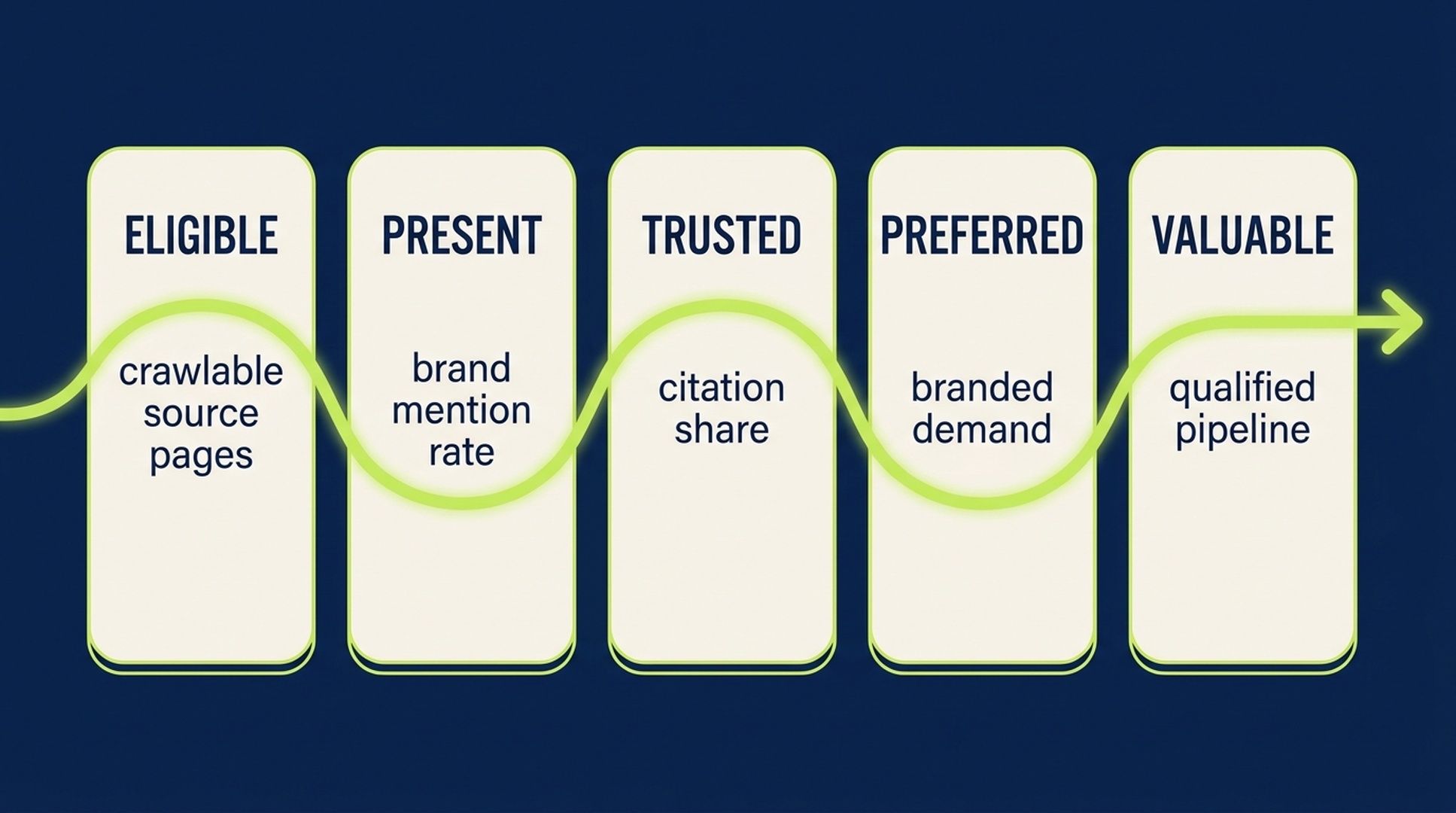
A useful dashboard connects source eligibility, answer presence, trust signals, demand, and business value.
Four metrics worth adding to the monthly review
1. Brand mention rate
Brand mention rate is the percentage of tracked prompts where the answer names your company, product, or a clearly recognized brand variant.
Start with prompts that map to real buying and evaluation moments, not vanity prompts. A B2B software company might track "best [category] for [use case]," "how to solve [problem]," and "[category] alternatives for [audience]." Group them by intent: discovery, comparison, implementation, and troubleshooting.
Track the result by platform and by topic cluster. A single headline rate can hide the fact that you are strong in troubleshooting prompts but absent from high-intent comparison prompts.
2. Citation share
Citation share measures how often your owned pages appear among the sources an answer cites, compared with the total citations captured for the same prompt set.
This is more useful than counting citations in isolation. Ten citations may be strong in a small, high-value topic cluster and weak in a broad category where competitors receive hundreds. Review both the rate and the pages earning the citations. You want to know which evidence is reusable, which questions it answers, and where competitors keep being selected instead.
3. Answer position and recommendation context
A mention is not a recommendation. Record how the brand appears:
- named as a primary option;
- named in a comparison list;
- cited as a source without a brand recommendation;
- mentioned with a limitation or a negative qualifier.
That context changes the action. A source page that earns citations but never gets a direct recommendation may need a clearer explanation of the product fit. A brand repeatedly listed with the same outdated limitation may need better documentation, third-party evidence, or a product change.
4. Demand after exposure
AI answers rarely include a clean referral trail. Instead, use a small set of proxy signals and compare their direction over time: branded search impressions, direct visits, return visits, demo requests that mention an assistant, and assisted conversions from content paths that have strong citation coverage.
Do not claim that every branded query came from an AI answer. The goal is not false precision. The goal is to see whether stronger answer visibility and stronger commercial demand move together over a meaningful period, then investigate the gaps.
A practical prompt set beats a giant keyword list
Teams often bring keyword habits straight into AI search and end up tracking hundreds of variations that produce no decision-quality signal. A smaller, reviewed prompt set is better.
Build the first set from four sources: sales-call language, support questions, competitor comparison pages, and your existing high-intent search queries. Give every prompt an owner, an intent label, a target market, and a reason it belongs in the set. Remove prompts that are too broad to be useful or too obscure to represent real demand.
Then take a weekly snapshot. AI answers vary, so a one-time check is not a benchmark. Track the prompt, platform, date, answer summary, brand presence, citation URLs, competitor mentions, and recommendation context. The pattern over several reviews is what matters.
What to change when your brand is absent
An absence in AI answers is not a cue to publish a pile of generic "AI-optimized" pages. First identify the reason.
Observation | Likely issue | Better response |
|---|---|---|
Competitors are cited; your site is absent | Your source does not answer the question as clearly or credibly | Build a direct, evidence-led page for the question; improve facts, examples, and source clarity |
Your brand is named but never cited | The entity is recognized, but owned proof is weak | Publish useful documentation, original data, and clear product/use-case pages |
You are cited for informational prompts only | Your commercial fit is unclear | Connect educational content to specific use cases and decision criteria |
Your brand is mentioned with stale claims | The public information environment is inconsistent | Audit core brand facts across owned pages and prioritize corrections where buyers and answer engines encounter them |
The work is familiar in one sense: better information architecture, clearer claims, useful documentation, and credible evidence. The difference is the feedback loop. Instead of waiting months for a ranking report, you can see which buyer questions produce a weak or missing brand presence and prioritize the next asset accordingly.
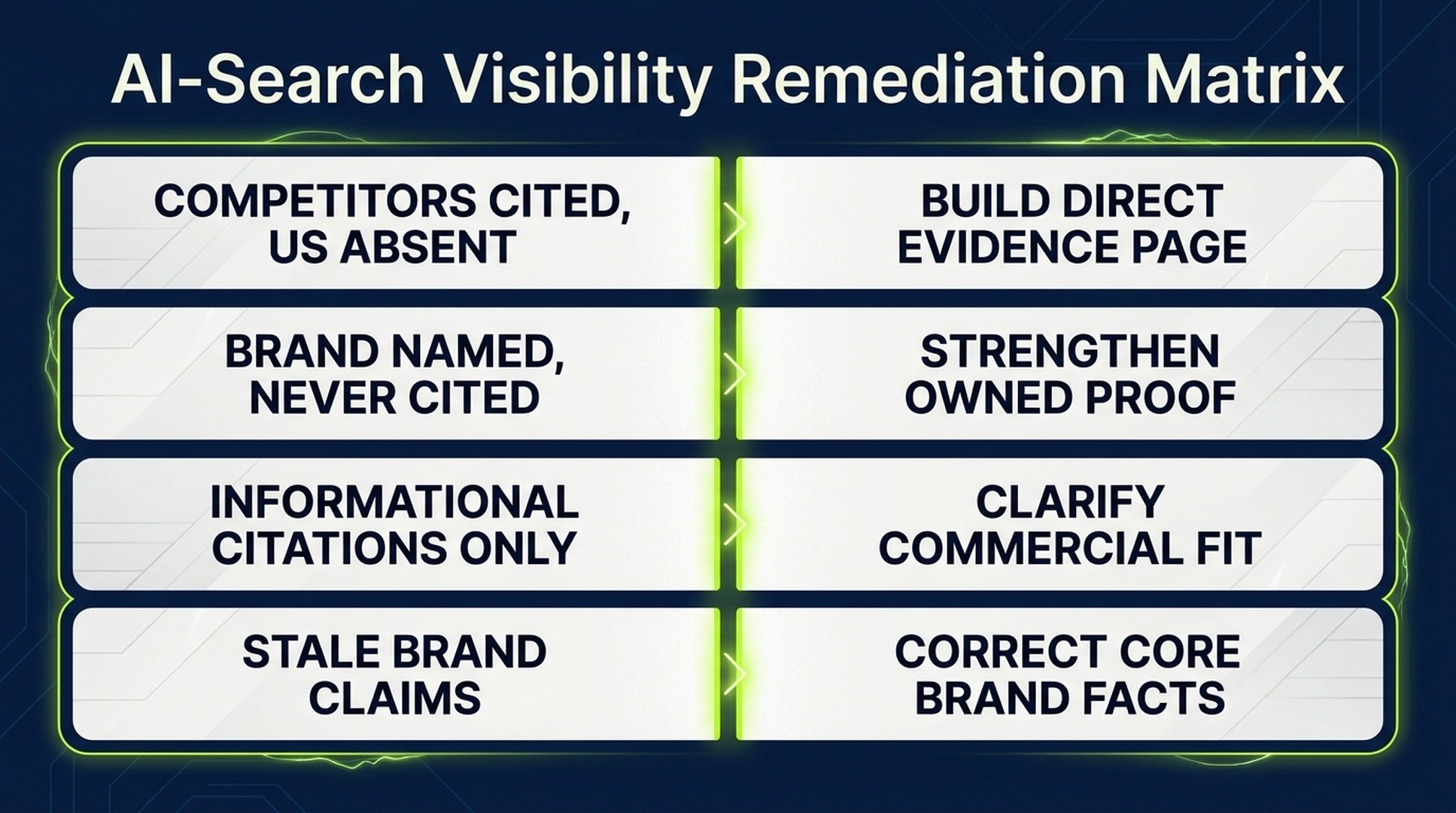
Treat an absence or weak citation pattern as a diagnosis, then assign the matching corrective action.
Why a manual handoff model breaks down
This type of measurement asks for repeated checks across prompts, markets, platforms, competitors, citations, and page changes. A spreadsheet maintained through one-off handoffs can start well, then quietly decay. Prompts get skipped. Citation context is lost. No one has time to reconcile a weak answer with a content brief, an entity issue, and a commercial page update.
This is where an AI-search workflow earns its place in daily operations. The system should collect recurring observations, flag material changes, cluster gaps by topic, and give the team a prioritized queue. Human judgment still matters for claims, evidence, and product positioning. It should not be spent copying answer text into a sheet every week.
Where Auspia fits
Auspia helps teams combine SEO, GEO, AEO, and AI-search visibility into one working program. The starting point is a structured view of the prompts and topics that matter, followed by monitoring of brand mentions, citations, competitor presence, and the pages behind those signals.
From there, the work becomes concrete: fix the pages that answer engines cannot use, strengthen the evidence behind pages that should be cited, and turn recurring visibility gaps into a content and entity roadmap. Teams that want a quick baseline can begin with Auspia's AI Search Visibility Checker before moving into a deeper audit and ongoing workflow.
The point is not to replace SEO reporting with a prettier set of AI metrics. It is to connect the two. Search performance tells you what people did on your site. AI visibility tells you whether your brand entered the conversation before that visit. You need both to understand how demand is being created now.
A 30-day measurement reset
- Keep your current rank, traffic, and conversion reporting intact.
- Select 30 to 50 buyer-relevant prompts across discovery, comparison, and problem-solving intent.
- Capture a baseline for brand mentions, citations, competitor presence, and recommendation context across the answer surfaces your audience uses.
- Match each important gap to a page, evidence asset, or brand-information issue.
- Review the dashboard weekly and connect material changes to branded demand and qualified conversions each month.
At the end of the month, you will not have a perfect attribution model. You will have something more useful: a repeatable view of where your brand is being included, ignored, or cited as the answer changes hands from search results to AI interfaces.
FAQ
Should AI search metrics replace SEO metrics?
No. Rankings, organic traffic, and conversions still describe important parts of performance. AI-search metrics fill the visibility gap created when people receive an answer before they visit a website.
What is a good AI citation rate?
There is no universal benchmark. Compare citation share within the same prompt cluster, market, platform, and review period. A useful target is a measured improvement in the high-value questions that matter to your buyers, not a large number from unrelated prompts.
Can a brand benefit from an AI answer without a click?
Yes. An answer can introduce a brand, establish relevance, or influence a shortlist. Measure the downstream signals carefully, such as branded demand and assisted conversions, rather than claiming direct causality from every zero-click answer.
Author: Naomi Ellis, Brand Mention Analyst Across 20k+ Visibility Signals at Auspia. Naomi writes about brand presence, citation gaps, and practical ways to measure AI-search influence.