Quick Answer
Automotive GEO is the work of making vehicle pages, dealership pages, financing pages, service pages, comparison pages, inventory pages, trade-in pages, and buyer guides easier for AI answer systems to understand, compare, and cite when shoppers ask car-buying and ownership questions.
Auto shoppers rarely ask only for SUV near me, used cars, or Toyota dealer. They ask questions that combine lifestyle, budget, reliability, fuel economy, financing, local inventory, warranty, incentives, service trust, and purchase risk:
What SUV should I buy for a family of five with a long commute?Is it better to buy new, used, or certified pre-owned?What fees should I ask about before buying a car from a dealer?How do I know if a used car dealer is trustworthy?Should I lease or finance an EV if I drive a lot?
For automotive brands and dealers, the strongest GEO assets are model pages, trim comparison pages, inventory pages, local dealership pages, financing explainers, trade-in pages, service pages, warranty pages, CPO guides, EV education pages, ownership cost pages, and transparent FAQ sections.
This playbook gives dealerships, OEMs, auto marketplaces, repair groups, EV brands, parts retailers, and automotive service businesses 100 AI Search queries to track, a vehicle-decision framework, a query-to-page map, and a 30-day execution plan.
Important note: this article is about SEO/GEO content strategy, not financial, legal, insurance, safety, tax, or mechanical advice. Auto teams should involve qualified product, finance, compliance, legal, or service experts before publishing claims about incentives, warranties, financing, repairs, or vehicle safety.
The Vehicle Decision Confidence Stack
Automotive GEO is different from many industries because the buyer is making a high-cost decision that combines product fit, local availability, financing, trade-in value, dealer trust, and long-term ownership risk.
That creates a vehicle decision confidence stack:
Layer | What The Shopper Needs | Example Query | Page That Should Support The Answer |
|---|---|---|---|
Use Case | Which vehicle fits my life? |
| Use-case guide |
Vehicle Fit | Which model, trim, or body type is right? |
| Model / trim comparison page |
Total Cost | What will it really cost? |
| Pricing / fee FAQ |
Financing Path | How should I pay? |
| Financing guide |
Inventory Reality | Is the vehicle available locally? |
| Inventory / local page |
Trust Check | Can I trust the seller or service provider? |
| Dealer trust page |
Ownership Risk | What happens after purchase? |
| Warranty / service guide |
A useful first step is to check which prompts already surface your dealership, inventory, service department, or model pages using an AI Search Visibility Checker, then build a prompt library around missing models, weak dealer trust signals, unclear fees, or inaccurate financing summaries.
Why Automotive GEO Starts With Buyer Confidence, Not Inventory Keywords
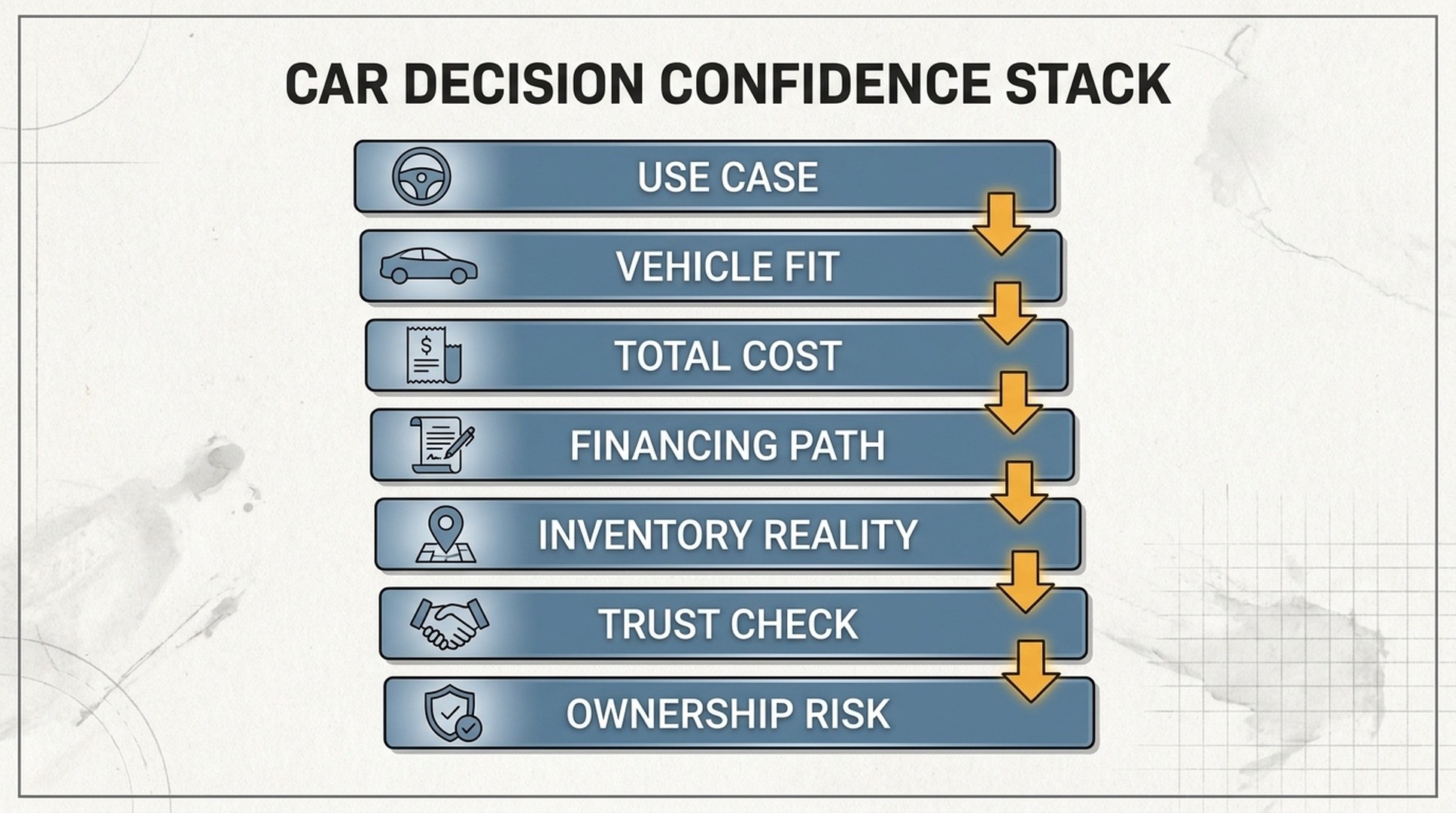
Automotive AI Search prompts move through use case, vehicle fit, total cost, financing path, inventory reality, trust check, and ownership risk.
Traditional automotive SEO often starts with model keywords, inventory pages, local dealer pages, and service pages. Those still matter. GEO adds a new layer because AI systems may summarize which vehicle, seller, financing path, or service option makes sense before the shopper clicks a listing.
The prompt usually contains practical constraints:
What is a good commuter car if I drive 80 miles a day?Should I buy a hybrid or EV if I cannot charge at home?What should first-time buyers ask before financing a car?How do I compare two used cars with different mileage?What service records should I check before buying a used SUV?
These questions require pages that explain fit, tradeoffs, assumptions, local availability, ownership cost, warranty coverage, and next steps. A thin inventory page cannot answer the whole decision.
Automotive content also needs careful wording. Avoid universal claims about reliability, safety, savings, financing approval, incentives, resale value, or total cost. Strong automotive GEO states the vehicle type, driver profile, usage assumptions, location context, and limitations clearly.
The 10 Query Types Automotive Teams Should Map
Classify prompts before creating pages. This prevents teams from publishing repetitive model pages or thin best car lists without enough purchase context.
Query Type | What The User Wants | Best Content Asset |
|---|---|---|
Use Case | Match a vehicle to family, commute, towing, city driving, work, or lifestyle | Use-case guide |
Vehicle Comparison | Compare body types, models, trims, engines, EV vs hybrid, or new vs used | Comparison page |
Pricing / Fees | Understand MSRP, dealer fees, taxes, incentives, monthly payment, and total cost | Pricing FAQ, fee guide |
Financing / Leasing | Compare lease, loan, cash, credit factors, down payment, and mileage limits | Financing guide |
Inventory / Local | Find available vehicles, local trims, colors, service locations, or offers | Inventory page, local page |
Trade-In / Resale | Estimate trade-in factors, appraisal process, negative equity, and resale value | Trade-in guide |
Trust / Dealer Selection | Choose a dealer, service center, marketplace, or repair shop | Dealer trust page, reviews guide |
Warranty / Ownership | Understand warranty, CPO, maintenance, repairs, recalls, and service intervals | Warranty / service page |
Risk / Inspection | Check vehicle history, inspection, title, accident, battery, or repair risk | Used-car checklist |
Scenario / Driver Type | Match vehicles to first-time buyers, families, commuters, rideshare drivers, contractors, or EV owners | Scenario guide |
Every high-value query cluster needs one owner page. If fees, incentives, and warranty terms are scattered across inventory disclaimers, PDFs, and sales pages, AI systems may summarize the wrong answer.
How To Prioritize Automotive GEO Queries
Use a buyer-confidence scoring model:
Priority = Purchase Intent + Local Inventory Fit + Decision Impact + Evidence Strength + AI Answer Probability - Claim Risk - Competition Difficulty
Factor | How To Evaluate It |
|---|---|
Purchase Intent | Is the user close to visiting a dealer, requesting a quote, booking a test drive, applying for financing, or scheduling service? |
Local Inventory Fit | Can the brand or dealer support the answer with actual models, trims, inventory, offers, or service availability? |
Decision Impact | Could the answer change which vehicle, dealer, financing path, or service provider the user chooses? |
Evidence Strength | Do you have vehicle specs, inventory data, pricing logic, warranty terms, reviews, service expertise, or trade-in process details? |
AI Answer Probability | Is the query likely to trigger a comparison, recommendation, checklist, or local suggestion? |
Claim Risk | Could the answer overpromise approval, savings, safety, reliability, incentives, range, or resale value? |
Competition Difficulty | Are OEMs, marketplaces, review sites, forums, or large dealer groups dominating? |
Start with queries where the team has owned proof and the shopper has a real decision. Avoid broad best car pages unless the page defines driver profile, budget, criteria, assumptions, and limitations.
100 Automotive GEO Query Examples
Use these prompts as a starting library. Adapt them by market, vehicle class, drivetrain, fuel type, inventory, financing rules, and local compliance review.
Use Case Queries
- What SUV should I buy for a family of five?
- What car is best for a long daily commute?
- What vehicle is good for city driving and easy parking?
- What truck should I consider for light towing?
- What car works well for new drivers?
- What SUV is good for road trips and cargo space?
- What vehicle should rideshare drivers compare?
- What car should contractors consider for work and family use?
- What vehicle is good for snowy areas?
- What car should I consider if I drive mostly short trips?
Vehicle Comparison Queries
- Compact SUV vs midsize SUV: which is better?
- Sedan vs crossover for commuters
- New car vs used car: what should buyers compare?
- Certified pre-owned vs used car from a dealer
- Hybrid vs EV if I cannot charge at home
- AWD vs FWD for daily driving
- Gas vs hybrid SUV for highway commuting
- Base trim vs premium trim: is it worth upgrading?
- Pickup truck vs cargo van for small business use
- Lease return vehicle vs private seller used car
Pricing / Fees Queries
- What fees should I ask about before buying a car?
- What affects the out-the-door price of a vehicle?
- How do dealer fees work?
- What taxes and registration costs should car buyers expect?
- How do manufacturer incentives affect price?
- What should I compare besides monthly payment?
- How much should buyers budget for insurance before buying?
- What affects the total cost of owning an EV?
- What costs do first-time car buyers often miss?
- How do destination charges work on new vehicles?
Financing / Leasing Queries
- Lease vs finance: which is better for high-mileage drivers?
- What credit score affects car financing?
- How much down payment should I consider for a car loan?
- What should first-time buyers ask before financing a car?
- What happens if I trade in a car with negative equity?
- What should buyers know about pre-approval?
- How do mileage limits work in a lease?
- Is leasing an EV different from leasing a gas car?
- What should I check before signing an auto finance contract?
- How do loan terms affect total interest paid?
Inventory / Local Queries
- Hybrid SUV available near me with AWD
- Used trucks under budget near me
- Certified pre-owned SUV near me with warranty
- Best local dealer for first-time car buyers
- Where can I test drive an EV near me?
- Which dealership has service appointments this week?
- Where can I compare used cars from local dealers?
- Best dealership near me for trade-in appraisal
- Where can I find family SUVs with third-row seating?
- Which local dealer has transparent pricing?
Trade-In / Resale Queries
- What affects my car's trade-in value?
- Should I trade in my car or sell it privately?
- How does mileage affect trade-in value?
- What documents do I need to trade in a vehicle?
- How do dealers appraise trade-ins?
- What should I fix before trading in a car?
- What happens if I owe more than my car is worth?
- How do accident history and repairs affect resale value?
- When is the best time to trade in a vehicle?
- What should I ask before accepting a trade-in offer?
Trust / Dealer Selection Queries
- How do I know if a used car dealer is trustworthy?
- How do I choose a dealership for buying a car?
- What reviews matter when choosing a car dealer?
- What should I ask before buying from an online car marketplace?
- What makes a dealership transparent?
- How do I compare dealership service departments?
- What should I look for in a repair shop?
- How do I verify a dealer's reputation?
- What should I ask before buying a car from out of state?
- How do I avoid pressure during a car purchase?
Warranty / Ownership Queries
- What warranty questions should I ask before buying used?
- What does certified pre-owned warranty usually cover?
- What maintenance should buyers expect after buying a used car?
- How often should an EV battery be checked?
- What should owners know about manufacturer recalls?
- What service records should I check before buying a used SUV?
- What is usually covered by a powertrain warranty?
- What is not covered by a typical vehicle warranty?
- What should I know about prepaid maintenance plans?
- How do I compare service packages from dealerships?
Risk / Inspection Queries
- What should I check during a used car inspection?
- What are red flags in a vehicle history report?
- What title issues should used car buyers avoid?
- What should I check before buying a high-mileage car?
- How do I compare two used cars with different mileage?
- What should EV buyers check about battery health?
- What should buyers know about flood-damaged cars?
- What should I ask after a car has been in an accident?
- What should I inspect before buying a used truck?
- What should buyers know before purchasing a car online?
Scenario / Driver Type Queries
- Best car for first-time buyers on a budget
- Best SUV for parents with car seats
- Best vehicle for commuters who drive 80 miles a day
- Best EV for apartment renters without home charging
- Best used car for college students
- Best truck for small business owners
- Best car for rideshare drivers who want low fuel costs
- Best vehicle for drivers moving to a snowy climate
- Best family vehicle for road trips and sports gear
- Best car for retirees who want easy entry and visibility
How To Turn Automotive Queries Into Citation-Ready Pages
An automotive query library should become a buyer-confidence architecture. The strongest pages are model pages, trim pages, comparison pages, local inventory pages, financing pages, trade-in pages, service pages, warranty pages, dealer trust pages, and used-car checklists.
Query Cluster | Owner Page | Page Type | Required Proof |
|---|---|---|---|
Use-case prompts | Vehicle use-case guide | Buyer guide | Driver profile, needs, tradeoffs, next step |
Comparison prompts | Model / trim comparison | Comparison page | Specs, pros and cons, fit criteria, assumptions |
Pricing prompts | Pricing / fee FAQ | Cost guide | Fees, taxes, incentives, disclaimers, update date |
Financing prompts | Financing guide | Finance page | Lease/loan terms, credit caveats, contract checklist |
Inventory prompts | Local inventory page | Inventory / dealer page | Availability, location, trim, contact path |
Trade-in prompts | Trade-in guide | Appraisal page | Factors, process, documents, negative equity caveats |
Trust prompts | Dealer trust page | Reviews / profile page | Reviews, policies, staff, service scope, transparency signals |
Warranty prompts | Warranty / service guide | Ownership page | Coverage, exclusions, service intervals, official references |
Risk prompts | Used-car checklist | Checklist page | Inspection, history, title, battery, accident, flood checks |
Scenario prompts | Driver-type guide | Scenario page | Budget, driving pattern, vehicle class, limitations |
A citation-ready automotive page should answer the shopper's decision question first, then support the answer with vehicle specs, local inventory, pricing assumptions, financing caveats, warranty information, trust proof, and next steps.
For technical readiness, auto brands and dealers should make sure inventory pages, model pages, service pages, finance pages, and dealership pages are crawlable, indexable, and internally linked. A quick Website SEO Score Checker can help catch basic crawl, metadata, schema, and page-quality issues before teams rewrite revenue-critical pages.
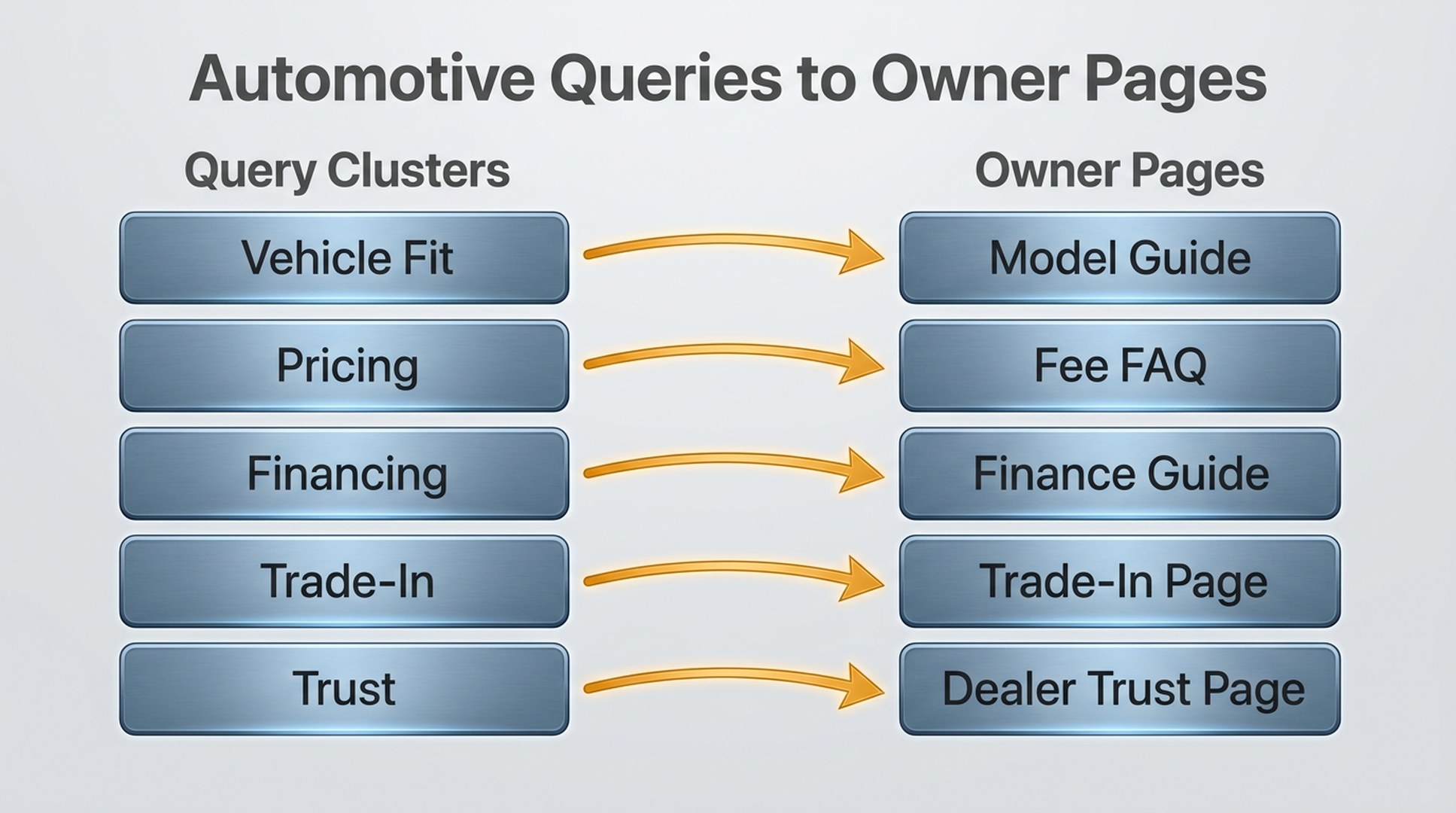
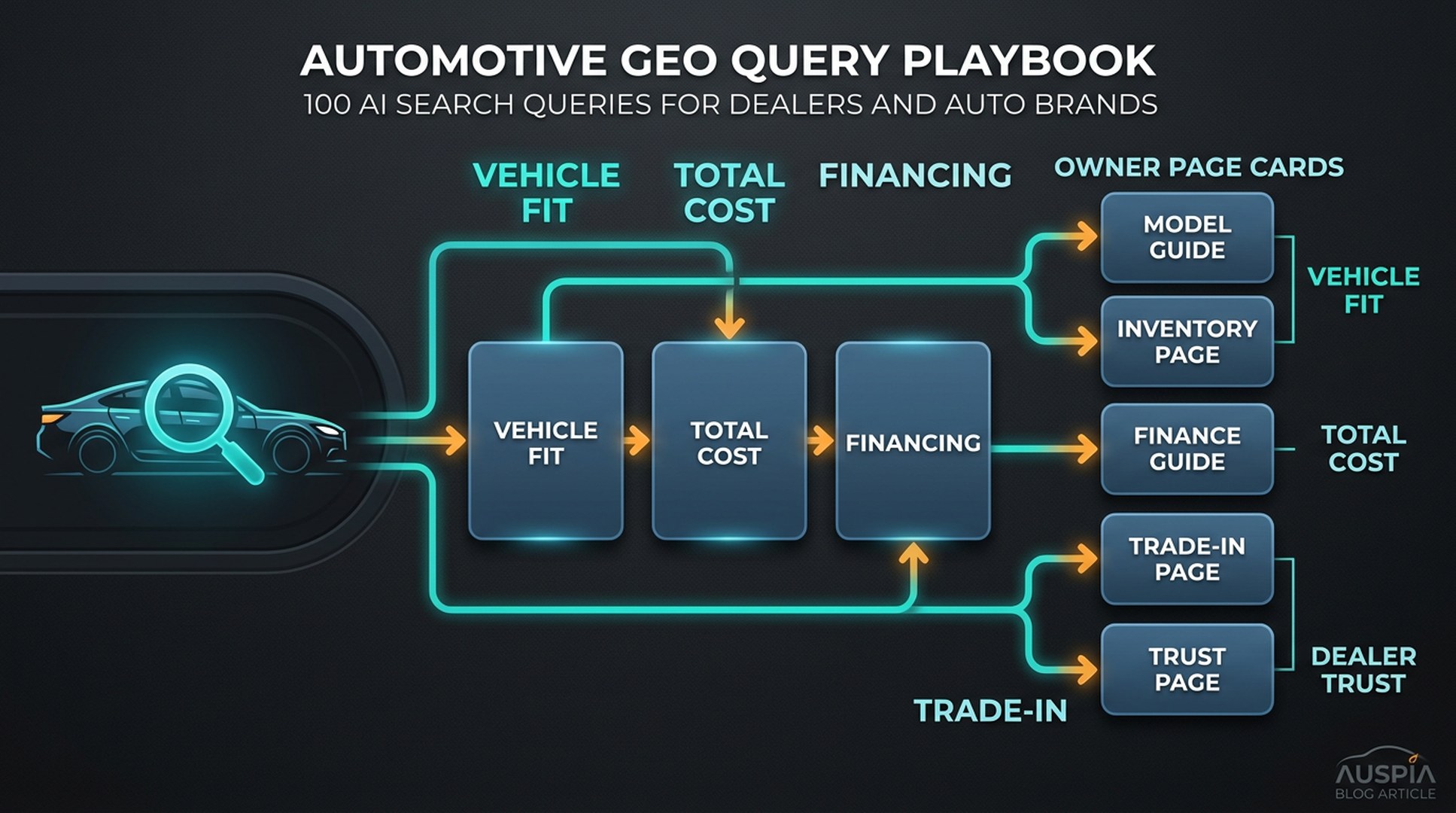
Vehicle-fit, pricing, financing, trade-in, and trust queries should map to durable owner pages that support purchase confidence.
The First 20 Queries To Prioritize
If an automotive brand or dealership is starting from scratch, these 20 prompts usually create a practical first backlog.
Priority | Query | Why It Matters | Likely Owner Page |
|---|---|---|---|
1 | What SUV should I buy for a family of five? | High vehicle-fit intent | Family SUV guide |
2 | What car is best for a long daily commute? | Use-case and purchase fit | Commuter car guide |
3 | Compact SUV vs midsize SUV | Common comparison | Body-type comparison page |
4 | New car vs used car | High decision impact | New vs used guide |
5 | Hybrid vs EV if I cannot charge at home | EV education and fit | EV vs hybrid guide |
6 | What fees should I ask about before buying a car? | Purchase friction | Dealer fee FAQ |
7 | What should I compare besides monthly payment? | Financing quality | Total cost guide |
8 | Lease vs finance for high-mileage drivers | Finance decision | Lease vs finance page |
9 | What should first-time buyers ask before financing a car? | Conversion and trust | First-time finance guide |
10 | Certified pre-owned SUV near me with warranty | Local inventory and trust | CPO inventory page |
11 | Which local dealer has transparent pricing? | Dealer-selection intent | Transparent pricing page |
12 | What affects my car's trade-in value? | Trade-in lead value | Trade-in guide |
13 | How do dealers appraise trade-ins? | Process clarity | Appraisal process page |
14 | How do I know if a used car dealer is trustworthy? | Trust validation | Dealer trust page |
15 | What reviews matter when choosing a car dealer? | Reputation signal | Reviews guide |
16 | What warranty questions should I ask before buying used? | Risk-sensitive query | Used warranty FAQ |
17 | What should I check during a used car inspection? | High decision impact | Used-car checklist |
18 | What should EV buyers check about battery health? | EV risk query | EV battery guide |
19 | Best car for first-time buyers on a budget | Scenario and purchase intent | First-time buyer guide |
20 | Best vehicle for commuters who drive 80 miles a day | Use-case lead value | High-mileage commuter guide |
These prompts are useful because they can be answered by pages that already influence test drives, quote requests, finance applications, trade-ins, and service appointments.
30-Day Execution Plan
Timeframe | Action | Output |
|---|---|---|
Days 1-3 | Build the automotive AI Search query library and classify by use case, vehicle type, buyer stage, and page owner | 100-query prompt library |
Days 4-7 | Score prompts by purchase intent, local inventory fit, decision impact, evidence, AI answer probability, claim risk, and competition | First 20 prompt backlog |
Days 8-14 | Map prompts to model pages, inventory pages, financing pages, trade-in pages, warranty pages, trust pages, and checklists | Query-to-page map |
Days 15-21 | Rewrite priority pages with direct answers, specs, local context, fees, financing caveats, warranty details, proof, and next steps | Updated citation-ready pages |
Days 22-30 | Test prompts across AI answer surfaces and record brand mentions, cited URLs, competitor mentions, and inaccurate vehicle facts | Automotive AI visibility tracker |
A local dealer can start with five assets: a family vehicle guide, a transparent pricing FAQ, a trade-in guide, a used-car inspection checklist, and a dealer trust page. An OEM or marketplace should add model comparisons, trim guides, EV education pages, ownership cost pages, inventory hubs, and warranty explainers.
Common Mistakes
Automotive GEO fails when teams publish inventory-heavy pages without enough decision support, trust proof, or cost clarity.
Avoid these mistakes:
- Letting inventory pages do all the work. Inventory changes constantly; evergreen buyer guides create more stable AI visibility.
- Hiding fees and financing caveats. Shoppers need total cost, contract, incentive, and monthly payment context.
- Overpromising safety, reliability, savings, or approval. Use careful wording and explain assumptions.
- Publishing generic `best car` pages. Define driver profile, budget, usage, criteria, and limitations.
- Treating dealer trust as only reviews. Add pricing policy, service process, staff expertise, warranties, and customer support details.
- Ignoring EV-specific questions. Charging, range, incentives, battery health, and apartment charging need dedicated answers.
- Measuring only rankings. Track AI mentions, cited pages, competitor inclusion, and inaccurate summaries of pricing, warranty, inventory, or financing.
FAQ
What is automotive GEO?
Automotive GEO is the process of making vehicle, model, inventory, dealership, financing, trade-in, service, warranty, comparison, and buyer-guide pages easier for AI answer systems to understand, summarize, and cite accurately.
Is automotive GEO the same as automotive SEO?
No. Automotive SEO focuses on rankings, inventory visibility, local pages, technical health, and lead generation. Automotive GEO builds on that foundation but focuses on how AI systems answer vehicle-fit, pricing, financing, local inventory, trade-in, dealer trust, and ownership-risk questions.
Should dealers create one page for every AI Search query?
No. The 100-query list should become a page map. Many questions should be answered by stronger model pages, comparison pages, financing pages, trade-in pages, dealer trust pages, service pages, warranty pages, and used-car checklists.
Which automotive queries should teams prioritize first?
Start with questions about vehicle fit, new vs used, EV vs hybrid, total cost, fees, financing, local inventory, trade-in value, dealer trust, warranty, inspection, and first-time buyer scenarios. These queries influence test drives, quote requests, and dealership visits.
How can auto brands avoid risky GEO content?
Use clear assumptions, avoid guaranteed financing or savings claims, keep incentives and inventory current, explain warranty limits, review safety and reliability claims, and involve finance, legal, product, or service experts when needed.
How should automotive teams measure GEO performance?
Track a stable prompt set across AI answer surfaces. Record whether the brand appears, which URLs are cited, which competitors appear, whether vehicle facts are accurate, and whether AI answers omit important pricing, financing, warranty, or inventory details.
Auspia Takeaway
Automotive GEO is buyer confidence support. AI systems need vehicle fit, comparison logic, total cost, financing caveats, local inventory, trade-in details, dealer trust, warranty scope, and ownership risk before they can recommend or cite an auto brand responsibly.
Start with prompts that affect test drives, finance applications, trade-ins, service appointments, and dealership visits. Map the first 20 queries to pages that already shape purchase conversations. Then rewrite those pages so the answers are direct, specific, current, and safe to summarize.
Author: Simon Vale, 11-Year Search Intent Researcher at Auspia. Simon writes about buyer queries, SERP patterns, intent mapping, and content systems that match real decision behavior.