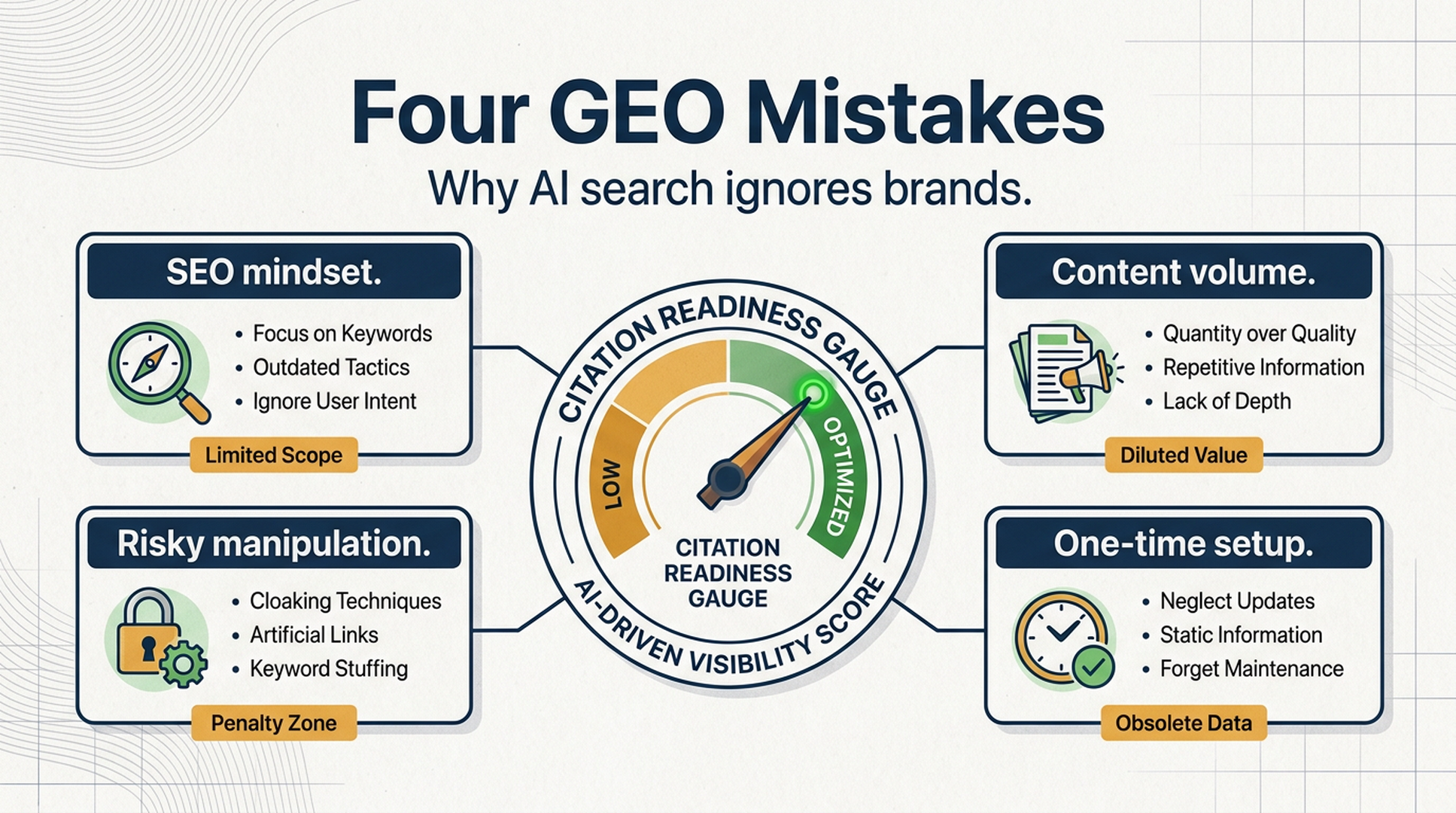
Four GEO mistakes that make AI search ignore your brand
Most companies do not fail at GEO because they lack content. They fail because they treat generative engine optimization like a louder version of SEO: more keywords, more pages, more mentions, more repetition. AI answer systems do not reward that pattern for long. They try to assemble an answer from sources they can understand, compare, and trust.
The practical fix is simple, but not easy: build a source base that is specific, current, structured, and safe to cite. That means fewer generic posts and more pages that answer real buyer questions with verifiable facts, first-hand experience, clear entities, and a maintenance rhythm.
If your team is starting a GEO program, audit for these four mistakes before you publish another batch of AI-written articles.
GEO mistake | What it looks like | Better operating principle |
|---|---|---|
Treating GEO as SEO with new branding | Keyword stuffing, backlink-first planning, rank-only reporting | Optimize for citation readiness, entity clarity, and answer usefulness |
Publishing volume without evidence | Dozens of generic posts that say the same thing as everyone else | Ship fewer pages with original data, screenshots, examples, and named expertise |
Chasing exposure with risky manipulation | Fake mentions, synthetic reviews, misleading comparison pages | Build white-hat evidence that an AI system can verify across sources |
Running GEO once and walking away | One-time page edits, no answer monitoring, no update calendar | Maintain facts, pages, third-party profiles, and prompt tests every month |
Mistake 1: using traditional SEO logic for GEO
This is the first place teams waste money. They take a familiar SEO playbook, swap in a few AI-search words, and expect ChatGPT, Perplexity, Gemini, or AI Overviews to cite them.
The logic is different.
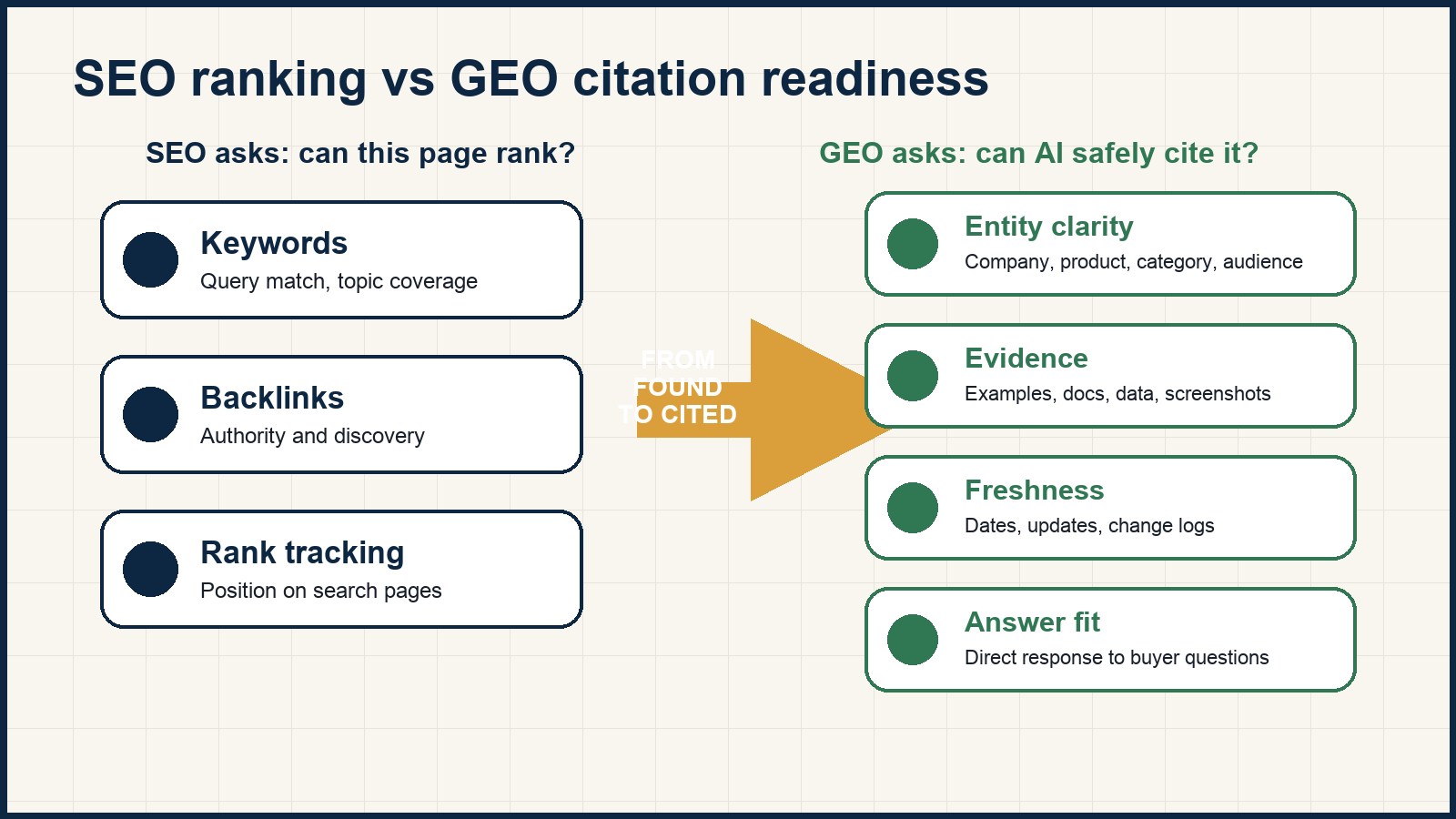
Classic SEO asks: "Can this page rank for a query?" GEO asks: "Can an answer engine safely use this source when it explains a topic?" Those are related, but they are not the same job.
A search results page can list a page even if the page is thin, outdated, or only loosely relevant. An AI answer has a higher burden. It has to generate a response that feels coherent. It may compare multiple sources, compress information, and avoid claims that look unsupported or inconsistent. If your content is vague, self-promotional, or hard to reconcile with other sources, the model has little reason to use it.
A GEO-ready page usually has five traits:
- It states the entity clearly: company, product, category, market, location, author, and dates.
- It answers a real question in language buyers would use.
- It separates facts, opinions, examples, and recommendations.
- It includes evidence an AI system can cross-check, such as docs, case details, screenshots, methodology, or third-party references.
- It stays current enough that the answer engine does not have to guess whether the information still applies.
The shift is not "SEO is dead." Search rankings still matter because many AI systems learn from, retrieve, or validate against web content that already has visibility. But ranking is no longer the only scoreboard. The better question is whether your site can become a reliable source inside an answer.
A quick test: copy one of your priority buyer questions into several AI search tools. If they mention competitors, analyst pages, review sites, or community threads but not you, the issue may not be search volume. It may be that your brand is not packaged as citeable evidence.
For a first pass, run a page through an AI Search Visibility Checker and compare what the tool sees against what your SEO report says. The gap is often where the GEO work starts.
Mistake 2: thinking GEO means "publish more articles"
The second mistake is more tempting now that everyone has a writing assistant. A team builds a list of prompts, produces 50 posts, and assumes one of them will land in an AI answer.
That sometimes creates traffic noise. It rarely creates trust.
AI-generated content is not automatically bad. The problem is generic content with no reason to exist. A page called "Best project management tools for 2026" that repeats public feature lists is not much of a source. A page that explains how a real operations team chose between Asana, Monday.com, ClickUp, and Jira, with criteria, screenshots, tradeoffs, and update notes, is much more useful.
GEO content needs substance that a model can use. In practice, that substance comes from four places:
Evidence type | Example | Why it helps AI answers |
|---|---|---|
First-hand experience | A teardown of how your team solved a real workflow problem | Shows experience and reduces generic claims |
Expert authorship | Named specialists, reviewed guidance, or clear editorial ownership | Helps connect advice to accountable people or teams |
Structured facts | Pricing ranges, feature tables, version dates, limitations, methodology | Makes extraction and comparison easier |
External corroboration | Documentation, public profiles, reviews, press, customer pages, standards | Gives answer systems multiple places to verify claims |
This is where many content operations need to slow down. Ten strong pages can do more for AI visibility than 100 interchangeable posts. The strong pages are not always longer. They are more specific.
A useful GEO editorial brief should include:
- the exact user question the page should answer;
- the entities that must be clear, including product names, competitors, roles, regions, and industries;
- the evidence available before writing starts;
- the claims that need a citation or screenshot;
- the page format, such as glossary, comparison, workflow, benchmark, case note, or FAQ;
- the update trigger, such as a product launch, pricing change, regulation shift, or model behavior change.
Without that brief, a content team usually defaults to filler. The page may read smoothly, but it gives an answer engine nothing to hold onto.
Mistake 3: chasing AI exposure while ignoring trust and compliance
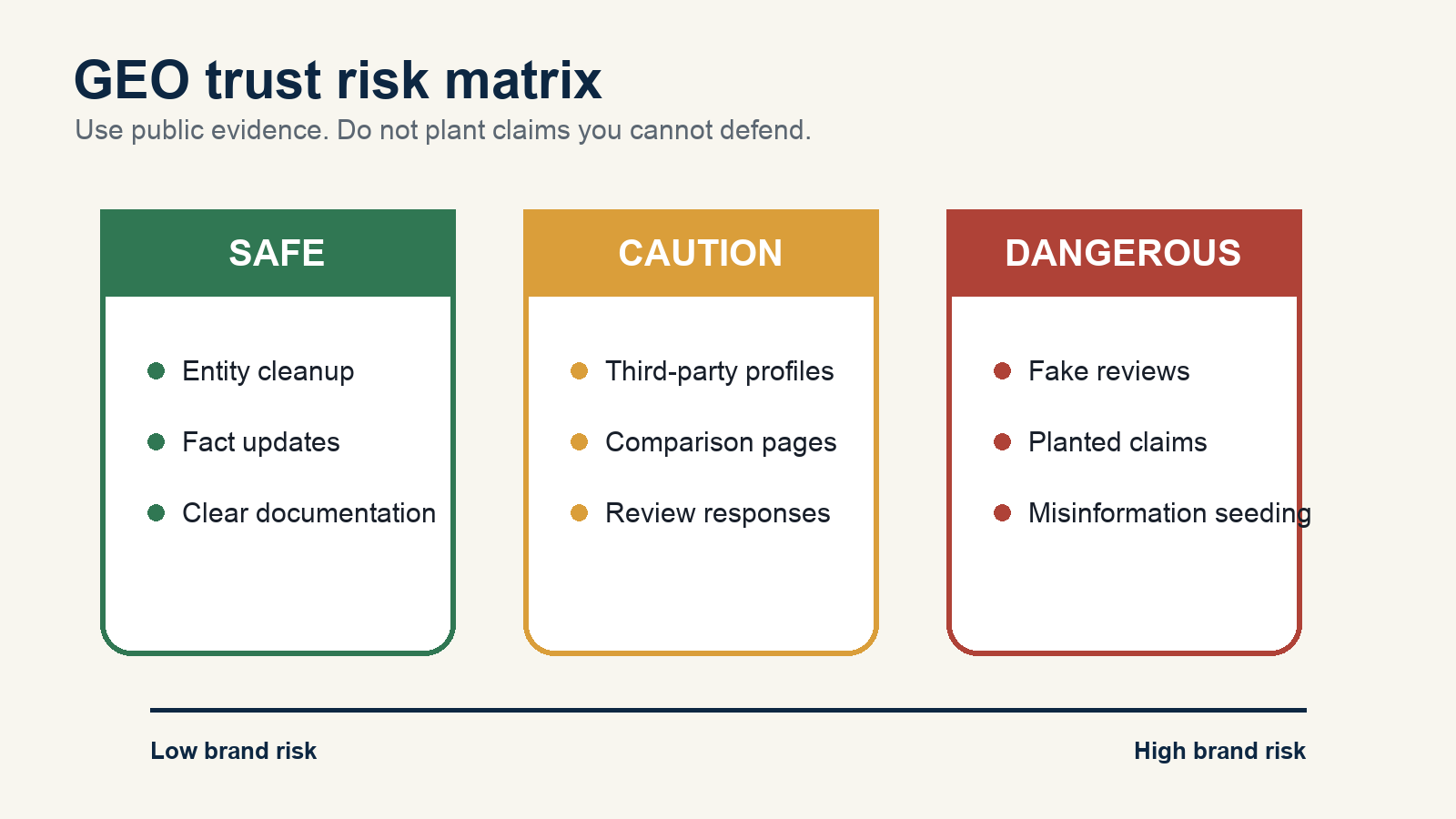
Some teams hear that AI systems can be influenced by repeated web mentions and take the worst possible lesson from it. They flood low-quality sites with fake claims, manufacture reviews, create misleading comparison pages, or try to seed distorted information into public sources.
This is not a durable GEO strategy. It is brand risk with a new name.
Answer systems are getting better at comparing sources, spotting contradictions, and discounting thin or suspicious pages. Even when manipulation works briefly, it creates a bigger problem: the web starts carrying claims your legal, product, support, and sales teams cannot defend.
White-hat GEO is boring in the right way. It improves the public evidence around your brand so AI systems can describe you accurately. That work may include:
- fixing inconsistent company descriptions across your site, directories, review profiles, and documentation;
- publishing clear product and category pages with dates and owners;
- opening useful technical files where appropriate, such as robots.txt policies and LLM-facing documentation;
- correcting outdated third-party pages when they describe your product incorrectly;
- turning real customer questions into supportable FAQ entries;
- adding methodology notes to benchmarks, comparisons, and claims.
The goal is not to trick the model. The goal is to remove ambiguity.
A good compliance rule for GEO is this: if you would be uncomfortable with a buyer, regulator, journalist, or customer success manager reading the claim, do not plant it for an AI system either.
This matters even more for YMYL categories, financial services, healthcare, legal services, cybersecurity, education, and B2B products that affect customer operations. In those categories, vague claims can be worse than no claims at all.
Mistake 4: treating GEO as a one-time setup project
GEO is not a launch task. It is an operating rhythm.
A one-time optimization project can clean up obvious problems: missing definitions, old pages, weak schema, confusing product language, inconsistent profiles. That is worth doing. But AI answers move as models change, competitors publish, sources update, and user questions shift.
A page that was accurate in March can be stale by September. A competitor can release a stronger comparison page. A documentation update can change the best answer to a technical question. A new model can start citing different sources for the same prompt.
Teams need a maintenance loop, not a one-off checklist.
Here is a simple monthly cadence:
Cadence | Task | Output |
|---|---|---|
Weekly | Test 10-20 priority prompts across major AI answer tools | Visibility notes, cited sources, competitor mentions |
Monthly | Update pages with stale dates, screenshots, pricing, product names, and claims | Change log and refreshed content |
Monthly | Check entity consistency across site, docs, review profiles, directories, and social profiles | Corrections list |
Quarterly | Review content gaps by buyer journey and category | GEO content roadmap |
Quarterly | Audit risky or unsupported claims | Removal, rewrite, or evidence request |
The important part is not the exact calendar. It is ownership. Someone has to watch answer behavior, decide which pages deserve updates, and coordinate fixes across marketing, product, support, and web teams.
Auspia usually recommends starting with a small prompt library: 25 to 50 questions that cover your category, alternatives, pricing, use cases, problems, integrations, and buyer objections. Track which brands appear, which URLs get cited, and what language the answer uses. That gives you a real operating view instead of a vague hope that "AI visibility" is improving.
A practical GEO reset checklist
If your current GEO work feels busy but not useful, pause the publishing queue and run this reset.
Check | Ask this | Action if the answer is no |
|---|---|---|
Entity clarity | Can an AI system tell exactly who we are, what we sell, and who it is for? | Rewrite company, product, and category descriptions consistently |
Evidence | Do our important claims have proof? | Add screenshots, methodology, docs, examples, author notes, or source links |
Intent fit | Does each page answer a buyer question directly? | Replace keyword-first topics with prompt-first briefs |
Structure | Are facts easy to extract? | Add tables, definitions, bullets, dates, and comparison blocks |
Freshness | Would this page still be accurate six months from now? | Add owners, update dates, and review triggers |
Safety | Are we making claims we can defend? | Remove planted, exaggerated, or unsupported claims |
Monitoring | Do we know how AI systems describe us today? | Build a prompt library and run it on a schedule |
If you only do one thing this week, do this: pick five buyer questions where you should be mentioned, ask them in several AI search tools, and write down the sources that appear. Do not argue with the answer. Study its evidence trail. That trail tells you what kind of source your brand needs to become.
Auspia takeaway
GEO is not magic, and it is not a shortcut around credibility. It is the discipline of making your brand easier for AI systems to understand, verify, and cite.
The teams that win will not be the ones publishing the most. They will be the ones with the clearest entities, strongest evidence, safest claims, and most consistent maintenance loop.
Start there. Then publish.
FAQ
Is GEO just SEO for AI search?
No. GEO and SEO overlap, but GEO focuses on whether AI answer systems can understand, verify, and cite your content. SEO still matters for discovery and authority, but GEO adds entity clarity, evidence quality, source consistency, and answer monitoring.
How many articles do we need for GEO?
There is no useful fixed number. A small set of strong, evidence-rich pages can outperform a large batch of generic posts. Start with priority buyer questions, then build pages that answer those questions better than the sources AI tools currently cite.
Can AI-written content work for GEO?
Yes, if humans add evidence, expertise, structure, and review. Raw AI output usually lacks first-hand experience and specific proof. Treat AI as a drafting assistant, not the source of authority.
How often should a GEO program be updated?
For active categories, review priority prompts weekly or monthly and update important pages at least quarterly. Update faster when pricing, product features, regulations, competitor positioning, or AI answer behavior changes.
What is the safest first GEO project?
Start with entity cleanup and answer monitoring. Make sure your company, product, category, audience, and proof points are consistent across your website, docs, profiles, and important third-party pages. Then build content around the questions where AI systems already mention competitors.