Direct answer
The best GEO and SEO tool stack covers five jobs: SEO diagnostics, keyword and intent research, AI visibility testing, citation/source analysis, and reporting. No single tool replaces the workflow. The goal is to connect rankings and clicks with AI mentions, citations, and answer accuracy.
The tool stack by job
Job | Tool type | What it answers |
|---|---|---|
Technical SEO | Crawlers, Search Console, page speed tools | Can search systems access and understand the site? |
Keyword research | Keyword databases, SERP tools, GSC data | What demand exists and what pages should target it? |
AI visibility | AI search visibility checkers, prompt trackers | Does the brand appear in AI answers? |
Citation analysis | AI citation logs, backlink tools, source audits | Which sources are trusted and cited? |
Reporting | Dashboards, CRM, analytics, prompt scorecards | Is visibility turning into pipeline or demand? |
What SEO tools still do well
Traditional SEO tools are still necessary. They help with crawl issues, indexation, rankings, backlinks, content gaps, internal links, schema, and page performance. Those inputs matter for GEO because AI systems often rely on retrievable, structured, reputable web content.
Use SEO tools to answer:
- Which pages can be crawled and indexed?
- Which queries already create demand?
- Which competitors rank and why?
- Which pages have link authority?
- Which content needs refresh?
What GEO tools add
GEO tools should answer different questions:
- Does an AI answer mention the brand?
- Does it cite the brand's site or a third-party source?
- Is the description accurate?
- Which competitors are recommended?
- Which prompts trigger the category?
- Which source would be easiest to improve or earn?
Auspia's AI Search Visibility Checker is designed for this kind of first pass. Pair it with page-level SEO checks to see whether a visibility gap is caused by weak content, weak authority, unclear entity facts, or missing evidence.
How to choose a GEO tool
Do not buy a tool just because it says "AI SEO." Ask for the workflow.
A useful GEO tool should support:
- reusable prompt libraries;
- checks across more than one AI answer surface;
- citation tracking;
- competitor comparison;
- exportable reports;
- page-level recommendations;
- clear distinction between traffic, mentions, and citations.
If the tool only generates generic content, it is not a GEO measurement tool.
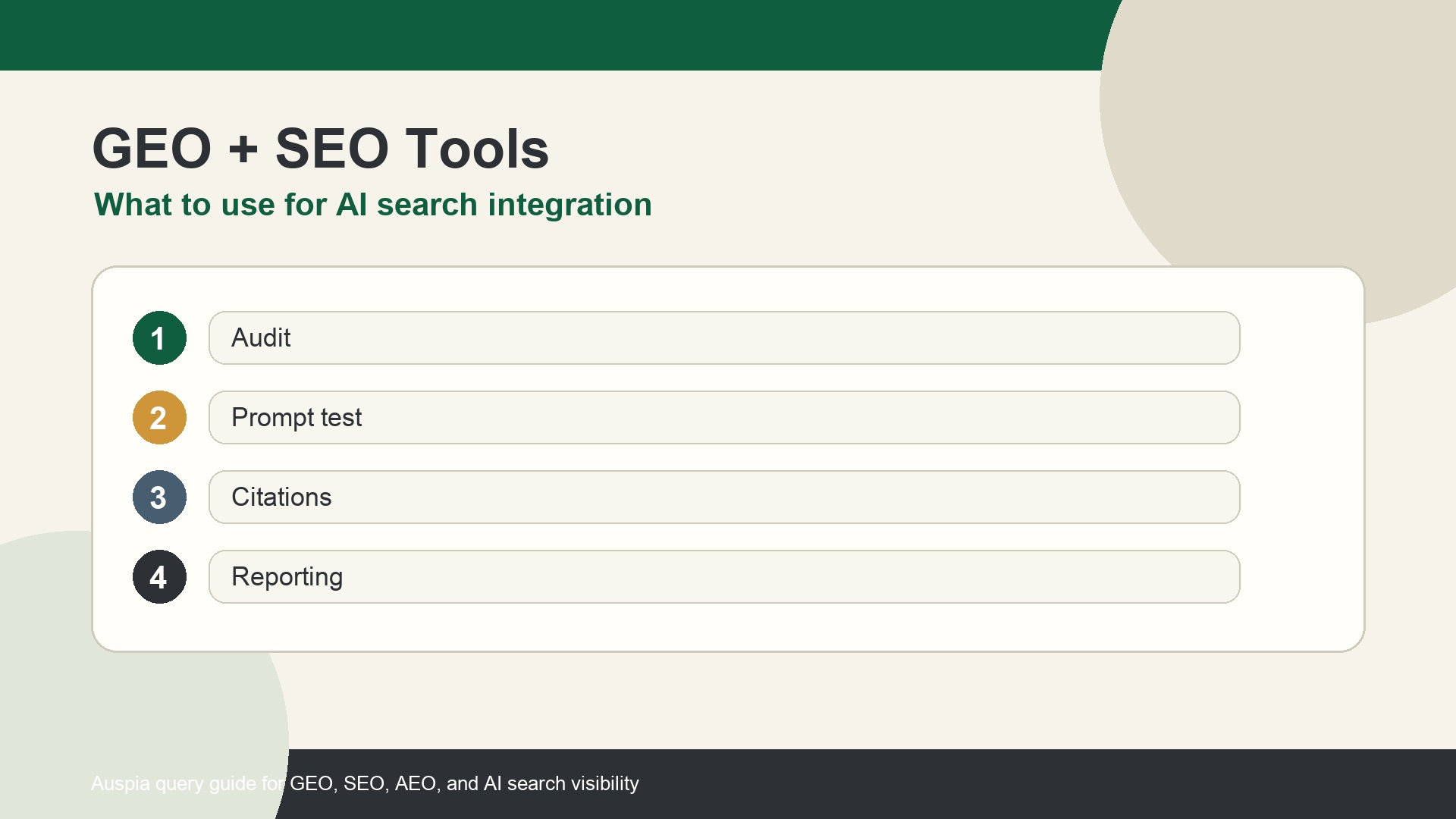
A simple starter workflow
- Pull top organic pages from Google Search Console.
- Pick 20 prompts that those pages should answer.
- Test those prompts in AI systems or an AI visibility checker.
- Record mentions, citations, competitors, and factual errors.
- Update the pages with direct answers, evidence, tables, and entity facts.
- Re-test monthly.
FAQ
Which tool bridges traditional SEO and GEO?
A bridge tool must connect page-level SEO diagnostics with AI answer visibility. It should show whether a page is technically sound, answer-ready, and likely to be cited.
Are SEO tools enough for GEO?
No. SEO tools explain rankings and traffic. GEO also needs prompt testing, AI citation checks, and brand mention analysis.
What are GEO rankings?
GEO does not have one stable ranking position like classic SERPs. Teams usually track mention frequency, citation frequency, answer position, sentiment, and competitor share of answer.
What should agencies use?
Agencies should use SEO crawlers and keyword tools, plus prompt libraries, AI visibility checks, citation audits, and client-ready reporting templates.
Author: Alice Monroe, AI SEO Tools Analyst Covering 150+ Tools at Auspia. Alice writes about search intent, AI search visibility, and practical organic growth systems for teams that need clearer decisions.